
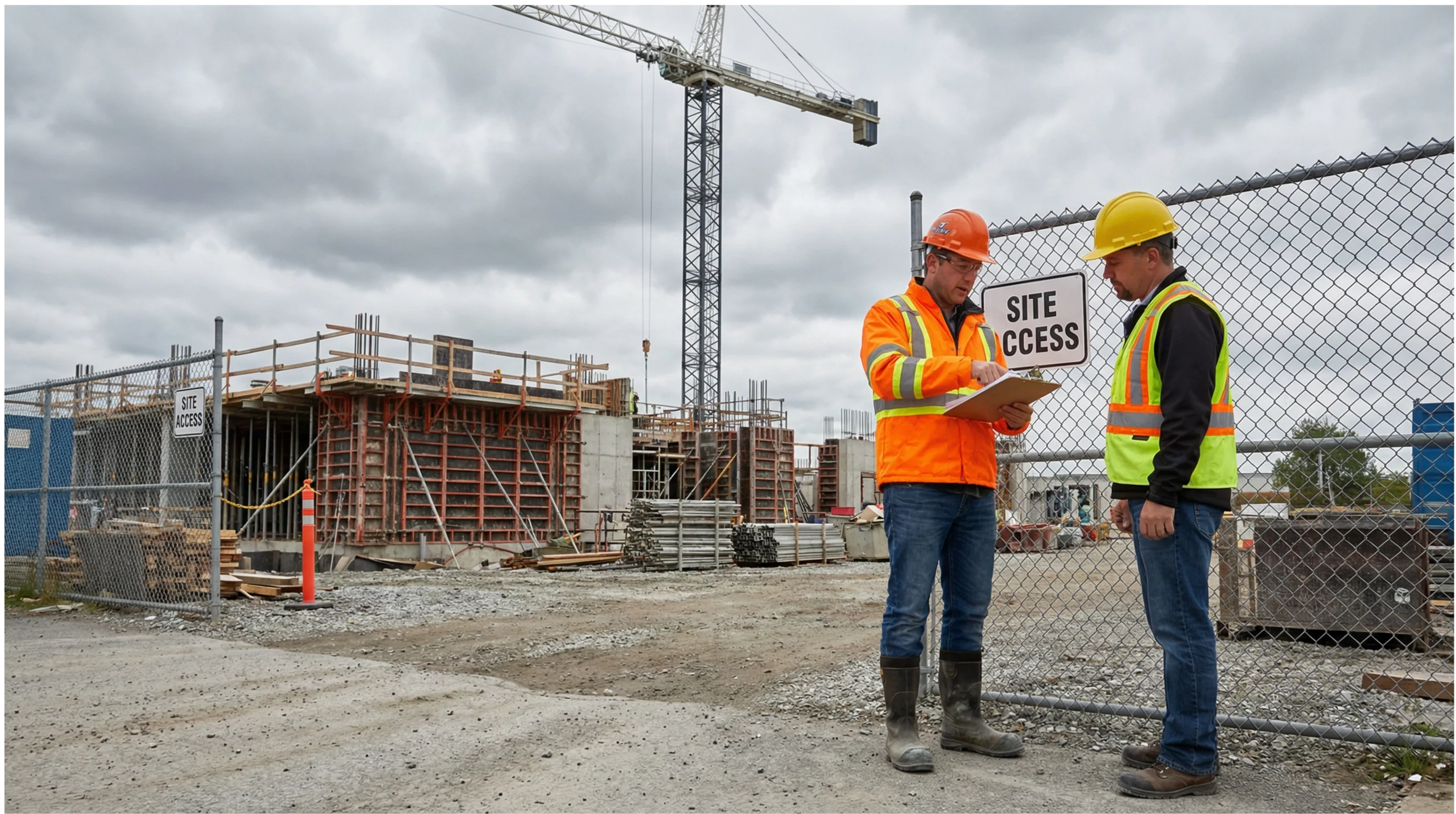
There is a particular feeling that runs through a site when someone spots an unfamiliar vehicle pulling up to the gate. If the person who gets out is carrying a clipboard and wearing a vest with a government logo on it, that feeling sharpens into something closer to anxiety. Most site supervisors have been there.
The thing is, that anxiety is almost always worse than the inspection itself. OHS inspectors are not primarily there to catch you out. They are there to check whether your site is being run in a way that keeps workers alive. The two goals are not always in conflict. But if you have gaps in your documentation, missing training records, or active hazards that have been left unaddressed, the visit can get expensive fast.
In 2025, OHS Insider's annual fines scorecard tracked 175 significant OHS fines across Canada totaling $28.2 million. That is up from 136 fines in 2024. The average fine amount was $160,952. Eighty-two of those 175 fines were in the six-figure range. Construction was well represented in that list.
This post walks through what actually happens during an OHS inspection on a Canadian construction site, what types of orders can be issued, what the fine exposure looks like in Ontario, BC, and Alberta, and how to make sure your site is not the one that ends up in next year's scorecard.
Why enforcement is getting more serious
The increase in fine totals is not accidental. All three major construction provinces have deliberately raised the stakes over the past three years.
Ontario amended the Occupational Health and Safety Act in 2022 and again in 2024. The maximum corporate fine is now $2,000,000. More significantly, Ontario introduced mandatory minimum fines for repeat offenders: if a corporation is convicted of two or more offences that result in the death or serious injury of a worker within a two-year period, the minimum fine is $500,000. With the mandatory 25% victim fine surcharge, that becomes $625,000 with no judicial discretion to reduce it. As Stringer LLP's December 2024 analysis notes, this is a genuine departure from how courts have historically sentenced corporate defendants, where company size and ability to pay played a significant role.
In British Columbia, WorkSafeBC has been active. The largest single fine in Canada in 2025 was $788,867, issued to a BC company following a combustible dust explosion. A crane-related violation resulted in a $688,589 penalty against a prime contractor. These are not outliers. BC has consistently produced the highest individual fine amounts in the country.
Alberta's administrative penalty regime caps individual contraventions at $10,000 per day. That sounds modest compared to Ontario's maximums, but the "per day, per contravention" structure means that a site with multiple ongoing violations can accumulate significant exposure quickly. Alberta's penalties can be issued to prime contractors, contracting employers, employers, supervisors, workers, and suppliers, which means the liability does not sit only with the company at the top.
Two types of visits: inspection vs. investigation
Before getting into what an inspector looks for, it helps to understand that there are two different reasons an OHS officer might show up on your site.
The first is a proactive inspection. This is a routine, unannounced visit. In Ontario, the Ministry of Labour, Immigration, Training and Skills Development runs a dedicated Construction Program that conducts thousands of proactive inspections each year, with a focus on the hazards that kill the most construction workers: falls, struck-by incidents, and electrical contact. In BC, WorkSafeBC prevention officers take a risk-based approach, prioritizing sites and sectors where the likelihood of serious injury is highest. In Alberta, OHS officers have authority to enter any provincially regulated work site without prior notice.
The second is a reactive investigation. This happens after a fatality, a critical injury, a reported work refusal, or a formal complaint from a worker. Reactive investigations are more intensive, involve more documentation requests, and are more likely to result in orders or referrals for prosecution. If your site has had a serious incident, expect a reactive investigation to follow.
The preparation advice in this post applies primarily to proactive inspections. If you are dealing with a reactive investigation following a fatality or critical injury, you need legal advice immediately.
What the inspector will ask to see
When a proactive inspection begins, the officer will typically speak with the most senior person on site, explain the purpose of the visit, and then start reviewing documentation. According to Workplace Safety and Prevention Services, Ontario Ministry inspectors commonly ask for the following:
The written health and safety policy, signed by the most senior person in the organization. The JHSC (Joint Health and Safety Committee) meeting minutes from the past 12 months. Worker training records, including proof of mandatory training such as Working at Heights certification in Ontario. The first aid log and confirmation that the required level of first aid coverage is in place for the crew size. Incident investigation reports for any injuries or near misses that have occurred on the project. Equipment maintenance and inspection records, particularly for cranes, hoists, and mobile equipment. Any hazard assessments or risk assessments that have been completed for the project.
After the documentation review, the officer will walk the site. They are looking at the physical conditions: fall protection in place and properly used, guardrails installed where required, housekeeping, excavation protection, scaffold integrity, electrical safety, and whether workers are actually wearing the PPE they are supposed to be wearing. They may speak directly with workers, and workers have the right to participate in the inspection.
The documentation review and the site walk together take anywhere from one hour to a full day depending on the size of the project and what the officer finds.
The three types of orders
If the inspector identifies a violation, they will issue an order. There are three types, and the difference between them matters.
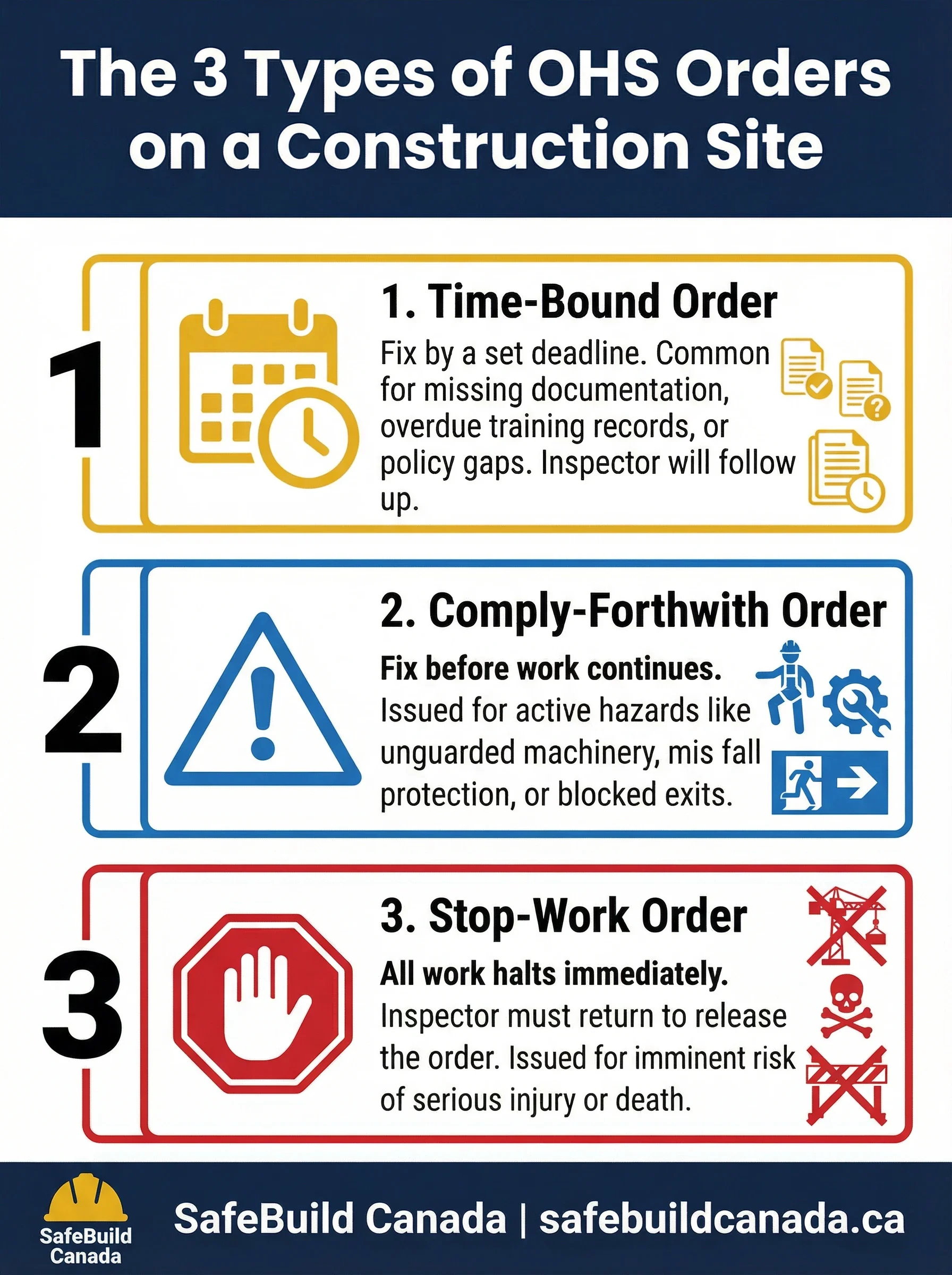
A time-bound order gives you a deadline to fix the problem. These are typically issued for documentation gaps: a missing written policy, JHSC minutes that have not been kept, training records that are incomplete. The inspector will set a date by which the deficiency must be corrected and will follow up to confirm it has been addressed. These orders are inconvenient but manageable.
A comply-forthwith order means fix it before work continues in that area. These are issued when the inspector observes an active hazard: a worker without fall protection on a leading edge, an unguarded opening, a scaffold that is not properly braced. The work in the affected area stops until the hazard is corrected. The inspector does not need to return to release this type of order, but the hazard must be addressed before anyone goes back to work in that zone.
A stop-work order is the most serious. It halts all work on the site, or on a defined portion of it, immediately. Stop-work orders are issued when the inspector believes there is an imminent risk of serious injury or death. The inspector must return to the site and physically release the order before work can resume. A stop-work order on a large commercial project can cost tens of thousands of dollars per day in idle labour and equipment costs, on top of any eventual fines.
Receiving any type of order does not automatically trigger a prosecution. But failing to comply with an order, or receiving repeat orders for the same violations, significantly increases the likelihood that the file gets referred for prosecution.
What the fine exposure actually looks like
The infographic below summarizes the current fine landscape across the three largest construction provinces.
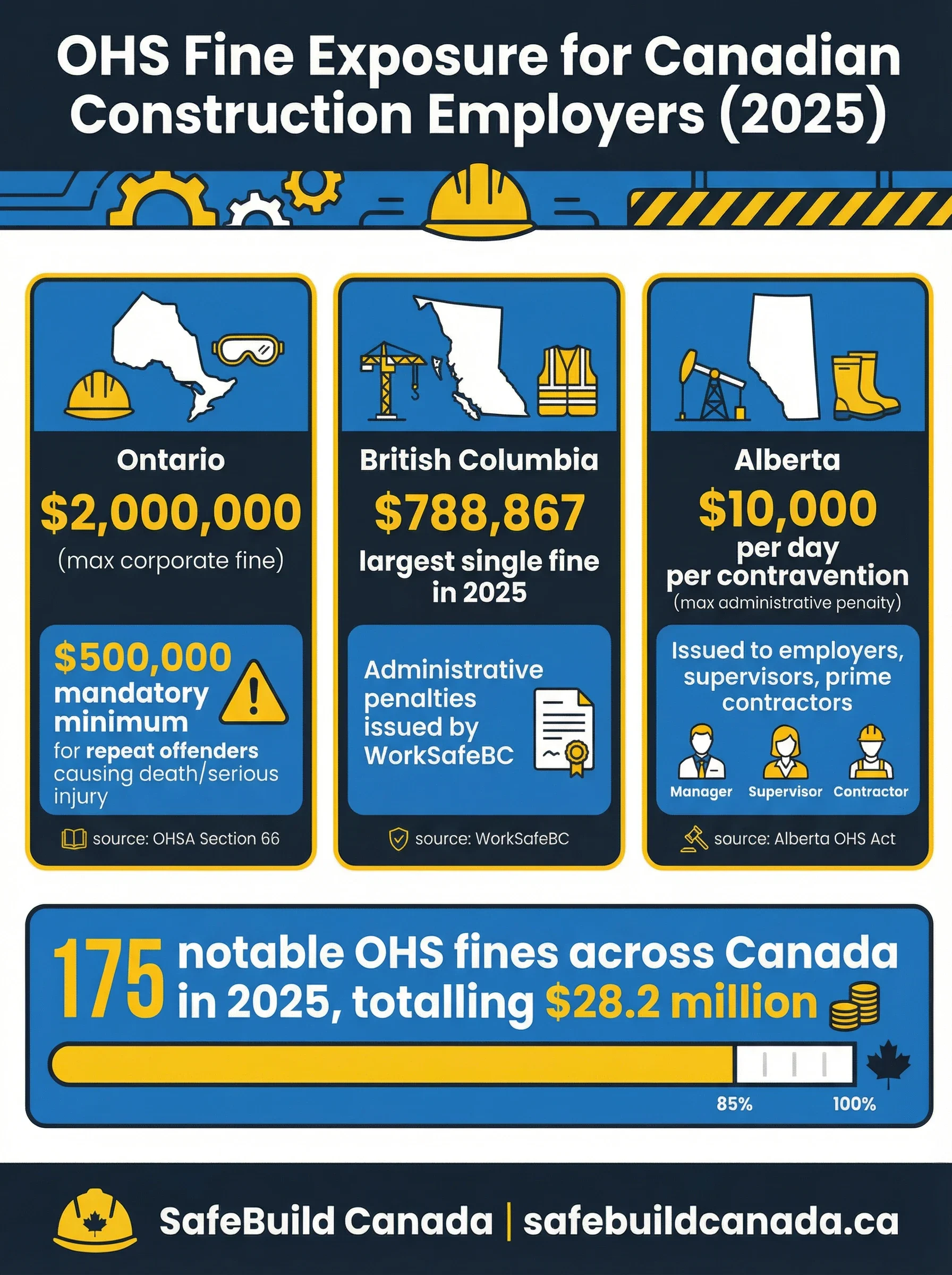
A few things worth noting about these numbers. The Ontario mandatory minimum of $500,000 applies to repeat offenders, not first-time violations. A first-time conviction for a serious violation in Ontario can still result in a fine well into the six figures, but the court has discretion. The mandatory minimum removes that discretion entirely for companies that have already been convicted once.
In BC, the $788,867 fine was the result of a catastrophic incident. Most WorkSafeBC administrative penalties are lower than that. But the fact that BC regularly produces the largest individual fines in the country reflects both the seriousness of the incidents and the agency's willingness to use the full range of its enforcement powers.
Alberta's $10,000 per day per contravention structure is worth understanding carefully. A site with five separate active violations, each running for five days before being corrected, is looking at $250,000 in administrative penalties before any prosecution is considered. The "per day" element is what makes it compound.
The Ontario OHSA Part IX penalties guide also notes that directors and officers of corporations can be personally fined up to $1,500,000 and face up to 12 months imprisonment. This is not a theoretical risk. Ontario courts have imposed personal fines on directors and officers in construction fatality cases.
How to prepare before the inspector arrives
The best time to prepare for an OHS inspection is not the morning you see the government vehicle at the gate. It is every other morning.
The documentation that inspectors ask for is not difficult to maintain. It requires discipline, not expertise. JHSC meetings need to happen on schedule and the minutes need to be recorded and filed. Training records need to be kept current and accessible. The written health and safety policy needs to be reviewed annually and signed. First aid records need to be maintained. Incident investigations need to be completed and documented, even for near misses.
On the physical side of things, the most common violations that result in comply-forthwith orders and stop-work orders are also the most preventable. Fall protection is the most frequently cited violation in Canadian construction. Workers on leading edges without harnesses, guardrails that have been removed and not replaced, floor openings that are uncovered. These are not complicated hazards. They are the result of pressure to move fast and a culture that tolerates shortcuts.
The most useful thing a site supervisor can do is conduct their own unannounced walk of the site at least once a week, looking at it through the lens of what an inspector would see. If you find something you would not want an inspector to find, fix it before the inspector finds it. That is the entire preparation strategy.
Some sites use a pre-inspection checklist that mirrors the documentation requirements and the most common physical violations. If you want a starting point for that, the digital inspection tools available for Canadian construction sites can help you build a consistent routine that produces the records you need.
What happens after the inspection
After the site walk, the inspector will debrief the site supervisor and the worker representative. They will explain what they found, what orders are being issued, and what the timelines are. You will receive a written inspection report.
If orders are issued, respond to them promptly. Contact the inspector if you have questions about what is required. Inspectors are generally willing to clarify what compliance looks like. What they are not willing to do is extend deadlines indefinitely or accept partial compliance on comply-forthwith orders.
If you disagree with an order, you have the right to appeal. In Ontario, appeals go to the Ontario Labour Relations Board. In BC, you can request a review through WorkSafeBC's internal review process. In Alberta, appeals go to the Alberta Labour Relations Board. Appeals take time, and in most cases the order remains in effect while the appeal is being heard, which means the practical advice is to comply first and appeal second.
If the inspection results in a referral for prosecution, you need legal counsel. The prosecution process is separate from the inspection process and operates on a different timeline.
The bottom line on OHS inspections
An OHS inspection is not a test you pass or fail in a single visit. It is a snapshot of how your site is being run on an ongoing basis. A site that maintains its documentation, addresses hazards as they arise, and takes its JHSC obligations seriously will generally have a straightforward inspection. A site that has been cutting corners will have a more difficult one.
The fine numbers in 2025 are large enough that no construction company should be treating OHS compliance as an administrative burden to be minimised. A $600,000 fine, like the one issued to a construction contractor in Ontario following a crane fatality, can threaten the financial viability of a mid-sized company. The mandatory minimum regime in Ontario means that a second conviction resulting in a death or serious injury carries a floor of $625,000 with no way down.
The practical message is straightforward: keep your documentation current, fix hazards when you find them, and treat the JHSC as a real function rather than a compliance checkbox. If an inspector shows up, you want to be the site that has nothing to hide.
Sources
OHS Insider / Bongarde, OHS Fines Scorecard 2025, December 2025.
Ontario Ministry of Labour, Immigration, Training and Skills Development, Part IX: Offences and penalties, Guide to the Occupational Health and Safety Act, updated March 2025.
WorkSafeBC, WorkSafeBC inspections: What to expect and how they help 2025.
Workplace Safety and Prevention Services (WSPS): What to expect when a Ministry inspector comes to your workplace, February 2026.
Stringer LLP (Ryan Conlin and Jeremy Schwartz), Sky High Mandatory Fines: OHSA FAQ, December 9, 2024.
Government of Alberta: OHS administrative penalties 2025.
Government of Alberta: OHS inspections 2025.