

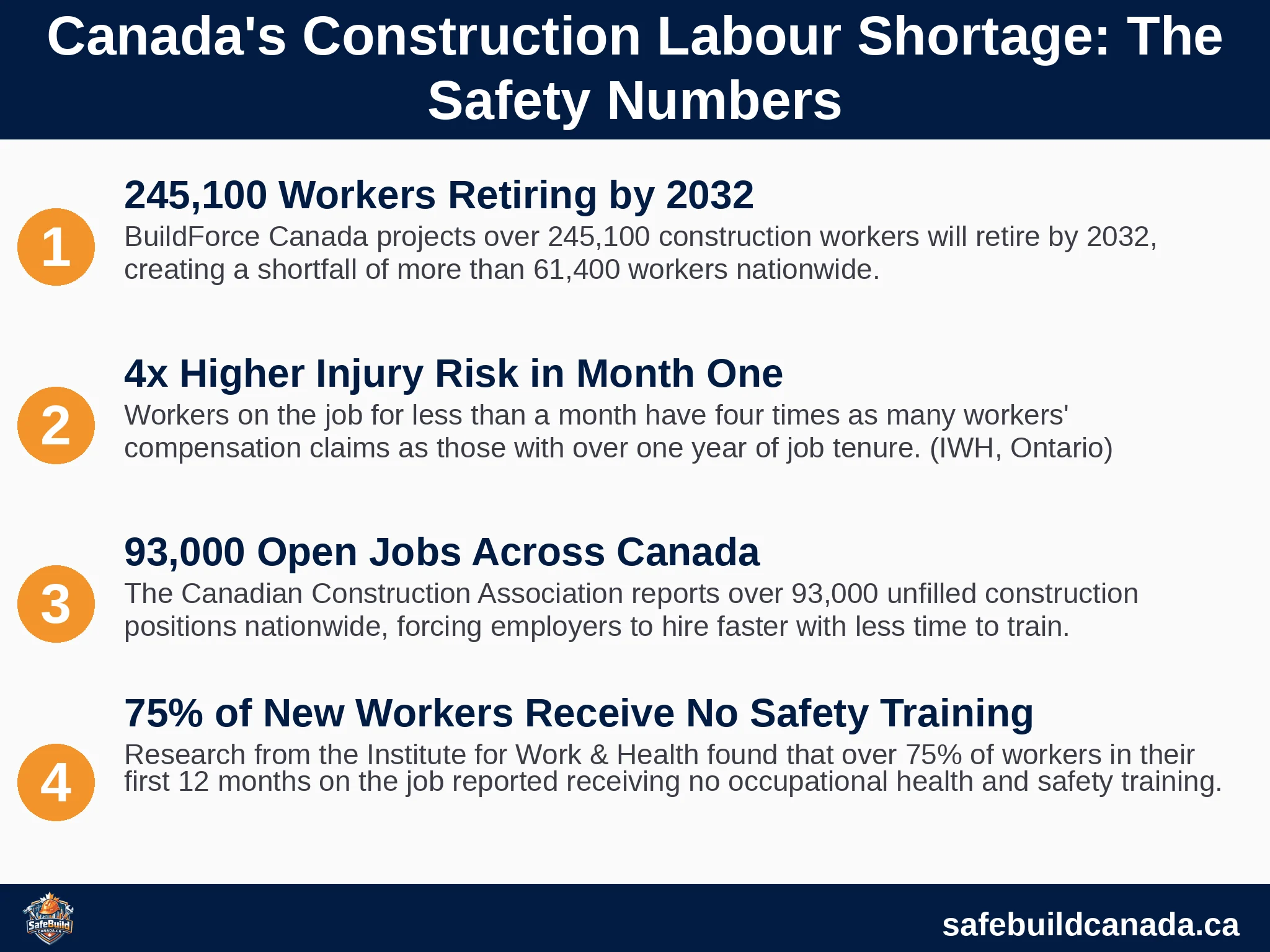
The Canadian construction industry is facing a demographic cliff. According to Statistics Canada and BuildForce Canada, more than 245,100 construction workers are expected to retire by 2032, creating a net shortfall of just over 61,400 workers even after accounting for new entrants. While the industry is aggressively recruiting to fill these gaps, the reality on the ground is a massive loss of institutional knowledge. The construction labour shortage and safety in Canada are now deeply intertwined issues. When experienced journeypersons leave the site, they take decades of hazard recognition skills with them, leaving behind a workforce that is younger, less experienced, and statistically far more likely to be injured.
This is not just a productivity problem. It is a genuine occupational health and safety crisis. Regulators across the country, from WorkSafeBC to Ontario's Ministry of Labour, Immigration, Training and Skills Development, do not lower their compliance standards simply because a contractor is short-staffed. The legal duty to protect workers remains exactly what it was before the shortage began.
This post examines the direct safety implications of the labour shortage, the statistical risks associated with new workers, and the practical steps Canadian employers must take to maintain compliance and protect their crews when experience is in short supply.
The statistical reality of "newness" on the job site
The most dangerous time for any construction worker is their first month on the job. Research from the Institute for Work & Health (IWH) in Ontario has consistently shown that the risk of occupational injury is severely elevated among workers who are new to their roles.
The data is stark. Workers who have been on the job for less than a month have four times as many workers' compensation claims as those who have held their current job for more than a year. For men in manual occupations, the claim rate in the first month is five times higher than for experienced workers. The injury rate drops sharply in the second month, but it still remains double that of workers with over a year of tenure.
This "newness" factor is the hidden danger of the labour shortage. As contractors scramble to fill the 93,000 open jobs currently tracked by the Canadian Construction Association, they are inevitably hiring individuals with less site experience. These workers do not yet possess the situational awareness required to navigate a complex, dynamic environment where hazards change daily. They are less likely to recognize the subtle signs of an unstable trench, the risk of a swinging crane load, or the proper way to tie off on a leading edge.
There is another dimension to this that rarely gets discussed openly: the training gap. The Institute for Work & Health found that over 75 percent of workers in their first 12 months of employment reported receiving no occupational health and safety training. That figure is troubling on its own. Paired with the current pace of hiring, it becomes a direct predictor of preventable incidents. When you combine this influx of inexperienced workers with the sobering reality of construction fatality statistics in Canada, the urgency of the situation becomes impossible to ignore. The industry cannot afford to let new workers learn safety by trial and error.
The strain on supervisory capacity
The labour shortage does not just affect the frontline workforce. It severely strains supervisory capacity, and that is where many of the real safety risks originate.
In a fully staffed, balanced workforce, a seasoned supervisor has the time to mentor apprentices, monitor new hires closely, and intervene before a mistake becomes an incident. Today, those same supervisors are often managing larger crews, dealing with supply chain delays, and trying to keep projects on schedule despite being short-handed. The time available for direct, hands-on safety mentoring has shrunk considerably.
This creates a dangerous gap in the field execution of safety protocols. A new worker might sit through a generic safety video in the site trailer, but without an experienced supervisor watching them perform the task in the field, that classroom knowledge rarely translates into safe physical execution. The gap between knowing the rule and applying it under real site conditions is enormous, and it takes months of supervised practice to close.
The pressure to maintain project schedules with fewer workers often leads to rushed work, extended hours, and fatigue. This compounding stress is a real factor in the broader conversation about mental health among Canadian construction workers. Fatigued supervisors are more likely to miss critical safety hazards, and fatigued new workers are more likely to make errors that experienced workers would catch automatically.
Regulatory obligations do not change
Employers need to be clear on one thing: provincial occupational health and safety regulations make no allowances for labour shortages. The legal duty to protect workers remains absolute.
Under the Ontario Occupational Health and Safety Act (OHSA), the British Columbia Workers Compensation Act, and the Alberta Occupational Health and Safety Act, employers must take every precaution reasonable in the circumstances for the protection of a worker. This includes providing the information, instruction, and supervision necessary to protect their health and safety. The word "reasonable" does not mean "whatever is convenient given current staffing levels." Courts and adjudicators interpret it based on what a prudent employer in the same industry would do, not on what a short-staffed one chose to do.
If a new worker is injured because they were handed a tool they did not know how to use, or instructed to perform a task without adequate supervision, the employer is liable. Claiming that the site was short-staffed or that experienced supervisors were busy elsewhere is not a valid legal defence against an OHS prosecution.
Regulators are acutely aware of the risks associated with new and young workers. WorkSafeBC has specific regulatory requirements under Part 3 of the OHS Regulation dictating exactly what must be included in young and new worker orientation and training. Employers must document this training and prove that the worker demonstrated competency before being allowed to perform hazardous work. Ontario's O. Reg. 213/91 (Construction Projects) similarly requires that workers be informed of hazards specific to their assigned tasks before starting work. Alberta's OHS Code requires that workers be trained in the hazards of their work before they begin. None of these obligations are suspended during a labour shortage.
If you are unsure whether your current onboarding process meets these legal standards, reviewing the mandatory construction site training requirements in Canada is a necessary first step to identifying your compliance gaps.
Field execution: protecting inexperienced workers
Knowing the statistics and the regulations is only half the battle. The real challenge is implementing controls on the job site that actually protect inexperienced workers when experienced labour is scarce.
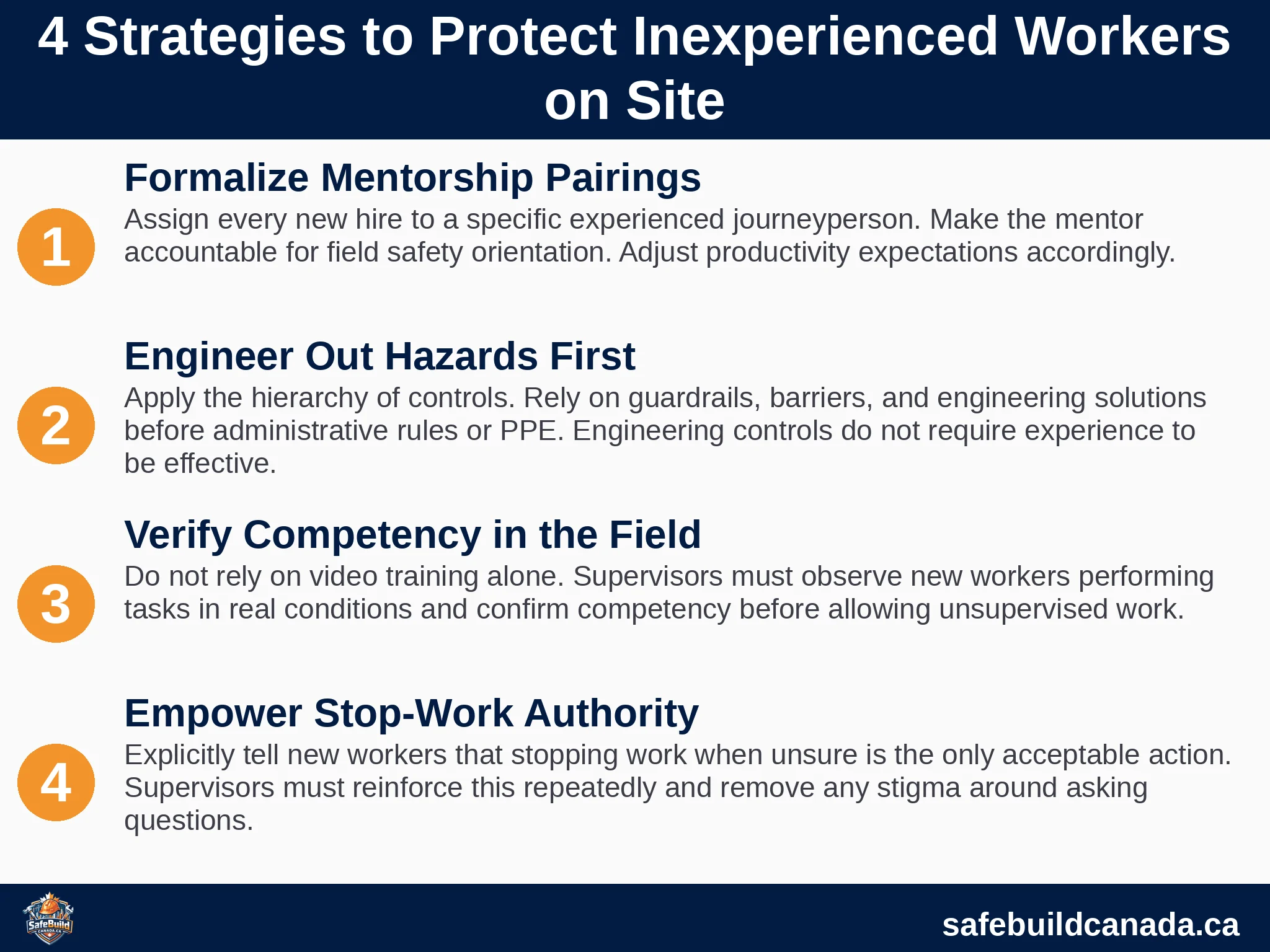
Start with the hierarchy of controls. When you have an inexperienced workforce, you cannot rely on administrative controls (rules and procedures) or personal protective equipment (PPE) as your primary defense. These controls require workers to make the right decision every time, and new workers do not yet have the instincts to do that consistently. You must engineer the hazards out of the environment wherever possible. If you have green workers near a leading edge, do not just give them a harness and assume they know how to tie off correctly. Build a guardrail. Engineering controls do not require experience to be effective.
Second, formalize your mentorship and buddy systems. You cannot simply assign a new worker to a crew and hope they figure it out. Pair every new hire with a specific, experienced journeyperson. Make it clear that the experienced worker is responsible for the new hire's safety orientation in the field. This requires adjusting productivity expectations. An experienced worker cannot perform at full capacity if they are actively mentoring a green hand, and trying to force that combination without adjusting expectations is how mentorship programs fail.
Third, implement strict stop-work authority and ensure new workers feel genuinely empowered to use it. New workers are often intimidated by the fast pace of a construction site and fear looking incompetent if they ask questions. Supervisors must explicitly state, repeatedly, that asking questions is expected and that stopping work when unsure is the only acceptable action. This is not a soft cultural preference. Under the OHSA in Ontario, workers have the right to refuse unsafe work. Under BC's Workers Compensation Act, the same right exists. The law is on the worker's side, and supervisors need to reinforce that reality in the field every day.
Fourth, verify competency through direct observation, not just documentation. Watching a worker sign a training form is not the same as watching them perform the task safely in real conditions. Supervisors must observe new workers executing hazardous tasks before allowing them to work unsupervised. This takes time, but it is the only reliable way to close the gap between classroom knowledge and field execution.
When to bring in external safety expertise
The reality for many mid-sized contractors is that their internal safety capacity is currently overwhelmed. When your site superintendents are spending all their time managing schedule delays and material shortages, safety oversight slips. That is not an opinion; it is a predictable consequence of trying to maintain the same safety infrastructure with fewer experienced people.
This is the moment when bringing in external expertise becomes a necessary business decision, not a luxury. If your company is struggling to keep up with site inspections, if your new worker orientations are being rushed, or if you are seeing an uptick in near-misses, you need to augment your team.
Hiring a third-party safety consultant or a dedicated safety officer can bridge the gap. These professionals can take over the time-consuming tasks of delivering comprehensive orientations, conducting daily hazard assessments, and monitoring new workers in the field. They also bring an outside perspective that can identify systemic gaps your internal team has become too close to see.
If you are looking to build this capacity internally over the long term, understanding the pathway to construction safety certifications like the NCSO and CRSP can help you develop your own dedicated safety leaders. These are not credentials for their own sake. A site with a certified safety officer has a documented, accountable safety function, and that matters both for compliance and for the retention of experienced workers who want to work in a professional environment.
The labour shortage is not going away anytime soon. BuildForce Canada's projections run to 2032, and the retirement wave is already well underway. The contractors who manage this period successfully will be the ones who treat safety investment as a retention and recruitment tool, not just a compliance obligation. Protecting your newest, most vulnerable workers is the only way to build the experienced workforce you will need in five years.
Sources
Institute for Work & Health. "Newness" and the risk of occupational injury. iwh.on.ca/plain-language-summaries/newness-and-risk-of-occupational-injury
Statistics Canada. Changes in the population of tradespeople between 2016 and 2021. September 2024. www150.statcan.gc.ca/n1/pub/81-595-m/81-595-m2024002-eng.htm
Canadian Construction Association. Labour shortage hampering construction industry's ability to drive even greater growth for Canada. cca-acc.com
WorkSafeBC. Young and new worker statistics, 2020-2024. worksafebc.com/en/health-safety/education-training-certification/young-new-worker/statistics