

The numbers are sobering, and they tell a story that every construction professional in Canada needs to hear. When we look at construction fatality statistics in Canada, the data reveals a persistent challenge that the industry has yet to fully overcome. Despite decades of regulatory improvements, advanced personal protective equipment, and a growing emphasis on safety culture, construction remains one of the most dangerous sectors in the country.
But what do the numbers actually show? To understand the true state of safety on Canadian jobsites, we have to look beyond the top-line figures. We need to examine how the data is collected, what it misses, and why certain hazards continue to claim lives year after year. This is not just an academic exercise. For site supervisors, safety managers, and business owners, understanding these statistics is the first step toward preventing the next tragedy.
The national picture: a baseline of accepted claims
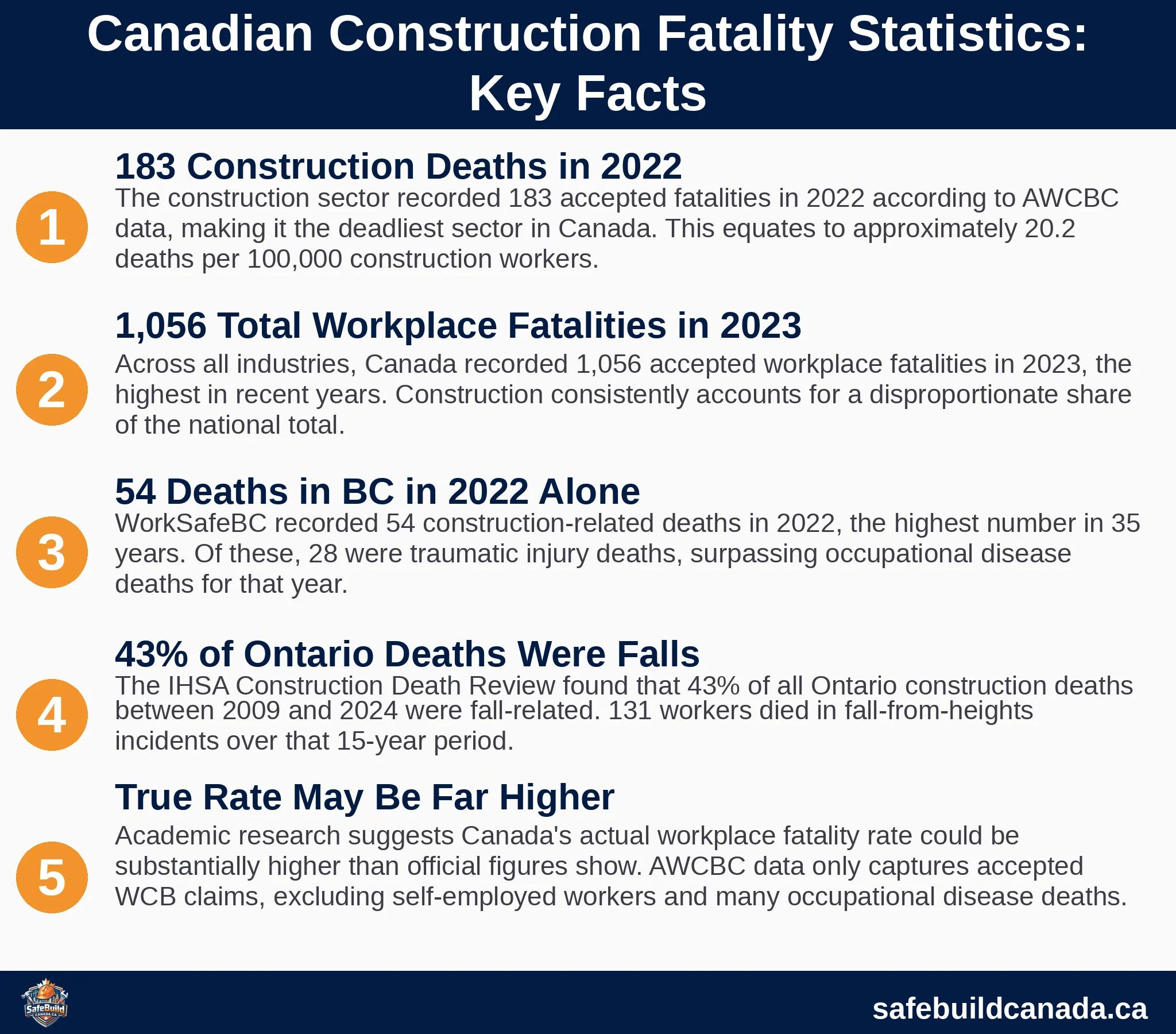
When we talk about Canadian workplace fatalities in the construction sector, the primary source of data is the Association of Workers' Compensation Boards of Canada. The AWCBC manages the National Work Injury Statistics Program, which aggregates accepted lost-time claims and fatalities from provincial and territorial boards.
According to the most recent comprehensive data analyzed in the 2025 Report on Work Fatality and Injury Rates in Canada, the country saw 1,056 accepted workplace fatalities across all industries in 2023. This represents the highest number in recent years. Within that national total, the construction sector consistently accounts for a disproportionate share of the tragedy. In 2022, the AWCBC recorded 183 construction fatalities across Canada, making it the deadliest sector in the country. To put that in perspective, that equates to roughly 20.2 workers killed annually for every 100,000 workers in the industry.
It is critical to understand how these numbers are categorized. The data is generally split into two main groups: traumatic injury fatalities and occupational disease deaths. Traumatic injuries are the sudden, catastrophic events that occur on the jobsite, such as falls, struck-by incidents, or equipment rollovers. Occupational diseases, on the other hand, are illnesses that develop over time due to workplace exposures, with asbestos-related diseases being the most prominent historical example. Historically, occupational disease deaths have outnumbered traumatic injury deaths by a ratio of roughly two to one across all sectors. However, in construction, the immediate physical hazards of the jobsite mean that traumatic injuries remain a massive and visible threat.
The reality of under-reporting
As alarming as the official statistics are, safety researchers and academics widely agree that they do not tell the whole story. The fundamental limitation of AWCBC data is that it only includes claims that have been officially accepted for compensation by a provincial or territorial board.
This means the official numbers exclude several categories of workers and incidents. For example, independent contractors or self-employed tradespeople who do not have optional workers' compensation coverage are often missing from the data. Workers who are killed in motor vehicle accidents while commuting to the jobsite may be excluded depending on the jurisdiction. Furthermore, occupational disease deaths are notoriously under-reported because it can be difficult to definitively link an illness like cancer to a specific workplace exposure that occurred decades earlier, especially if the treating physician does not take a detailed occupational history.
Researchers like Dr. Steven Bittle at the University of Ottawa have pointed out that workers' compensation boards were established primarily as insurance systems, not as comprehensive health and safety tracking agencies. Some academic estimates suggest that the true rate of workplace fatalities and injuries in Canada could be substantially higher than what the accepted claims data shows. The issue of claim suppression remains a concern, where incidents are not reported due to fears of increased insurance premiums or regulatory scrutiny. While severe trauma deaths are difficult to hide, the under-reporting of serious injuries and near-misses deprives the industry of critical leading indicators that could prevent future fatalities.
Provincial variations and the data lag
Construction fatality statistics in Canada also reveal distinct regional variations. The risks and outcomes are not uniform across the country.
For instance, WorkSafeBC construction deaths reached 54 in 2022, which was the highest number the province had seen in 35 years. This included 28 trauma deaths, a figure that surpassed occupational disease deaths for that period. Meanwhile, provinces like Saskatchewan and Alberta, along with the northern territories, consistently report some of the highest average injury fatality rates in the country. Ontario, despite having a massive construction sector and a well-developed regulatory framework, saw its overall injury fatality rate creep up to 1.7 per 100,000 in 2023, the highest it had been since 2011.
These regional differences can be attributed to various factors, including the types of construction activity dominant in each province, the pace of economic growth, and the specific regulatory environments. When there is a massive influx of funding for housing or infrastructure, the pressure to build quickly can strain safety systems.
Another major challenge with Canadian fatality statistics is the data lag. National figures are often released years after the fact. The 2022 data, for example, was only fully analyzed and debated in early 2024. This delay makes it difficult for safety professionals to identify emerging trends in real-time and adjust their hazard identification and risk assessment protocols accordingly. Safety advocates have long called for more timely and harmonized data reporting across all jurisdictions to enable proactive prevention strategies.
The leading cause: falls from heights
When we look at the specific causes of traumatic fatalities in Canadian construction, one hazard stands out above all others: falls from heights. Year after year, falls remain the leading cause of death on jobsites across the country.
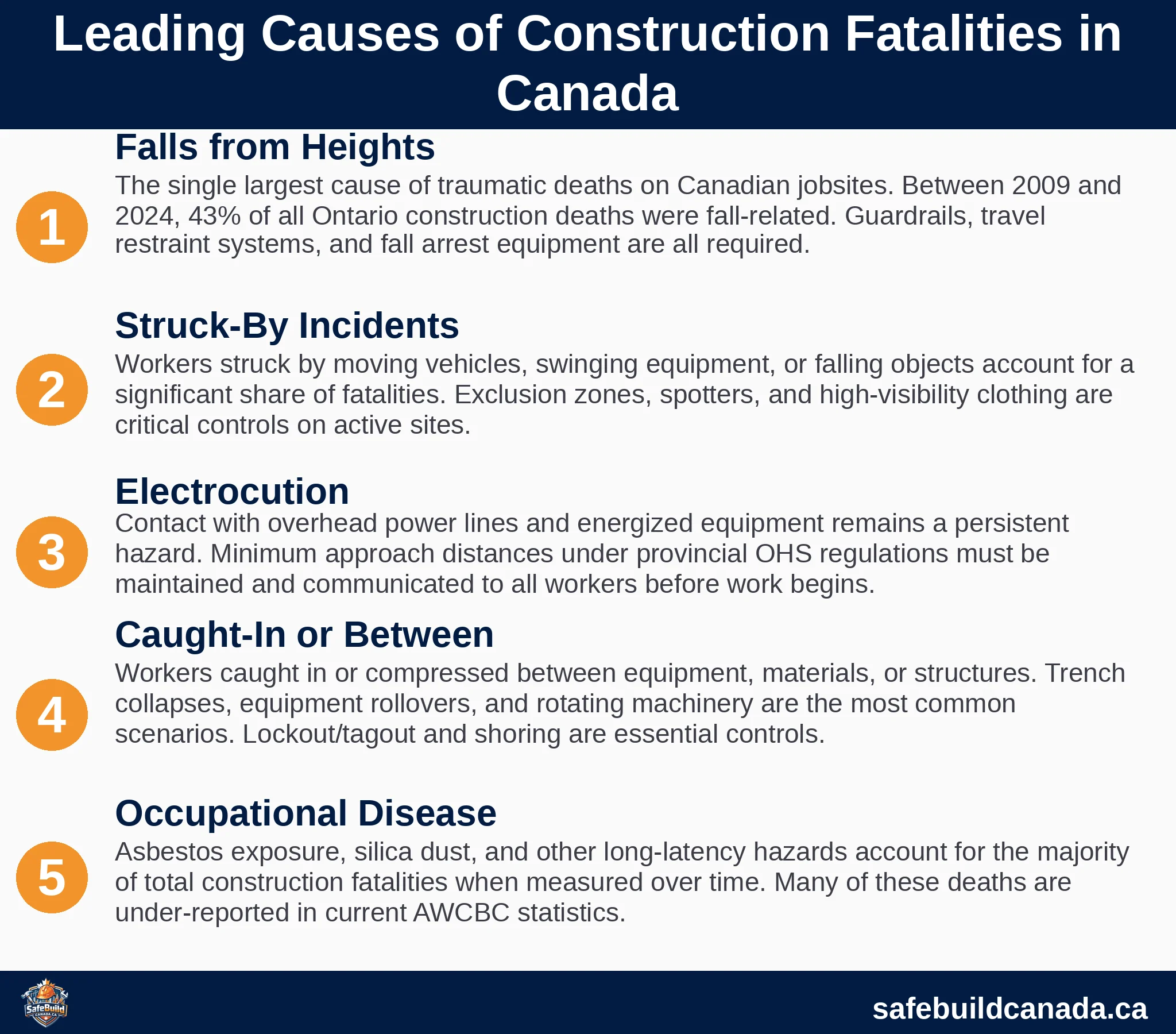
The Infrastructure Health and Safety Association in Ontario recently published an IHSA construction death review focusing specifically on this issue. Their data showed 131 falls from heights deaths in the province between 2009 and 2024. This is a staggering number for a hazard that is entirely preventable with proper equipment and training.
The statistics also reveal important nuances about who is falling. Research from organizations like the Center for Construction Research and Training indicates that older workers often have a higher fall mortality rate. This can be attributed to factors such as diminished balance or hearing loss, which can compromise situational awareness on a busy site. Conversely, young workers are disproportionately affected by injuries overall, often due to a lack of experience or inadequate construction site safety orientation.
Preventing falls requires more than distributing equipment. It requires a comprehensive fall protection plan that prioritizes engineering controls, such as guardrails and travel restraint systems, before relying on personal fall arrest equipment. When fall arrest systems are necessary, employers must ensure that workers are rigorously trained on how to inspect, fit, and use the gear correctly. If you are unsure where to start, reviewing how to build a fall protection plan for Canadian construction sites (https://www.safebuildcanada.ca/blog/fall-protection-plan-canada) is a necessary first step.
The human element: beyond the numbers
Statistics are essential for understanding the scope of the problem, but they can also have a desensitizing effect. It is easy to look at a spreadsheet and forget that every single number represents a human being who went to work and never came home.
The changing demographics of the Canadian construction workforce also play a role in these statistics. As the industry relies increasingly on new immigrants to fill labour shortages, language barriers and differing cultural expectations around safety can increase risk. Workers who are new to the country may not fully understand their right to refuse unsafe work, or they may fear reprisal if they speak up. Employers have a legal and moral obligation to ensure that safety training is accessible and comprehended by all workers, regardless of their background.
Furthermore, the pressure of project deadlines and tight margins can create an environment where safety is compromised for speed. When a worker decides to skip tying off because a task will only take a minute, they are making a risk calculation influenced by the site culture. This is why a well-enforced construction site safety plan must be actively enforced by leadership. Safety cannot be a secondary priority; it must be integrated into every aspect of project planning and execution.
Turning data into action
So, what can employers do with this information? The first step is to recognize that compliance with the minimum regulatory standards is not enough to guarantee a safe site. The statistics show that workers are still dying in environments that are ostensibly regulated.
Employers must take a proactive approach to safety management. This means moving beyond lagging indicators, like fatality and injury rates, and focusing on leading indicators. Leading indicators are proactive measures that predict and influence safety performance. Examples include the number of safety audits completed, the frequency of toolbox talks, the timely closure of corrective actions, and the level of worker participation in safety committees.
Implementing digital tools can greatly improve an employer's ability to track these metrics. Modern construction safety software allows teams to conduct inspections, report hazards, and track training compliance in real-time. This data can then be analyzed to identify high-risk activities or specific crews that may need additional support. By identifying trends before they result in an incident, employers can intervene and prevent the next statistic. If your current systems are failing to capture this data, you may need to consult a professional to audit how to build a construction site safety plan in Canada that actually works for your specific operations.
The role of mental health
Finally, it is impossible to discuss construction fatalities without acknowledging the role of mental health. While the AWCBC statistics focus on physical injuries and occupational diseases, the construction industry also faces a crisis of suicides and substance abuse overdoses.
The stress of the job, long hours, seasonal instability, and the physical toll on the body can all contribute to severe mental health challenges. When a worker is struggling with their mental health, their focus and situational awareness on the jobsite can be compromised, increasing the risk of a physical accident. Furthermore, the stigma surrounding mental health in the trades often prevents workers from seeking the help they need.
Addressing this requires a whole-person approach to worker well-being. Employers must foster a culture where workers feel supported and where mental health resources are readily available and actively promoted. Understanding the full scope of mental health in Canadian construction is just as critical as understanding the mechanics of fall protection.
Conclusion
The construction fatality statistics in Canada are a stark reminder of the inherent dangers of the industry. While the numbers provide actionable insights into the most common hazards and regional trends, they also expose the limitations of our current reporting systems.
To truly improve safety, the industry must look beyond the accepted claims data. Employers must recognize the human cost behind every statistic and commit to a proactive, comprehensive approach to safety management. This means investing in training, embracing new technologies, addressing the unique needs of a diverse workforce, and prioritizing both the physical and mental well-being of every worker on the site. For a broader perspective on how these trends fit into the national picture, review our construction industry insights Canada hub. Only by understanding what the numbers actually show can we begin to change the narrative and ensure that every construction worker in Canada returns home safely at the end of their shift.