
Construction kills workers in two ways. One shows up in incident reports. The other rarely does.
The physical hazards get tracked, investigated, and reported to regulators. Falls, struck-by incidents, and equipment failures generate paperwork, fines, and corrective action plans. Mental health does not work that way. A worker who dies by suicide does not show up in a company's lost-time injury rate. A tradesperson who starts drinking heavily to cope with chronic pain and job insecurity does not trigger a safety alert. The industry has spent decades building systems to count the visible deaths. The invisible ones are still catching up.
The numbers, when you look at them directly, are hard to absorb. According to Statistics Canada data cited by the Infrastructure Health and Safety Association, 33 per cent of men in the construction industry report poor mental health. A December 2025 webinar hosted by the Residential Construction Council of Ontario put the suicide rate in construction at 53 per 100,000 workers, nearly four times the national average. Deaths by suicide in the construction sector outnumber on-the-job fatalities from accidents by a ratio of roughly four to one.
That last figure is worth sitting with. For every worker who dies from a fall, a cave-in, or a struck-by incident, four more die by suicide. The industry talks constantly about physical safety. The mental health conversation, while improving, is still nowhere near proportional to the actual death toll.
This post covers what the current Canadian data shows, why construction workers face disproportionate risk, what programs actually exist in this country, and what site managers and safety officers can do that goes beyond hanging a poster.
Why the numbers are this bad
The construction industry does not create mental health problems from nothing. It amplifies risk factors that already exist and adds several of its own.
Seasonal and project-based employment means workers face income uncertainty for months at a time. A framer who finishes a residential project in November may not have steady work again until March. That cycle of employment and unemployment, repeated over a career, creates chronic financial stress that does not disappear when the next job starts. Add to that the physical toll: construction workers carry injuries, chronic pain, and the cumulative wear of physically demanding work in ways that office workers simply do not. Chronic pain is one of the most reliable predictors of both depression and substance use, and the construction industry has a substance use problem that the sector is only beginning to address honestly.
The Canada's Building Trades Unions mental health report, released in September 2025 and covering more than 1,000 members across 60 skilled trades, found that 25 per cent of tradespeople use substances daily or weekly to cope with mental health challenges. That is not a fringe behavior. It is one in four workers on a given site. The same report found that 77 per cent of tradespeople experience stress, 62 per cent report anxiety, 50 per cent report burnout, and 45 per cent report depression.
Then there is the culture. Construction has historically rewarded toughness and penalized vulnerability. Workers who express distress risk being seen as unable to handle the job. Foremen who show emotion risk losing authority. This is not unique to Canada, but it is particularly entrenched in trade environments where physical capability is the primary measure of professional worth. Kate Cowan, director of training, awareness, and prevention at the Ontario Ministry of Labour, Training and Skills Development, put it plainly at the RESCON webinar: "the silence is costly, impacting safety, productivity, and lives."
The silence is also self-reinforcing. When workers do not see colleagues seeking help, they assume nobody does, which makes it harder to be the first. The CBTU report found that 84 per cent of tradespeople believe their union offers mental health supports, but only 10 per cent have ever used them. Awareness is not the problem. Stigma is.
What the current data actually shows
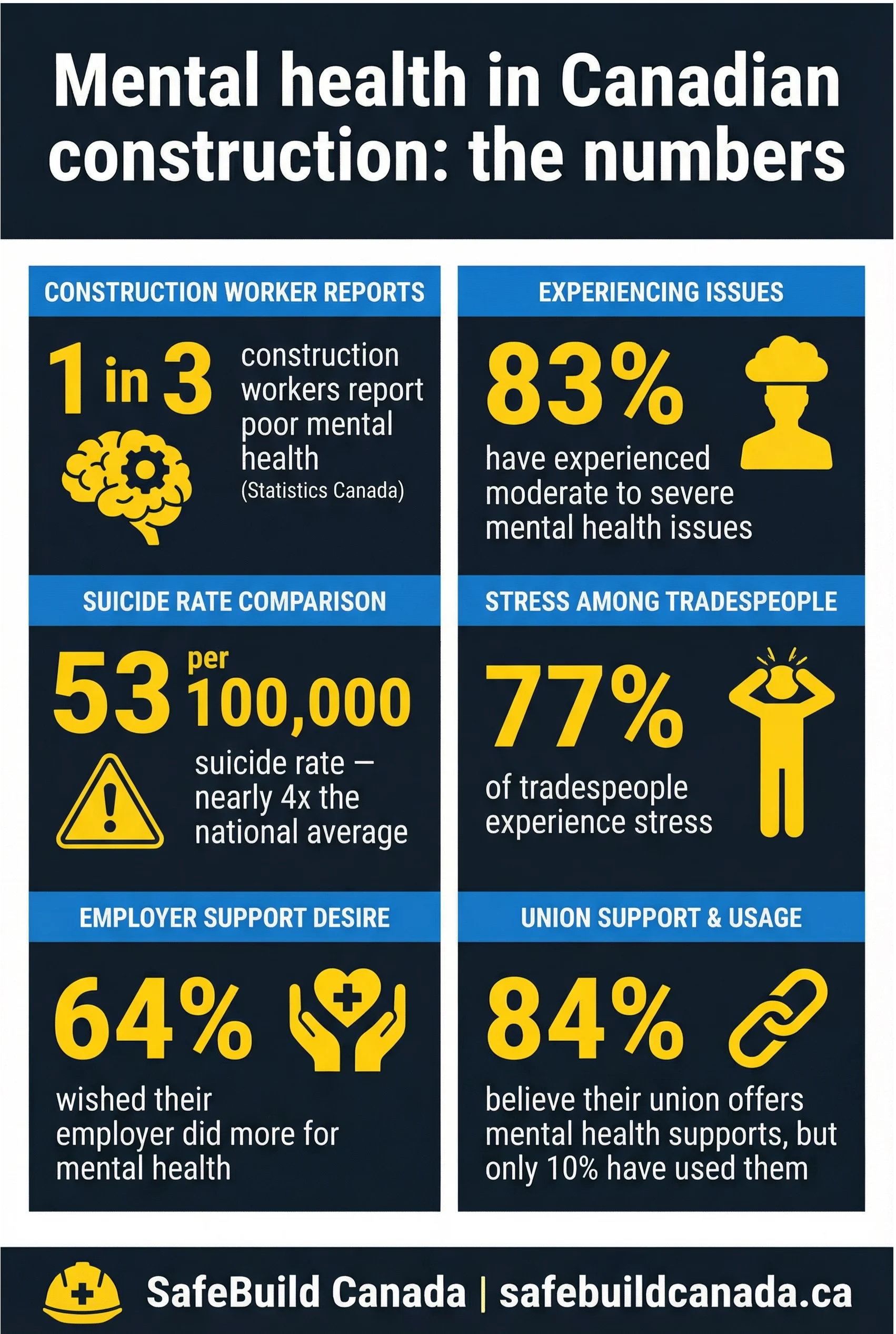
The statistics above are not from a single alarming study. They come from multiple sources across 2024 and 2025, and they are consistent. The CBTU report, the RESCON webinar data from the Ontario Ministry of Labour, and the IHSA/Opening Minds case study all point to the same picture.
One figure from the RESCON webinar deserves particular attention: in 2020, 2,500 Ontarians died from drug overdoses, and 30 per cent of those were construction workers. That is 750 people in a single province in a single year, dying from overdoses. Associate Attorney General Michael Tibollo, speaking at the same event, noted that up to 750 construction workers in Ontario are dying each year from opioid overdoses. The physical safety culture that has developed over the past 30 years in Canadian construction has not extended to this dimension of worker mortality.
WorkSafeBC has been tracking the psychological side of this more formally than most provincial regulators. WorkSafeBC's Psychological Health and Safety Planned Inspectional Initiative notes that psychological injury claims accepted by the regulator grew 118 per cent between 2018 and 2022, with 1,997 psychological injury-only claims accepted in 2022. About 30 per cent of short and long-term workplace disability claims in Canada are attributed to psychological issues, according to the Mental Health Commission of Canada. These are not soft numbers. They are claims, costs, and lost productivity that show up on balance sheets.
What Canadian programs actually exist
The good news, and there is genuine good news here, is that the Canadian construction sector has developed some of the most sector-specific mental health programming in the world. The problem is that most workers do not know it exists.
The Working Mind for the Trades, developed by the Infrastructure Health and Safety Association in partnership with Opening Minds, is the most directly relevant program for Ontario construction employers. It is a customized version of the Mental Health Commission of Canada's Working Mind program, built specifically for trades workers. The customization matters: the program uses real stories from electricians, ironworkers, and construction workers, not generic workplace scenarios. Kathy Martin, IHSA's research and mental health specialist, described the barrier clearly: "We might talk about aches and pains, but we don't always share feelings and that is probably the biggest barrier, the stigma." The program is designed to work within that reality rather than pretend it does not exist. The post on mandatory construction site training in Canada covers how to integrate programs like this into your site's required training schedule.
In British Columbia, BuildStrong by CIRP has operated since 1980 as the province's only sector-specific mental health and substance use treatment program built for unionized construction, trades, and technical industries. It provides one-on-one clinical counselling, bed-based treatment, and help finding pain relief, housing, medical, and financial resources. The service is free and confidential for BC unionized construction workers and their families. Their own data shows that 1 in 2 construction workers will experience problematic mental health issues, and 1 in 3 will struggle with problematic substance use.
At the national level, Canada's Building Trades Unions announced in September 2025 the formation of a nationwide Mental Health and Substance Use Committee, bringing together representatives from 14 international unions. The committee's mandate is to share best practices, advocate for consistent standards, and build on the union support networks that the CBTU report identified as a genuine strength. The report found that tradespeople feel more supported by their trades community than workers in most other sectors, which is a real foundation to build on.
For workers in crisis, the Canada Suicide Prevention Lifeline is available by calling or texting 9-8-8. This number should be posted on every Canadian construction site, in every site office, and in every lunchroom.
What employers and site managers can actually do
The gap between knowing the problem exists and doing something about it is where most construction companies currently sit. The CBTU report's finding that 84 per cent of workers believe supports exist but only 10 per cent have used them is an employer failure as much as a stigma problem. If workers do not know how to access what is available, the program might as well not exist.
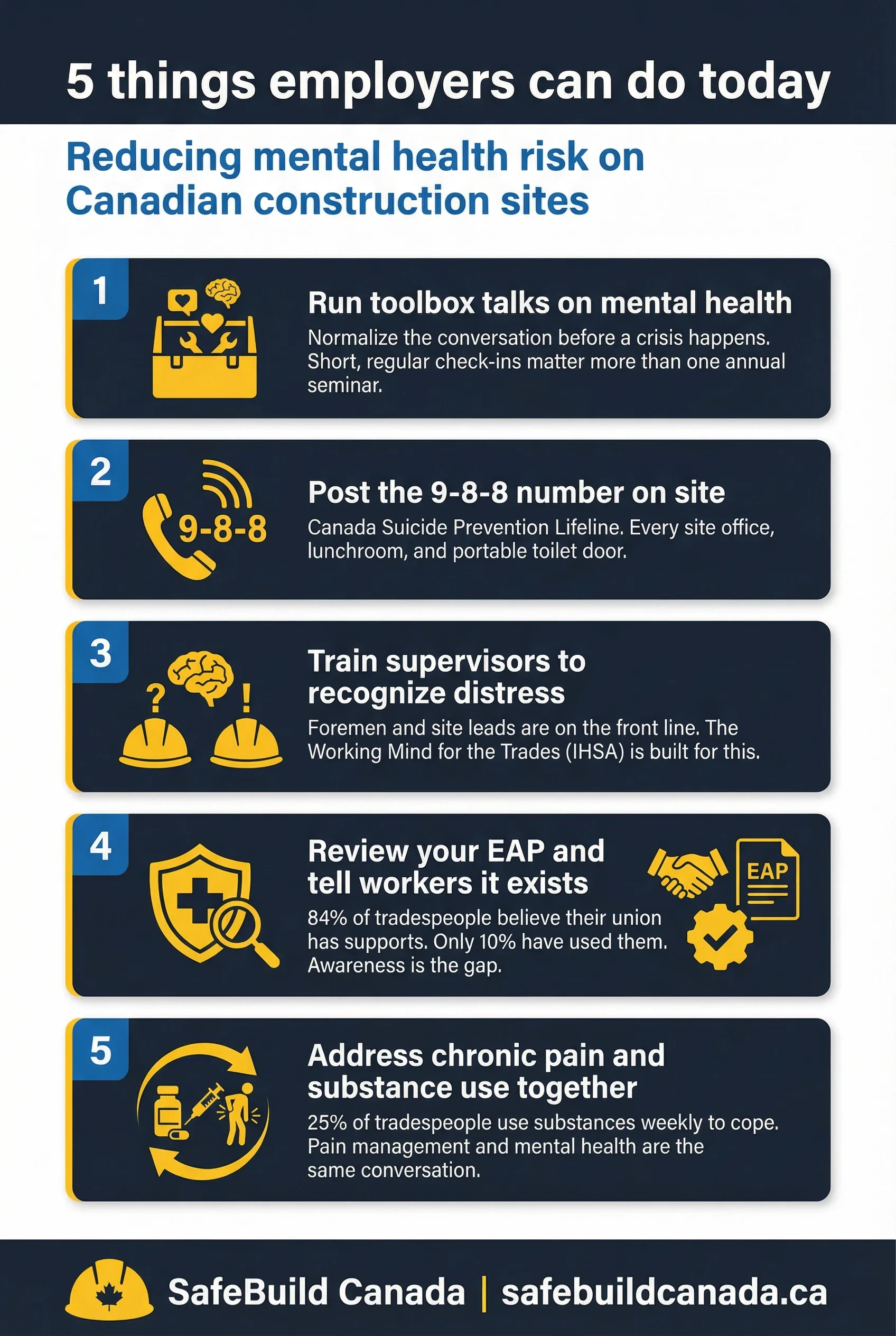
Start with toolbox talks, not seminars. A one-day mental health awareness training once a year does not change culture. Short, regular conversations do. A five-minute toolbox talk that acknowledges stress, names the 9-8-8 number, and invites workers to check in with each other costs nothing and normalizes the conversation over time. The same principle that applies to physical safety, where regular daily habits matter more than periodic events, applies equally to mental health.
Train supervisors and foremen specifically. Foremen are the first point of contact for a worker in distress. They are also the people least likely to have received any training on how to recognize or respond to mental health issues. The Working Mind for the Trades program is designed for exactly this: it gives supervisors language, scenarios, and confidence to have conversations they currently avoid. A foreman who knows what to say when a worker seems withdrawn or unusually irritable is worth more than any poster on a site office wall.
Review your EAP and tell workers it exists. Most medium and large contractors have Employee Assistance Programs. Most workers either do not know about them or do not believe they are confidential. If your EAP exists, it needs to be communicated clearly, repeatedly, and in plain language. The CBTU report's finding that only 10 per cent of tradespeople have used union-provided mental health supports despite 84 per cent believing they exist is a communication failure. Fix the communication.
Address chronic pain directly. The link between chronic pain, opioid use, and mental health deterioration is well established in the construction context. A worker who is managing a back injury with substances is not primarily a substance use problem, they are a pain management problem that has not been addressed. Employers who create pathways for workers to access physiotherapy, modified duties, and pain management support are addressing the root cause, not just the symptom.
Post 9-8-8 everywhere. This is the simplest possible action. The Canada Suicide Prevention Lifeline number should be on every site office wall, every lunchroom, and every portable toilet door. It costs nothing and it saves lives.
The regulatory direction of travel
WorkSafeBC's psychological health and safety initiative, which covers construction among other sectors, signals where provincial regulators are heading. The initiative focuses on ensuring workplaces have basic psychological safety program elements in place, including working alone policies, violence prevention, bullying and harassment prevention, and new worker training. Officers are actively engaging employers and workers on how these programs affect psychological health.
Ontario's Ministry of Labour has been similarly direct. The RESCON webinar in December 2025 included a ministry director presenting current statistics and calling on industry leaders to advocate for policies that prioritize mental health resources. The direction is clear: psychological health is becoming a compliance issue, not just a wellness initiative. The post on Canadian construction OHS regulation updates for 2025 and 2026 covers the broader regulatory changes affecting employers this year.
Employers who treat mental health as a box-ticking exercise are going to find themselves behind when enforcement catches up with the data. The companies that are ahead of this are the ones building it into their safety culture now, the same way they built physical safety culture over the past three decades.
The honest conclusion
The construction industry in Canada has made real progress on mental health awareness over the past five years. The CBTU report, the IHSA program, BuildStrong in BC, and the RESCON webinars all represent genuine effort. The statistics are still terrible, but they are being talked about openly in ways they were not a decade ago.
The problem is that awareness without action is just a more informed version of the same silence. Suicide rates at four times the national average are not a trend that better awareness alone will reverse. They require employers who actually change what happens on site, supervisors who are trained and supported, programs that workers can access without shame, and a culture that treats asking for help as a sign of self-awareness rather than weakness.
If you are a site manager or safety officer reading this, the place to start is not a policy document. It is a toolbox talk next Monday morning where you say, out loud, that mental health is a safety issue on this site and that the 9-8-8 number is on the wall in the lunchroom. That conversation, repeated consistently, is how culture changes. The programs and resources exist. The question is whether employers are willing to use them. Building that kind of culture starts with the same commitment that went into your construction site safety plan: a deliberate decision to make it a priority before something goes wrong.
SOURCES
Canada's Building Trades Unions, Mental Health and Substance Use Report (Douglas Coldwell Layton Foundation), September 2025.
Opening Minds / Mental Health Commission of Canada, Innovating Mental Health Solutions for the Trades with IHSA, February 2025.
Daily Commercial News / ConstructConnect, "Silence is costly: One in three construction workers report poor mental health," December 3, 2025.
BuildStrong by CIRP, Mental Health and Substance Use Treatment for BC's Construction Industry, 2024.
WorkSafeBC, Psychological Health and Safety Planned Inspectional Initiative, 2024.