
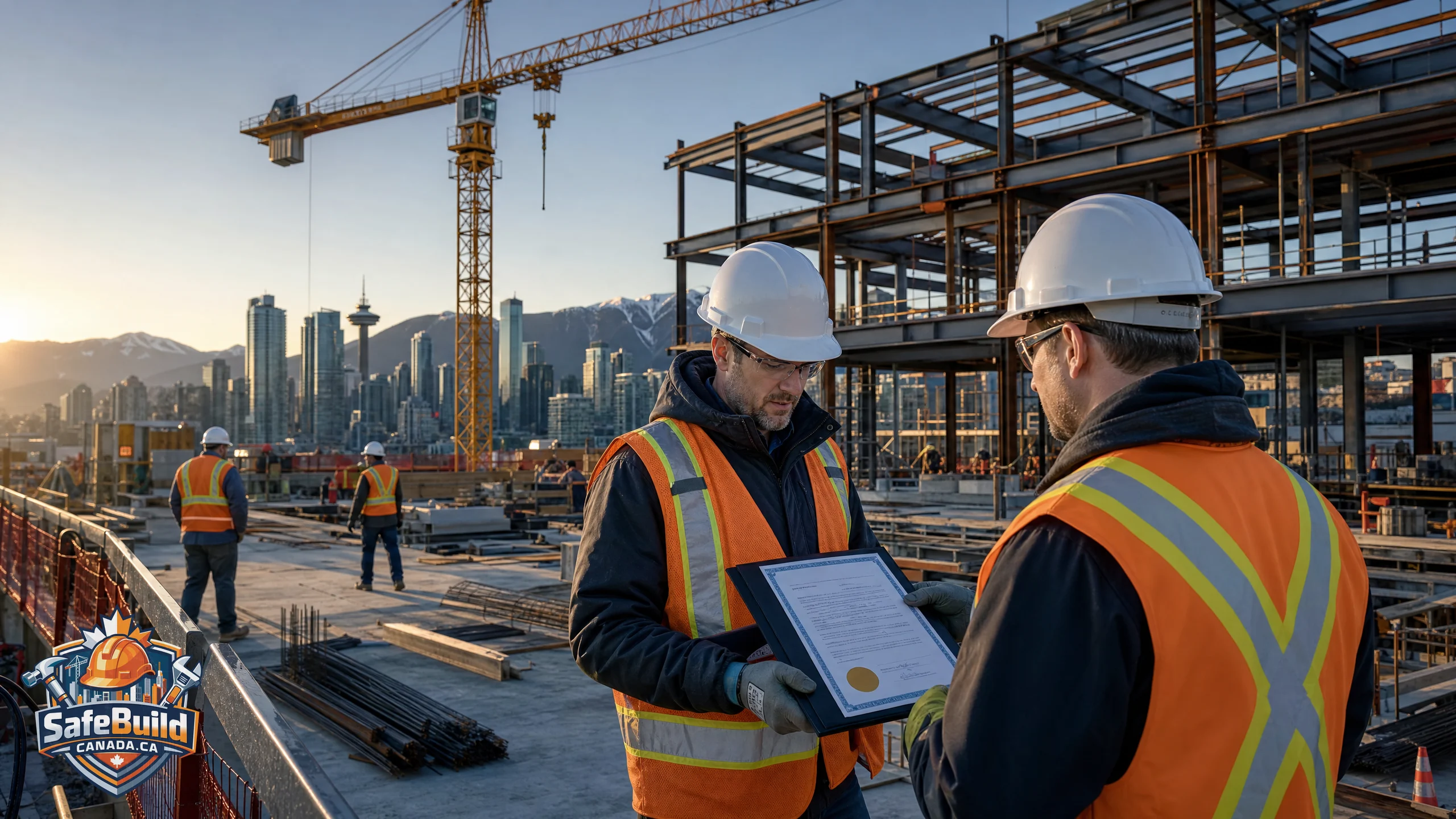
For Canadian construction companies, winning bids often comes down to more than just price and schedule. Public owners, municipalities, and large general contractors increasingly demand proof that a subcontractor operates safely before they even look at the numbers. In most provinces, that proof is the Certificate of Recognition, universally known as COR.
While it began as a voluntary program in Alberta more than two decades ago, COR has evolved into the national standard for occupational health and safety management in the construction industry. Holding this certification signals to the market that a company does not just talk about safety but has a fully implemented, independently audited system to protect its workers.
Navigating the certification process can feel overwhelming for contractors looking at it for the first time. The requirements are rigorous, the audits are thorough, and the timeline requires commitment. However, the business case for achieving certification is compelling. Beyond opening doors to larger contracts, certified companies consistently see fewer injuries, lower claim costs, and substantial financial rebates from provincial workers compensation boards.
This guide breaks down exactly what the certification entails, who requires it, the difference between small and large employer programs, and the step-by-step process to achieve and maintain it across Canada.
What is COR Certification?
The Certificate of Recognition is an occupational health and safety accreditation program that verifies a fully implemented safety and health management system meets national standards. The program is nationally registered, trademarked, and endorsed by the Canadian Federation of Construction Safety Associations.
Unlike basic regulatory compliance, which focuses on meeting the minimum legal requirements of the local occupational health and safety act, this certification requires employers to take an active, structured approach. Companies must build a thorough system based on a continuous cycle of planning, doing, checking, and acting. This system must be documented, actively used by workers and supervisors, and proven effective through rigorous auditing.
The certification is delivered province by province through member associations that serve as the Authority Having Jurisdiction. These certifying partners, such as the Infrastructure Health and Safety Association in Ontario or the BC Construction Safety Alliance in British Columbia, develop the audit instruments, train the auditors, and review the final results before recommending a company for certification.
Achieving the standard requires passing an audit that evaluates every element of the safety program. While specific passing grades vary slightly by province, the national standard requires a minimum score of 65 percent in each individual element and an overall score of 80 percent or higher. This high bar guarantees that certified companies have no major gaps in their safety protocols.
Who Needs It and Why
In strict legal terms, the certification is voluntary. No provincial occupational health and safety act mandates that a company must hold it to operate. However, in practical commercial terms, it has become a mandatory requirement for doing business at a certain scale.
Public infrastructure projects are the primary driver. Federal, provincial, and municipal governments routinely write the certification into their procurement policies as a strict prequalification requirement. If a contractor wants to bid on a highway expansion, a municipal water treatment plant, or a provincial hospital build, lacking the certificate usually means the bid is disqualified immediately.
Large general contractors have adopted the same standard for their supply chains. When a major builder takes on a massive project, they assume the role of prime contractor and carry the liability for site safety. To manage that risk, they require all subcontractors to prove their safety competence before stepping on site. The certificate serves as that proof, eliminating the need for the general contractor to audit every trade individually.
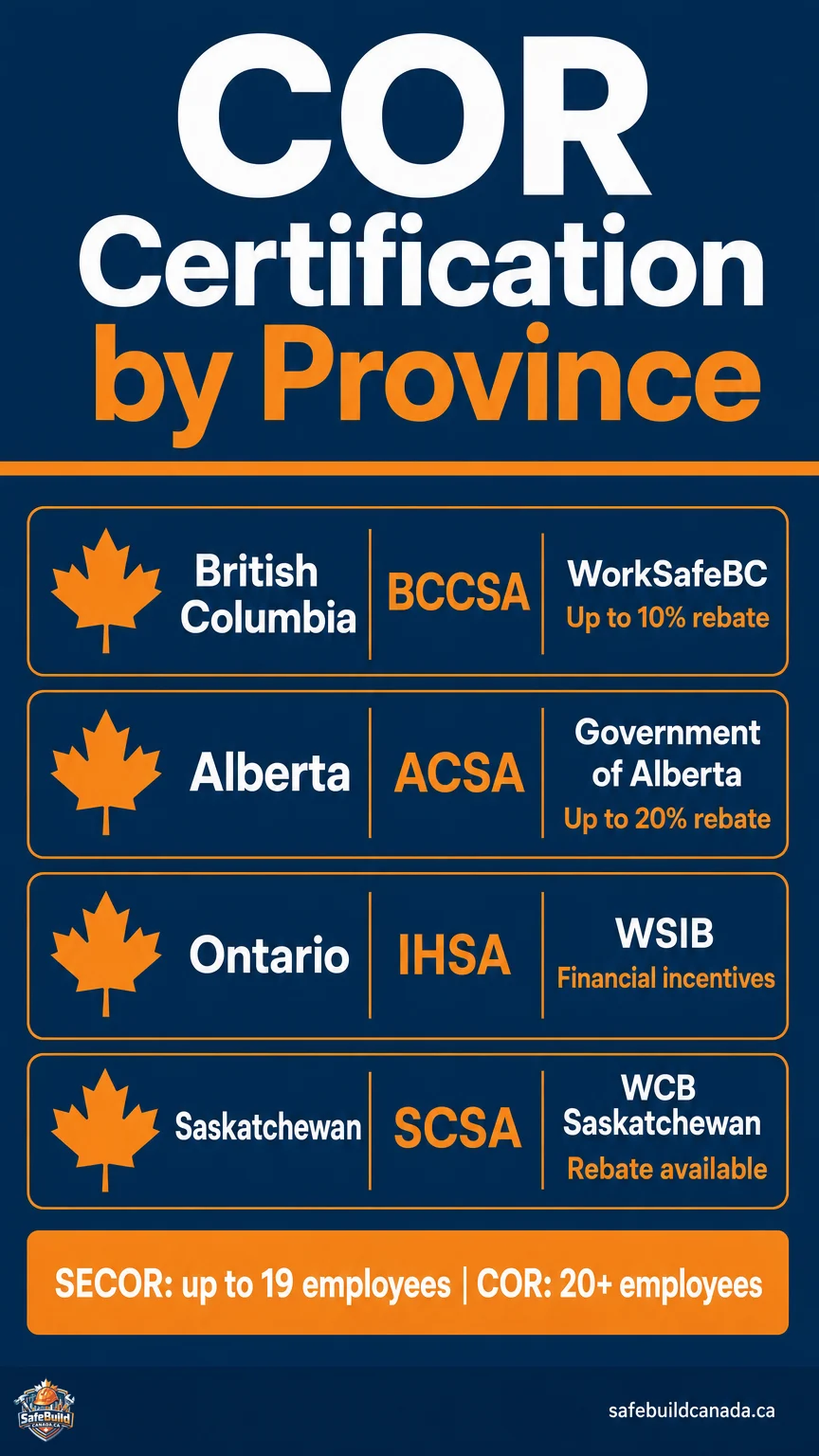
Beyond market access, the financial incentives are a major reason companies pursue the program. Provincial workers compensation boards recognize that certified companies have lower injury rates and cost the system less money. To encourage participation, they offer substantial premium rebates. In Alberta, the Partnerships in Injury Reduction program offers up to a 20 percent rebate on premiums. In British Columbia, WorkSafeBC offers up to a 10 percent annual incentive payment. For a mid-sized contractor with a million dollar payroll, these rebates often cover the entire cost of maintaining the safety program.
Understanding SECOR vs COR
The architects of the program recognized that a ten person framing crew cannot manage the same administrative burden as a five hundred person civil engineering firm. To make the standard accessible to the entire industry, the program is split into two tiers based on company size.
The Small Employer Certificate of Recognition, commonly called SECOR, is designed for smaller operations. In Alberta, this applies to companies with up to ten employees. In British Columbia, the Small COR program covers companies with up to nineteen employees. The standards for hazard assessment and worker protection remain high, but the administrative requirements are scaled down. Crucially, small employers are usually permitted to conduct self assessments rather than hiring external auditors, which substantially reduces the cost of compliance.
The standard Certificate of Recognition applies to larger employers who exceed those headcount thresholds. These companies must meet the full administrative requirements of the program and must hire certified external auditors to conduct their certification and re-certification audits.
Companies that grow past the small employer threshold are required to transition to the full program. This transition requires upgrading documentation, training internal auditors, and preparing for external scrutiny. Smart contractors build their initial small employer programs with this future growth in mind, creating systems that can scale naturally as they hire more workers.
The Step-by-Step Process to Certification
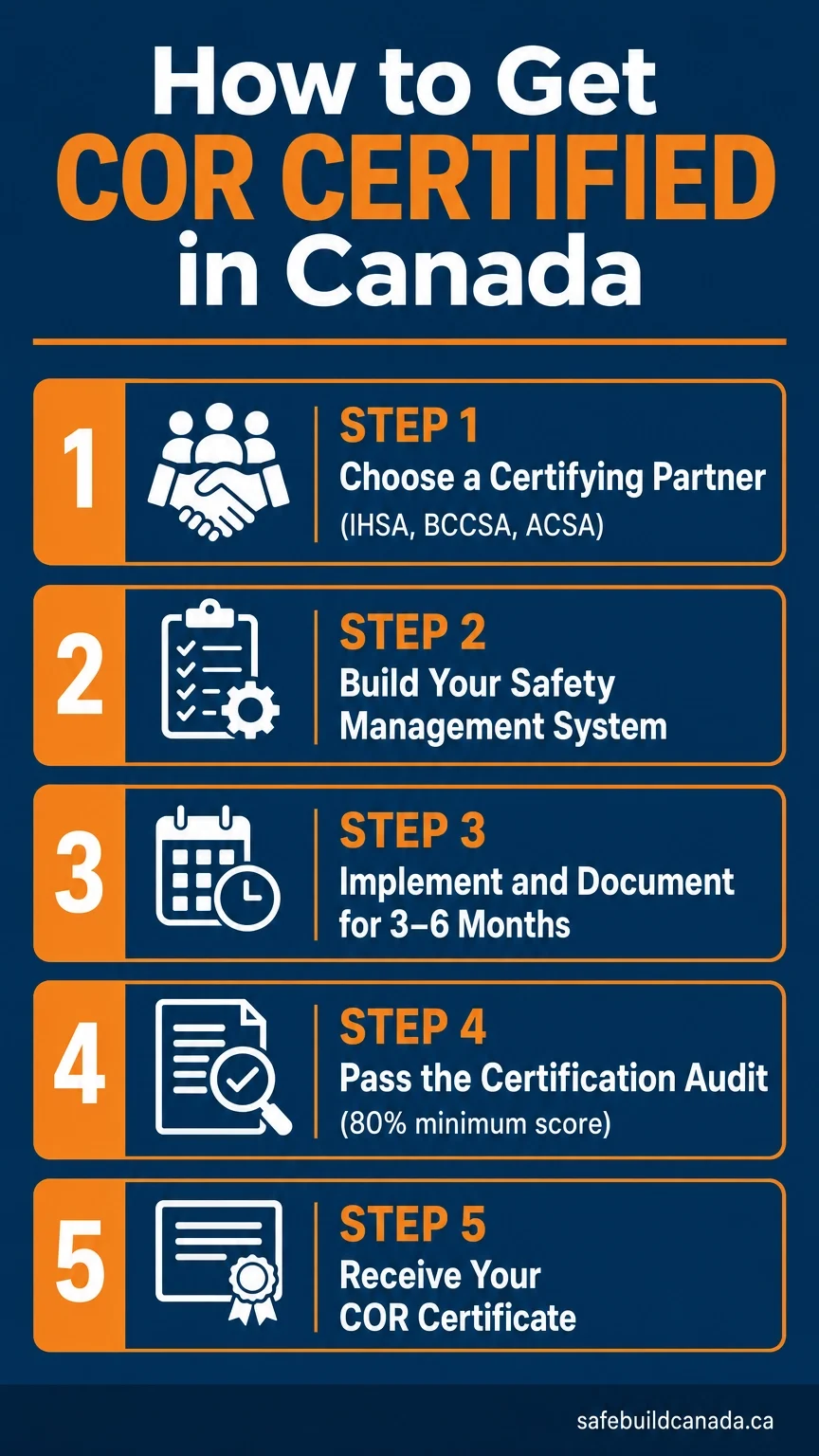
Achieving the standard is not a quick process. For a company starting from scratch, building the system, generating the required documentation, and passing the audit typically takes six to twelve months. The process follows a structured path regardless of the province.
Step 1: Register with a Certifying Partner
The first step is identifying the correct certifying partner for the province and industry. Construction companies must register with their provincial construction safety association. This registration formally enters the company into the program and provides access to the specific audit instruments, training materials, and templates required for that jurisdiction.
Step 2: Complete Required Training
The certifying partner will require key personnel from the company to complete specific training courses. This usually includes a program overview course, a safety management system building course, and an internal auditor training course. Having a trained internal auditor on staff is critical, as they will be responsible for conducting the annual maintenance audits required to keep the certificate active.
Step 3: Build the Safety Management System
This is the most labor intensive phase. The company must develop a detailed safety manual that addresses every element of the audit standard. This includes writing policies for hazard identification, developing a construction site safety plan, creating emergency response procedures, and establishing a joint health and safety committee. Many companies choose to hire a safety consultant during this phase to confirm the manual meets the standard without becoming overly bureaucratic.
Step 4: Implement and Document
A written manual is useless if it sits on a shelf. The audit requires proof that the system is actually being used in the field. Companies must implement their new procedures and generate a paper trail of compliance. This means conducting documented hazard assessments, holding recorded toolbox talks, performing site inspections, and investigating any near misses. Auditors typically require three to six months of documentation to prove the system is fully operational before they will conduct the certification audit.
Step 5: The Certification Audit
Once the system is running and the documentation is gathered, the company schedules the certification audit. For large employers, this must be done by a certified external auditor. The auditor will review the safety manual, examine the field documentation, interview workers and supervisors to verify their knowledge, and conduct site observations. The auditor then scores the program against the standard.
Step 6: Review and Issuance
The auditor submits their final report to the certifying partner for quality assurance review. If the report meets all standards and the company has achieved the required passing grades, the certifying partner recommends certification. The provincial workers compensation board or government authority then issues the official certificate, which is typically valid for three years.
Maintaining the Standard
Getting the certificate is only the beginning; keeping it requires ongoing effort. The program is built on the principle of continuous improvement, and companies must prove they are maintaining their standards every year.
During the three year lifecycle of the certificate, the company must conduct internal maintenance audits in years two and three. These audits are usually performed by the company's trained internal auditor, though some companies choose to hire external consultants to get an objective view. The maintenance audit follows the same rigorous process as the certification audit, including documentation review, interviews, and site observations.
If a company fails to submit a maintenance audit, or if the audit reveals that the safety system has been abandoned, the certifying partner can revoke the certificate. This revocation immediately disqualifies the company from bidding on restricted contracts and cuts off any workers compensation premium rebates.
When the three year cycle ends, the company must undergo another full external audit to achieve re-certification. This cycle keeps safety as a permanent operational priority rather than a one time project.
Provincial Differences and Reciprocity
While the Canadian Federation of Construction Safety Associations maintains the national standard, the specific administration of the program varies by province. Contractors operating across provincial lines must understand these differences to maintain compliance.
In Alberta, where the program originated, the Alberta Construction Safety Association is the primary certifying partner for the industry. The province ties the certification directly to the Partnerships in Injury Reduction program, offering some of the highest premium rebates in the country. Alberta contractors must also confirm their programs align with the specific Alberta OHS Act employer duties.
In British Columbia, the BC Construction Safety Alliance manages the program, while WorkSafeBC issues the financial incentives. BC contractors must build their systems to comply with the highly detailed BC OHS Regulation, which has specific requirements for prime contractors and fall protection that differ from other provinces.
Ontario operates slightly differently. The Infrastructure Health and Safety Association is the sole authority for the province. The Workplace Safety and Insurance Board manages the financial incentives through its Health and Safety Excellence program. Ontario has seen a massive surge in certification requirements over the last five years, driven largely by transit and municipal infrastructure projects in the Greater Toronto Area.
For contractors working in multiple provinces, the national standard provides a mechanism called reciprocity. If a company holds a valid certificate in its home province, it can apply for reciprocity in another province without having to rebuild its entire safety program. The company must still demonstrate that it understands and complies with the specific occupational health and safety legislation of the new province, usually by completing a legislative supplement to their audit.
The Cost of Certification
The cost of achieving the standard varies widely based on the size of the company, the baseline state of their existing safety program, and how much external help they hire.
For a small employer pursuing SECOR, the hard costs are relatively low. Association registration and training fees might total a few hundred to a thousand dollars. Because they can conduct a self assessment, there is no external auditor fee. If the owner builds the program themselves using association templates, the total first year cost might be under two thousand dollars. However, this requires a massive investment of the owner's time.
For a larger employer pursuing the full standard, the costs are higher. Training fees for multiple staff members can reach two thousand dollars. Hiring a safety consultant to build the manual and guide the implementation often costs between three thousand and six thousand dollars. The external certification audit adds another two thousand to six thousand dollars depending on the size and complexity of the operations. A typical first year all in cost for a mid sized contractor ranges from five thousand to twelve thousand dollars.
While these numbers seem high, they must be weighed against the financial returns. The workers compensation premium rebates alone often generate a positive return on investment in the first year. When combined with the ability to bid on larger, more lucrative contracts and the reduction in costly workplace incidents, the certification becomes a profit driver rather than a sunk cost.
Building a Culture of Safety
Ultimately, the true value of the program goes beyond bidding requirements and premium rebates. The rigorous structure of the audit forces companies to look closely at how they operate. It replaces informal, verbal safety instructions with documented, repeatable processes.
When a company commits to the standard, it changes the culture on the job site. Workers see that management is investing real time and money into their protection. Supervisors have clear frameworks for conducting hazard identification and risk assessment before starting a task. The entire organization shifts from reacting to incidents after they happen to actively managing risks before they cause harm.
For Canadian construction companies looking to grow, protect their workforce, and compete at the highest levels of the industry, achieving this standard is no longer just an option; it is an essential foundation for long term success.