

Navigating the legal landscape of construction safety in Ontario requires a deep understanding of the Occupational Health and Safety Act. Often referred to simply as the OHSA, this legislation forms the foundation of workplace safety across the province. For construction employers, constructors, and supervisors, failing to grasp the specific duties outlined in the Act can lead to severe consequences, ranging from costly stop-work orders to massive financial penalties and even imprisonment.
The OHSA is not merely a set of guidelines. It is a strict legal framework designed to protect workers from hazards on the job. In the construction industry, where risks are inherently high, the Ministry of Labour, Immigration, Training and Skills Development enforces these rules with rigorous inspections. Understanding your exact responsibilities under the OHSA is the first step in building a compliant and safe project site.
This guide breaks down the core components of the Ontario Occupational Health and Safety Act specifically for the construction sector. We will explore the hierarchy of duties, the specific requirements for employers and constructors, the powers of provincial inspectors, and the penalties for non-compliance.
The internal responsibility system
At the heart of the Ontario OHSA is the concept of the internal responsibility system. This principle dictates that everyone in the workplace, from the project owner down to the individual worker, shares the responsibility for health and safety. However, the level of responsibility is directly proportional to the level of authority a person holds.
This means that those with the most control over the workplace, such as constructors and employers, bear the greatest legal burden. They are expected to foresee potential hazards and implement systems to mitigate them. Supervisors act as the critical link between management and the workforce, making certain that safety policies are executed on the ground. Workers are responsible for following the rules, using provided protective equipment, and reporting hazards.
The internal responsibility system relies on active participation. It requires open communication about safety issues and a collaborative approach to problem-solving. When this system functions correctly, it creates a culture where safety is integrated into every aspect of the construction process, rather than being treated as an afterthought.
Understanding the hierarchy of duties
The OHSA clearly defines the roles and responsibilities of different parties on a construction project. It is vital to understand which category you fall into, as this determines your legal obligations. In many cases, a single entity may act as both the constructor and an employer, meaning they must fulfill the duties of both roles simultaneously.
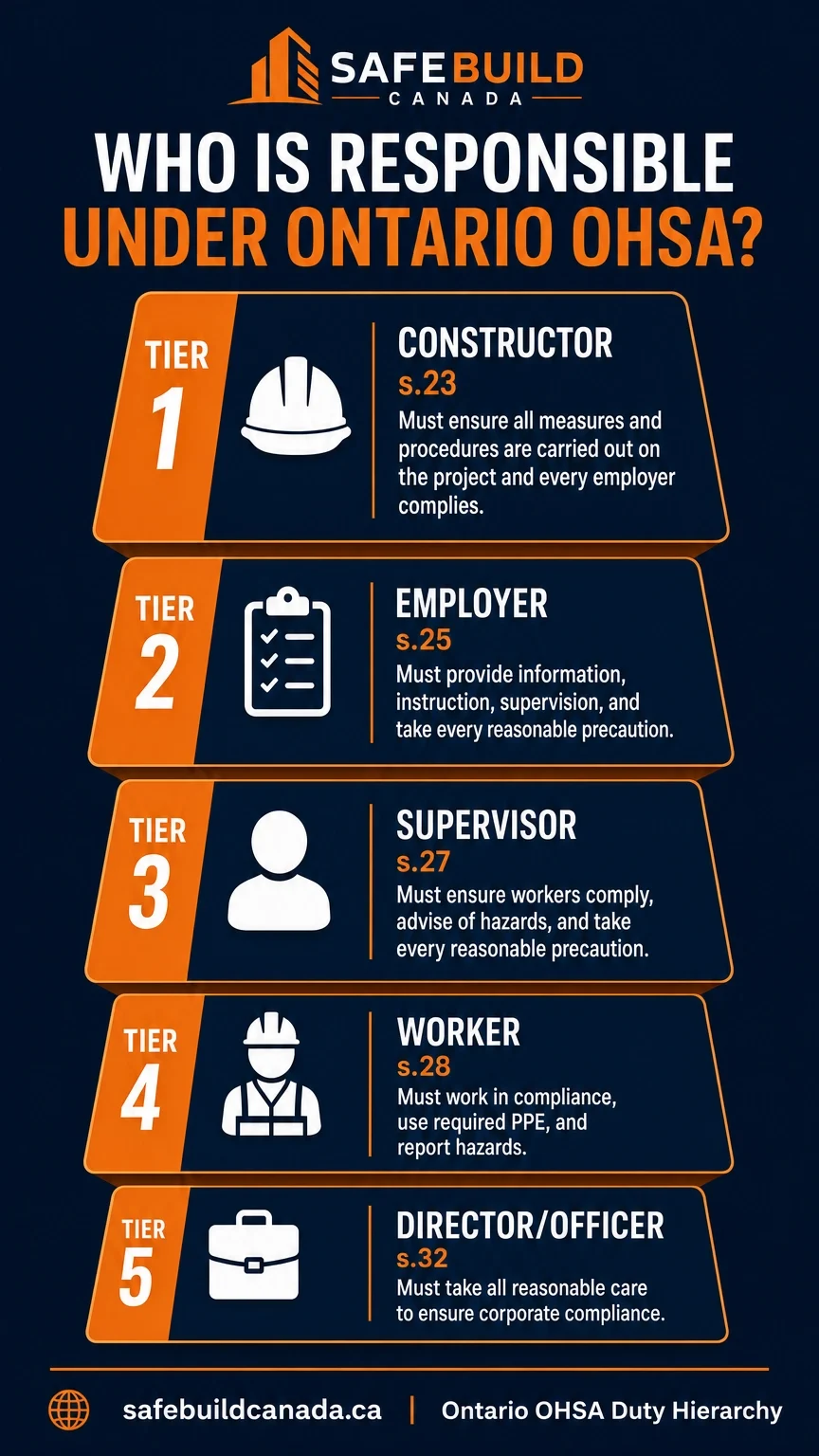
Constructor duties under Section 23
In Ontario construction law, the "constructor" is typically the general contractor or the owner who undertakes the project directly. The constructor has overall responsibility for health and safety on the entire project site. According to Section 23 of the Ontario Occupational Health and Safety Act, the constructor must make certain that all prescribed measures and procedures are carried out on the project.
Furthermore, the constructor must make certain that every employer and every worker performing work on the project complies with the Act and its regulations. This is a massive undertaking on large sites with multiple subcontractors. It requires the constructor to have strong oversight mechanisms in place. They must coordinate the activities of all trades to prevent overlapping hazards and maintain a safe environment for everyone present.
Before work even begins, the constructor is often required to file a Notice of Project with the Ministry of Labour. This applies to projects that meet specific criteria, such as exceeding a certain total cost or expected duration. Failing to file this notice is a direct violation of the OHSA and can trigger immediate regulatory action.
Employer duties under Section 25
Section 25 of the OHSA outlines the duties of employers. An employer is any person or business that employs one or more workers. On a construction site, this includes the general contractor (acting as an employer to their own staff) and every subcontractor.
The most critical clause for employers is Section 25(2)(h), which states that an employer must take every precaution reasonable in the circumstances for the protection of a worker. This is a broad, sweeping requirement that forms the basis of many Ministry of Labour prosecutions. It means that simply following the explicit rules in the regulations is not always enough. If a hazard exists that is not specifically covered by a regulation, the employer is still legally obligated to address it.
Employers must also provide information, instruction, and supervision to protect worker health and safety. This includes conducting a thorough hazard identification and risk assessment for all tasks. They must acquaint workers with any hazards in the work and provide the necessary equipment, materials, and protective devices, making certain they are maintained in good condition.
Supervisor duties under Section 27
Supervisors are the frontline defenders of safety on a construction site. Under Section 27 of the OHSA, a supervisor must make certain that workers comply with the Act and regulations. They must also make certain that workers use or wear the equipment, protective devices, or clothing required by the employer.
Supervisors have a legal duty to advise workers of the existence of any potential or actual danger to their health or safety. Where prescribed, they must provide workers with written instructions on the measures and procedures to be taken for their protection. Like employers, supervisors are also bound by the requirement to take every precaution reasonable in the circumstances to protect workers.
To fulfill these duties, supervisors must be competent persons as defined by the Act. This means they must have the knowledge, training, and experience to organize the work safely, be familiar with the OHSA and its regulations, and have knowledge of any potential or actual danger to health or safety in the workplace.
Worker rights and duties under Section 28
Workers also have specific legal duties under Section 28 of the OHSA. They must work in compliance with the Act and regulations, use or wear the required protective equipment, and report any workplace hazards or contraventions of the Act to their employer or supervisor. Workers are strictly prohibited from removing or making ineffective any protective device required by the regulations or their employer.
Equally important are the three fundamental rights granted to workers under the OHSA. The right to know gives workers the right to be informed about the hazards in their work and to receive the training needed to do their jobs safely. The right to participate gives workers the right to be part of the process of identifying and resolving health and safety concerns, typically through a Joint Health and Safety Committee or a health and safety representative. Under Section 43, the right to refuse gives workers the right to refuse unsafe work if they have reason to believe that the equipment, workplace conditions, or the work itself is likely to endanger them or another worker.
When a worker exercises their right to refuse unsafe work, a specific investigation process must be followed. The employer or supervisor must investigate the situation in the presence of the worker and a safety representative. If the issue cannot be resolved internally, a Ministry of Labour inspector must be called in to make a determination.
The role of O. Reg. 213/91
While the OHSA provides the overarching legal framework, the specific, detailed rules for construction sites are found in Ontario Regulation 213/91: Construction Projects. This regulation is a substantial document that covers almost every conceivable aspect of construction safety.
O. Reg. 213/91 details the exact requirements for fall protection systems, scaffolding construction, excavation shoring, electrical safety on construction sites, and fire safety requirements. It dictates the minimum distances workers must maintain from overhead power lines and the specific procedures for entering confined spaces.
For construction employers, compliance means adhering to both the general duties in the OHSA and the specific requirements in O. Reg. 213/91. When Ministry of Labour inspectors visit a site, they are primarily checking for violations of this specific regulation.
Ministry of Labour inspections and enforcement
The Ontario Ministry of Labour, Immigration, Training and Skills Development employs a large team of inspectors dedicated to enforcing the OHSA on construction sites. These inspectors have extensive powers under Part VI of the Act to investigate workplaces and compel compliance.
Understanding what an inspector can do is essential for any construction employer. When an inspector arrives on site, they are legally authorized to conduct a thorough review of your operations, equipment, and documentation.
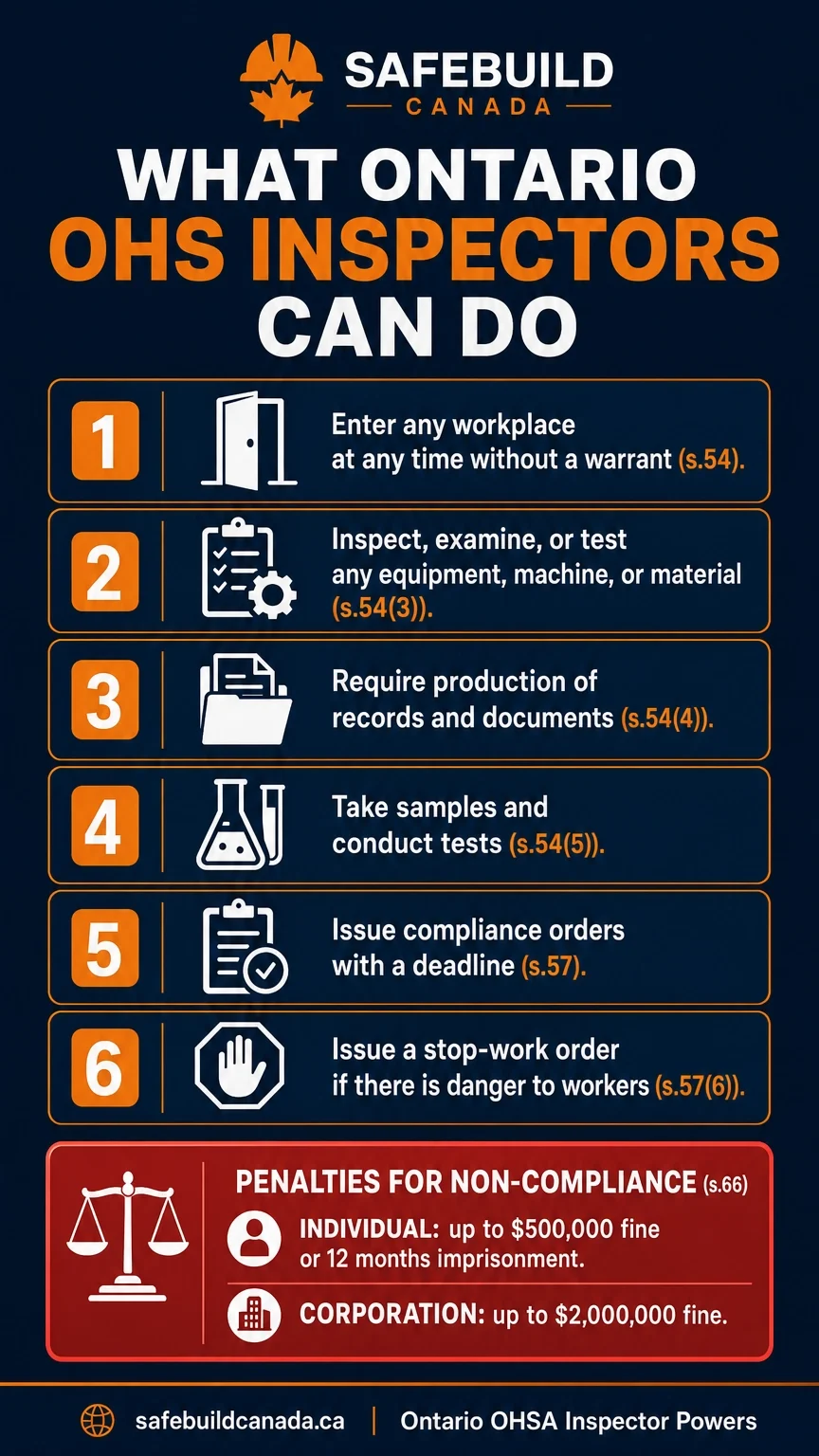
Inspector powers under Section 54
Under Section 54 of the OHSA, an inspector may enter any workplace at any time without a warrant or notice. Once on site, they can inspect, examine, or test any equipment, machine, device, material, or biological, chemical, or physical agent.
Inspectors have the authority to require the production of any drawings, specifications, records, or documents, and they may take these items away to make copies. They can take samples of materials and conduct tests to determine if hazards are present. They may also require an employer to conduct specific tests at the employer's expense and provide the results to the inspector.
During an OHS inspection, it is a strict violation of the Act to hinder, obstruct, or interfere with an inspector. Employers and supervisors must furnish all necessary means to facilitate the inspection.
Orders and stop-work directives
If an inspector finds a violation of the OHSA or its regulations, they have the power to issue orders under Section 57. A compliance order requires the employer or constructor to correct the violation within a specified timeframe.
More severely, if an inspector determines that a contravention poses a danger or hazard to the health or safety of a worker, they can issue a stop-work order. This order immediately halts all work associated with the hazard until the inspector is satisfied that the danger has been removed and the order is officially lifted. Stop-work orders can cause massive delays and financial losses on a construction project, making advance compliance planning essential.
Penalties for non-compliance
The penalties for violating the Ontario OHSA are among the most severe in Canada. Section 66 of the Act outlines the maximum fines and terms of imprisonment that can be levied against individuals and corporations found guilty of an offence.
For an individual, which includes supervisors, workers, and directors or officers of a corporation, the maximum penalty is a fine of up to $500,000, imprisonment for a term of up to 12 months, or both.
For a corporation, the maximum fine is $2,000,000 per charge. In cases where a corporation has a prior conviction under the Act, and the current offence involves a worker's death or serious injury, the minimum fine is set at $500,000.
When determining the exact penalty, courts consider several aggravating factors. These include whether the offence resulted in death or serious injury, whether the defendant acted recklessly, whether they ignored previous inspector orders, and whether the offence was motivated by a desire to reduce costs.
The due diligence defence
The primary defence against a charge under the OHSA is proving due diligence. Section 66(3) states that it is a defence for the accused to prove that every precaution reasonable in the circumstances was taken.
Establishing due diligence requires more than just good intentions. Employers must demonstrate that they had a documented construction site safety plan in place, that workers received all mandatory training, that supervisors actively enforced the rules, and that hazards were promptly addressed when identified. Documentation is critical; if a safety measure was not recorded, it is very difficult to prove in court that it actually happened.
Building a compliant safety culture
Compliance with the Ontario OHSA is not a one-time task; it is an ongoing operational requirement. Construction employers must integrate safety into every phase of a project, from the initial bidding and planning stages through to final completion.
This requires a commitment from the highest levels of management. Directors and officers must allocate the necessary resources to support the safety program. Supervisors must be empowered to stop unsafe work and correct hazards immediately. Workers must feel comfortable reporting issues without fear of reprisal.
By understanding the specific duties outlined in the OHSA, respecting the powers of Ministry of Labour inspectors, and actively managing risks, construction employers can protect their workforce and shield their businesses from the devastating consequences of non-compliance.
Sources
1. Ontario Occupational Health and Safety Act, R.S.O. 1990, c. O.1
2. Ontario Regulation 213/91: Construction Projects
3. Guide to the Occupational Health and Safety Act — Ontario
4. CCOHS: Canadian Centre for Occupational Health and Safety — OHSA Overview
5. IHSA: Infrastructure Health and Safety Association — Legislation and Regulations
6. Ministry of Labour, Immigration, Training and Skills Development