
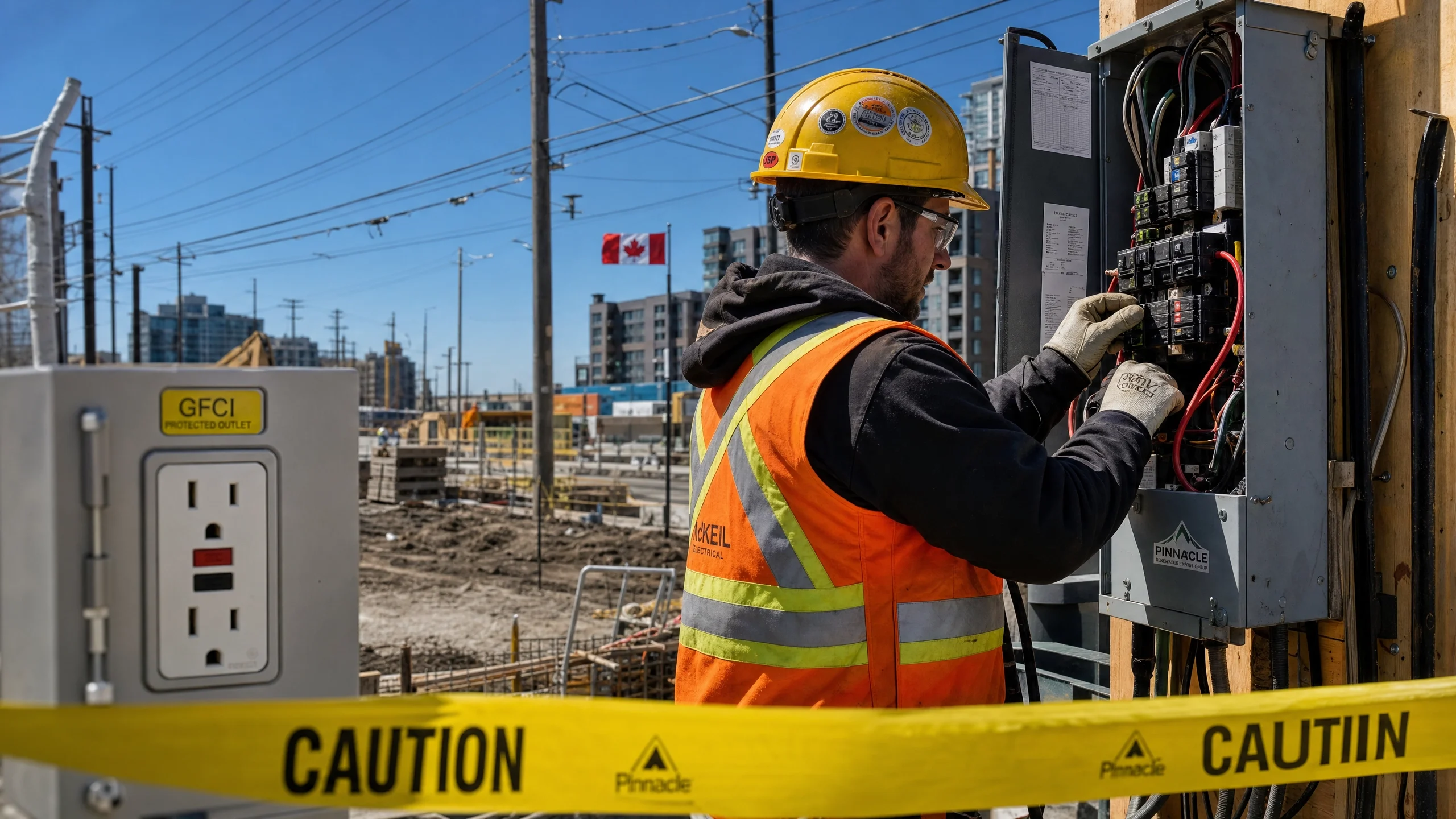
Electrical hazards represent one of the most severe risks on any construction project. Unlike many physical hazards that provide visual or auditory warnings before an incident occurs, electricity is invisible, silent, and unforgiving. A single moment of contact with an energized source can result in severe burns, cardiac arrest, or immediate fatality. In fact, electrical contact remains one of the leading causes of fatal injuries in the Canadian construction industry, with overhead power lines posing the greatest threat to heavy equipment operators and ground workers alike.
For prime contractors, site supervisors, and safety professionals, managing electrical hazards requires a thorough understanding of provincial Occupational Health and Safety regulations, strict enforcement of safe work procedures, and continuous worker education. The legal framework governing electrical safety on construction sites is rigorous, placing significant obligations on employers to identify hazards, implement controls, and verify that all temporary power installations meet national and provincial standards.
This guide breaks down the critical legal requirements for electrical safety on Canadian construction sites. We will examine the specific rules surrounding overhead power line clearances, the mandatory use of Ground Fault Circuit Interrupters, proper grounding procedures for temporary power, and the essential steps for safely managing hazardous energy during maintenance operations.
The reality of electrical hazards in construction
Construction sites are dynamic environments where the electrical infrastructure is constantly changing. Temporary power panels are installed, moved, and eventually replaced by permanent systems. Extension cords are dragged across rough terrain, exposed to weather, and subjected to heavy traffic. Heavy equipment operates near existing overhead and underground utilities. This constant state of flux creates numerous opportunities for electrical incidents if strict safety protocols are not maintained.
The Canadian Centre for Occupational Health and Safety notes that even standard 120-volt circuits can deliver a lethal shock when workers are sweating, standing in water, or in contact with grounded metal structures, as body resistance to electrical current drops significantly in these conditions.
To effectively manage these risks, employers must integrate electrical safety into their broader hazard identification and risk assessment processes. This means evaluating the site for existing electrical infrastructure before mobilization, planning the layout of temporary power to minimize cord damage, and establishing clear protocols for equipment operation near power lines.
Navigating overhead power line clearances
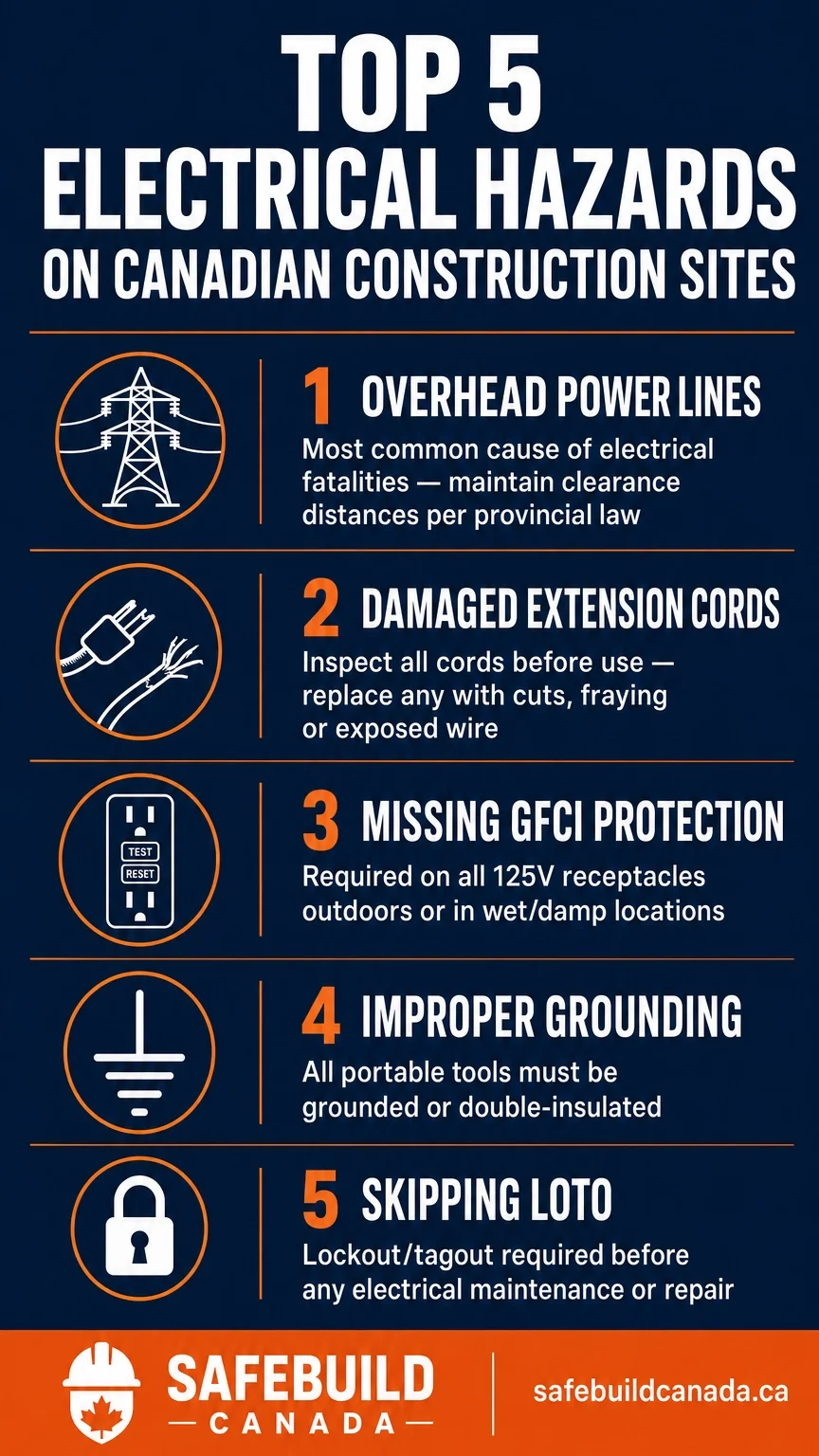
Contact with overhead power lines is the single most common cause of electrical fatalities in the construction sector. These incidents typically involve cranes, excavators, dump trucks, or scaffolding coming into contact with, or coming too close to, energized high-voltage lines. It is a critical misconception that equipment must physically touch a power line to cause an incident; high-voltage electricity can arc across open air if equipment breaches the safe limit of approach.
Because of this extreme risk, provincial OHS regulations establish strict minimum clearance distances that must be maintained between any worker, tool, or piece of equipment and an energized overhead power line. These distances vary based on the voltage of the line and the specific provincial jurisdiction.
Ontario requirements
Ontario's O. Reg. 213/91 prohibits any object from being brought closer to an energized overhead conductor than the specified minimum distances. For conductors at 750 volts or less, the minimum clearance is 3 metres. For conductors between 150,000 and 250,000 volts, the minimum is 4.5 metres, and for those over 250,000 volts, it is 6 metres. If work must be performed closer than these distances, the employer must contact the utility to have the power de-energized or the conductor relocated.
Alberta requirements
Alberta's OHS Code (Part 17) requires that before any work is done or equipment is operated within 7 metres of an overhead power line, the employer must determine the voltage and establish the appropriate safe limit of approach distance as listed in Schedule 4. If work must be done closer than the established limit, the employer must notify the utility and obtain their assistance. The Code also prohibits placing earth or materials under or beside a power line if doing so reduces the clearance below the safe limit.
British Columbia requirements
WorkSafeBC's OHS Regulation (Part 19) outlines specific minimum approach distances for working close to exposed electrical equipment and conductors. For voltages over 750V up to 75kV, the minimum approach distance is 3 metres. For voltages over 75kV up to 250kV, the distance increases to 4.5 metres, and for voltages over 250kV up to 550kV, the distance is 6 metres.
WorkSafeBC also specifies minimum clearance distances for equipment passing under exposed conductors. If the minimum distances cannot be maintained, the employer must obtain written assurance from the owner of the power system stating that the equipment will be displaced, rerouted, isolated, grounded, or visually identified and guarded.
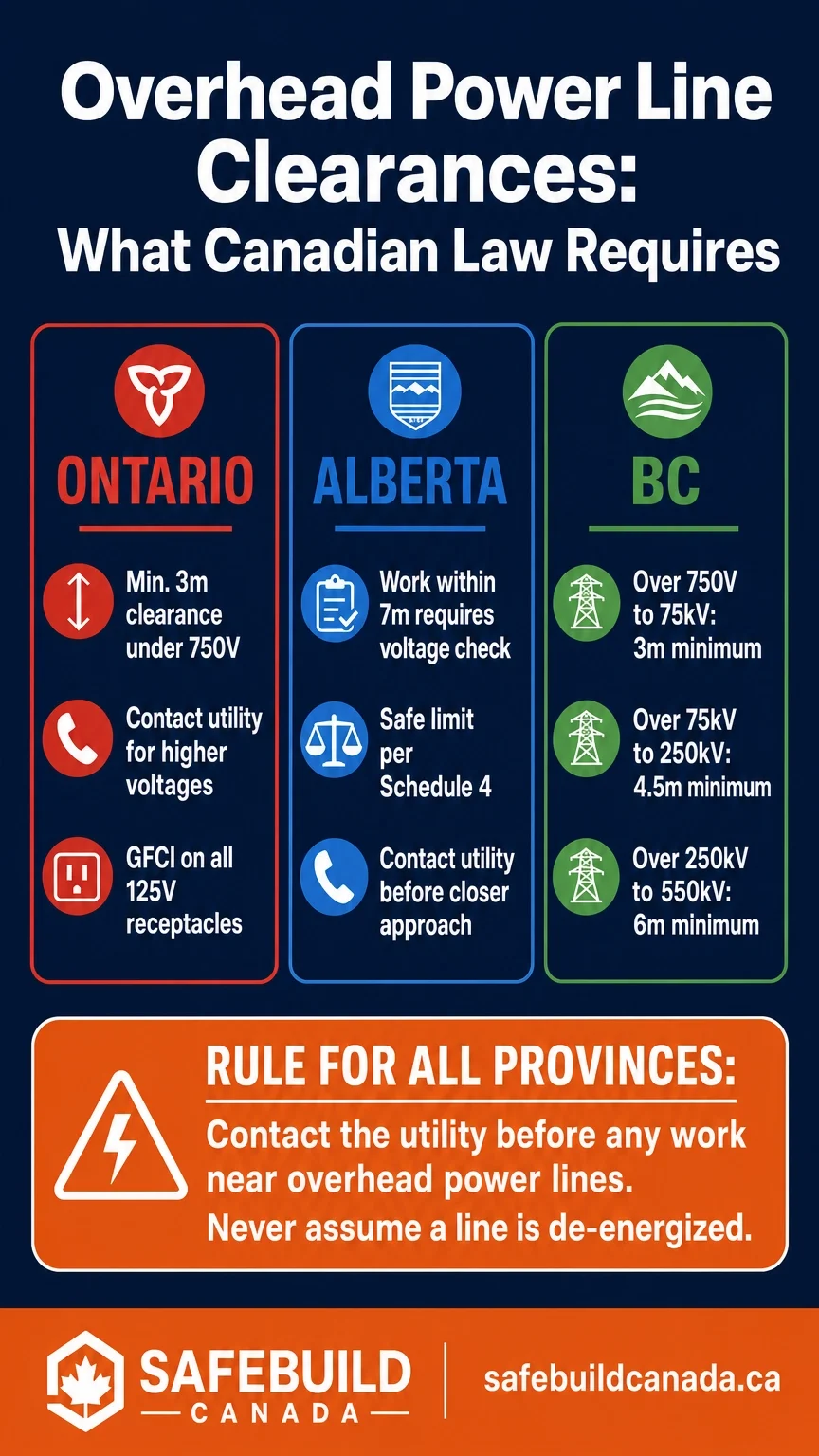
Regardless of the province, the foundational rule of overhead power line safety remains the same: always contact the local utility company before commencing work near their infrastructure. They are the only authority qualified to confirm the voltage, determine the exact safe limits, and implement protective measures such as line covers or de-energization.
Temporary power and GFCI protection
Temporary power systems are the lifeblood of a construction site, providing the necessary electricity for tools, lighting, and site trailers. However, these systems are inherently more vulnerable to damage and environmental exposure than permanent installations. To mitigate the risk of electric shock, Canadian OHS laws mandate the use of Ground Fault Circuit Interrupters (GFCIs) in specific high-risk scenarios.
A GFCI is a fast-acting circuit breaker designed to shut off electric power in the event of a ground fault within as little as 1/40 of a second. It works by comparing the amount of current going to and returning from equipment along the circuit conductors. If the difference exceeds a very small amount (typically 5 milliamperes), the GFCI interrupts the current, preventing a lethal shock.
Mandatory GFCI applications
Provincial regulations generally require Class A GFCI protection for all 125-volt, 15-ampere, and 20-ampere receptacles used on construction sites, particularly those outdoors or in wet or damp locations. WorkSafeBC requires that portable electrical equipment used outdoors or in damp locations be protected by an approved Class A GFCI at the receptacle or circuit panel. Ontario similarly requires GFCI protection for all receptacles used on a project, with very few exceptions.
A GFCI does not protect against all electrical hazards. It will not protect a worker who touches both the line and neutral conductors simultaneously. GFCI protection must therefore be used alongside proper grounding and double-insulated tools.
Inspecting cords and tools
OHS regulations require that all electrical equipment be inspected before each use and maintained in good working condition. Workers must be trained to identify common defects such as missing ground prongs, frayed insulation, exposed wires, and damaged plug casings. Any defective equipment must be immediately removed from service, tagged out, and either repaired by a qualified person or destroyed. All electrical tools and equipment must bear the certification mark of an accredited testing organization such as the Canadian Standards Association (CSA), Underwriters Laboratories of Canada (ULC), or Intertek (ETL).
Grounding requirements for construction sites
Grounding provides a safe, low-resistance path for electrical current to flow to the earth in the event of a fault, preventing the current from passing through a worker's body. Verifying that all temporary power systems, generators, and portable tools are adequately grounded is a critical employer responsibility.
System grounding and equipment grounding
System grounding connects one of the current-carrying conductors (usually the neutral) to the earth, stabilizing voltage and providing a path for fault currents to return to the source and trip the overcurrent protection device. Temporary power services installed by the utility or a licensed electrical contractor will include proper system grounding.
Equipment grounding connects all non-current-carrying metal parts of electrical equipment (tool casings, generator frames, metal conduit) to the earth. If a fault occurs and a live wire contacts the metal casing of a tool, the equipment ground provides a safe path for the current to flow to the earth rather than through the worker holding the tool.
Portable generators and tools
When a portable generator supplies power directly to tools via its mounted receptacles and the tools are double-insulated or equipped with a three-prong grounding plug, the generator frame typically serves as the ground and a separate grounding electrode may not be required. When the generator connects to a temporary power distribution panel, it must be grounded in accordance with the Canadian Electrical Code.
Portable hand tools must be either properly grounded using a three-wire cord and three-prong plug, or double-insulated. Workers must never remove the ground prong from a three-prong plug to fit it into a two-prong extension cord or receptacle.
Ensuring proper grounding is a key component of a thorough construction site safety guide, as it forms the baseline defense against electrical shock.
Managing hazardous energy: Lockout/Tagout
The risk of electrical injury spikes dramatically during maintenance, repair, or installation work on electrical systems. Employers must implement strict hazardous energy control procedures, commonly known as Lockout/Tagout (LOTO). The principles involved are similar to those used in a confined space entry program, where all potential sources of hazardous energy must be isolated and secured before work begins.
The legal requirement for isolation
Provincial OHS regulations are clear: work must not be performed on energized electrical equipment unless absolutely necessary and specific safe work procedures are followed. The default legal requirement is that the equipment must be completely isolated from its power source, tested to verify de-energization, and locked out. WorkSafeBC requires that high-voltage electrical equipment be completely isolated, grounded, and locked out before starting work. If isolation is not practicable, written safe work procedures must be followed, two or more qualified persons must be present, and appropriate electrical protective equipment must be used.
The LOTO process
A compliant electrical LOTO procedure involves several critical steps:
Identify all energy sources: The worker must identify all sources of electrical energy supplying the equipment. This may involve reviewing electrical drawings and tracing conduits.
Disconnect the power: The equipment must be shut down and the disconnecting means (breaker, disconnect switch) must be opened to isolate the power.
Apply locks and tags: The worker performing the maintenance must apply their personal lock and tag to the disconnecting means. If multiple workers are involved, each must apply their own lock using a multi-lock hasp.
Verify de-energization: The worker must use a properly rated voltage tester to confirm that the equipment is completely de-energized before touching any exposed conductors. The tester should be checked on a known live source before and after the test to confirm it is functioning correctly.
Only qualified individuals, typically licensed electricians or registered apprentices working under direct supervision, are legally permitted to perform electrical LOTO and conduct maintenance on electrical systems.
Emergency response for electrical incidents
Despite the best prevention efforts, electrical incidents can still occur. When a worker makes contact with an energized source, the immediate response of coworkers can mean the difference between life and death. The construction site emergency response plan must include specific protocols for electrical emergencies.
The most important rule is to never touch a worker who is still in contact with the energized source. The immediate priority is to safely disconnect the power source by turning off the breaker or unplugging the equipment. If the power cannot be disconnected, rescuers must use a dry, non-conductive object to separate the worker from the energy source. Once clear, trained personnel should begin CPR or use an AED if necessary while another worker calls emergency services.
All workers should be trained on the location of main electrical disconnects and proper emergency procedures. Workers exposed to electrical hazards must be equipped with appropriate CSA PPE standards compliant gear, including dielectric footwear and arc-rated clothing where required.
Conclusion
Electrical safety on Canadian construction sites is a matter of strict legal compliance and rigorous procedural enforcement. The hazards posed by overhead power lines, temporary power systems, and energized equipment require constant vigilance from every person on the site.
By understanding the provincial regulations governing clearance distances, mandating GFCI protection, verifying proper grounding, and enforcing strict lockout/tagout procedures, employers can protect their workforce from the invisible dangers of electricity. Regular OHS inspections should specifically target electrical hazards, confirming that extension cords are in good condition, temporary panels are secure, and workers are maintaining safe distances from overhead lines. No job is so urgent that it justifies compromising electrical safety protocols.