
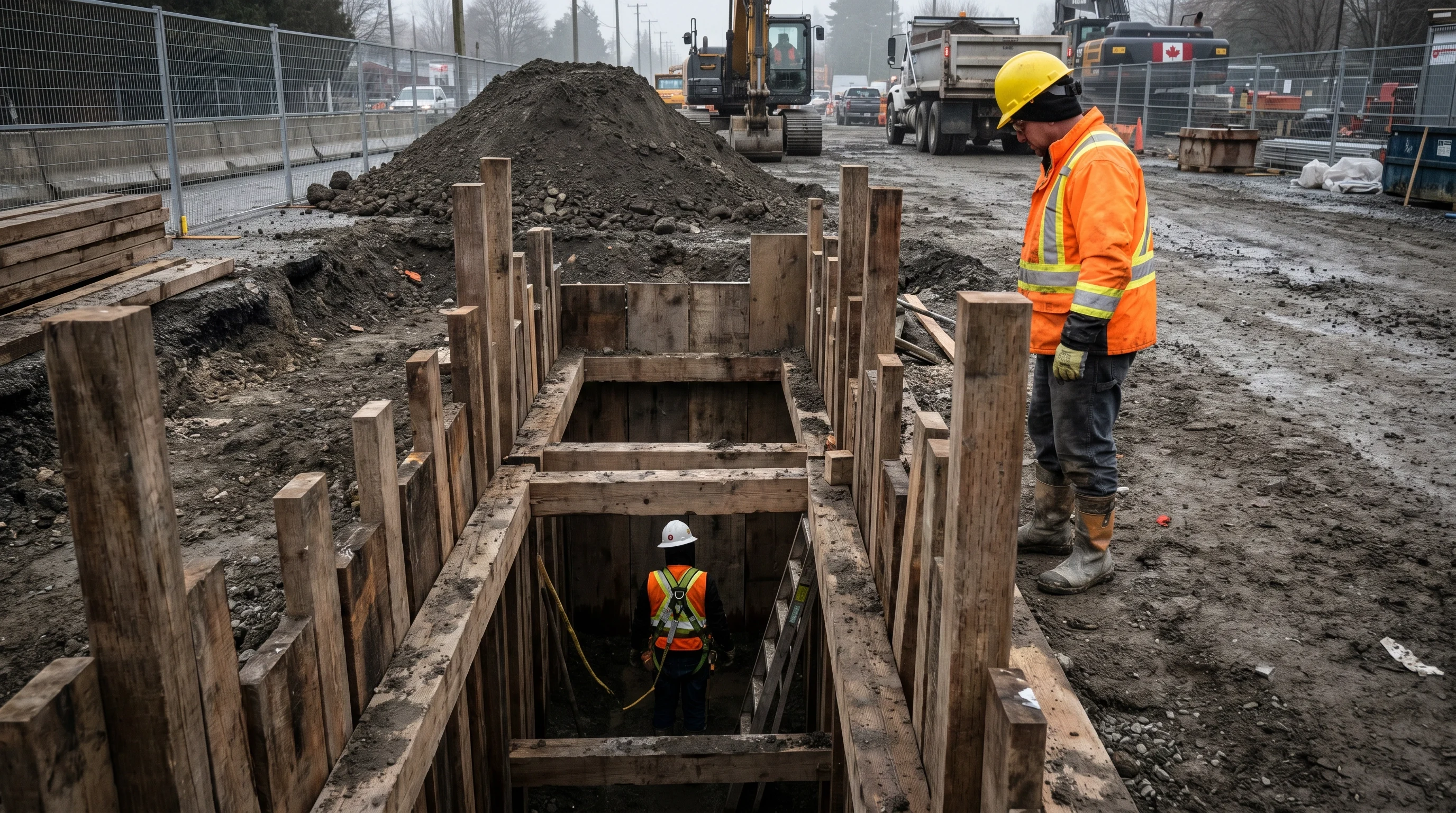
Trenching and excavation work remains one of the most hazardous activities in the Canadian construction industry. Every year, workers face severe risks from cave-ins, equipment falls, and hazardous atmospheres when working below grade. A cubic metre of soil can weigh as much as a small car, meaning that a sudden trench collapse leaves workers with almost no time to react and often results in fatal crushing or suffocation injuries. Understanding and implementing proper trenching and excavation safety protocols is not just a regulatory requirement; it is a fundamental moral obligation for every contractor, site supervisor, and project manager.
This guide details the critical components of trenching and excavation safety across Canada. We will examine how different provinces classify soil types, the specific trigger depths that mandate protective systems, and the practical application of shoring, sloping, and trench boxes. By integrating these practices into your broader construction site safety guide, you can protect your crews from the devastating consequences of excavation failures.
The reality of excavation hazards
The primary hazard in any excavation project is the risk of a cave-in. Soil is incredibly heavy and inherently unstable once disturbed. When a trench wall collapses, the sheer weight and pressure of the soil can instantly crush a worker or cause fatal asphyxiation, even if the worker's head remains above the dirt. According to safety authorities, including the Infrastructure Health and Safety Association, the vast majority of trenching fatalities are caused by cave-ins, and surprisingly, more than half of these fatal incidents occur in trenches that are less than three metres deep.
Beyond cave-ins, workers face several other significant risks. Heavy equipment operating too close to the edge can cause the trench walls to fail under the surcharge load, or the equipment itself may fall into the excavation. Excavated soil, known as the spoil pile, can roll back into the trench if placed too close to the edge. Trenches also often intersect with existing underground utilities, presenting severe electrocution or explosion risks if buried power lines or gas mains are struck. Managing these overlapping risks requires a robust hazard identification and risk assessment process before a single shovel breaks the ground.
Pre-excavation planning and utility locates
Safe excavation begins long before the digging starts. Comprehensive pre-excavation planning is a strict legal requirement across all Canadian jurisdictions. The most critical first step is identifying and marking all buried facilities. Striking an underground utility can cause immediate explosions, fires, electrocution, or flooding.
Contractors must contact their provincial utility notification service, such as Ontario One Call, Alberta One-Call, or BC One Call, well in advance of the project start date. Once the utilities are marked, contractors must use non-destructive digging methods, such as hydrovac excavation or careful hand digging, to expose the utilities within the designated tolerance zones before mechanical excavation can proceed.
In addition to utility locates, contractors must assess the site for overhead hazards, such as power lines that could interfere with excavators or cranes. The site layout must be planned to keep heavy equipment and spoil piles at a safe distance from the trench edges. If the trench is deep enough to restrict natural airflow or if it intersects with active sewer lines, the contractor must evaluate whether the excavation constitutes a confined space. If it does, a formal confined space entry program must be implemented.
Understanding soil classification
The stability of a trench wall depends entirely on the type of soil being excavated. Because soil conditions can vary dramatically even within a single job site, occupational health and safety regulations require a competent person to classify the soil before determining the appropriate protective system. Soil classification must be treated as a dynamic process; weather events can rapidly degrade soil stability, requiring immediate reassessment.
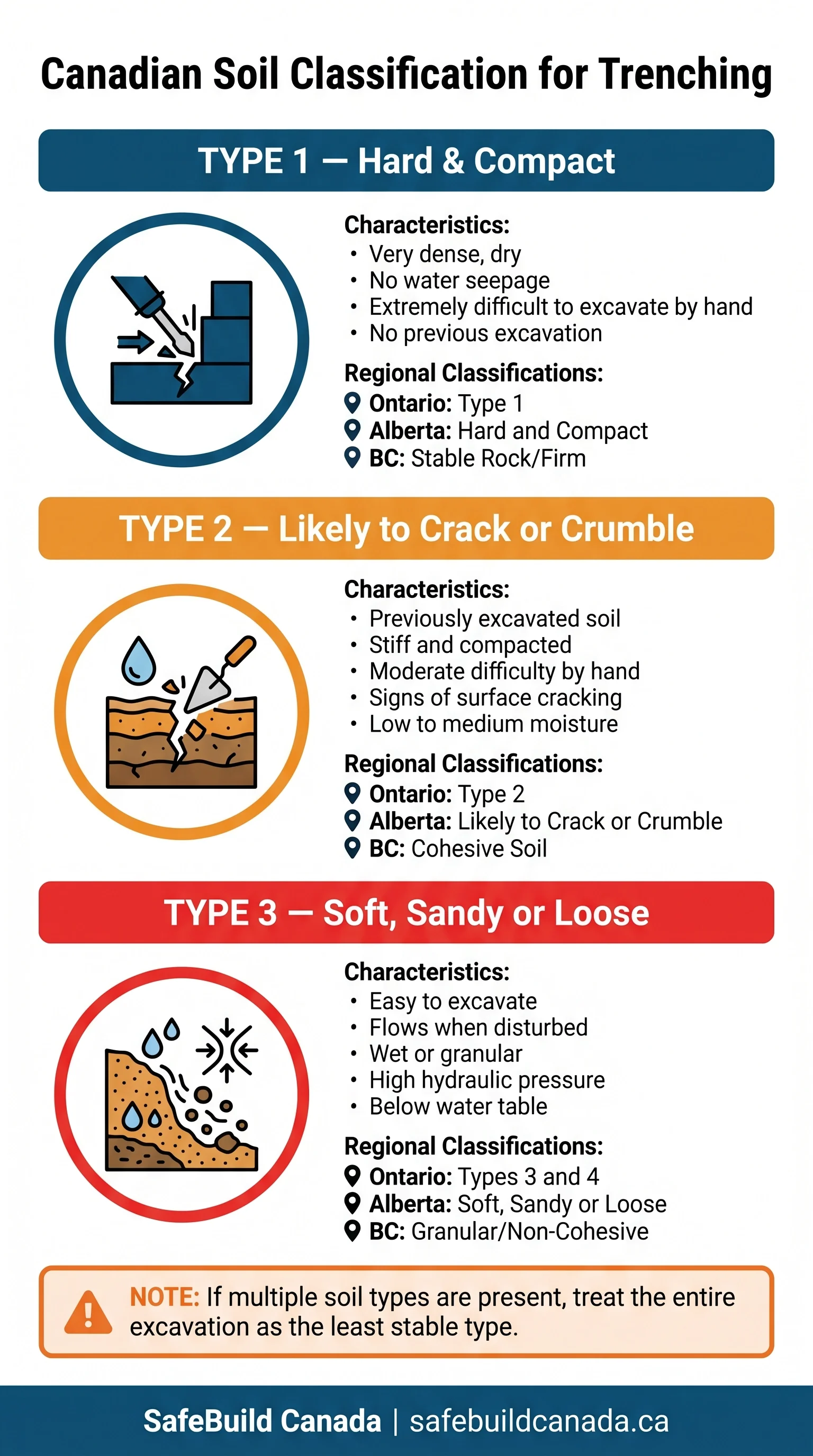
While the exact terminology varies slightly by province, Canadian regulations generally categorize soil into three or four distinct types based on their stability and cohesive properties.
Hard and compact soil
This is the most stable type of soil. It is very dense, appears dry, and shows no signs of water seepage. In Ontario, this is classified as Type 1 soil. In Alberta, it is known as "hard and compact," and in British Columbia, it is referred to as stable rock or firm soil. While this soil is highly stable, it still requires protective systems if the trench exceeds the regulatory trigger depth.
Soil likely to crack or crumble
This intermediate category includes soils that are stiff and compacted but exhibit signs of surface cracking or localized water seepage. Any soil that has been previously excavated automatically falls into this category or a lower one, because disturbed soil never regains its original structural integrity. Ontario classifies this as Type 2 soil, while Alberta refers to it as "likely to crack or crumble," and British Columbia categorizes it as cohesive soil.
Soft, sandy, or loose soil
This is the least stable and most dangerous type of soil. It is easy to excavate with hand tools, appears wet, and flows or becomes unstable when disturbed. Ontario divides this unstable category into Type 3 (soft, sandy, or loose) and Type 4 (soft clay). Alberta groups it all under "soft, sandy or loose," and British Columbia refers to it as granular or non-cohesive soil.
When an excavation contains multiple layers of different soil types, the law requires contractors to treat the entire excavation as if it consists entirely of the least stable soil type present.
Trigger depths for protective systems
Occupational health and safety regulations mandate the use of protective systems when an excavation reaches a specific depth.
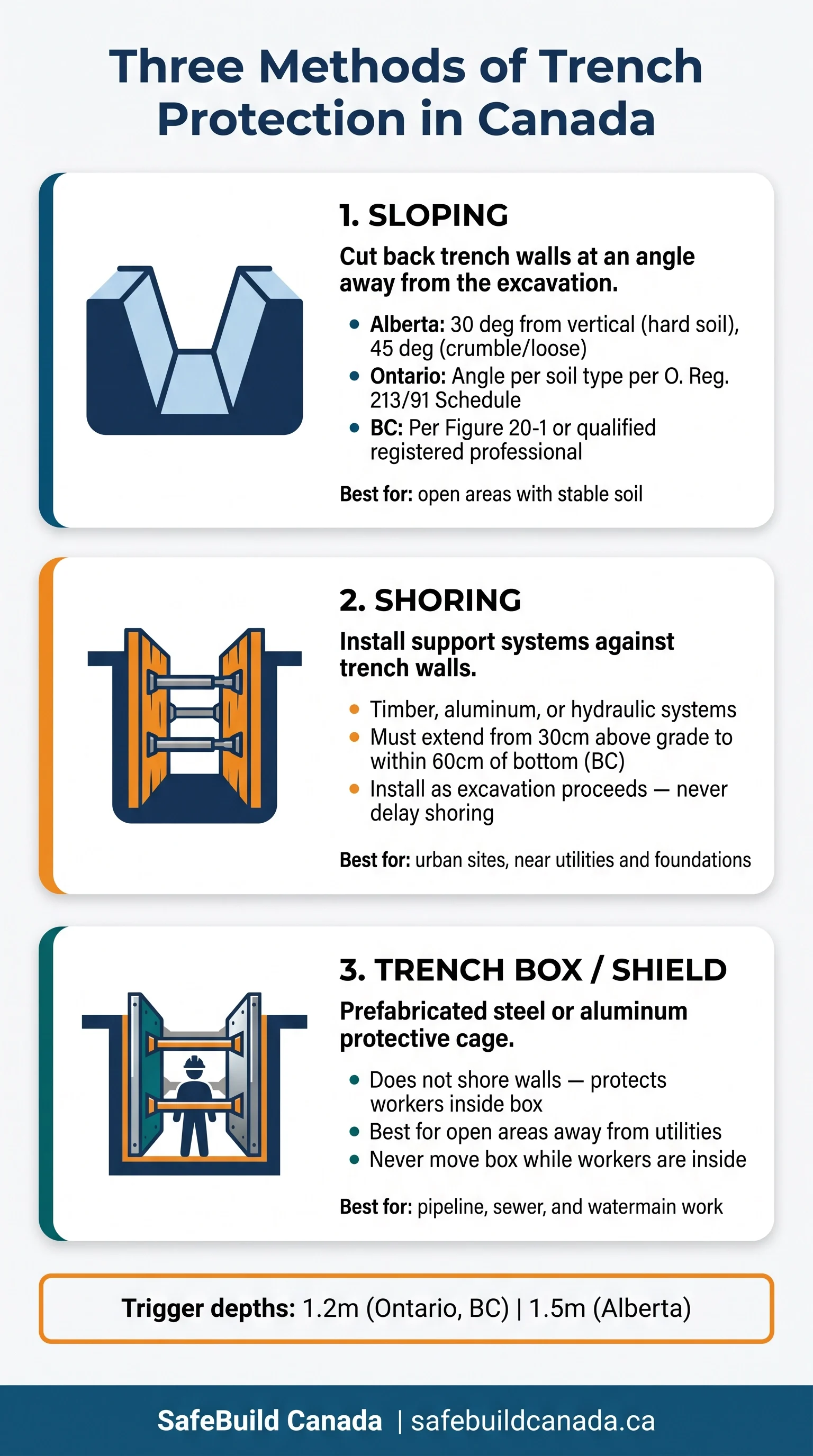
In Ontario and British Columbia, the trigger depth is 1.2 metres (approximately 4 feet). In Alberta, the trigger depth is slightly deeper at 1.5 metres (approximately 5 feet).
It is important to understand that these trigger depths are absolute minimums. If a competent person determines that a shallower trench poses a cave-in hazard due to poor soil conditions, high water tables, or heavy surcharge loads from nearby equipment, protective systems must be installed regardless of the depth. This is why a thorough OHS inspection by a qualified supervisor is required daily before any worker enters the excavation.
Methods of trench protection
When an excavation reaches the regulatory trigger depth, contractors must implement one of three primary protective systems to safeguard workers from cave-ins.
Sloping and benching
Sloping involves cutting back the trench walls at an angle inclined away from the excavation, effectively removing the weight of the soil that could cause a collapse. The required angle of the slope depends entirely on the soil classification.
Benching is a variation of sloping where the walls are cut back in a series of steps or horizontal levels, resembling a staircase. Benching is generally only permitted in cohesive soils.
While sloping is highly effective and relatively inexpensive, it requires a massive amount of open space. In dense urban environments or on tight commercial sites, there is rarely enough room to slope a deep trench safely.
Shoring systems
When space is limited, shoring is the preferred method of protection. Shoring involves installing a structural support system directly against the trench walls to prevent the soil from moving.
Modern shoring systems are often made of lightweight aluminum or steel and utilize hydraulic cylinders to apply active pressure against the trench walls. Timber shoring is still used, particularly for custom or complex excavations, but it requires precise engineering and skilled installation.
A key rule for shoring is that it must be installed from the top down as the excavation proceeds. Workers must never enter an unprotected trench to install shoring. In British Columbia, regulations specifically require that shoring extend from at least 30 centimeters above ground level down to within 60 centimeters of the trench bottom.
Trench boxes and shields
Trench boxes, also known as trench shields, are prefabricated steel or aluminum structures designed to protect workers who are inside them. Unlike active hydraulic shoring, trench boxes do not support the trench walls or prevent the soil from moving. Instead, they are designed to withstand the massive crushing forces of a cave-in.
Trench boxes are highly efficient for linear projects like pipeline, sewer, and watermain installations.
However, strict rules govern the use of trench boxes. Workers must never be inside the box when it is being moved or lifted. The space between the outside of the box and the trench wall should be backfilled and compacted to prevent the box from shifting violently during a collapse.
Managing surcharge loads and equipment
Protecting the trench walls from the inside is only half the battle; contractors must also manage the forces acting on the trench from the surface. These forces, known as surcharge loads, can dramatically increase the lateral pressure on the trench walls and trigger a catastrophic collapse. The most common surcharge load is the spoil pile - the excavated soil removed from the trench. Regulations strictly dictate that spoil piles, construction materials, and heavy tools must be kept a minimum safe distance from the upper edge of the excavation. In Ontario, this distance is at least one metre.
Heavy equipment, such as excavators, dump trucks, and cranes, presents an even greater surcharge hazard. The immense weight and vibrations generated by these machines can quickly destabilize even hard and compact soil. Equipment operators must maintain a safe distance from the trench edge, and contractors should establish clear restricted access zones. When equipment must approach the trench to lower materials or remove soil, strict heavy equipment safety protocols must be followed.
Safe access, egress, and emergency response
Getting into and out of a trench safely is a critical component of excavation safety. Workers must never be forced to climb up the shoring, scramble up the sloped dirt walls, or ride in the bucket of an excavator. Regulations require that a safe means of access and egress, typically a secured ladder, be provided within a specific distance of any worker in the trench. In Alberta, a safe point of entry and exit must be located within 8 metres of any worker in a trench that is more than 1.5 metres deep.
Despite all preventative measures, contractors must be prepared for the worst-case scenario. A comprehensive construction site emergency response plan must be developed specifically for trench rescue. Trench rescue is a highly technical and dangerous operation. Co-workers must never jump into an unprotected collapsed trench to dig out a trapped colleague with their hands or shovels, as this almost always leads to secondary collapses and multiple fatalities.
Conclusion
Trenching and excavation safety requires rigorous planning, continuous assessment, and strict adherence to protective protocols. By accurately classifying soil types, respecting regulatory trigger depths, and properly deploying shoring, sloping, or trench boxes, contractors can mitigate the severe risks associated with below-grade work. Remember that soil conditions can change rapidly, and a trench that was safe yesterday may be a deadly hazard today.
Sources
CCOHS: Trenching and Excavation
Ontario O. Reg. 213/91: Construction Projects - Part III Excavations
Ontario Ministry of Labour: Excavation hazards on construction projects
Alberta Occupational Health and Safety Code - Part 32 Excavating and Tunnelling
WorkSafeBC OHS Regulation Part 20: Construction, Excavation and Demolition
Infrastructure Health and Safety Association (IHSA): Trenching Safety