
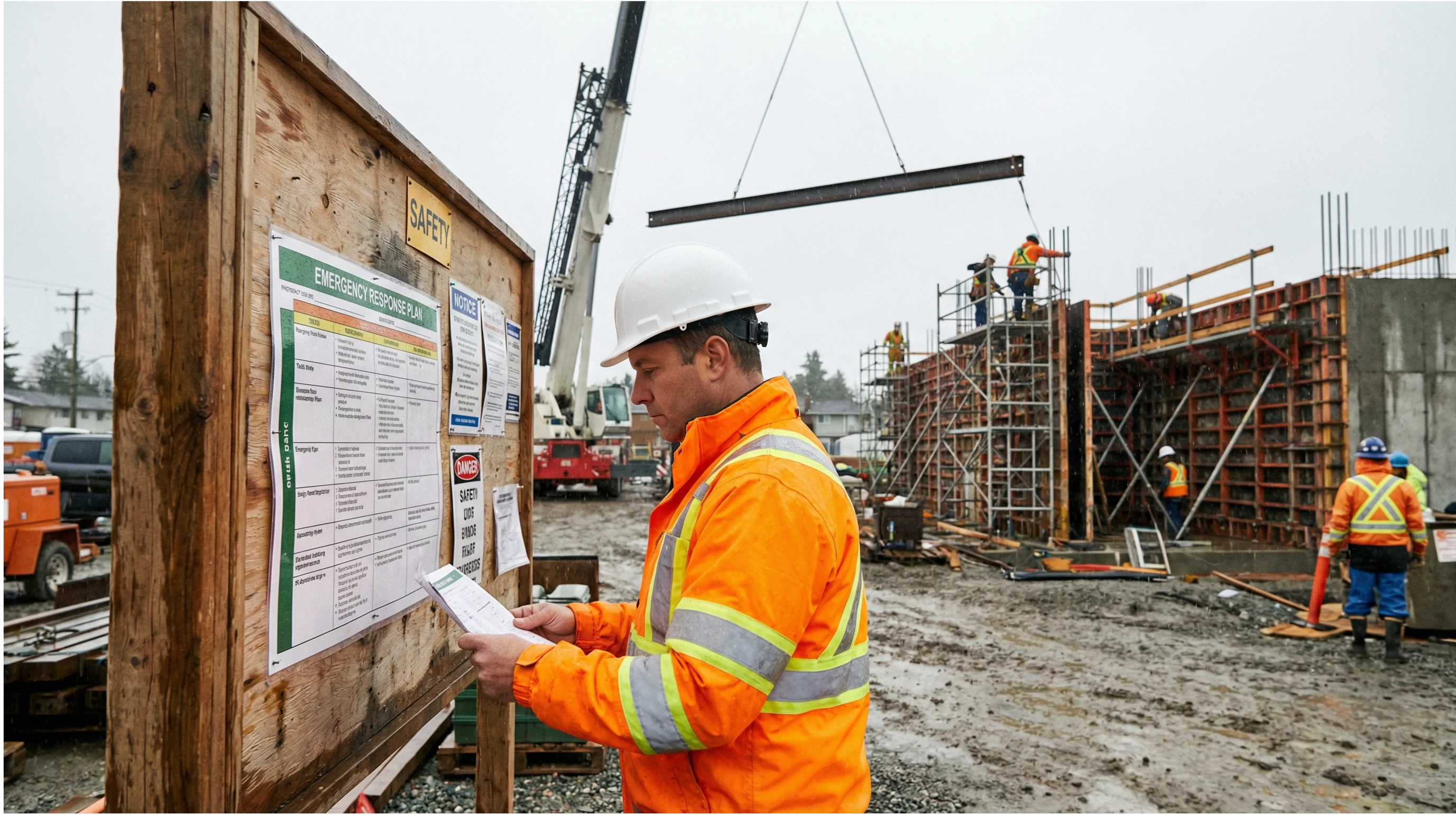
Construction sites are among the highest-risk workplaces in Canada. Between the heavy equipment, work at heights, excavations, and rotating crews of subcontractors, the conditions for a serious incident exist on almost every project. What separates a site that handles an emergency well from one that makes it worse is almost always preparation, and that preparation starts with a construction site emergency response plan that people have actually read and practiced.
The problem is that most emergency response plans on Canadian construction sites are written to satisfy a compliance checkbox, not to guide real decisions under pressure. They sit in a binder in the site trailer, reviewed once at project startup and never touched again. When something actually happens, the plan is useless because nobody knows what is in it and nobody has rehearsed what to do.
This guide covers what Canadian law requires for construction site emergency response plans across Ontario, British Columbia, and Alberta, what every plan must contain, how to handle the first 60 minutes after a serious incident, and how to run an incident investigation that actually prevents the next one.
Why most construction emergency plans fail when it counts
The gap between having a plan and having a plan that works is wider than most site managers want to admit. A plan that is written by a safety consultant, filed in a binder, and never communicated to the crew is not a safety tool. It is a liability document.
There are a few patterns that show up repeatedly on sites with inadequate emergency planning. The first is that the plan was written for a generic construction site rather than for the specific project. A plan that does not account for the site's actual hazards, the nearest hospital, the site address in a format that 911 dispatchers can use, or the communication dead zones in the building is not ready for an emergency.
The second pattern is that the plan was never communicated to subcontractors. On a multi-trade project, the general contractor's emergency procedures are only as effective as the weakest subcontractor's understanding of them. If a subcontractor's crew does not know where the assembly point is, who is in charge during an evacuation, or how to reach the site supervisor, the plan breaks down at the first test.
The third pattern is that the plan was never drilled. The Infrastructure Health and Safety Association's emergency response planning guide for construction projects is explicit on this point: planning must begin before any work commences, and the plan must be communicated to every new subcontractor and supplier as they come on site. A plan that exists only on paper is not a plan.
What Canadian law actually requires
The legal requirements for construction site emergency response plans vary by province, but the direction is consistent: every construction project must have one, it must be communicated to workers, and it must be practiced.
In Ontario, the Occupational Health and Safety Act and Ontario Regulation 213/91 (Construction Projects) require constructors to establish emergency response procedures for every project. The plan must be posted in a conspicuous place on the project, and the type and location of emergency communication systems must also be posted. When a critical injury or fatality occurs, the constructor must immediately notify the Ministry of Labour, Immigration, Training and Skills Development at 1-877-202-0008, which operates 24 hours a day. Ontario's incident reporting requirements also require a written report within 48 hours to the Ministry, the joint health and safety committee, and the union if one is present. The scene must not be disturbed except to attend to the injured, prevent further injuries, or protect property at risk.
In British Columbia, WorkSafeBC's emergency planning and response requirements under sections 4.13 to 4.18 of the OHS Regulation require employers to plan for any emergency that could affect worker health and safety. Employers must consult with their joint health and safety committee or worker representative when developing the plan, and drills must be conducted at least once a year or when workplace circumstances change. Immediate notification to WorkSafeBC's Prevention Information Line is required for a worker seriously injured or killed, a major structural failure or collapse (including cranes, hoists, temporary construction support systems, and excavations), a major release of a hazardous substance, a dangerous fire or explosion with potential for serious injury, and any blasting incident resulting in injury.
In Alberta, the OHS Act requires all work sites to have an emergency response plan, and the OHS Code specifies what that plan must contain. Alberta's emergency response planning toolkit for OHS provides an 11-step process covering hazard identification, emergency equipment inventory, communication requirements, rescue and evacuation procedures, and response procedures for each identified emergency type. The prime contractor, or the employer if there is no prime contractor, must report serious injuries and incidents to an OHS Director as soon as possible under Section 33 of the OHS Act.
The 7 elements every construction ERP must have
A compliant and functional construction site emergency response plan covers seven areas. These are not suggestions; they are the minimum.
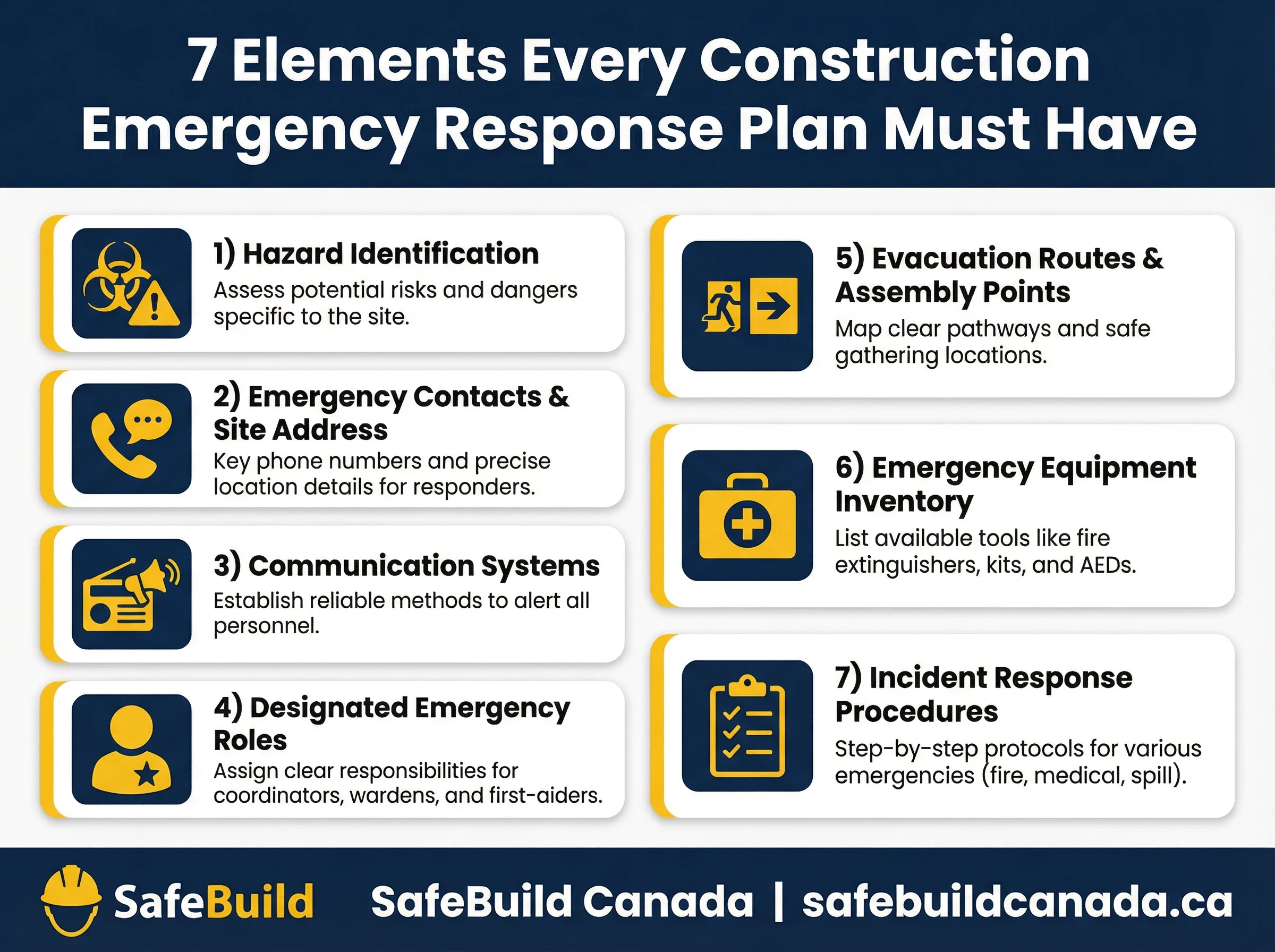
1. Hazard identification. Construction sites are dynamic. The hazards on day 30 of a project are different from the hazards on day 1. The plan must identify the specific emergencies that could reasonably occur at this site, including fires, structural collapses, falls, chemical spills, medical emergencies, and environmental emergencies like flooding or extreme weather. A generic list copied from another project is not adequate.
2. Emergency contacts and site address. This sounds basic, but it is the element that fails most often. The plan must include the site's exact civic address in a format that emergency services can use, the nearest hospital and trauma center, the phone number for the provincial OHS authority, and the names and numbers of designated emergency contacts on site. The address must be posted at the site entrance and near every communication device.
3. Communication systems. The plan must identify how workers will be notified of an emergency and how they will communicate with emergency services. On large or multi-storey sites, this includes backup communication methods for areas with poor cell coverage. The IHSA recommends that the type and location of all emergency communication systems be posted on the project.
4. Designated emergency roles. Someone must be in charge during an emergency, and everyone on site must know who that is before an emergency happens. The plan must name the emergency coordinator, area wardens, first aiders, and their backups. Roles must be assigned to positions, not just to individuals, so that coverage is maintained when people are off site.
5. Evacuation routes and assembly points. The plan must map the primary and secondary evacuation routes for the site and identify the assembly point where workers gather for a headcount. The assembly point must be far enough from the hazard to be safe, and workers must know where it is before they need it.
6. Emergency equipment inventory. The plan must list the location of all emergency equipment: fire extinguishers, first aid kits, AEDs, spill kits, and any specialised rescue equipment. This inventory must be checked regularly and kept current as the site layout changes.
7. Incident response procedures. For each identified emergency type, the plan must describe the specific response steps. A fire response procedure is different from a structural collapse procedure, which is different from a medical emergency procedure. Generic "call 911 and evacuate" instructions are not adequate for a construction site.
When an incident happens: the first 60 minutes
The first 60 minutes after a serious incident on a construction site are the most consequential, both for the injured worker and for the legal record. The sequence matters.
The first priority is always the injured worker. Ensure first aid is administered and emergency services are called. Do not move an injured worker unless leaving them in place creates an immediate additional risk.
The second priority is securing the scene. Under the OHS legislation in Ontario, BC, and Alberta, the scene of a serious incident must not be disturbed except to attend to the injured, prevent further injuries, or protect property at risk. This means stopping work in the affected area and preventing other workers from entering. The scene must be preserved for the investigation that follows.
The third priority is notification. In Ontario, the constructor must immediately notify the Ministry of Labour at 1-877-202-0008. In BC, the employer must contact WorkSafeBC's Prevention Information Line. In Alberta, the prime contractor must notify an OHS Director as soon as possible. These calls must happen even if the situation is still developing. Waiting until the full picture is clear is not an option under any provincial OHS legislation.
The fourth priority is documentation. Assign someone to begin recording: the time of the incident, who was present, what was happening immediately before, what equipment was involved, and what the site conditions were. Photographs of the scene, taken before anything is moved, are among the most valuable evidence in any subsequent investigation. This documentation is also the foundation of the written report that Ontario requires within 48 hours.
The fifth priority is worker support. Witnessing a serious injury or fatality is traumatic. The IHSA's emergency response planning guide recommends including a debriefing and post-traumatic stress procedure in the plan. Workers who witnessed the incident should be removed from the immediate area, given access to support, and not required to return to the same task on the same day.
Incident investigation: going beyond blaming the worker
Once the immediate response is handled, the investigation begins. This is where most construction sites fall short, and where the difference between a compliant investigation and a useful one becomes clear.
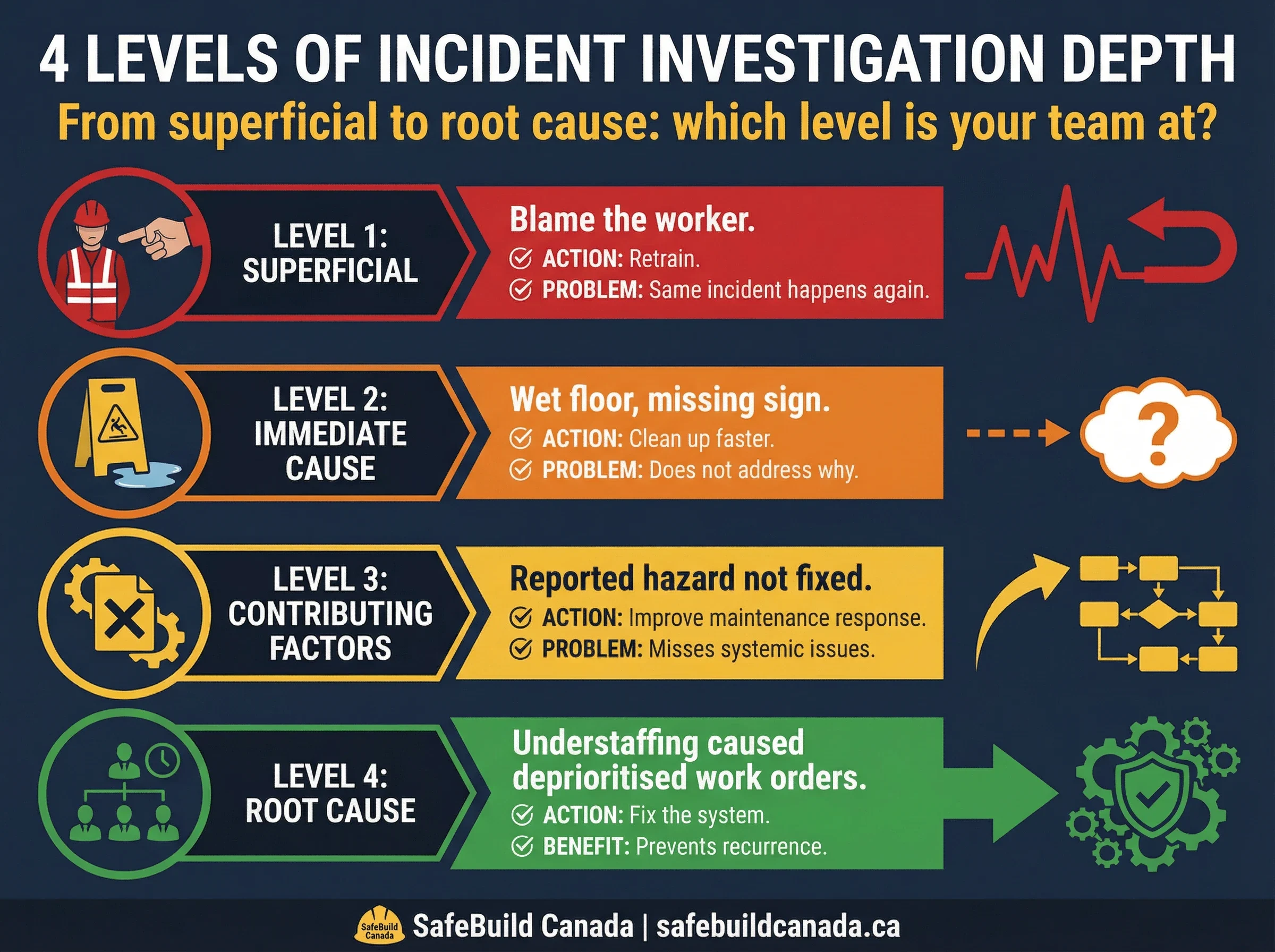
The most common failure in incident investigations is stopping at the immediate cause. A worker fell because the guardrail was missing. A worker was struck because the spotter was not in position. These findings are accurate but incomplete. They identify what happened without explaining why it happened, and without that explanation, the corrective action is almost always inadequate.
Nicole Orr and Carol Casey of National Safety Services, writing in OHS Canada Magazine in April 2025, described four levels of investigation depth. The superficial investigation blames the worker and recommends retraining. The basic investigation identifies the immediate cause. The deeper investigation examines contributing factors, like a reported hazard that was not fixed. The root cause investigation asks why the system allowed the hazard to persist, and finds the answer in understaffing, deprioritized maintenance, or a safety culture that did not take hazard reports seriously.
The investigation team should include the supervisor of the area, workers with direct knowledge of the work, the safety officer, and the JHSC or worker representative. The CCOHS incident investigation guidelines recommend a structured process: secure the scene, collect physical evidence, conduct interviews, build a timeline, identify contributing factors, determine root causes, and develop corrective actions.
Root cause analysis tools that work well in construction include the Five Whys (asking "why" five times in succession until the systemic cause is reached), SCAT (Systemic Cause Analysis Technique), and TapRooT. The choice of method matters less than the commitment to actually use one. An investigation that stops at "the worker did not follow the procedure" without asking why the procedure was not followed is not a root cause investigation.
The corrective action plan must address root causes, not just immediate causes. If the root cause is that hazard reports were not being acted on, the corrective action is not a toolbox talk about hazard reporting. It is a change to the process for reviewing and responding to hazard reports, with accountability assigned to a named person.
Keeping the plan alive: drills, reviews, and updates
A construction site emergency response plan is not a document you write once and file. It is a living tool that must be updated as the project evolves and tested regularly to confirm it works.
WorkSafeBC requires drills at least once a year or when workplace circumstances change. On a construction project, circumstances change constantly: new subcontractors arrive, the site layout shifts, work moves to new floors or areas, and the hazard profile changes. The plan should be reviewed at each of these transitions, not just annually.
Drills do not need to be full-scale simulations. A tabletop exercise, where the emergency coordinator and area wardens walk through the response to a hypothetical scenario, takes an hour and reveals gaps that would otherwise only show up during a real emergency. The IHSA recommends debriefing after every drill to identify what worked and what did not, and updating the plan accordingly.
New subcontractors and suppliers must be briefed on the emergency response procedures before they begin work on site. This is a legal requirement in Ontario under the OHSA and a practical necessity everywhere. A crew that does not know where the assembly point is or who to call in an emergency is a crew that will make the situation worse.
The plan must also be reviewed after every incident, near miss, or drill. The SafeBuild Canada construction site inspection checklist includes emergency preparedness as a standing inspection item, which is a practical way to keep the plan visible and current between formal reviews.
A plan on paper vs. a plan that works
There is a version of emergency preparedness that is about documentation and a version that is about outcomes. The documentation version produces a binder that satisfies an OHS inspector. The outcomes version produces a crew that knows what to do when something goes wrong, a site supervisor who makes the right calls in the first 60 minutes, and an investigation process that actually prevents the next incident.
The legal requirements across Ontario, BC, and Alberta are clear: every construction site must have an emergency response plan, it must be communicated to workers, it must be practiced, and serious incidents must be reported immediately. Meeting those requirements is the floor, not the ceiling.
If your site's emergency response plan has not been reviewed since project startup, or has never been drilled, that is the place to start. Review the OHS regulations that apply to your province and use the seven elements above to close the gaps before the next inspection.