

Operating a construction company in Alberta requires a deep understanding of the provincial safety framework. The Alberta Occupational Health and Safety Act serves as the foundation for all workplace safety rules in the province. For construction employers, compliance is not merely a suggestion; it is a strict legal requirement enforced through inspections, orders, and substantial financial penalties.
The legislation places the heaviest burden of responsibility squarely on the employer. Whether you are managing a small residential framing crew or acting as the prime contractor on a massive commercial development in Calgary, the law expects you to anticipate hazards and protect everyone on your site. This guide breaks down the critical Alberta OHS Act employer duties that every construction company must follow to maintain compliance and keep workers safe.
The Foundation of Employer Responsibility
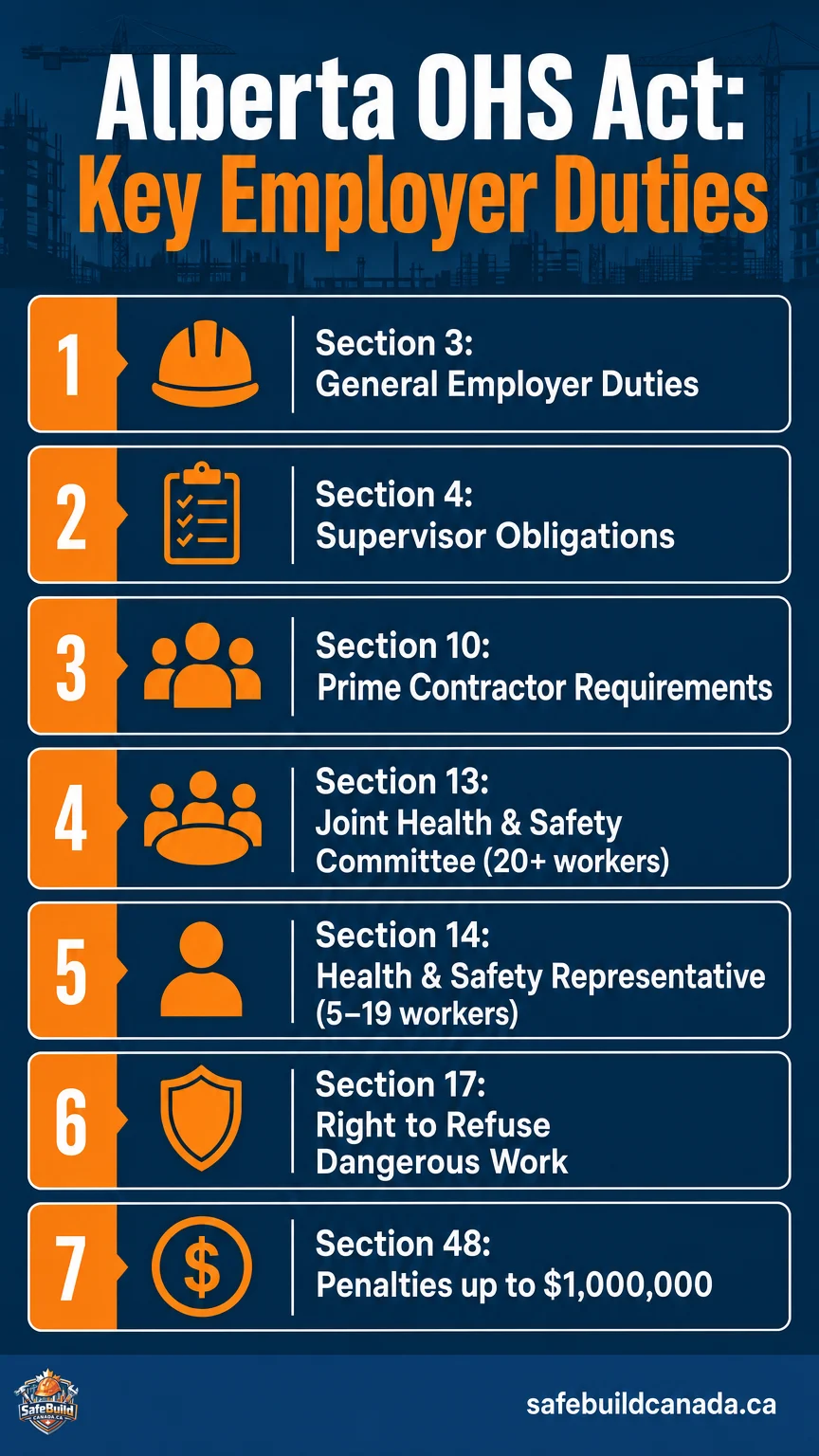
Under Section 3 of the Alberta OHS Act, the general duty clause establishes the baseline for all employer obligations. The law states that every employer must, as far as it is reasonably practicable, protect the health, safety, and welfare of their workers. This obligation extends beyond direct employees. You are also legally responsible for protecting other persons at or in the vicinity of the work site who might be affected by your operations.
This means that if your excavation work creates a hazard for a neighboring property, or if your crane operations pose a risk to pedestrians on the sidewalk below, you are accountable under the Act. The legislation requires employers to act ahead of hazards. You must confirm that workers are aware of their rights and duties, that they are not subjected to harassment or violence, and that they are supervised by a competent person who is familiar with the OHS legislation.
Furthermore, employers must verify that workers are adequately trained in all matters necessary to protect their health and safety before they begin work. If a task is particularly dangerous, it must only be performed by a competent worker or by a worker who is under the direct supervision of a competent worker. Ignorance of the law is never an acceptable defence during an inspection or following an incident.
Understanding the Prime Contractor Role
Construction sites are uniquely complex environments where multiple employers often work side by side. To prevent confusion over safety responsibilities, Section 10 of the Alberta OHS Act mandates the designation of a prime contractor. Every construction work site where two or more employers are involved in work at the same time must have a prime contractor.
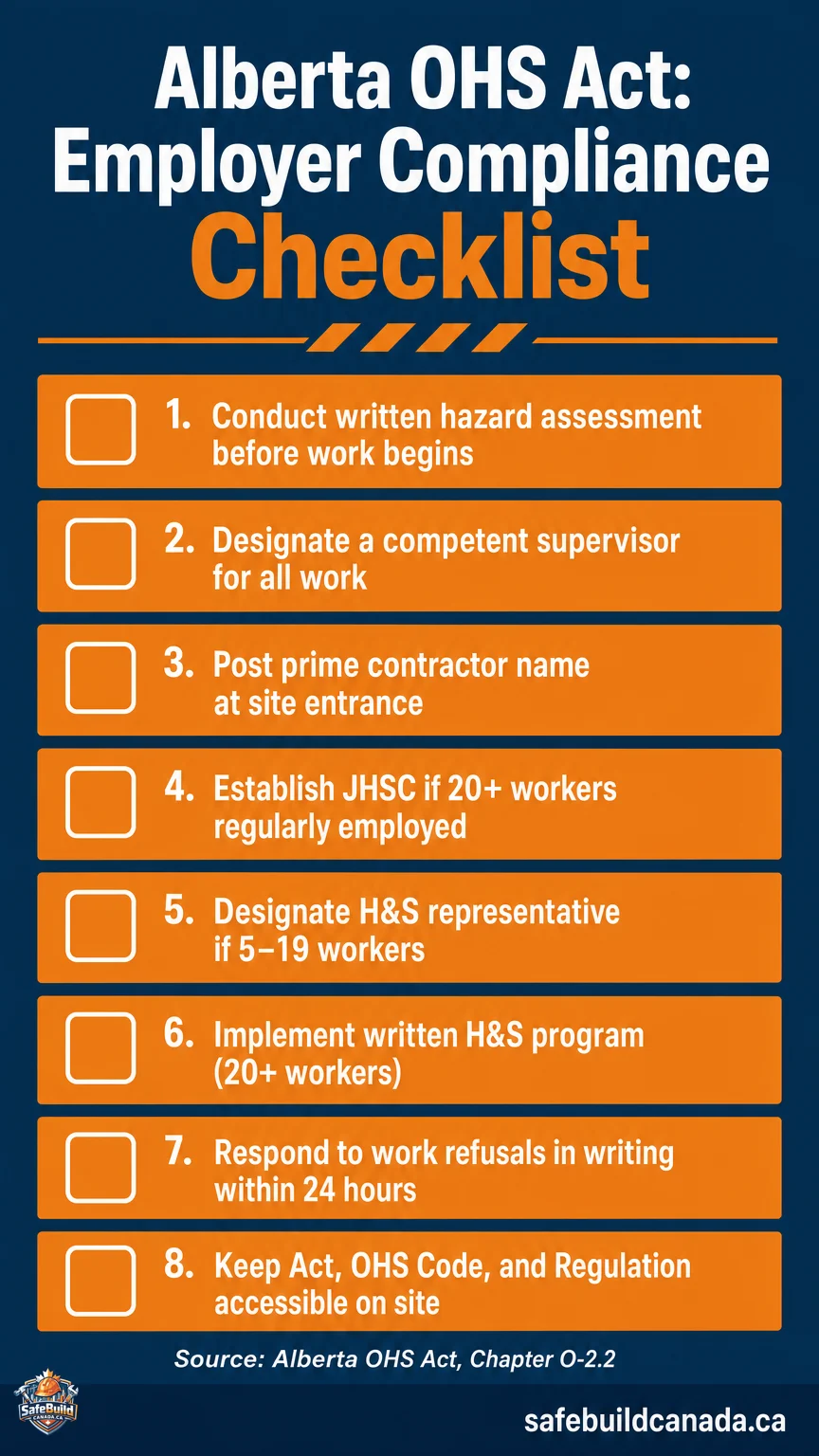
The person in control of the work site, typically the owner or the general contractor, must designate the prime contractor in writing. If they fail to do so, the person in control of the site is automatically deemed to be the prime contractor by default. Once designated, the prime contractor must post their name in a conspicuous place at the work site so that all workers know who is ultimately in charge of site safety.
The prime contractor's primary duty is to establish a system or process that drives compliance with the Act, the regulations, and the OHS Code across the entire site. They must coordinate the health and safety activities of all employers, suppliers, and service providers present. This includes confirming that everyone is informed of any existing or potential hazards. If you are taking on the prime contractor role, you need a well-structured construction site safety plan to manage these overlapping responsibilities effectively.
Health and Safety Committees and Representatives
Worker participation is a cornerstone of the Alberta OHS framework. The Act requires employers to establish formal mechanisms for workers to engage in health and safety matters, with the specific requirements based on the size of the workforce.
If your construction company regularly employs 20 or more workers, Section 13 requires you to establish a Joint Health and Safety Committee (JHSC). This committee must consist of worker representatives who are not associated with management, alongside employer representatives. The law strictly dictates that the number of employer representatives cannot exceed the number of worker representatives. The JHSC plays a vital role in receiving safety concerns, participating in hazard assessments, making recommendations to the employer, and reviewing site inspection documentation.
For smaller companies that regularly employ between 5 and 19 workers, Section 14 requires the designation of a health and safety representative. This individual must be a worker who is not part of management. The representative performs the same essential duties as a full committee, working in cooperation with the employer to address safety issues.
Both committee members and representatives must be allowed to carry out their duties during normal working hours. Employers must consult with any certified bargaining agents when establishing these roles. If multiple employers are working at a site with 20 or more total workers, and no prime contractor has been designated, the employers must coordinate to establish a site-wide JHSC.
Hazard Assessment and Safety Programs
Identifying and controlling hazards before they cause harm is the most critical function of any construction safety management system. While the specific requirements for hazard assessments are detailed in the OHS Code, the Act provides the overarching mandate. Employers must keep hazard information readily available and share it with the JHSC, the health and safety representative, and the prime contractor.
Conducting a thorough hazard identification and risk assessment is not a one-time event. It must be an ongoing process that adapts as the construction site evolves. When new trades arrive, when weather conditions change, or when new equipment is introduced, the hazard assessment must be updated to reflect the new reality.
Additionally, Section 16 of the Act requires employers who regularly employ 20 or more workers to establish and implement a formal health and safety program. This program must meet the specific criteria outlined in the OHS Code, providing a structured approach to managing safety policies, training, inspections, and incident investigations.
The Right to Refuse Dangerous Work
One of the most fundamental worker rights protected by the Alberta OHS Act is the right to refuse dangerous work. Section 17 states that a worker may refuse to work if they believe on reasonable grounds that there is an undue hazard at the work site. The Act defines an "undue hazard" as a hazard that poses a serious and immediate threat to the health and safety of a person.
When a worker exercises this right, a strict legal process is triggered. The worker must promptly report the refusal and the reasons for it to their employer or supervisor. The employer must then inform the JHSC or the health and safety representative as soon as possible.
If the hazard cannot be remedied immediately, the employer must inspect the situation, take corrective action to fix it, and prepare a written report of the refusal, the inspection, and the actions taken. Crucially, the employer cannot request or assign another worker to do the refused work until they have determined that the work does not constitute an undue hazard. If another worker is eventually assigned to the task, they must be advised in writing of the previous refusal and the reasons why the employer believes the work is now safe.
Section 18 provides powerful protection for workers who exercise this right. It strictly prohibits any person from taking disciplinary action against a worker for acting in compliance with the Act. Employers who attempt to punish or terminate a worker for refusing dangerous work face severe legal consequences.
Incident Reporting and Investigation
When things go wrong on a construction site, the Alberta OHS Act imposes strict reporting requirements. Section 33 mandates that employers must report specific types of incidents to the government immediately. This includes any incident that results in a fatality, an injury requiring a worker to be admitted to a hospital, or an unplanned explosion, fire, or flood that had the potential to cause serious injury.
In the event of a serious incident, the scene must be secured and left undisturbed, except for the purpose of attending to injured persons or preventing further damage, until an OHS officer authorizes the release of the scene. The prime contractor, or the employer if there is no prime contractor, must conduct their own investigation into the incident, prepare a report outlining the circumstances and corrective actions, and provide a copy to the JHSC or safety representative.
Knowing what happens when an OHS inspector shows up is vital for construction management. Inspectors have broad powers to enter work sites, examine records, interview workers, and issue binding orders to correct unsafe conditions.
Enforcement and Penalties
The Government of Alberta takes workplace safety seriously, and the penalties for violating the OHS Act are designed to be a strong deterrent. Section 48 outlines the financial and legal consequences of non-compliance.
For a first offence, an employer can face a fine of up to $500,000. If the offence is a continuing one, they can be fined an additional $30,000 for each day the offence continues. In severe cases, individuals can face imprisonment for a term not exceeding six months.
For a second or subsequent offence, the maximum fine doubles to $1,000,000, with continuing daily fines of up to $60,000, and potential imprisonment for up to 12 months. Failing to comply with a stop-work order issued by an officer also carries a maximum penalty of $1,000,000 or 12 months in prison.
Beyond traditional fines, Section 49 gives the courts the power to issue creative sentencing orders. A convicted employer may be ordered to fund safety training programs, support research initiatives, or provide scholarships for occupational health and safety studies. These penalties underscore the reality that investing in safety compliance is always more cost-effective than dealing with the aftermath of a violation.
Comparing Provincial Frameworks
While the core principles of occupational health and safety are consistent across Canada, the specific legislative mechanisms vary by jurisdiction. Construction companies operating in multiple provinces must navigate these differences carefully.
For example, the threshold for requiring a Joint Health and Safety Committee in Alberta is 20 workers, which aligns with the federal requirements under the Canada Labour Code Part II. However, other provinces have different triggers. Understanding the nuances of the OHS regulations in Canada is essential for national contractors.
Similarly, the prime contractor rules in Alberta share similarities with the constructor concept in Ontario and the prime contractor designation under the BC OHS Regulation, but the specific duties and documentation requirements differ. Employers must always refer to the legislation of the province where the work is actually taking place.
Building a Culture of Compliance
Meeting the legal requirements of the Alberta OHS Act is the minimum standard for construction employers. True safety excellence requires moving beyond mere compliance to build a strong safety culture. This involves active leadership commitment, continuous worker engagement, and a relentless focus on hazard elimination.
By understanding your duties under the Act, establishing clear lines of responsibility through prime contractor designations, supporting your JHSC, and respecting the right to refuse dangerous work, you protect your most valuable asset: your workforce. The legislation provides the framework, but it is the daily commitment of employers and supervisors on the ground that truly prevents injuries and saves lives.