
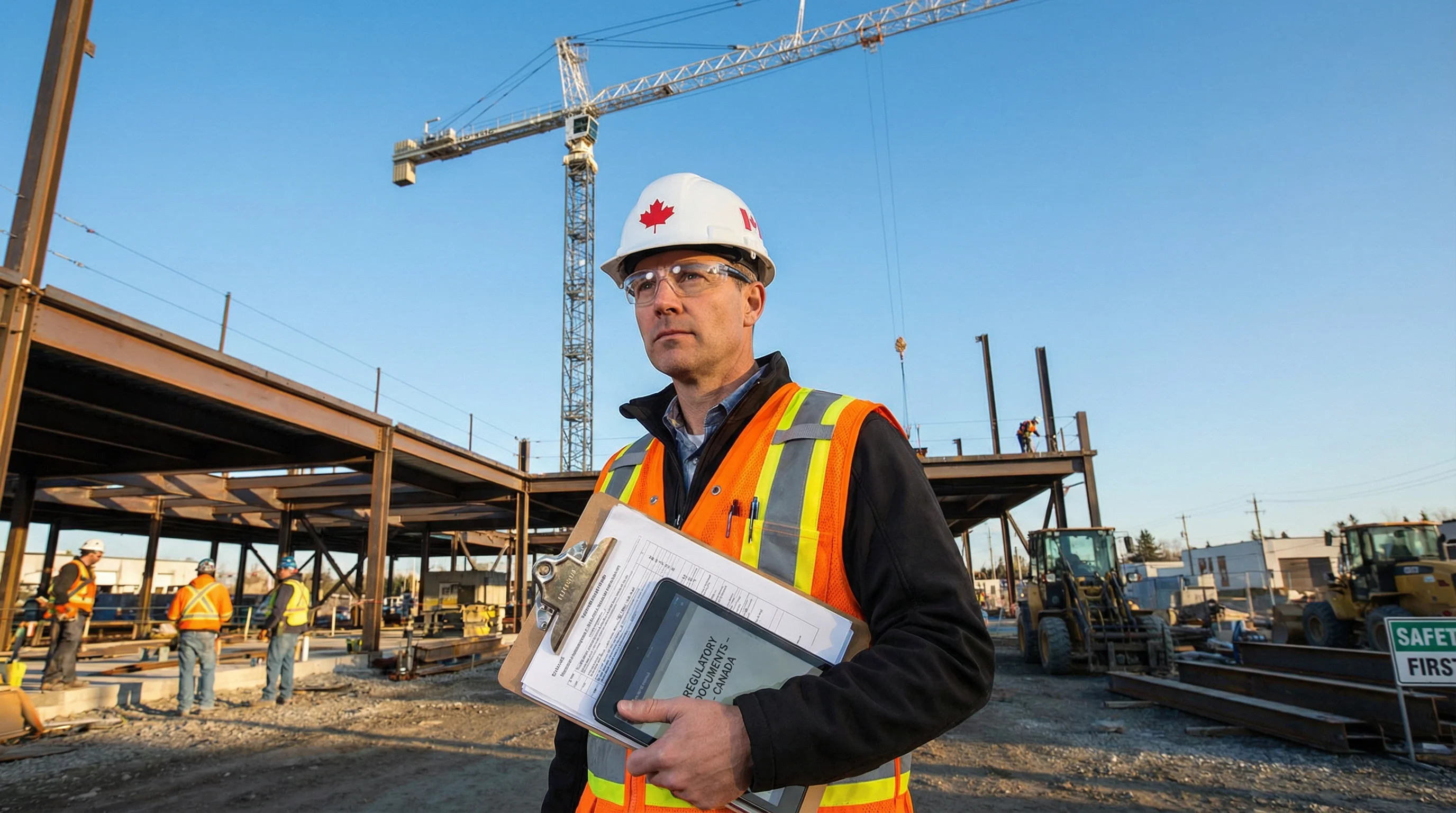
Canada recorded 1,056 accepted workplace fatalities in 2023, according to data compiled by the Association of Workers' Compensation Boards of Canada. Construction accounts for a disproportionate share of those deaths every year. The sector is physically dangerous by nature, but the legal framework that governs it is also more complex than most employers realise. Federal law applies to some sites. Provincial law applies to others. And in every jurisdiction, the employer carries the primary duty of care.
If you run a construction company in Canada, or manage a site, or supervise workers, OHS regulations are not background noise. They define what you are legally required to do, what happens when something goes wrong, and in the most serious cases, whether you face criminal charges. This guide covers the full framework: how jurisdiction works, what the law requires of you, how each major province structures its obligations, and what non-compliance actually looks like.
How OHS jurisdiction works in Canada
Canada does not have a single national OHS law that covers all workplaces. Jurisdiction is split between the federal government and the provinces and territories. Understanding which law applies to your site is the first thing every construction employer needs to get right.
Federal law under Part II of the Canada Labour Code applies to industries that fall under federal constitutional authority. That includes banking, telecommunications, interprovincial transportation, federal Crown corporations, and postal services. Construction workers employed directly by a federally regulated employer, or working on federal infrastructure projects such as interprovincial bridges or federal government buildings, fall under federal jurisdiction. For most construction employers in Canada, however, the applicable law is provincial.
Each of the ten provinces and three territories has its own OHS legislation. The names differ: Ontario has the Occupational Health and Safety Act, Alberta has the Occupational Health and Safety Act (RSA 2000, c O-2) and the OHS Code, British Columbia operates under the Workers Compensation Act and the OHS Regulation. The specifics differ too. But the underlying architecture is consistent across every jurisdiction, because all Canadian OHS law is built on the same foundational principle: the internal responsibility system.
The internal responsibility system: the backbone of Canadian OHS law
The internal responsibility system, or IRS, is not a regulation. It is the philosophical premise that every piece of Canadian OHS legislation is built on. The core idea is straightforward: the people closest to the hazard are best positioned to identify and control it. Government inspectors cannot be everywhere. The IRS places the primary responsibility for safety on the workplace parties themselves, with government enforcement as the backstop.
In practice, the IRS means that every person on a construction site has defined OHS obligations, not just the employer. The Canadian Centre for Occupational Health and Safety identifies the key parties as: employers, supervisors, workers, owners, prime contractors, suppliers, service providers, and contracting employers. Each party has specific duties. Where those duties overlap, the legislation typically allows one party to fulfil the obligation on behalf of others, provided doing so does not compromise anyone's safety.
For construction employers, the IRS has a direct practical implication. You cannot delegate your OHS obligations to a subcontractor and walk away. If you are the constructor on an Ontario project, or the prime contractor on an Alberta multi-employer site, you carry coordination responsibility for the entire site, not just your own workers. That distinction matters enormously when an incident occurs and investigators start asking who was responsible for what.
Employer obligations: what the law requires across all jurisdictions
Despite the jurisdictional differences, certain employer obligations appear in every Canadian OHS framework. These are not optional. They are the minimum floor that every construction employer must meet regardless of province.
Every employer must ensure the health, safety, and welfare of workers and the public at or near the work site. That obligation is not limited to workers on the payroll. If a member of the public is injured because of a hazard your site created, you bear responsibility. Every employer must also ensure that workers are supervised by competent supervisors who understand the relevant OHS legislation. Competence is not assumed. It must be demonstrated and documented.
Training is a universal obligation. Workers must be informed of known and reasonably foreseeable hazards before they begin work. That means site-specific hazard information, not just a generic orientation. Every employer must also make current copies of the applicable OHS legislation available to workers and, where required, to the joint health and safety committee or health and safety representative.
Hazard reporting and incident reporting are mandatory in all jurisdictions. When a worker reports a hazard, the employer must respond. When a serious injury or fatality occurs, the employer must notify the relevant government authority immediately. Failure to report is itself a violation, separate from whatever caused the incident.
Federal obligations: Canada Labour Code Part II
For construction employers working under federal jurisdiction, the governing legislation is Part II of the Canada Labour Code. The full breakdown of federal employer obligations is detailed in a separate post, but the key structural requirements are worth understanding here.
Federal employers must establish a Hazard Prevention Program, a documented system for identifying, assessing, and controlling workplace hazards. This is not a safety plan in the general sense. The Code specifies what the program must contain, including a process for ongoing hazard identification, a method for assessing risk, a hierarchy of controls, and a procedure for investigating incidents.
Federal employers with 300 or more employees must establish a policy health and safety committee at the organizational level, in addition to any workplace-level committees. Smaller employers must establish workplace health and safety committees or designate health and safety representatives depending on workforce size. These committees have real authority: they can conduct inspections, investigate incidents, and make binding recommendations in some circumstances.
Workers under federal jurisdiction have the same three rights that appear in all Canadian OHS legislation: the right to know, the right to participate, and the right to refuse dangerous work. The right to refuse is procedurally specific. A worker who believes a situation is dangerous must report to their supervisor, who must investigate. If the issue is not resolved, a government health and safety officer is called. The worker cannot be disciplined for exercising this right in good faith.
Ontario: OHSA and O.Reg 213/91
Ontario's Occupational Health and Safety Act is the primary legislation, but for construction employers, the regulation that governs day-to-day operations is Ontario Regulation 213/91, the Construction Projects regulation. Every construction employer working in Ontario needs to understand both.
The OHSA establishes the framework: employer duties, supervisor duties, worker rights, the role of joint health and safety committees, and the enforcement powers of Ministry of Labour inspectors. The constructor, which is the equivalent of a general contractor or prime contractor in Ontario's terminology, carries the highest duty of care on any project. The constructor must ensure that every employer on the project complies with the OHSA and its regulations. That is not a soft obligation. If a subcontractor's worker is injured because of a regulatory violation, the constructor can face charges even if the constructor's own workers were not involved.
O.Reg 213/91 covers the physical requirements: fall protection, scaffolding, excavation, electrical safety, equipment operation, and dozens of other site-specific requirements. Before work begins on a project, the constructor must file a Notice of Project with the Ministry of Labour if the project meets certain thresholds, including projects expected to last more than 14 days or employ more than five workers at any one time.
Joint health and safety committees are required on projects where 20 or more workers are regularly employed for a period of three months or longer. As of January 1, 2026, those same projects must also have either a Health Canada-licensed medical facility or an automated external defibrillator on site, a change introduced through amendments to O.Reg 213/91.
Ontario's enforcement model relies heavily on compliance campaigns. The Ministry of Labour conducts targeted inspection blitzes each year focused on specific hazards. In 2025-2026, the campaign focus includes workplace violence prevention and fall protection. Inspectors have broad powers: they can enter any workplace without notice, issue orders, stop work, and lay charges. Understanding what happens when an OHS inspector shows up on your construction site is not optional knowledge for Ontario employers.
Alberta: OHS Act, OHS Code, and the prime contractor model
Alberta's OHS framework is built around nine defined work site parties, each with specific obligations under the OHS Act (RSA 2000, c O-2). The Alberta government's work site parties guidance lays out these obligations in detail, but the most important structural feature for construction employers is the prime contractor requirement.
On any Alberta construction site where two or more employers are working simultaneously, a prime contractor must be designated. The designation must be in writing, and the prime contractor's name must be posted visibly at the site. If the person in control of the site fails to designate a prime contractor, that person is automatically deemed to be the prime contractor and assumes all associated obligations.
The prime contractor's duties go beyond managing their own workers. They must create a system that ensures OHS compliance across all employers on the site, designate a person responsible for implementing a joint health and safety committee system, ensure that all parties are informed of existing and potential hazards, and maintain their own work activities so that no one is exposed to uncontrolled hazards. In practice, this means the prime contractor is responsible for the safety management system of the entire site, not just their own scope of work.
Alberta's OHS Code (AR 191/2021) is the detailed technical regulation. It covers hazard assessment and control in Part 2, which requires employers to assess all hazards before work begins, implement controls following the hierarchy of controls, and document the assessment. Part 27 covers violence and harassment prevention, with amendments that came into force in late 2024 requiring a consolidated Violence and Harassment Prevention Plan for all employers.
Alberta also operates the Certificate of Recognition (COR) program through the Partnerships in Injury Reduction initiative. COR is a voluntary safety management system certification, but it is effectively mandatory for employers who want to bid on government contracts or work for major industrial clients. Achieving COR demonstrates that your safety program meets a verified standard, and it provides a rebate on WCB premiums.
British Columbia: Workers Compensation Act and the OHS Regulation
British Columbia's OHS framework is administered entirely by WorkSafeBC, which combines the functions of a workers' compensation insurer and an OHS regulator. The governing legislation is the Workers Compensation Act, and the detailed technical requirements are in the OHS Regulation (BC Reg 296/97).
Part 20 of the OHS Regulation covers construction, excavation, and demolition. It establishes requirements for fall protection, scaffolding, excavation and trenching, demolition, and a range of other construction-specific hazards. Employers must conduct risk assessments before beginning work on any task that may expose workers to a hazard, implement controls in accordance with the hierarchy of controls, and ensure workers are trained on those controls before starting work.
WorkSafeBC's enforcement model is similar to other provinces: inspectors can enter workplaces without notice, issue orders, stop work, and levy administrative penalties. BC introduced administrative monetary penalties as a formal enforcement tool, and the amounts are significant. A first violation can result in a penalty in the tens of thousands of dollars. Repeat violations carry higher penalties and can result in prosecution.
Recent regulatory updates in BC include a requirement for three-point seat belts on mobile equipment and a new notification of project requirement for tower crane erection. These changes reflect WorkSafeBC's ongoing practice of updating the OHS Regulation in response to fatality investigations and industry trends. Staying current with the latest OHS regulation updates for 2025 and 2026 is part of every BC employer's compliance obligation.
Criminal liability: the Westray Bill and what it means for construction
Every Canadian construction employer should understand section 217.1 of the Criminal Code of Canada, commonly known as the Westray Bill or Bill C-45. This provision, enacted in 2004 following the Westray Mine disaster in Nova Scotia, imposes a legal duty on organization's and individuals who direct work to take all reasonable steps to protect workers and the public from bodily harm.
The critical word in the provision is "wantonly." Criminal charges under s.217.1 require proof that the duty was wantonly or recklessly disregarded and that bodily harm or death resulted. This is a higher threshold than a regulatory violation. But it is not an impossible threshold. Canadian courts have convicted both corporations and individual supervisors under this provision in construction-related fatalities where the evidence showed a pattern of ignoring known hazards.
The practical implication for construction employers is this: a regulatory violation that results in a worker death is not just an OHS matter. It can become a criminal matter. The same incident can trigger a WorkSafeBC or Ministry of Labour investigation, an OHS prosecution under provincial legislation, and a criminal investigation under the Criminal Code simultaneously. The people most at risk of personal criminal liability are not just company owners. Supervisors who direct work and who knew about a hazard and did nothing about it can face charges as individuals.
This is not a theoretical risk. It is the reason that documented hazard assessments, written safety procedures, and evidence of worker training matter so much. When investigators arrive after a fatality, the first thing they look for is what the employer knew, when they knew it, and what they did about it.
Joint health and safety committees and worker rights
Every Canadian OHS jurisdiction requires some form of worker participation in health and safety. The specific threshold varies: in most provinces, a joint health and safety committee is required once a workplace reaches a certain size, typically 20 workers or more. Smaller workplaces may require a health and safety representative instead.
On construction sites, the threshold is often project-specific rather than company-wide. In Ontario, the 20-worker threshold applies to the project, not the employer. A small subcontractor with five workers on a large project does not need its own committee, but the constructor must ensure a committee exists for the project as a whole.
JHSC members have specific rights: they can conduct workplace inspections, investigate incidents and work refusals, make recommendations to the employer, and in some jurisdictions receive copies of inspection reports and incident reports. Employers must respond to JHSC recommendations in writing within a specified timeframe. Ignoring a JHSC recommendation is itself a violation.
Workers in all Canadian jurisdictions have three fundamental rights: the right to know about hazards in their workplace, the right to participate in health and safety activities, and the right to refuse work they believe is unsafe. The right to refuse is procedurally protected. A worker who refuses unsafe work in good faith cannot be disciplined, reassigned, or otherwise penalized for doing so. Employers who retaliate against workers for exercising their right to refuse face reprisal charges, which are treated seriously by every provincial OHS authority.
Documentation: what you need to have on file
OHS compliance is not just about what you do on site. It is about what you can prove you did. When an inspector arrives, or when an incident triggers an investigation, the documentation you have on file determines whether you can demonstrate compliance or whether you are left arguing that you did the right things without any evidence to support it.
Every construction employer should maintain, at minimum: a written safety program or safety plan that reflects the actual hazards of the work being performed; documented hazard assessments for each phase of work; records of worker training, including the date, the content covered, and the worker's signature; records of site inspections, including any hazards identified and the corrective actions taken; records of JHSC meetings and any recommendations made and responses given; and incident reports for all injuries, near misses, and dangerous occurrences, regardless of whether a WCB claim was filed.
Building a construction site safety plan that meets the legal requirements of your province is the foundation of this documentation system. The safety plan is not a standalone document. It connects to your hazard assessments, your training records, your emergency response procedures, and your inspection program. If any of those components are missing or out of date, the safety plan is incomplete regardless of how well it reads on paper.
What non-compliance costs
OHS violations in Canadian construction carry consequences that go well beyond fines. The direct financial penalties vary by jurisdiction: Ontario's maximum fine for a corporation under the OHSA is $1.5 million per offence, with individual fines up to $100,000 and terms of imprisonment up to 12 months. Alberta and BC have comparable penalty structures. Federal violations under the Canada Labour Code carry their own penalty schedule.
But the fine is rarely the largest cost. Stop-work orders shut down production. A single day of lost productivity on a large project can cost more than the fine itself. Reputational damage affects your ability to bid on future work. WCB premium surcharges follow serious incidents for years. And if a fatality triggers a criminal investigation under the Westray Bill, the legal costs and potential consequences are in a different category entirely.
The employers who manage OHS compliance well do not do it because they fear inspectors. They do it because a well-run safety program is cheaper than the alternative. Fewer incidents means fewer lost-time claims, lower WCB premiums, less downtime, and a workforce that stays on the job. The construction safety certifications that your supervisors and safety officers hold are part of that system. A site where people know what they are doing and why is a site where fewer things go wrong.
Where to go from here
OHS regulation in Canada is not a single document you can read once and check off a list. It is a living framework that changes as provinces amend their legislation, as WorkSafeBC updates its regulation, and as federal amendments come into force. Staying current is part of the job.
The posts in this pillar cover the specific components of that framework in detail. The Canada Labour Code Part II breakdown covers federal employer obligations in full. The 2025-2026 OHS regulation updates tracks the most recent changes across Ontario, Alberta, BC, and federal jurisdiction. And if you want to understand what an OHS inspection actually looks like from the employer's side, the post on OHS inspector visits covers the process step by step.
Sources
Canadian Centre for Occupational Health and Safety, Health and Safety Legislation in Canada: Basic Responsibilities, 2024.
Government of Canada, Occupational health and safety in federally regulated workplaces.
Government of Alberta, Obligations of work site parties.
Government of Ontario, O.Reg 213/91: Construction Projects.
WorkSafeBC, OHS Regulation Part 20: Construction, Excavation and Demolition.
Association of Workers' Compensation Boards of Canada, National Work Injury Statistics Program.
Canadian Occupational Safety / Tucker & Keefe, 2025 Report on Work Fatality and Injury Rates in Canada.
Government of Canada, Criminal Code s.217.1 (Westray Bill).