
Navigating the regulatory landscape of construction safety in British Columbia requires a deep understanding of the Occupational Health and Safety Regulation. Enforced by WorkSafeBC, this far-reaching framework establishes the legal requirements that every construction employer must meet to protect workers from job site hazards. The regulation is divided into 33 parts, but certain sections are particularly critical for the construction industry. Understanding these key parts is not just about avoiding penalties; it is about building a culture of safety that protects lives and livelihoods.
This guide breaks down the most important sections of the BC OHS Regulation for construction employers, focusing on rights and responsibilities, fall protection, and construction-specific requirements. By mastering these rules, employers can create safer work environments and maintain compliance with WorkSafeBC standards.
Understanding the Structure of the BC OHS Regulation
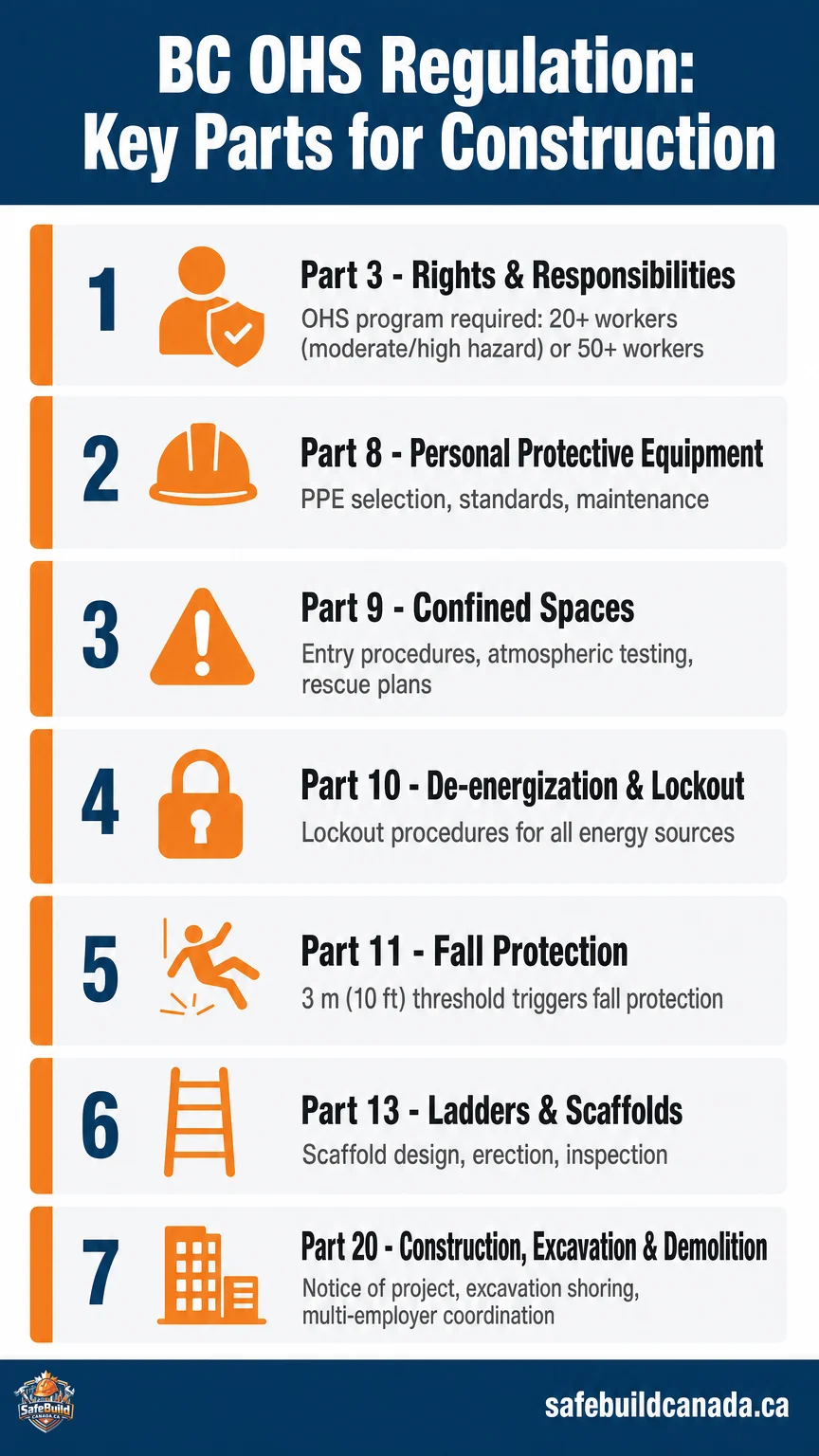
The BC OHS Regulation is adopted under the authority of the Workers Compensation Act and applies to almost all workplaces in the province, with exceptions for mines and federally regulated sectors. The regulation is organized into three main categories:
Core Requirements (Parts 1 to 4): These sections apply to all workplaces and cover fundamental definitions, application rules, rights and responsibilities, and general conditions.
General Hazard Requirements (Parts 5 to 19): These parts address specific hazards found across various industries, such as chemical agents, noise, personal protective equipment, confined spaces, and fall protection.
Industry-Specific Requirements (Parts 20 to 32 and 34): These sections focus on particular industries or high-risk activities. Part 20 is dedicated entirely to construction, excavation, and demolition.
For construction employers, navigating this structure means understanding how the core requirements interact with both general hazards and industry-specific rules. A solid foundation in these regulations is essential for developing an effective construction site safety plan.
Part 3: Rights and Responsibilities
Part 3 of the regulation outlines the foundational elements of a health and safety program. It defines the duties of employers, supervisors, and workers, establishing a shared responsibility for workplace safety.
When is an OHS Program Required?
According to Section 3.1, an employer must initiate and maintain an occupational health and safety program if they have:
A workforce of 20 or more workers AND at least one workplace with a moderate or high hazard rating.
A workforce of 50 or more workers, regardless of the hazard rating.
Construction sites are typically classified as high hazard, meaning the 20-worker threshold almost always applies. Even if a site falls below this threshold, a WorkSafeBC officer can mandate a program if they deem it necessary.
Contents of an OHS Program
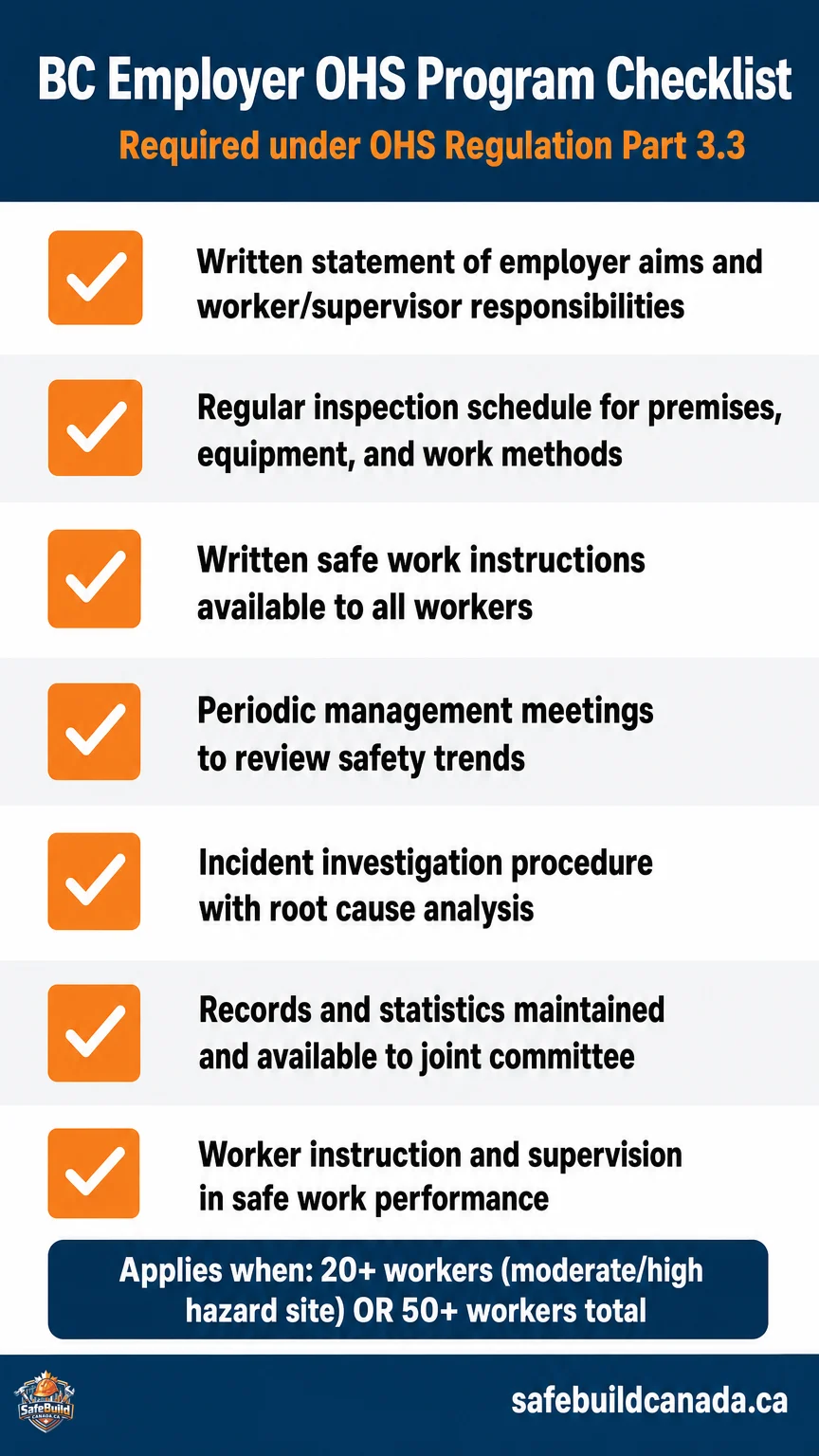
Section 3.3 details the required components of an OHS program. These include a written statement of employer aims, provisions for regular inspections, written safe work instructions, periodic management meetings, prompt incident investigations, and the maintenance of records and statistics. Employers must also provide instruction and supervision so that workers can perform their tasks safely.
The Right to Refuse Unsafe Work
Section 3.12 is a critical component of Part 3, detailing the procedure for refusing unsafe work. A worker must not carry out any task if they have reasonable cause to believe it would create an undue hazard. The worker must immediately report the unsafe condition to their supervisor, who must investigate without delay. If the issue remains unresolved, the investigation must continue in the presence of a worker representative. If a resolution is still not reached, a WorkSafeBC officer must be notified to investigate and issue necessary orders.
Part 11: Fall Protection
Falls remain one of the leading causes of injury and death in the construction industry. Part 11 of the BC OHS Regulation sets strict requirements for fall protection systems.
The 3-Metre Threshold
Section 11.2 establishes the primary trigger for fall protection. An employer must have a fall protection system in place whenever work is being done at a location from which a fall of 3 metres (10 feet) or more may occur. Additionally, fall protection is required if a fall from a height of less than 3 metres involves a risk of injury greater than the impact on a flat surface.
Hierarchy of Fall Protection
The regulation mandates a specific hierarchy of controls for fall protection:
Guardrails: Whenever practicable, employers must use guardrails or similar means of fall restraint.
Fall Restraint Systems: If guardrails are not practicable, another fall restraint system must be used to prevent the worker from reaching the fall hazard.
Fall Arrest Systems: If restraint is not practicable, a fall arrest system or a rope access system must be employed.
When a fall arrest system is used, Section 11.3 requires the employer to develop a specific fall protection plan. This plan must detail the procedures for assembling, maintaining, and inspecting the system, as well as the rescue procedures in the event of a fall.
Part 20: Construction, Excavation, and Demolition
Part 20 is the cornerstone of construction safety in British Columbia. It provides detailed requirements for the unique hazards associated with building, excavating, and demolishing structures.
Notice of Project
Before beginning major construction work, employers must file a Notice of Project with WorkSafeBC. Section 20.2 requires this notice at least 24 hours before work starts if the project meets certain criteria, such as an estimated cost exceeding $100,000, involvement of a professional engineer, or specific high-risk activities like deep trenching or working in compressed air. A separate notice is required 48 hours in advance for work involving hazardous substances like asbestos or lead.
Coordination of Multiple Employer Workplaces
Construction sites often involve multiple contractors and subcontractors working simultaneously. Section 20.3 addresses this complexity by requiring coordination. If overlapping work activities create hazards and the combined workforce exceeds five people, the prime contractor must appoint a qualified coordinator. This coordinator is responsible for informing all parties of the hazards and making certain they are addressed throughout the project.
Excavation and Trenching Rules
Excavations present severe risks, particularly from cave-ins. Sections 20.78 through 20.95 outline the rules for safe excavation. Key requirements include locating underground utility services before digging, sloping or shoring excavation walls, and keeping spoil piles at least 0.6 metres (2 feet) from the edge. Specific trench support structures are detailed in Table 20-1, so that workers are protected when entering deep trenches.
Washroom Facilities
A recent update to the regulation, effective October 2024, introduces specific requirements for washroom facilities at construction sites. Section 20.3.2 mandates that sites with 25 or more workers must provide flush toilets. If flush toilets are not practicable, chemical toilets must be provided. These facilities must be maintained, cleaned, illuminated, and equipped with handwashing stations.
Enforcement and Penalties Under the Workers Compensation Act
Compliance with the BC OHS Regulation is not optional. WorkSafeBC has broad enforcement powers under the Workers Compensation Act to hold employers accountable to their obligations.
Inspections and Stop-Work Orders
WorkSafeBC officers have the authority to enter any workplace without notice to conduct inspections. If an officer identifies unsafe conditions or regulatory violations, they can issue orders requiring immediate correction. In severe cases, an officer can issue a stop-work order, halting operations until the hazard is resolved. This power is essential for preventing imminent harm on construction sites.
Administrative Penalties
When employers fail to comply with the OHS Regulation, WorkSafeBC can impose administrative penalties. These financial penalties are designed to deter non-compliance and encourage a forward-thinking approach to safety.
OHS Citations: For minor violations, officers can issue citations with penalties up to $1,312.96 per violation.
Serious Violations: For more severe infractions, such as maintaining an unsafe workplace or repeatedly violating regulations, the Board can impose administrative penalties up to $816,148.69.
Employers facing serious penalties may raise a due diligence defence, demonstrating that they took all reasonable steps to prevent the violation. However, the burden of proof rests on the employer to show that their safety program was thorough and effectively implemented.
Comparing BC Regulations with Other Provinces
While the core principles of construction safety are similar across Canada, specific regulations vary by province. Understanding these differences is important for companies operating in multiple jurisdictions.
In Ontario, the Occupational Health and Safety Act (OHSA) and its specific construction regulation (O. Reg. 213/91) govern site safety. Like BC, Ontario uses a 3-metre threshold for fall protection. However, Ontario's penalty structure differs, with maximum fines reaching $1.5 million for corporations.
In Alberta, the Occupational Health and Safety Act and the OHS Code dictate requirements. Alberta also maintains a 3-metre fall protection threshold. Alberta's administrative penalties can reach $10,000 per day for ongoing violations, emphasizing the need for continuous compliance.
For a broader understanding of how these provincial rules fit into the national framework, employers should review the OHS regulations Canada construction guide. Additionally, staying informed about Canadian construction OHS regulation updates is vital for maintaining long-term compliance.
Building a Culture of Compliance
Understanding the BC OHS Regulation is the first step toward creating a safe construction site. Employers must move beyond mere compliance and actively integrate these rules into their daily operations. This involves regular training, consistent supervision, and a commitment to addressing hazards before they result in injuries.
By prioritizing the requirements of Part 3, Part 11, and Part 20, construction employers in British Columbia can protect their workers, avoid costly penalties, and build a reputation for excellence in safety. The regulations provide the blueprint; it is up to the industry to build the structure.