

If you have ever been handed a stack of safety documents on your first day at a new site and wondered which ones actually matter legally, you are not alone. Construction safety documentation in Canada is genuinely confusing, partly because the rules differ by province, partly because the terminology is inconsistent across jurisdictions, and partly because a lot of contractors are still working from templates they downloaded years ago without checking whether those templates actually meet current requirements.
This guide cuts through that confusion. It covers what Canadian law requires in a construction site safety plan, how those requirements differ across Ontario, British Columbia, Alberta, and Nova Scotia, and what the eight components every compliant plan needs to include. It also addresses the difference between a site-specific safety plan and a company-level OHS program, because conflating the two is one of the most common documentation mistakes contractors make. If you are looking for the broader picture of construction safety obligations across Canada, the complete Canadian construction site safety guide covers the full regulatory framework in detail.
The difference between an OHS program and a site-specific safety plan
Before getting into what must be in a safety plan, it is worth being clear about what kind of document we are actually talking about. Canadian OHS legislation generally recognizes two distinct levels of safety documentation, and they serve different purposes.
A company-level OHS program is a standing document that describes how your organization manages health and safety across all its operations. It covers your overall policy, your training and supervision methods, your hazard identification system, your incident investigation process, and your committee structure. As the Canadian Centre for Occupational Health and Safety explains in its guidance on health and safety program elements, this program must include the elements required by the health and safety legislation as a minimum, and it applies to your business regardless of which project you are working on.
A site-specific safety plan, often abbreviated as SSSP, is a project-level document. It takes the principles in your OHS program and applies them to the specific conditions, hazards, and scope of work at a particular construction site. The SSSP gets updated as the project evolves, new subcontractors come on site, or site conditions change. It is the document that a WorkSafeBC officer or an Ontario Ministry of Labour inspector is most likely to ask for during a site visit.
The confusion between these two documents causes real compliance problems. Contractors who submit their company OHS program in response to a request for a site-specific safety plan are presenting the wrong document. The OHS program tells the regulator how you manage safety in general. The SSSP tells them how you are managing safety on this project, with these workers, on this site, right now.
When is a written safety plan legally required in Canada?
The legal threshold for requiring a written safety plan varies by province and by the type of document being required. The infographic below summarizes the key thresholds across the four major construction provinces and the federal jurisdiction.
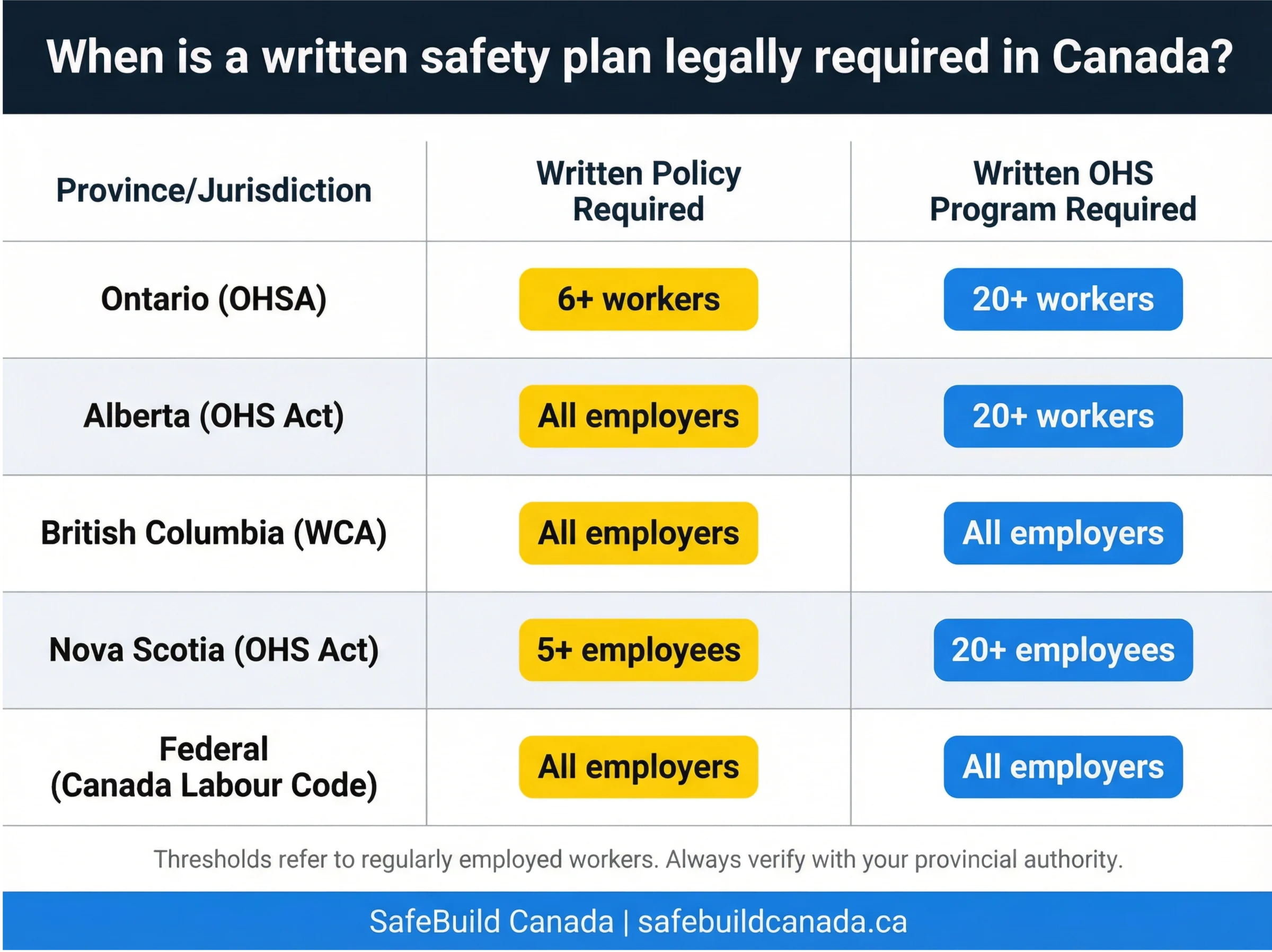
Ontario (OHSA): A written health and safety policy is required for employers with six or more workers. A written OHS program is required for employers with 20 or more workers. For construction projects specifically, Ontario Regulation 213/91 sets out detailed requirements for project-level safety documentation.
British Columbia (Workers Compensation Act and OHS Regulation): All employers must have a written OHS program regardless of size. The WorkSafeBC OHS Regulation Part 20 sets out the specific requirements for construction projects, including the requirement to file a Notice of Project for projects exceeding $100,000 in labour and materials.
Alberta (OHS Act): All employers must have a written health and safety policy. A written OHS program is required for employers with 20 or more workers. The OHS Act requires the program to be developed in consultation with the joint work site health and safety committee or health and safety representative.
Nova Scotia (OHS Act): A written health and safety policy is required for employers with five or more employees. A written OHS program is required for employers with 20 or more employees. The Construction Safety Nova Scotia OHS Guide is explicit that the program must include provision for monitoring its implementation and effectiveness.
Federal (Canada Labour Code Part II): All federally regulated employers must have a written health and safety policy and a written OHS program regardless of size. For an overview of how the federal framework applies to construction employers, the OHS regulations guide for Canadian construction employers covers the federal obligations alongside provincial requirements.
The 8 essential components of a Canadian site safety plan
The infographic below summarizes the eight components that every compliant Canadian construction site safety plan must include. Each component is explained in detail in the sections that follow.
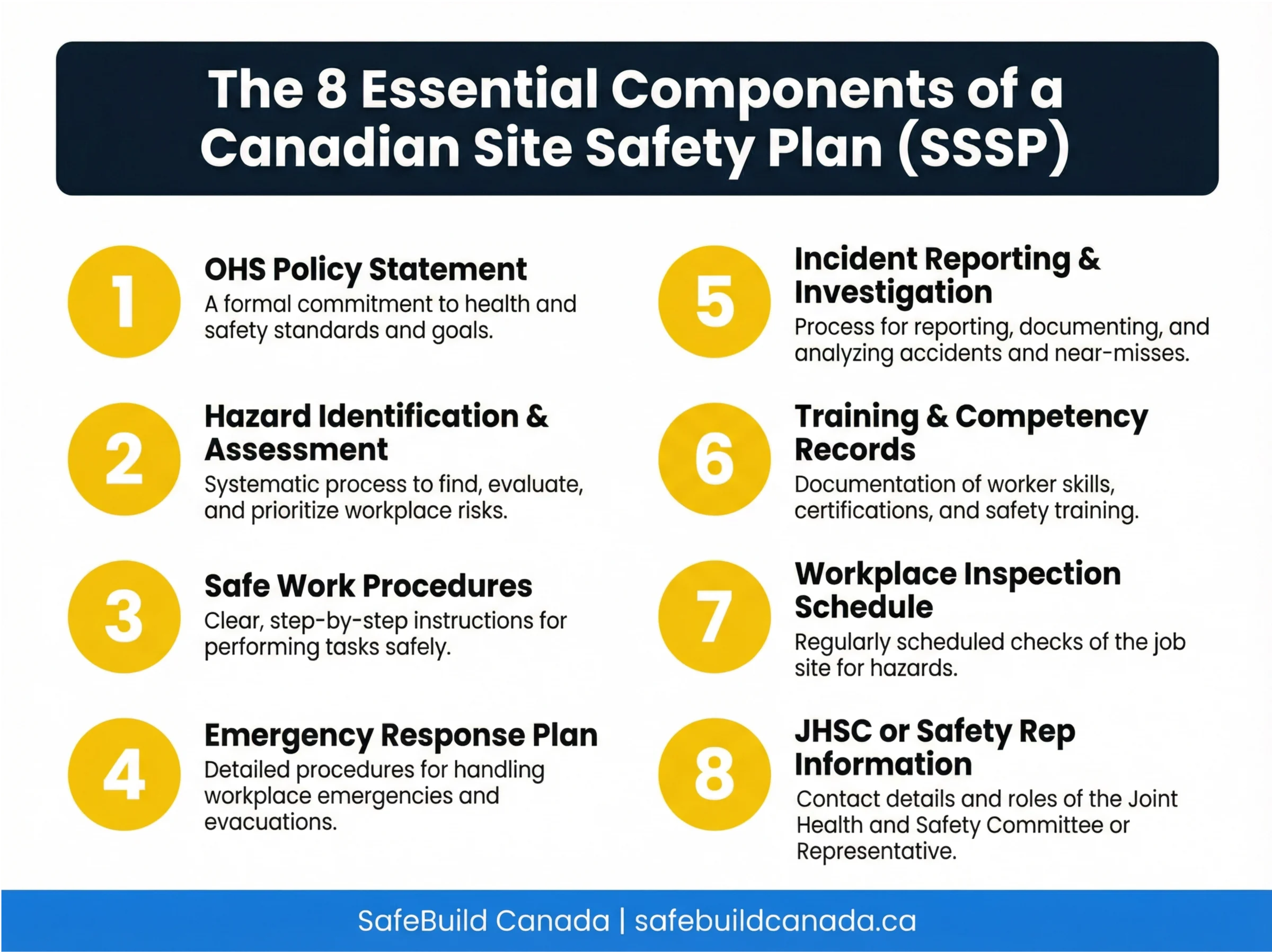
1. OHS policy statement
The policy statement is the foundation of the plan. It is a written declaration from senior management that commits the organization to providing a safe and healthy workplace. It must be signed by a senior officer of the company, dated, and reviewed at least annually. The policy should identify the employer's commitment to OHS, the roles and responsibilities of management and workers, and the mechanisms for worker participation in safety.
A policy statement that was signed five years ago and has never been reviewed will not satisfy an inspector. The date of the most recent review should be visible on the document.
2. Hazard identification and assessment
The plan must include a systematic process for identifying, evaluating, and prioritizing the hazards specific to the project. This means conducting a hazard assessment before work begins, updating it as site conditions change, and documenting the results. The assessment should cover physical hazards, chemical hazards, biological hazards, ergonomic hazards, and any project-specific risks such as working near energized equipment, excavation, or work at heights.
For a detailed breakdown of how to structure a hazard identification and risk assessment process that meets Canadian regulatory requirements, the post on hazard identification and risk assessment in Canadian construction covers the methodology and documentation requirements in full.
3. Safe work procedures
Safe work procedures (SWPs) are written, step-by-step instructions for performing specific tasks safely. The SSSP must identify which tasks require SWPs and include or reference those procedures. At minimum, SWPs are required for working at heights, operating mobile equipment, working in confined spaces, handling hazardous materials, and any task-specific procedures required by the applicable OHS regulation. The IHSA's Construction Health and Safety Manual is a useful reference for developing SWPs that align with Ontario's regulatory requirements, and it covers everything from fall protection to confined space entry.
4. Emergency response plan
Every construction site needs a written plan for responding to emergencies, including fires, medical emergencies, structural collapses, hazardous material spills, and severe weather events. The plan must identify the nearest hospital and emergency services, specify the location of first aid equipment and first aid attendants, establish evacuation routes and muster points, and assign clear responsibilities to named individuals. In federally regulated workplaces, the Canada Occupational Health and Safety Regulations require employers to post emergency telephone numbers and evacuation procedures in a location where workers can easily access them. Most provincial regulations have equivalent requirements.
5. Incident reporting and investigation
The plan must establish a clear process for reporting and investigating incidents, including near-misses. This means specifying what gets reported, to whom, within what timeframe, and using what forms. It also means documenting who is responsible for conducting investigations and what corrective actions are required. The CCOHS guidance on health and safety program elements notes that the program should specify what is to be reported, to whom it will be reported, how it is reported, which incidents are investigated, who will investigate them, what forms are used, and what records are to be kept. Inspectors look closely at this section because a well-documented investigation process is one of the clearest indicators of whether a safety culture is functioning or just performing.
6. Training and competency records
The plan needs to document what training workers have received, when they received it, and who delivered it. This includes mandatory training like Working at Heights in Ontario, WHMIS, and any task-specific training required by the applicable regulation. It also includes records of certifications and designations. If you are pursuing COR certification through IHSA in Ontario or ACSA in Alberta, your training records are one of the most scrutinized elements of the audit. Gaps in training documentation are a leading reason COR audits fail on the first attempt.
7. Workplace inspection schedule
Regular workplace inspections need to be planned, documented, and followed up on. The plan should specify how often inspections occur, who conducts them, what areas and equipment are covered, and how deficiencies are tracked and corrected. In most provinces, the Joint Health and Safety Committee (JHSC) or health and safety representative plays a role in conducting or reviewing inspections, and their involvement needs to be reflected in the plan. For a detailed guide to building an inspection program that satisfies both regulatory requirements and COR audit standards, the post on how to run a construction site inspection program in Canada covers the full process.
8. JHSC or safety representative information
The plan must identify the members of the JHSC or the designated health and safety representative, including their contact information and their role on the project. In Ontario, a JHSC is required for workplaces with 20 or more workers. In BC, a JHSC is required for workplaces with 20 or more workers on a project lasting more than three months. The CCOHS posting requirements page provides a useful summary of what must be displayed at the worksite across all Canadian jurisdictions, including the requirement to post the names and work locations of all committee members.
The WorkSafeBC notice of project: a documentation requirement many contractors overlook
In British Columbia, certain construction projects require the prime contractor or owner to file a Notice of Project (NOP) with WorkSafeBC before work begins. Under Part 20 of the OHS Regulation, an NOP is required for projects with an estimated cost of labour and materials exceeding $100,000, as well as for projects involving excavation deeper than 1.5 metres, demolition, tunnelling, caissons, cofferdams, or falsework.
The NOP must include the name and contact information of the owner and prime contractor, the project address or location, the scope of work, the start date and estimated duration, and the estimated total cost of labour and materials. A copy must be posted at the worksite before work begins and kept posted for the duration of the project. If any of that information changes significantly, WorkSafeBC must be notified and the posted copy updated.
The NOP is not the same as the SSSP, but it is a documentation requirement that sits alongside it. Contractors who are new to BC often miss this step entirely, which creates a compliance gap from day one of the project.
How the SSSP connects to COR certification
If your company is pursuing Certificate of Recognition (COR) certification through IHSA in Ontario, ACSA in Alberta, or BCCSA in BC, your site safety plan and OHS program documentation are not just regulatory requirements. They are the primary evidence base for your COR audit.
COR audits evaluate whether your documented safety management system reflects what is actually happening on your sites. An auditor will review your OHS program, your SWPs, your training records, your inspection reports, and your incident investigation files. They will also interview workers and supervisors to check whether the documentation matches the reality. A plan that looks thorough on paper but has not been communicated to workers or updated to reflect current site conditions will not pass.
The connection between documentation quality and COR outcomes is worth taking seriously. COR certification reduces your WSIB or WCB premiums in most provinces, which means the investment in getting your documentation right has a direct financial return. It also positions your company more competitively for public sector contracts, many of which now require COR as a prequalification criterion.
Managing subcontractor documentation within the SSSP
One of the most commonly overlooked elements of a site safety plan is how it handles subcontractors. The prime contractor is responsible for ensuring that every subcontractor on site has the documentation, training, and procedures required by the applicable OHS regulation. This means the SSSP needs to address how subcontractor safety is managed, not just how the prime contractor's own workers are managed.
At minimum, the plan should specify what documentation subcontractors must provide before starting work (proof of WSIB clearance, evidence of worker training, copies of their own SWPs for high-risk tasks), how the prime contractor will verify that documentation, and what happens if a subcontractor fails to meet the requirements. For a detailed guide to managing subcontractor safety documentation on Canadian construction sites, the post on subcontractor safety management in Canada covers the practical process from prequalification through to on-site monitoring.
Keeping the plan current: the part most contractors get wrong
The most common documentation failure on Canadian construction sites is not the absence of a safety plan. It is having a plan that was written at the start of the project and never updated. A site safety plan is a living document. It needs to be reviewed and revised whenever the scope of work changes, a new phase begins, a new subcontractor comes on site, a hazard assessment identifies a new risk, or an incident or near-miss occurs.
The Nova Scotia OHS Guide is direct on this point: the OHS program must include provision for monitoring the implementation and effectiveness of the program. That is not a passive requirement. It means someone needs to be assigned responsibility for keeping the plan current, and that responsibility needs to be documented.
In practice, this means building a review schedule into the plan itself. A reasonable approach for most construction projects is a formal review at the start of each new phase, a brief review whenever a notable change occurs, and a final review and close-out at project completion. The review dates, the reviewer, and any changes made should all be recorded in the document.
A practical starting point for contractors
If you are building a site safety plan from scratch or updating an existing one, the most useful first step is to download the applicable OHS regulation for your province and work through it systematically. WorkSafeBC's searchable OHS Regulation, Ontario's OHSA and Construction Regulation 213/91, and Alberta's OHS Act and Code are all publicly available and free to access. Cross-reference your plan against the specific sections that apply to your scope of work.
For contractors pursuing COR, the IHSA's audit standard for Ontario or ACSA's audit standard for Alberta provides a detailed checklist of what your documentation needs to cover. Working backward from the audit standard is an efficient way to build a plan that satisfies both the regulatory minimum and the COR requirement in a single document.
The bottom line is that a construction site safety plan is not a bureaucratic exercise. It is the document that tells your workers, your subcontractors, your clients, and your regulator that you have thought seriously about the risks on your site and have a credible plan for managing them. Getting it right is worth the effort.
Common mistakes to avoid when building your site safety plan
Even contractors who take safety documentation seriously tend to repeat the same set of mistakes. Understanding them in advance saves time and reduces the risk of a compliance gap being discovered during an inspection or audit.
Using a generic template without customizing it. A template is a starting point, not a finished product. A site safety plan that refers to hazards or equipment that do not exist on your project, or that omits hazards that do, signals to an inspector that the plan was not developed with this site in mind. Every section of the plan needs to reflect the actual conditions, scope of work, and workforce on your specific project.
Failing to communicate the plan to workers. A plan that workers have never seen or been trained on provides no protection to anyone. The plan needs to be communicated at orientation, reviewed at toolbox talks when relevant sections change, and kept accessible to workers throughout the project. In most provinces, workers have a legal right to access the OHS program and the site safety plan.
Not updating the plan when subcontractors change. The arrival of a new subcontractor on site changes the hazard profile of the project. New trades bring new equipment, new chemicals, new work sequences, and new workers who may not be familiar with the site conditions. The plan needs to be reviewed and updated whenever a new subcontractor mobilizes.
Treating the JHSC as a formality. The Joint Health and Safety Committee is a legal requirement in most provinces above certain worker thresholds, but it is also one of the most effective tools for identifying hazards before they cause incidents. A JHSC that meets regularly, conducts meaningful inspections, and has access to management with authority to resolve issues is a genuine asset. A JHSC that exists only on paper is a liability.
Keeping the plan only in the site office. The plan needs to be accessible to workers, not locked in a filing cabinet. Many contractors now maintain digital copies of the SSSP on a shared drive or safety management platform that workers can access from their phones. This also makes it easier to update the plan in real time as conditions change.
What to expect during an OHS inspection of your site safety plan
When an OHS inspector visits your construction site, the site safety plan is one of the first documents they will request. Understanding what they are looking for helps you prepare.
Inspectors typically check whether the plan exists and is current, whether it covers the hazards specific to the project, whether workers have been trained on it, whether the JHSC or safety representative is properly constituted and active, and whether inspection and investigation records are being maintained. They may also interview workers to verify that the plan reflects what is actually happening on site.
In Ontario, an inspector conducting a proactive inspection under the Ministry of Labour's construction blitz programs will work through a standardized checklist. In BC, WorkSafeBC prevention officers have broad authority to inspect any aspect of the OHS program and to issue orders requiring corrections within specified timeframes. In Alberta, OHS officers can issue improvement orders, stop-work orders, and administrative penalties for non-compliance.
The most important thing to understand about an OHS inspection is that inspectors are not looking for a perfect document. They are looking for evidence that you have a functioning safety management system. A plan that is clearly being used, regularly updated, and actively communicated to workers will always fare better than a polished document that has never left the site office.
Sources
Canadian Centre for Occupational Health and Safety, Health and Safety Program: General Elements, 2024
WorkSafeBC, OHS Regulation Part 20: Construction, Excavation and Demolition, 2025
Canadian Centre for Occupational Health and Safety, Health and Safety Legislation in Canada: Posting Requirements, 2024
Infrastructure Health and Safety Association, Construction Health and Safety Manual (M029), 2024
Construction Safety Nova Scotia, OHS Guide: Safety Program, 2024