
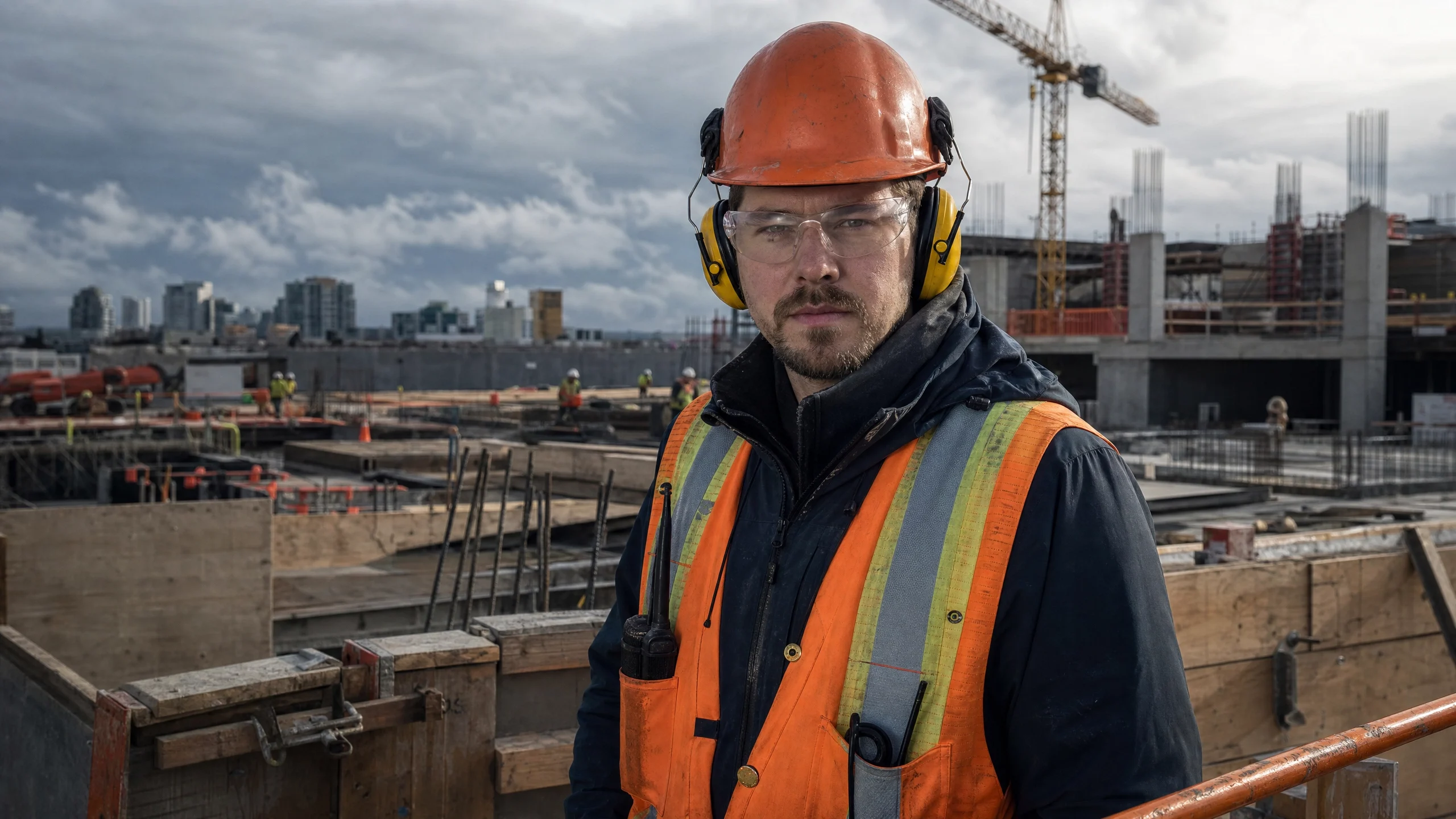
Construction sites are inherently loud environments. Between the constant hum of heavy machinery, the sharp crack of nail guns, and the grinding roar of concrete saws, workers are exposed to noise levels that can cause permanent, irreversible hearing damage. In Canada, occupational health and safety regulations strictly govern how employers must manage noise exposure to protect their workforce.
Understanding these requirements is not just about avoiding fines; it is about preserving the quality of life for the people building our infrastructure. Hearing loss is often gradual and painless, making it a hidden hazard that many workers do not notice until the damage is done. This guide breaks down the legal requirements for noise exposure on Canadian construction sites, the hierarchy of controls employers must implement, and the standards for selecting the right hearing protection devices.
The reality of construction site noise levels
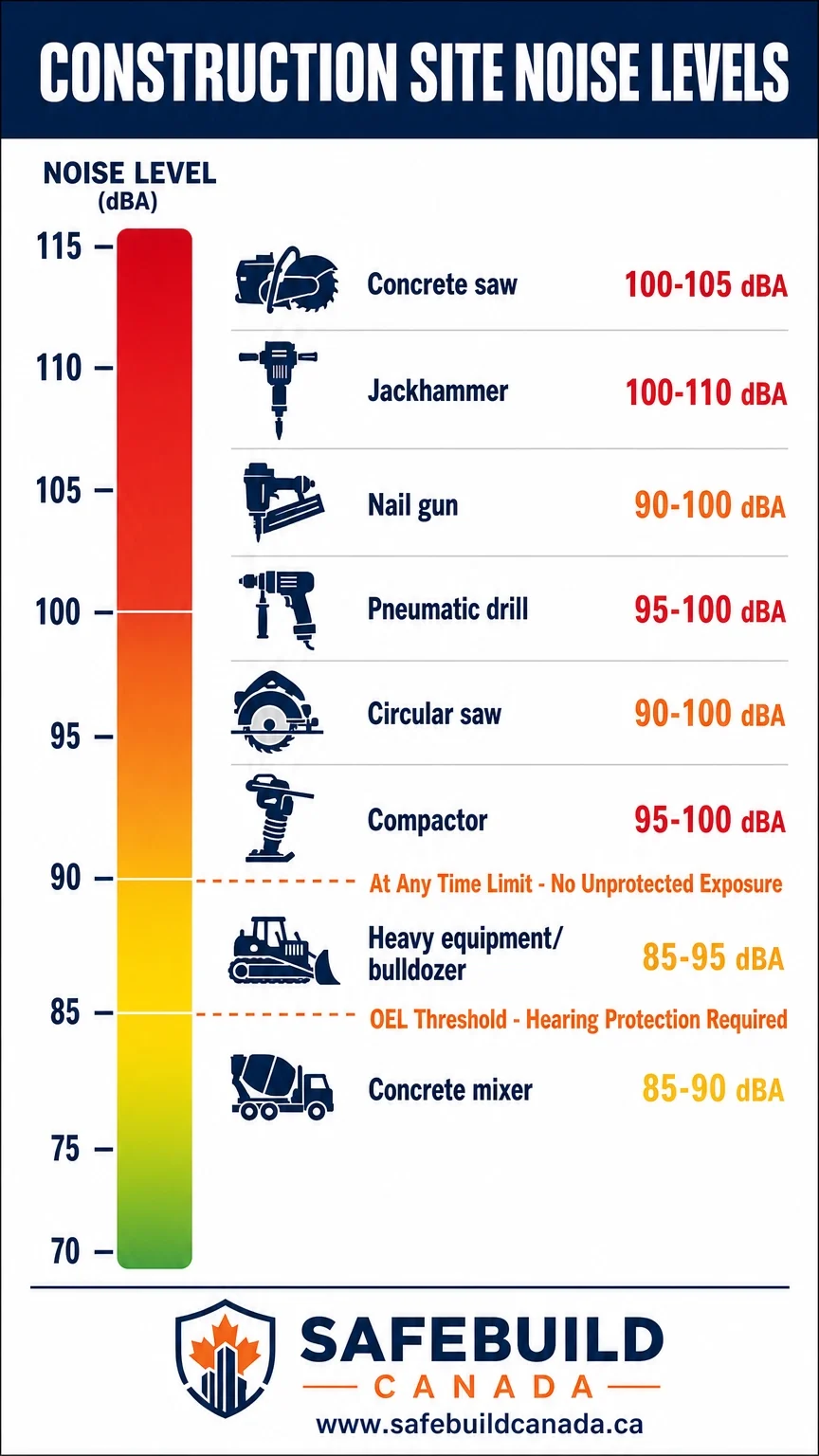
To understand the regulatory requirements, we first need to understand the scale of the hazard. Noise is measured in decibels (dBA), and the scale is logarithmic. This means that an increase of just three decibels represents a doubling of the sound energy. A concrete saw operating at 103 dBA is not just slightly louder than a pneumatic drill at 100 dBA; it is releasing twice as much sound energy into the environment.
When workers are exposed to these high noise levels without adequate protection, the tiny hair cells in the inner ear become damaged. Over time, this leads to noise-induced hearing loss, a condition that cannot be cured with surgery or medication. This is why Canadian occupational health and safety laws place strict limits on how much noise a worker can be exposed to during their shift.
Occupational exposure limits across Canada
The foundation of noise regulation in Canada is the occupational exposure limit (OEL). This limit dictates the maximum amount of noise a worker can be exposed to over a standard eight-hour work shift without requiring protective measures.
In the vast majority of Canadian jurisdictions, including Ontario, Alberta, and British Columbia, the occupational exposure limit is set at 85 dBA Lex. The "Lex" designation means that the noise exposure is time-weighted and averaged over an eight-hour period. If a worker is exposed to fluctuating noise levels throughout the day, their total exposure is calculated to determine if it exceeds the 85 dBA threshold.
The exchange rate
Because the decibel scale is logarithmic, regulations use an "exchange rate" to calculate allowable exposure times for noise levels above the 85 dBA limit. Most Canadian provinces use a 3 dBA exchange rate. This means that for every 3 dBA increase in noise level, the allowable exposure time is cut in half. At 88 dBA, the maximum exposure time is four hours. At 91 dBA, it drops to two hours. At 94 dBA, just one hour. At 100 dBA, a worker has only 15 minutes of allowable unprotected exposure. When you consider that a jackhammer can easily exceed 100 dBA, it becomes clear how quickly a worker can surpass their daily allowable exposure limit without protection.
The "at any time" limit
In addition to the time-weighted average, many provinces enforce an "at any time" limit, typically set at 90 dBA. This rule states that no worker may be exposed to noise levels exceeding 90 dBA at any time without wearing appropriate hearing protection, regardless of how short the duration of exposure might be.
The hierarchy of noise control
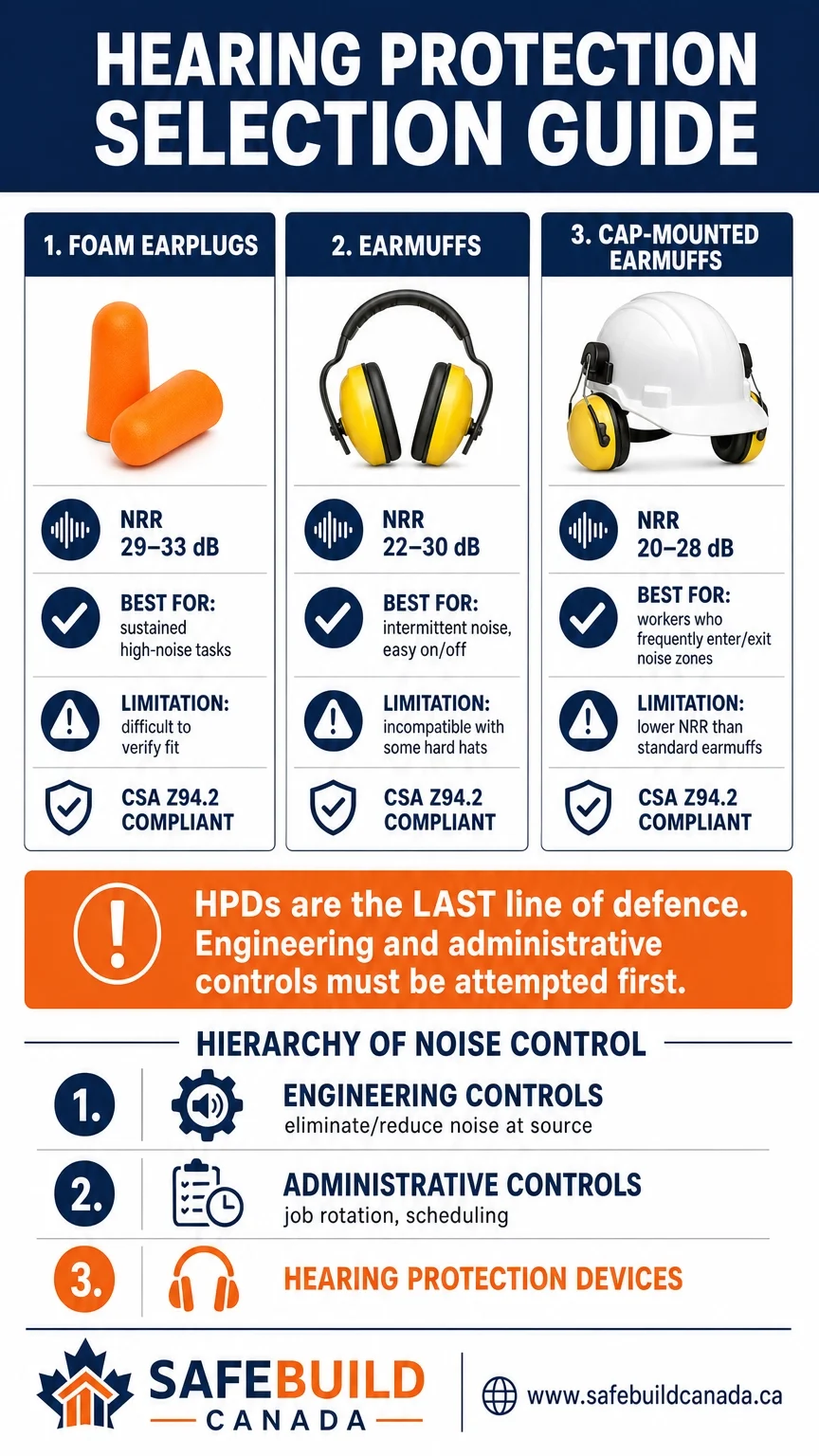
A common misconception on construction sites is that handing out earplugs is the first and only step required to manage noise exposure. However, Canadian occupational health and safety regulations mandate that employers follow the hierarchy of controls. Hearing protection devices are considered the last line of defence, not the primary solution.
Before relying on personal protective equipment, employers must attempt to eliminate or reduce the noise at its source. This approach is central to thorough hazard identification and risk assessment on any active site.
Engineering controls
Engineering controls involve modifying the equipment or the work environment to reduce the amount of noise generated or transmitted. This is the most effective method of protecting workers because it removes the hazard before it reaches their ears. Examples include purchasing or renting quieter equipment with sound-dampening enclosures, installing mufflers or silencers on pneumatic tools, erecting temporary sound barriers around noisy operations like concrete cutting, and maintaining equipment properly since worn bearings generate considerably more noise. In Alberta, the OHS Code specifically requires "noise control design," mandating that employers verify new equipment introduced to the work site does not expose workers to noise levels exceeding the 85 dBA limit whenever reasonably practicable.
Administrative controls
If engineering controls cannot reduce the noise below the occupational exposure limit, employers must implement administrative controls. These involve changing how and when work is performed to limit the duration of exposure for individual workers. This might include rotating workers through high-noise tasks, scheduling noisy operations during times when fewer workers are present, establishing designated quiet zones for breaks, and posting clear warning signs at the entrances to high-noise areas as required by Ontario's O. Reg. 381/15.
Hearing protection devices
Only when engineering and administrative controls are insufficient or impractical can employers rely on hearing protection devices (HPDs) to bring worker exposure down to safe levels. When HPDs are required, they must meet specific standards and be properly selected for the task.
Selecting the right hearing protection
In Canada, hearing protection devices must comply with the CSA Z94.2 standard for hearing protection devices. This standard outlines the performance requirements, testing methods, and selection criteria for earplugs, earmuffs, and communication headsets. When selecting hearing protection, employers must consider the Noise Reduction Rating (NRR) of the device. The NRR indicates how many decibels of noise the device can block when worn correctly. However, the laboratory-tested NRR is rarely achieved in real-world construction environments due to improper fit or interference from other personal protective equipment.
Types of hearing protection
Foam earplugs are the most common type of hearing protection on construction sites. When properly rolled, inserted, and allowed to expand, they offer excellent protection (often NRR 29-33 dB). They are ideal for sustained high-noise tasks and do not interfere with hard hats or safety glasses. However, their effectiveness relies entirely on the worker inserting them correctly, which can be difficult to verify visually.
Earmuffs consist of sound-attenuating cups connected by a headband. They are easy to put on and take off, making them suitable for intermittent noise exposures. They provide reliable protection (typically NRR 22-30 dB) because their fit is less dependent on the user's technique. The main limitation on a construction site is that standard headband earmuffs cannot be worn with a hard hat.
Cap-mounted earmuffs attach directly to the accessory slots on a hard hat. They offer the convenience of earmuffs while maintaining compliance with head protection requirements. Workers must verify that the attachment mechanism provides enough tension to seal the cups tightly against the head. When selecting HPDs, employers must verify they are compatible with the other CSA PPE standards required on the site. For example, thick safety glasses frames can break the seal of earmuffs, reducing their effectiveness considerably.
Training and instruction requirements
Providing hearing protection is only half the battle; employers are legally obligated to train workers on how to use it. Under regulations like Ontario's Noise Regulation (O. Reg. 381/15), an employer who provides a worker with a hearing protection device must also provide adequate training and instruction on its care and use. This training must cover the limitations of the specific device, how to achieve a proper fit (including the "roll, pull, and hold" technique for foam earplugs), how to inspect the device for wear and tear before each use, and proper maintenance, cleaning, and disinfection procedures for reusable devices.
A thorough construction site safety guide should always include detailed protocols for hearing protection training and enforcement.
Audiometric testing programs
In several Canadian provinces, including Alberta, British Columbia, and Saskatchewan, employers are required to implement audiometric testing programs for workers who are regularly exposed to noise levels exceeding the occupational exposure limit. Audiometric testing involves conducting baseline and periodic hearing tests to monitor a worker's hearing over time. The goal is to detect early signs of noise-induced hearing loss before it becomes a severe disability. If a test reveals a notable threshold shift (a measurable decrease in hearing ability), the employer must investigate the cause, review the effectiveness of their noise control measures, and confirm the worker is using appropriate hearing protection.
In Alberta, the OHS Code specifies that these tests must be administered by an audiometric technician working in consultation with a physician, audiologist, or occupational health nurse who is familiar with the work site.
Integrating noise management into site safety
Managing noise exposure requires a deliberate, systematic approach. It cannot be an afterthought. Employers must conduct regular noise exposure assessments to identify high-risk areas and tasks. These assessments should be documented and kept on file, as they form the basis of the site's noise management program.
During regular OHS inspections, safety officers will look for evidence that noise assessments have been completed, that the hierarchy of controls has been applied, and that workers are wearing the appropriate hearing protection correctly.
Furthermore, noise management should be integrated into the broader construction site emergency response plan. High noise levels can mask the sound of backup alarms, warning sirens, and verbal commands, creating secondary safety hazards. Employers must confirm that emergency communication systems, such as visual strobe lights or radio headsets, are effective even in the loudest areas of the site.
By understanding the regulations, applying the hierarchy of controls, and building a culture that values hearing conservation, Canadian construction employers can protect their workers from the silent, irreversible threat of noise-induced hearing loss.