

Personal protective equipment is the last line of defence on a construction site. When engineering controls, administrative controls, and work procedures have all been applied and a residual hazard still exists, PPE is what stands between a worker and a serious injury. That is why the Canadian Standards Association publishes detailed performance standards for every major PPE category, and why provincial OHS legislation across Canada requires that PPE meet those standards before it is issued to workers.
The challenge for many site managers and safety officers is that the standards are spread across multiple CSA documents, each with its own classification system, and the rules about who selects PPE, who pays for it, and how it must be maintained vary from province to province. Add in the Canadian Construction Safety Council's new 2026 PPE mandates, and the picture gets more complex still. This guide pulls it all together in one place.
Why CSA standards matter and what the law actually says
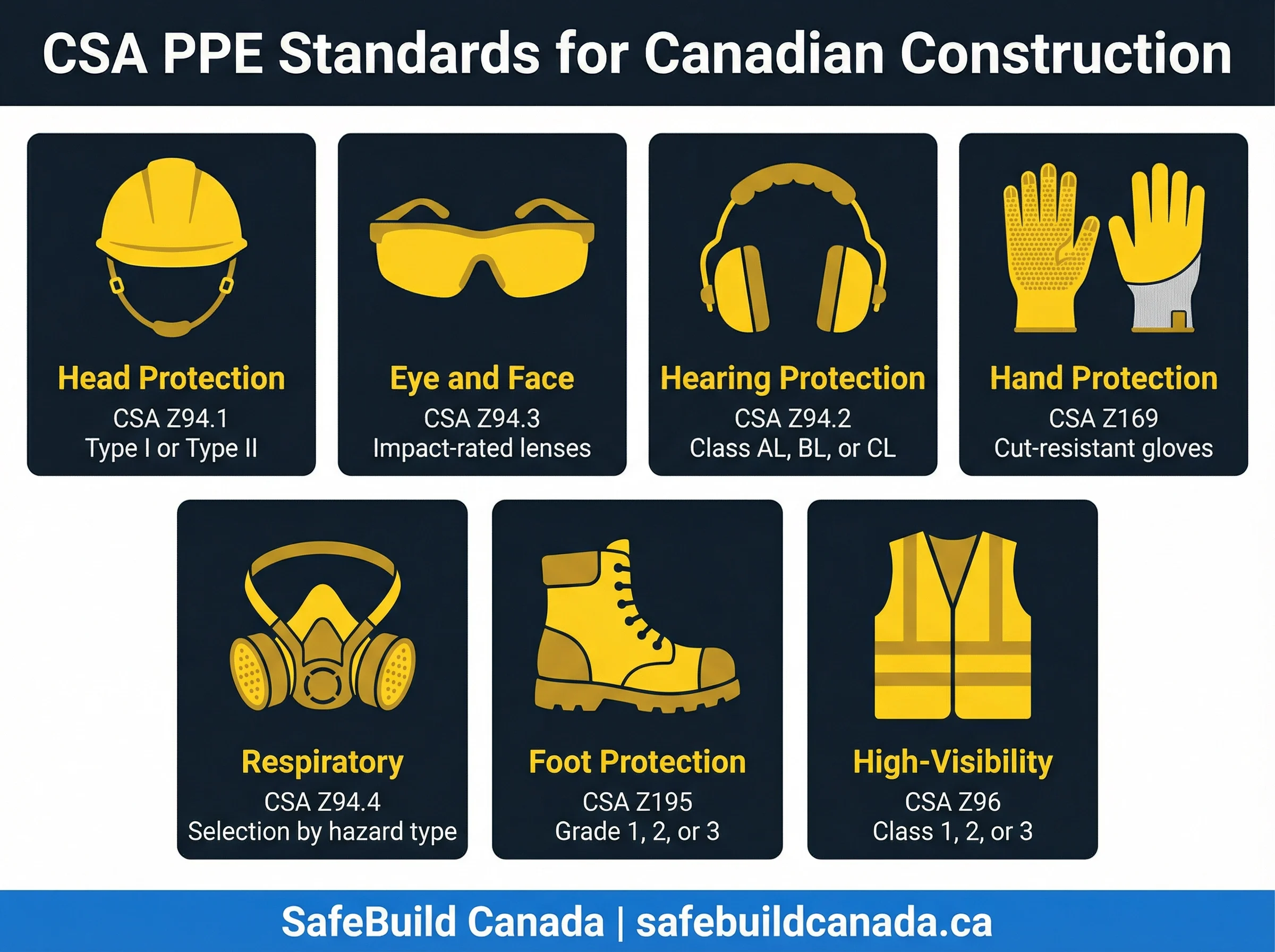
Every province and territory in Canada requires that PPE used on construction sites meet applicable standards. In Ontario, the Construction Regulation (O.Reg. 213/91) under the Occupational Health and Safety Act specifies CSA standards for head, foot, and eye protection. In British Columbia, WorkSafeBC's OHS Regulation Part 8 requires that PPE meet the standards of a recognized testing organization, which in practice means CSA Group. The federal Canada Labour Code Part II takes the same approach for federally regulated workplaces.
The CCOHS notes that employers are responsible for identifying which PPE is required based on a hazard assessment, selecting PPE that meets the applicable standard, ensuring proper fit for each individual worker, and providing training on correct use, maintenance, and storage. The hierarchy of controls applies here: PPE is always the last resort, not the first response to a hazard. If you are relying on PPE to manage a hazard that could be eliminated or engineered out, that is a gap in your safety program.
One question that comes up often is who pays for PPE. The answer depends on the province. In Quebec, Saskatchewan, the Northwest Territories, and Nunavut, the law is explicit that employers must provide PPE free of charge. In Ontario, the OHSA uses the word "provide," which courts have generally interpreted to mean at the employer's expense, but the legislation is less precise. In Alberta, the rules vary by PPE type. The safest approach for any Canadian employer is to provide all required PPE at no cost to workers, regardless of what the minimum legal standard in your province technically requires.
Head protection: CSA Z94.1 and the shift to Type II
Head protection on Canadian construction sites is governed by CSA Z94.1, which classifies hard hats by type and class. Type I helmets protect only the top of the head. Type II helmets provide additional protection from lateral impacts, meaning a blow to the side, front, or back of the head. Class C (conductive) helmets offer no electrical protection. Class G (general) helmets protect against low-voltage electrical contact. Class E (electrical) helmets protect against high-voltage contact and are the standard for most construction work.
The industry is moving firmly toward Type II. The Canadian Construction Safety Council, which represents twelve of Canada's largest general contractors including PCL, EllisDon, Aecon, and Graham, has mandated Type II helmets with manufacturer-integrated chin straps for all workers on member sites, with full compliance required in 2026. The chin strap requirement is not cosmetic. A helmet that comes off during a fall or impact provides no protection at all, and traditional hard hats are frequently dislodged in exactly those situations.
For a deeper look at the Type I vs. Type II distinction and what CSA Z94.1 requires, the earlier SafeBuild Canada guide on choosing the right hard hat for Canadian construction covers the full technical breakdown.
Eye and face protection: CSA Z94.3
Eye injuries are among the most common construction injuries in Canada, and most of them are preventable with properly selected and worn eye protection. CSA Z94.3 covers safety glasses, goggles, face shields, and welding helmets. The standard classifies lenses by impact resistance (basic impact vs. high impact), lens material (glass, plastic, polycarbonate), and special purpose applications such as laser protection or welding.
For general construction work, polycarbonate safety glasses rated to CSA Z94.3 high-impact standard are the practical baseline. Face shields are required when there is a risk of flying particles, splashing liquids, or molten metal, but they must always be worn over safety glasses, not instead of them. A face shield alone does not protect the eyes from particles entering from the sides or below.
The fit and comfort of eye protection matters more than most employers acknowledge. Workers who find their safety glasses uncomfortable or fogging will take them off. Investing in anti-fog coatings, adjustable frames, and prescription safety glasses for workers who need them is not a luxury. It is a compliance strategy.
Hearing protection: CSA Z94.2
Construction sites are among the noisiest work environments in Canada. Prolonged exposure to noise above 85 decibels causes permanent hearing loss, and many construction tasks, including concrete cutting, jackhammering, and nail gun use, regularly exceed that threshold. CSA Z94.2 governs the selection, care, and use of hearing protection devices, classifying them into three classes based on their noise reduction capability.
Class AL devices (earmuffs and earplugs) provide the lowest attenuation and are suitable for moderate noise environments. Class BL devices provide mid-range attenuation. Class CL devices provide the highest attenuation and are required in the loudest environments. The standard requires that employers conduct a noise assessment before selecting hearing protection, because the wrong class in either direction creates problems. Under-protection leaves workers exposed to damaging noise levels. Over-protection can prevent workers from hearing warning signals, equipment alarms, or verbal communication from colleagues.
Hearing protection is one area where the "provide and forget" approach fails regularly. Earplugs that are not inserted correctly provide a fraction of their rated protection. Regular fit-testing and training on proper insertion technique is not optional if you want the protection to actually work.
Respiratory protection: CSA Z94.4
Respiratory hazards on construction sites include silica dust from concrete and masonry cutting, asbestos fibres in older buildings, wood dust, welding fumes, and chemical vapors from coatings and adhesives. CSA Z94.4 covers the selection, care, and use of respirators, and it is one of the more technically demanding PPE standards because the right respirator depends entirely on the specific hazard.
Disposable filtering facepiece respirators (commonly called N95s or P100s) are appropriate for particulate hazards like silica dust. Half-face and full-face air-purifying respirators with cartridges are required for chemical vapors and gases. Supplied-air respirators are required when oxygen levels are deficient or when contaminant concentrations are immediately dangerous to life and health. Using the wrong type of respirator for the hazard present is not just ineffective. It can be fatal, because it gives the worker a false sense of protection.
Fit-testing is a legal requirement for tight-fitting respirators in most Canadian jurisdictions. A respirator that does not seal properly against the face provides dramatically reduced protection. Facial hair, even stubble, breaks the seal on a tight-fitting respirator. Employers need a clear policy on facial hair and respirator use, and they need to enforce it consistently.
Foot protection: CSA Z195
CSA Z195 governs protective footwear for Canadian workplaces, classifying boots by grade based on their protective features. Grade 1 boots provide the highest level of protection, including puncture resistance, metatarsal protection, and electrical hazard protection. Grade 2 boots provide toe protection and some additional features. Grade 3 boots provide basic toe protection only.
For most construction work, Grade 1 boots are the appropriate standard. The specific features required depend on the hazards present. Work near live electrical equipment requires electrical hazard rated footwear. Work involving the handling of heavy materials requires metatarsal protection. Work on surfaces with puncture hazards requires puncture-resistant midsoles.
One issue that comes up in practice is the question of gender-inclusive sizing and fit. Standard safety boots have historically been designed for male foot shapes, and female workers often find that the available options do not fit well. Ill-fitting boots cause discomfort, blisters, and fatigue, which leads workers to wear non-compliant footwear. Employers who want genuine compliance need to ensure that properly fitting CSA Z195 footwear is available for all workers, not just the majority.
High-visibility apparel: CSA Z96
High-visibility apparel is required on any construction site where workers are exposed to vehicular or equipment traffic. CSA Z96 classifies high-vis garments by class based on the amount of visible material and retroreflective tape. Class 1 provides the minimum visibility and is appropriate for low-risk environments. Class 2 is the standard for most construction sites. Class 3 provides the highest visibility and is required for work near high-speed traffic or in low-visibility conditions.
The standard specifies both the color of the background material (fluorescent yellow-green or fluorescent orange-red) and the placement and width of retroreflective tape. A vest that looks bright orange but does not meet the CSA Z96 tape requirements is not compliant, regardless of how visible it appears in daylight. At night or in low-light conditions, the retroreflective tape is what makes the difference between a worker being seen and not being seen.
The CCSC's new mandates and what they signal
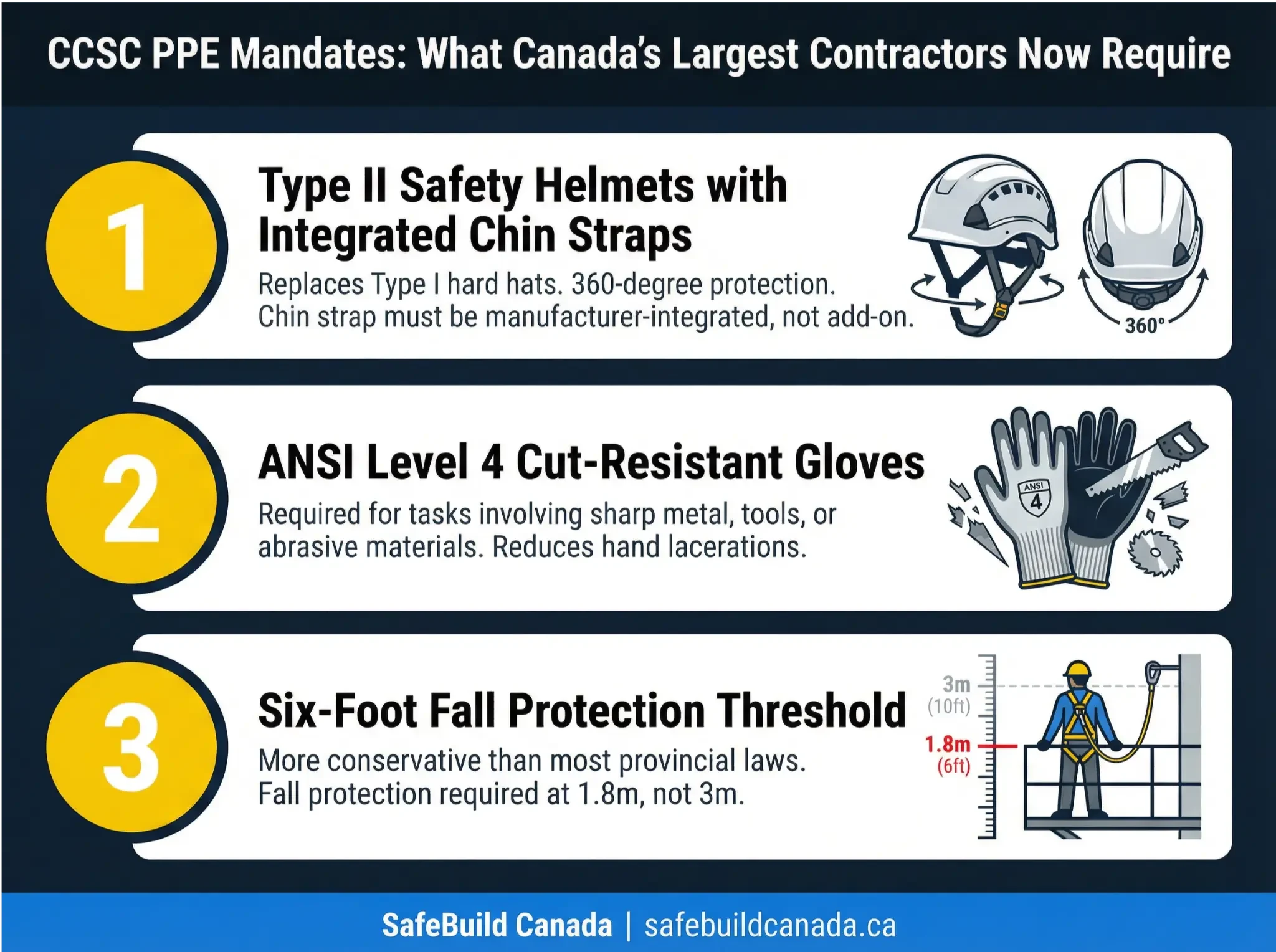
The Canadian Construction Safety Council's 2026 PPE mandates go beyond what most provincial OHS regulations currently require. The three key mandates are Type II helmets with integrated chin straps, ANSI Level 4 cut-resistant gloves for tasks involving sharp materials, and a six-foot fall protection threshold rather than the three-metre standard in most provincial legislation.
These mandates matter for two reasons. First, they reflect where the industry is heading. When twelve of Canada's largest general contractors align on a standard, subcontractors who work on their sites need to meet that standard or they will not get the work. Second, they represent a genuine improvement in worker protection. The evidence base for Type II helmets and cut-resistant gloves reducing serious injuries is solid. Adopting these standards now, before they become regulatory minimums, is the kind of forward-looking safety leadership that distinguishes strong safety cultures from compliance-minimum operations.
Building a PPE program that actually works
Issuing PPE to workers is not the same as running a PPE program. A genuine PPE program starts with a hazard assessment that identifies every residual hazard on the site after other controls have been applied. It then selects PPE that meets the applicable CSA standard for each hazard, ensures that PPE is properly fitted to each individual worker, provides training on correct use and maintenance, and establishes a system for inspecting and replacing PPE that has been damaged or has reached the end of its service life.
The maintenance and inspection piece is where many programs fall apart. Hard hats have a service life. Safety glasses get scratched. Respirator cartridges become saturated. High-vis vests fade and lose their retroreflective properties. A PPE program that does not have a clear replacement schedule and a process for workers to report damaged equipment is not a program. It is a procurement exercise.
For a broader look at how PPE selection fits into the overall hazard control process, the SafeBuild Canada guide on hazard identification and risk assessment for Canadian construction sites walks through the hierarchy of controls and where PPE sits within it. And if you are building or updating your site safety plan to document your PPE requirements, the guide on how to build a construction site safety plan in Canada covers the documentation requirements in detail.
The bottom line is that PPE compliance in Canada is not complicated, but it does require attention to the specific CSA standard for each category, the provincial rules that apply to your site, and the emerging industry standards that the CCSC is driving. Getting this right protects workers, reduces liability, and demonstrates the kind of safety leadership that the Canadian construction industry needs more of.
SOURCES
CCOHS, Designing an Effective PPE Program, 2024
IHSA, Personal Protective Equipment, 2024
CrossSafety, Canadian Construction PPE Changes: What Builders Should Know, 2026
Canadian Construction Safety Council, Safety Standards, 2025
WorkSafeBC, OHS Regulation Part 8: Personal Protective Clothing and Equipment, 2024