
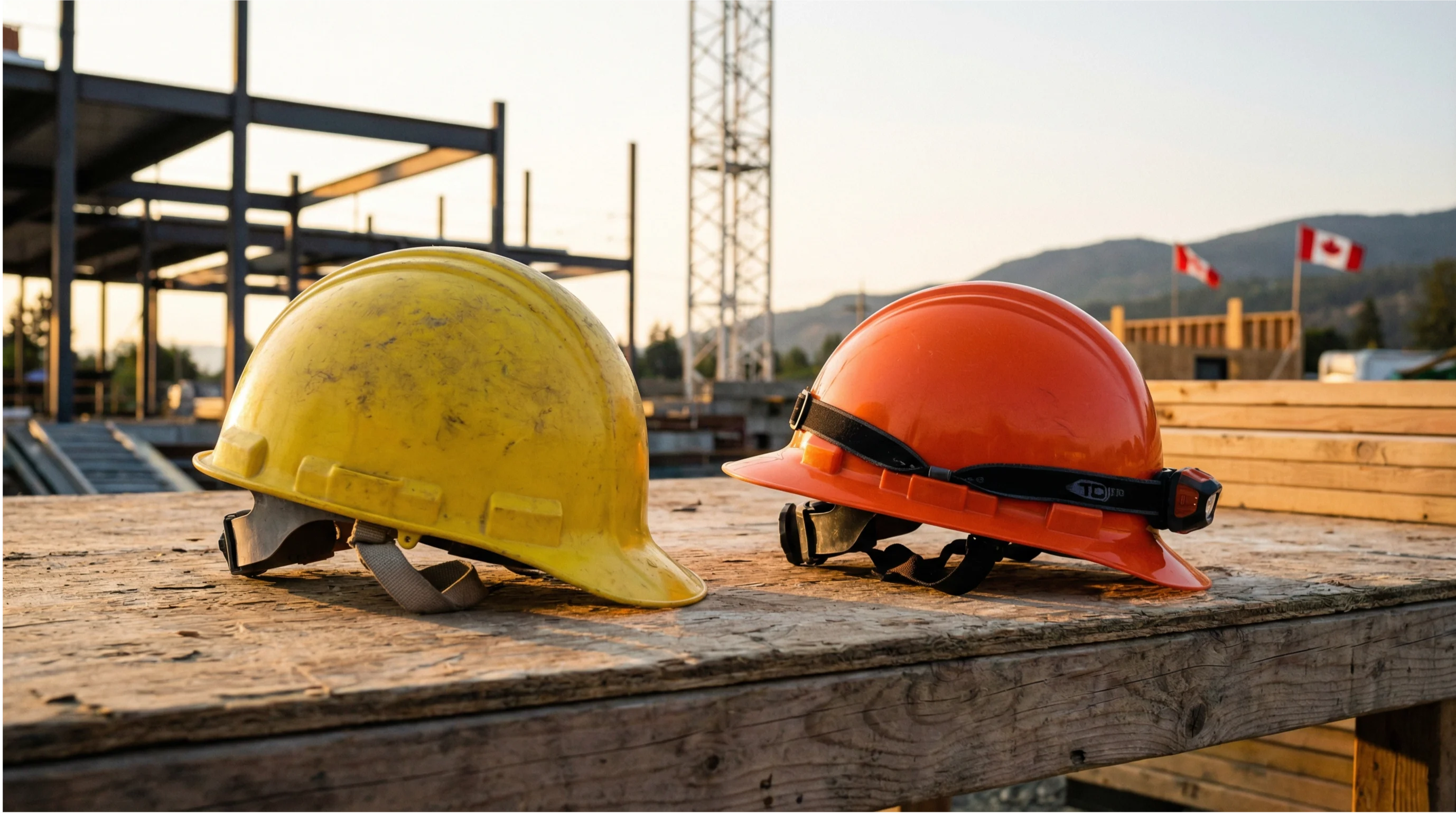
If you have been on a Canadian construction site in the last year, you have probably heard someone mention the Type 2 mandate. Canada's largest general contractors are requiring it. The CCSC has formalized it. And yet most sites are still running on Type 1 helmets because the legal minimum in most provinces has not changed. This post explains what the CSA standard actually requires, what the difference between Type 1 and Type 2 means in practice, and why the industry is moving ahead of the regulation.
What CSA Z94.1 actually governs
The CSA Z94.1-15 (R2020) standard is the document that governs industrial protective headwear in Canada. Most provincial OHS legislation references it directly as the compliance benchmark for hard hats on construction sites. Understanding what the standard covers, and what it does not, is the starting point for any purchasing decision.
The standard defines two systems of classification that operate independently of each other. The first is the type system, which describes the zones of impact and penetration protection. The second is the class system, which describes the level of electrical insulation. These two systems are not interchangeable. A Type 2 helmet is not automatically a Class E helmet, and a Class E helmet is not automatically a Type 2. You are selecting both a type and a class when you specify head protection for your site.
Most purchasing decisions go wrong because people conflate the two systems. A contractor who specifies "Class E" has addressed the electrical requirement but has said nothing about lateral impact protection. A contractor who specifies "Type 2" has addressed lateral impact but has said nothing about electrical insulation. The correct specification for most Canadian construction sites is a Type 2, Class E helmet under CSA Z94.1.
Type 1 vs. Type 2: the protection difference that matters most
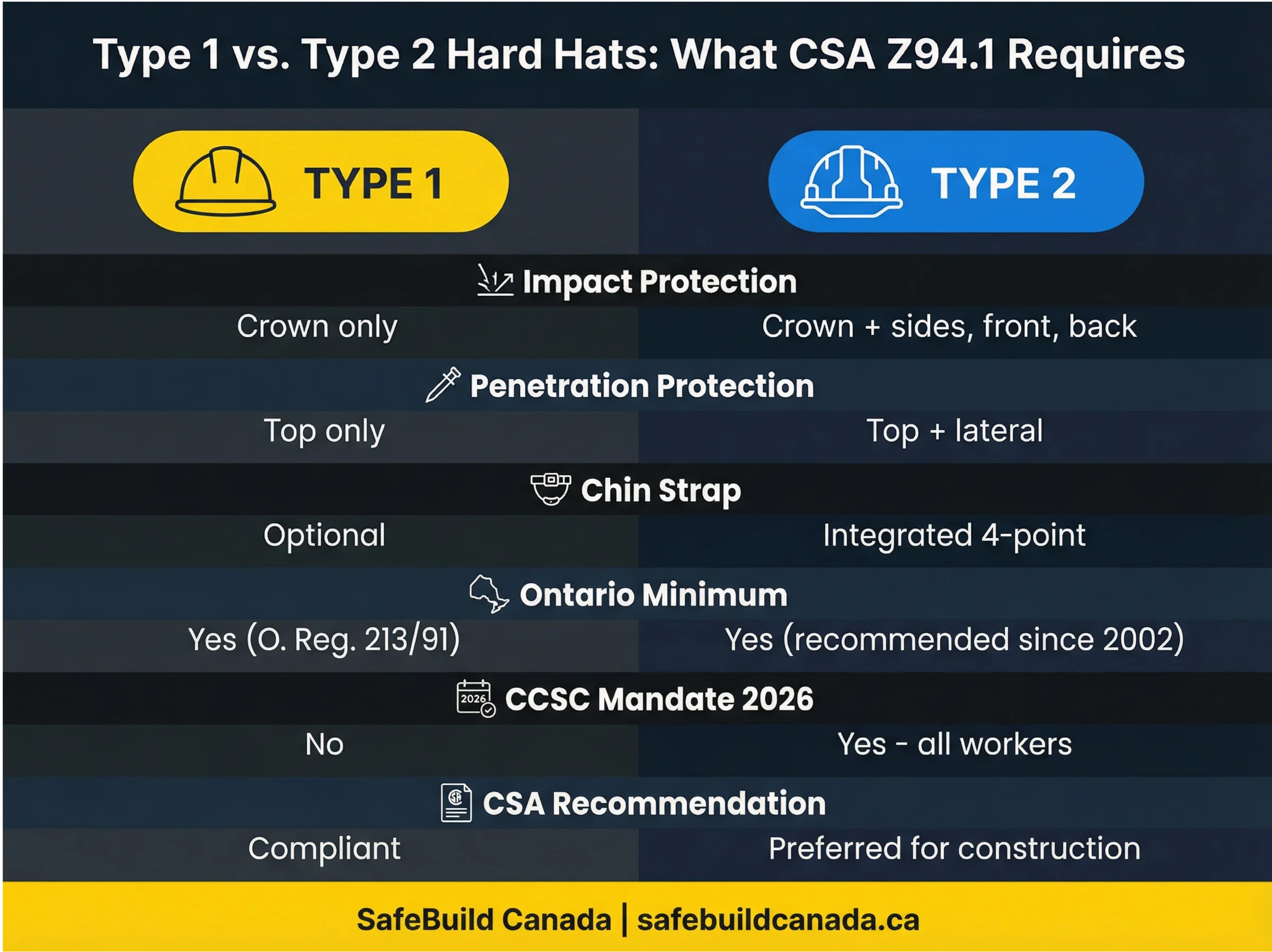
Type 1 hard hats protect against impact and penetration at the crown of the head only. That means the top. If a worker is struck on the side, the front, or the back of the head, a Type 1 helmet provides no certified protection in those zones. This is not a design flaw; it is simply what the Type 1 designation covers.
Type 2 hard hats protect against impact and penetration at the crown and laterally, meaning the sides, front, and back. The IHSA's head protection guidance states directly: "Although both Type 1 and Type 2 hard hats protect the top of the head, Type 2 hard hats provide extra protection against side impact and penetration. That's why a Type 2 hard hat is recommended for construction work."
The other key difference is the retention system. Type 2 helmets include an integrated adjustable chin strap, typically a four-point design, that keeps the helmet on the head during a fall or when a worker is struck. This matters more than many people appreciate. US OSHA data covering the six-year period from 2015 to 2021 found that 68 per cent of work-related traumatic brain injuries in the construction industry were caused by falls, the type of incident that tends to physically separate a worker from their head protection. A helmet that flies off during a fall offers no protection at all. The chin strap on a Type 2 helmet addresses exactly this failure mode.
The three CSA classes and which one your site needs
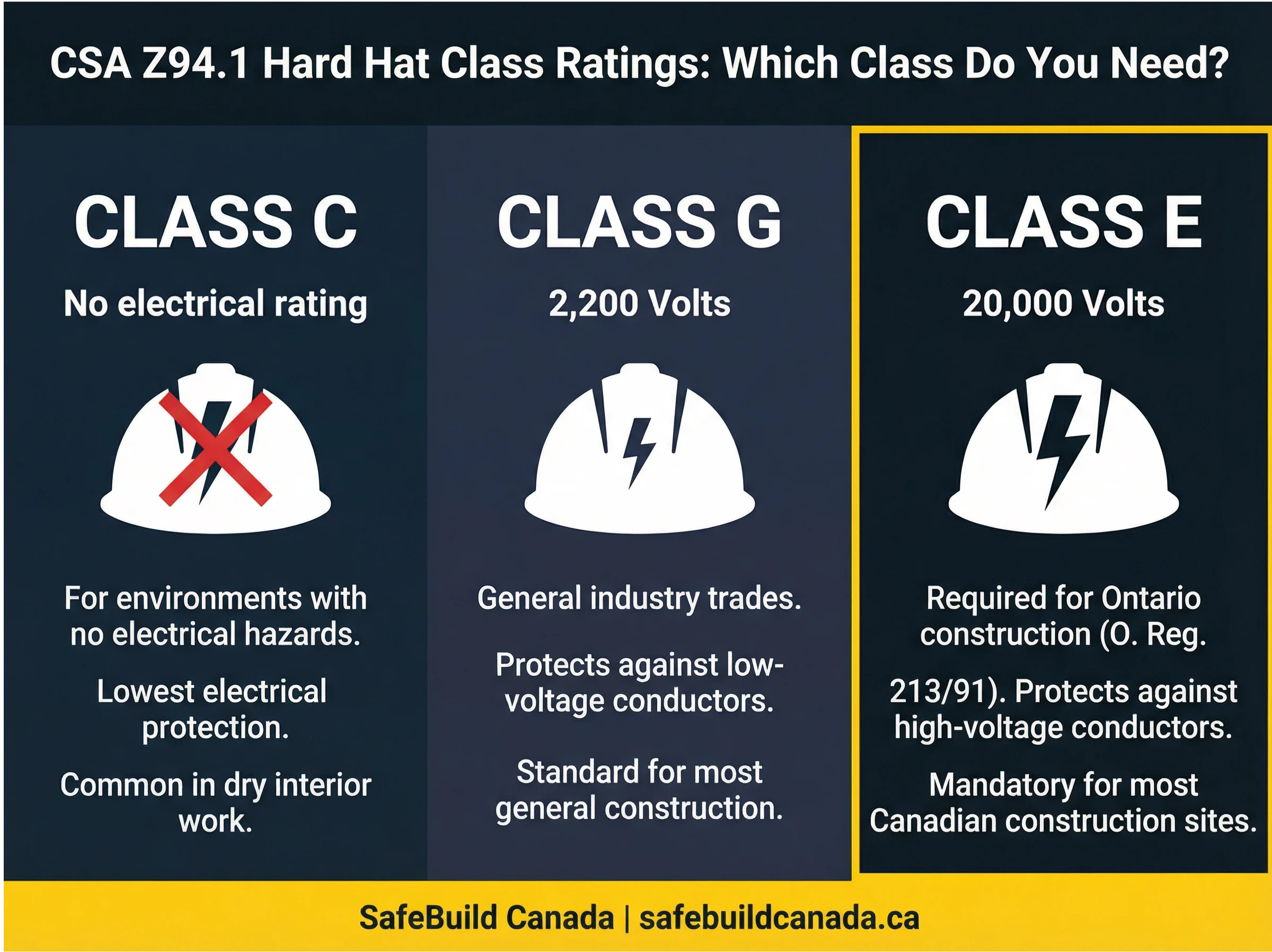
The class system is where a lot of purchasing decisions go wrong. The three classes under CSA Z94.1 are Class C, Class G, and Class E, and they refer exclusively to electrical insulation, not to impact protection.
Class C provides no electrical rating. It is appropriate for environments where there is no risk of contact with live electrical conductors. Class G is rated to 2,200 volts and covers general trades where low-voltage conductors may be present. Class E is rated to 20,000 volts and is the standard required for most Canadian construction sites.
Ontario's Construction Regulation is explicit on this point. The minimum compliant hard hat for an Ontario construction project is a Type 1, Class E under CSA Z94.1. The Class E requirement exists because construction sites routinely involve proximity to overhead power lines, temporary electrical systems, and energized equipment. A Class C or Class G helmet on an active construction site is not compliant with Ontario's minimum standard, regardless of how new or well-maintained it is.
The practical takeaway is that most construction sites in Canada need Class E as the baseline, and the type decision (1 or 2) sits on top of that. You are not choosing between Class E and Type 2. You are choosing a Class E, Type 2 helmet.
Why Canada's largest contractors are mandating Type 2 in 2026
Why Canada's largest contractors are mandating Type 2 in 2026
The Canadian Construction Safety Council, established in 2024 by a dozen of Canada's largest construction companies, has formally mandated the use of Type II helmets with integrated adjustable four-point straps for all workers employed by its member companies. All trade partners working with CCSC member companies are required to wear Type II helmets in 2026. The Canadian Federation of Construction Safety Associations has published a position paper on this shift, noting that accumulating evidence indicates Type II helmets are reducing the number of severe injuries and fatalities for North American construction workers.
This is not a fringe position or a precautionary overcorrection. It is a coordinated industry response to injury data that has been building for years. The CCSC mandate means that if you work as a subcontractor or trade partner on projects run by any of Canada's largest general contractors, your workers will need to be in Type 2 helmets to set foot on site. Getting ahead of this requirement now, rather than scrambling to replace your entire PPE inventory when a contract requires it, is simply good planning.
The CSA has recommended Type 2 hard hats for construction sites since 2002. The fact that it took over two decades for the industry to act on that recommendation says something about how slowly safety culture shifts when the legal minimum remains unchanged. The CCSC mandate is essentially the industry doing what regulation has not yet done.
What to look for when buying Type 2 hard hats for your crew
Not all Type 2 helmets are equal, and the purchasing decision involves more than just confirming the CSA label. Here are the practical factors that matter on a Canadian construction site.
Shell material affects durability, temperature performance, and weight. High-density polyethylene (HDPE) is the most common and handles a wide temperature range. Fibreglass and carbon fibre shells are lighter and more rigid but cost significantly more. In Canadian winters, shell performance at low temperatures matters. Check the manufacturer's temperature rating before purchasing for outdoor use in cold climates.
Suspension system determines fit, comfort, and how well the helmet stays on during a fall. A ratchet suspension with a six-point or eight-point system distributes impact force more evenly than a four-point system. The chin strap on a Type 2 helmet should be a four-point integrated design, not an aftermarket add-on. Aftermarket chin straps attached to Type 1 helmets do not convert them to Type 2 certification.
Accessory compatibility is a practical concern on most sites. If your workers use face shields, hearing protection, or welding attachments that clip to the helmet, confirm that the Type 2 model you are purchasing has compatible accessory slots. Not all Type 2 helmets accept the same accessories, and discovering this after purchase is a common problem. Check the manufacturer's accessory compatibility list before purchasing.
Weight is a real factor for workers wearing a helmet for eight to twelve hours a day. The difference between a 400g and a 600g helmet is noticeable by mid-afternoon. Lighter shells generally cost more, but the ergonomic benefit is real and reduces the temptation to remove the helmet during breaks.
When to replace a hard hat: the rules most sites get wrong
CSA Z94.1-15 (R2020) requires that a hard hat be replaced after any impact, even if there is no visible damage. This rule is widely ignored on Canadian construction sites, and it is one of the most common compliance gaps found during safety audits. The internal suspension and shell can sustain structural damage that is invisible to the naked eye but that significantly reduces protection in a subsequent impact.
Beyond impact replacement, the standard requires daily inspection of the shell, liner, and suspension before each use. Signs that require immediate replacement include cracks, dents, cuts, chalky or dull appearance, reduced flexibility of the shell, and any signs of chemical exposure. Hard hats exposed to prolonged UV radiation, heat, or chemical splash degrade faster than those stored properly.
The year and month of manufacture are marked inside every CSA-compliant hard hat. Many manufacturers recommend replacing the shell every two to five years regardless of visible condition, and the suspension every one to two years. Check your manufacturer's guidance and build replacement cycles into your PPE budget rather than treating hard hats as indefinite assets.
How this fits into your broader PPE program
A hard hat is one component of a layered head protection strategy, not a standalone solution. Your construction site safety plan should specify the type and class of headwear required for each work area, the inspection and replacement protocol, and the procedure for workers who arrive on site with non-compliant headwear.
If your site is subject to the CCSC mandate through a general contractor relationship, that requirement should be written into your subcontractor PPE requirements and communicated at orientation. Workers who show up with Type 1 helmets should not be turned away without a clear process for either providing compliant headwear or sending them to obtain it.
The broader point is that head protection decisions should be driven by hazard assessment, not by what happens to be in the supply room. The CCOHS guidance on protective headwear is clear that the workplace must assess the risk of head injury and provide appropriate protection based on the hazards present. A Type 1, Class E helmet may meet the legal minimum in Ontario, but if your workers are regularly exposed to lateral impact hazards, falling from heights, or working in environments where a fall would separate them from their helmet, the minimum is not the right answer.
The industry has been moving toward Type 2 for over two decades. The CCSC mandate has simply made that movement mandatory for a large portion of the Canadian construction market. Getting your PPE program aligned now means one less compliance gap to manage when the next contract lands on your desk.
For a complete picture of what CSA standards require across all PPE categories on Canadian construction sites, the post on CSA PPE standards for Canadian construction covers the full equipment hierarchy from head to foot. And for a broader overview of what the Construction PPE Canada guide covers across all equipment and gear categories, that cornerstone page is the starting point for your PPE compliance review.
Sources
CCOHS, "Headwear: Selecting Protective Headwear," Canadian Centre for Occupational Health and Safety, 2023.
CFCSA, "Type II Helmets Are Strengthening Protection Against Head Injuries for Construction Workers," Canadian Federation of Construction Safety Associations, 2024.
IHSA, "Chapter 12: Head Protection," Construction Health and Safety Manual, Infrastructure Health and Safety Association.
Government of Ontario, "Achieve Compliance on Construction Sites: General Requirements and Personal Protective Equipment," ontario.ca, 2025.
Canadian Occupational Safety, "The Best Hard Hats to Recommend to Your Construction Team," The Safety Magazine, 2024.