
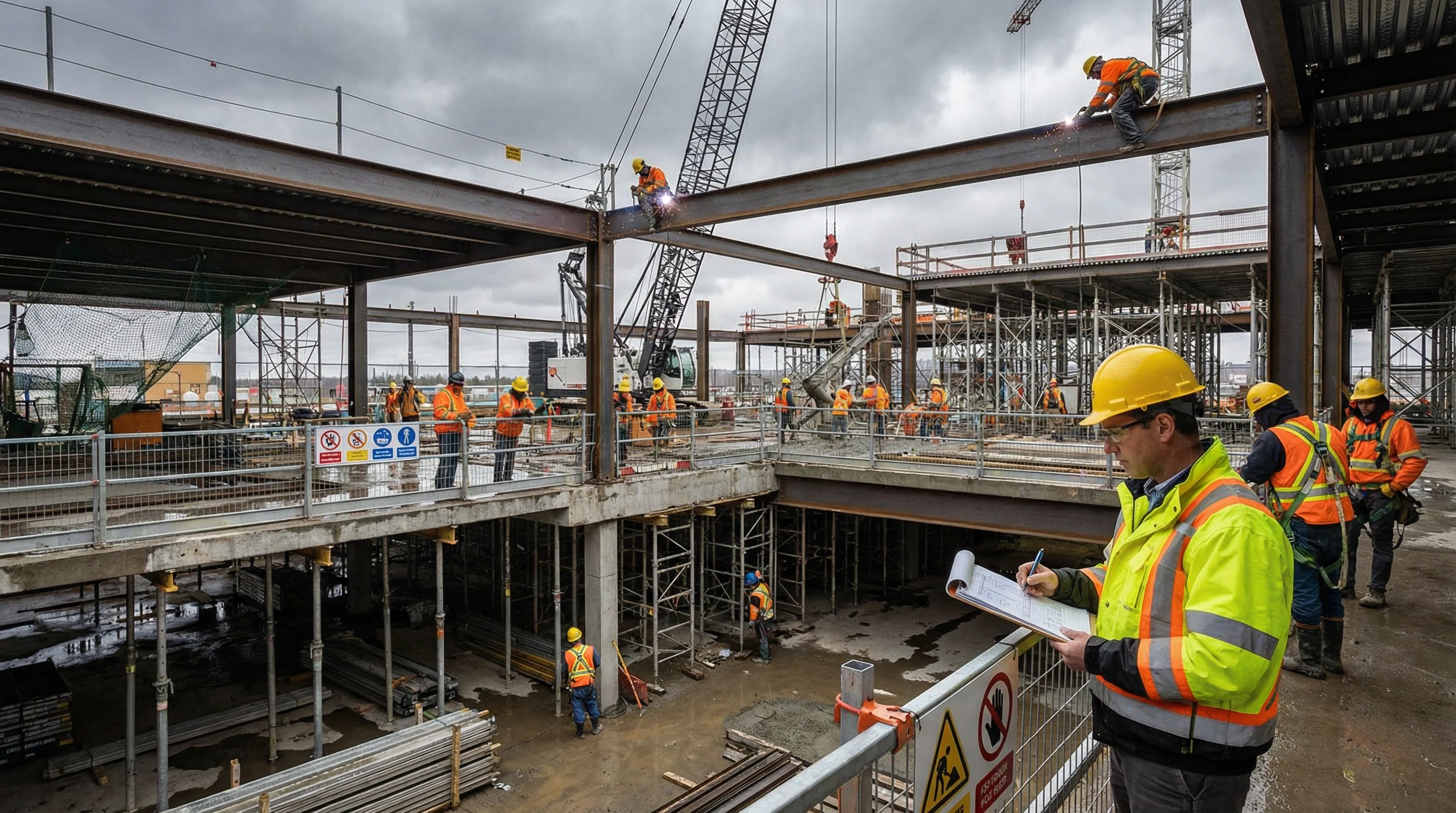
Canada's construction industry employs roughly 1.4 million workers, and it kills more of them than almost any other sector. In 2023, the Association of Workers' Compensation Boards of Canada recorded over 1,000 work-related deaths nationally, and construction consistently accounts for roughly 20 percent of that total. That is not a statistic to note and move on from. It means that on average, a construction worker in this country dies from a work-related cause every few days.
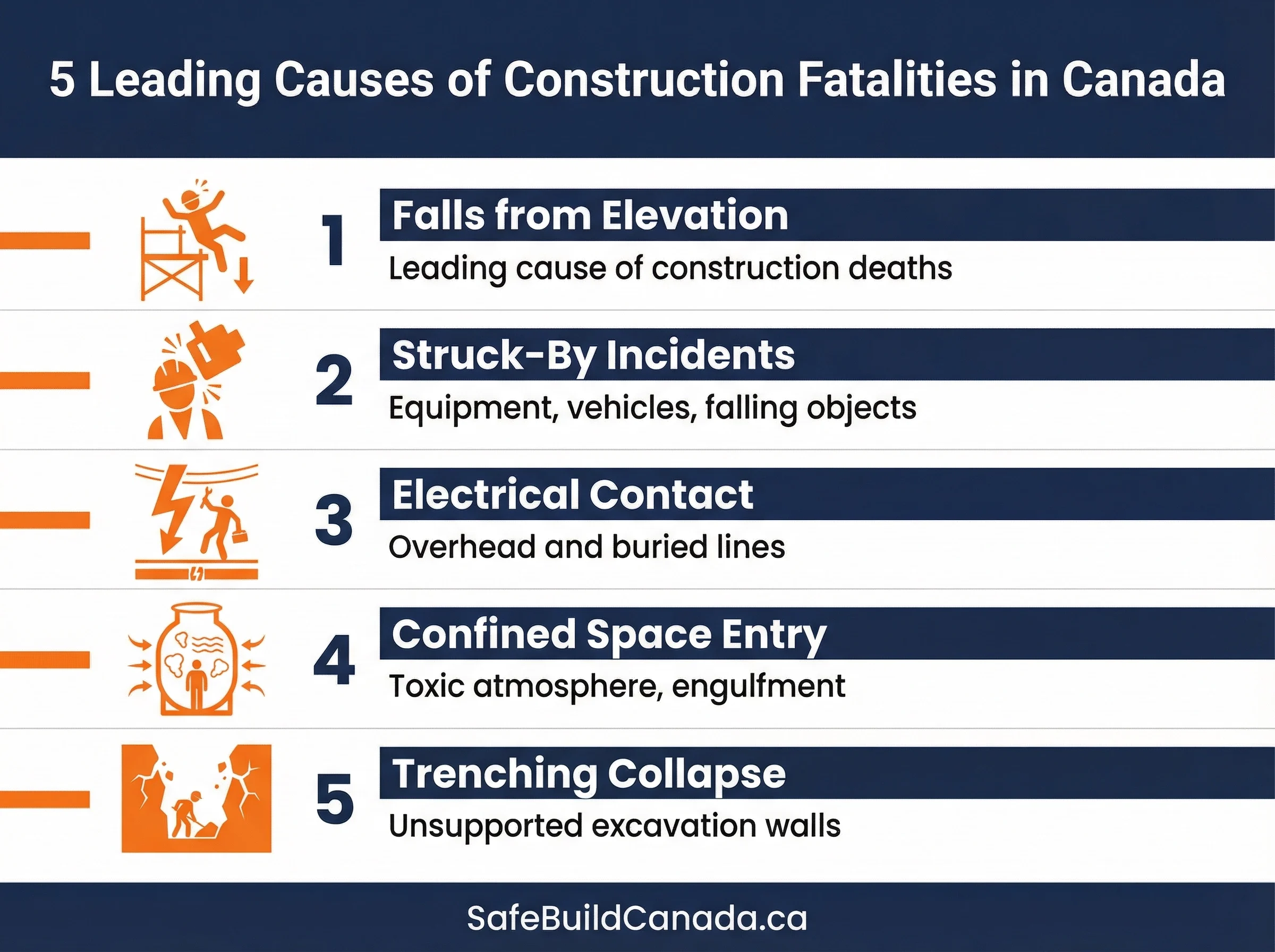
The causes are not mysterious. They are the same five hazards that have topped the fatality list for decades: falls from elevation, struck-by incidents involving vehicles and equipment, contact with electrical sources, confined space entry, and trenching collapses. Every one of these is preventable with the right planning, training, and systems in place.
This guide covers the full picture of construction site safety in Canada. It explains what federal and provincial law actually requires, what the five leading hazards look like in practice, and how to build a safety system that works on a real site with real workers, not just on paper.
Why construction is the most dangerous industry in Canada
The fatality rate in construction is roughly 20 deaths per 100,000 workers, which is more than three times the national average across all industries. That rate has not changed significantly in a decade, despite improvements in PPE technology, digital inspection tools, and safety training programs.
Part of the reason is structural. Construction sites are temporary workplaces that change daily. A hazard that did not exist on Monday morning can appear by Tuesday afternoon. Workers from multiple employers share the same space, often without clear communication about what the other trades are doing. Seasonal pressures, tight schedules, and subcontracting chains add layers of complexity that permanent workplaces simply do not have.
Part of the reason is cultural. Construction has historically treated injury as an occupational inevitability rather than a management failure. That attitude is changing, but slowly. The sites that have made the most progress on safety outcomes are the ones where management treats every near-miss as a data point and every incident as a system failure, not a worker failure.
The Canadian Centre for Occupational Health and Safety defines a health and safety program as "a definite plan of action designed to prevent incidents and occupational diseases." That definition matters because it frames safety as something you design and manage, not something that happens or does not happen to you.
The legal framework: what Canadian law actually requires
There is no single national OHS standard for construction in Canada. The federal Canada Labour Code covers federally regulated workers, but most construction falls under provincial jurisdiction. Ontario, British Columbia, and Alberta each have their own legislation, and the requirements differ in meaningful ways.
Ontario operates under the Occupational Health and Safety Act (OHSA) and Ontario Regulation 213/91: Construction Projects. The OHSA places duties on constructors (the party in overall control of a project), employers, supervisors, and workers. A constructor must ensure that all measures and procedures prescribed by the OHSA and its regulations are carried out on the project. Fines for corporations convicted under the OHSA reach $1.5 million per offence, and individuals can face fines up to $100,000. The Ministry of Labour, Immigration, Training and Skills Development enforces compliance through both planned and reactive inspections.
British Columbia operates under the Workers Compensation Act and the OHS Regulation administered by WorkSafeBC. Part 3 of the OHS Regulation sets out the rights and responsibilities of employers, supervisors, and workers. On multi-employer construction sites, the prime contractor is responsible for overall coordination of OHS activities. WorkSafeBC reported in April 2025 that over 1,000 construction workers were injured due to falls from elevation in BC in 2024 alone, which prompted a renewed planned inspectional initiative targeting fall protection on residential and commercial sites.
Alberta operates under the Occupational Health and Safety Act and the OHS Code. Alberta uses an administrative penalty system that can reach $10,000 per day for ongoing violations, in addition to prosecution under the OHS Act. The prime contractor concept applies on multi-employer sites, and employers with 20 or more workers are required to have a formal health and safety program.
The common thread across all three provinces is this: the legal obligation to maintain a safe worksite does not transfer to workers or subcontractors. The party in overall control of the site, whether that is a constructor in Ontario or a prime contractor in BC and Alberta, carries the primary duty to ensure safety measures are in place and followed. Contracts do not change that. A clause saying a subcontractor is responsible for their own safety does not relieve the prime from their statutory obligations.
The five leading causes of construction fatalities in Canada
Understanding where fatalities actually come from is the starting point for any serious safety program. The five hazard categories below account for the overwhelming majority of construction deaths in Canada.
Falls from elevation
Falls are the leading cause of construction fatalities in Canada, and have been for as long as national data has been collected. The hazard is straightforward: workers at height, without adequate protection, fall. The prevention is equally straightforward: guardrails, fall arrest systems, and travel restraints, properly selected, installed, and used.
The complexity is in the execution. A guardrail that is not properly anchored provides a false sense of security. A harness that is not connected to an anchor point is decoration. A worker who has been trained on fall protection but has never had a supervisor check their setup is a worker who may be making errors they do not know they are making.
The SafeBuild Canada guide on fall protection requirements in Canada covers the specific requirements under Ontario, BC, and Alberta regulations, including trigger heights, anchor point standards, and the difference between fall arrest and fall restraint systems.
Struck-by incidents
Struck-by incidents are the second leading cause of construction fatalities. They involve workers being hit by moving vehicles, swinging equipment, falling objects, or flying debris. The Ontario Ministry of Labour's 2024 compliance campaign on struck-by hazards found that a significant proportion of sites visited had inadequate traffic management plans, no exclusion zones around mobile equipment, and workers on foot sharing space with operating machinery without adequate separation.
The SafeBuild Canada guide on heavy equipment safety on Canadian construction sites covers the specific regulatory requirements for mobile equipment, pre-use inspection, exclusion zones, and operator training under Ontario O.Reg. 213/91 and BC OHS Regulation Part 16.
Electrical contact
Contact with overhead and buried electrical lines kills construction workers every year in Canada. The hazard is particularly common during excavation, when workers or equipment contact buried utilities, and during crane and boom truck operations near overhead lines. The minimum safe approach distances vary by voltage and jurisdiction, but the principle is consistent: before any work near electrical infrastructure, the lines must be identified, and a safe approach distance must be established and enforced.
Confined space entry
Confined spaces on construction sites include manholes, tanks, trenches deeper than 1.2 metres, crawl spaces, and any enclosed or partially enclosed space not designed for continuous human occupancy. The hazard is that the atmosphere inside a confined space can be toxic, oxygen-deficient, or flammable, and a worker who enters without testing the atmosphere and establishing rescue procedures can be overcome before anyone realizes what is happening.
The SafeBuild Canada guide on confined space entry on construction sites covers the entry permit system, atmospheric testing requirements, and rescue planning under Ontario, BC, and Alberta regulations.
Trenching and excavation collapse
Trenching collapses are among the most lethal construction incidents because they happen fast and the weight of soil is enormous. One cubic metre of soil weighs approximately 1,600 kilograms. A worker caught in a trench collapse has seconds, not minutes. Shoring, sloping, and benching are the three accepted methods of protecting workers in excavations, and the choice between them depends on soil type, depth, and site conditions.
The four pillars of a construction site safety system
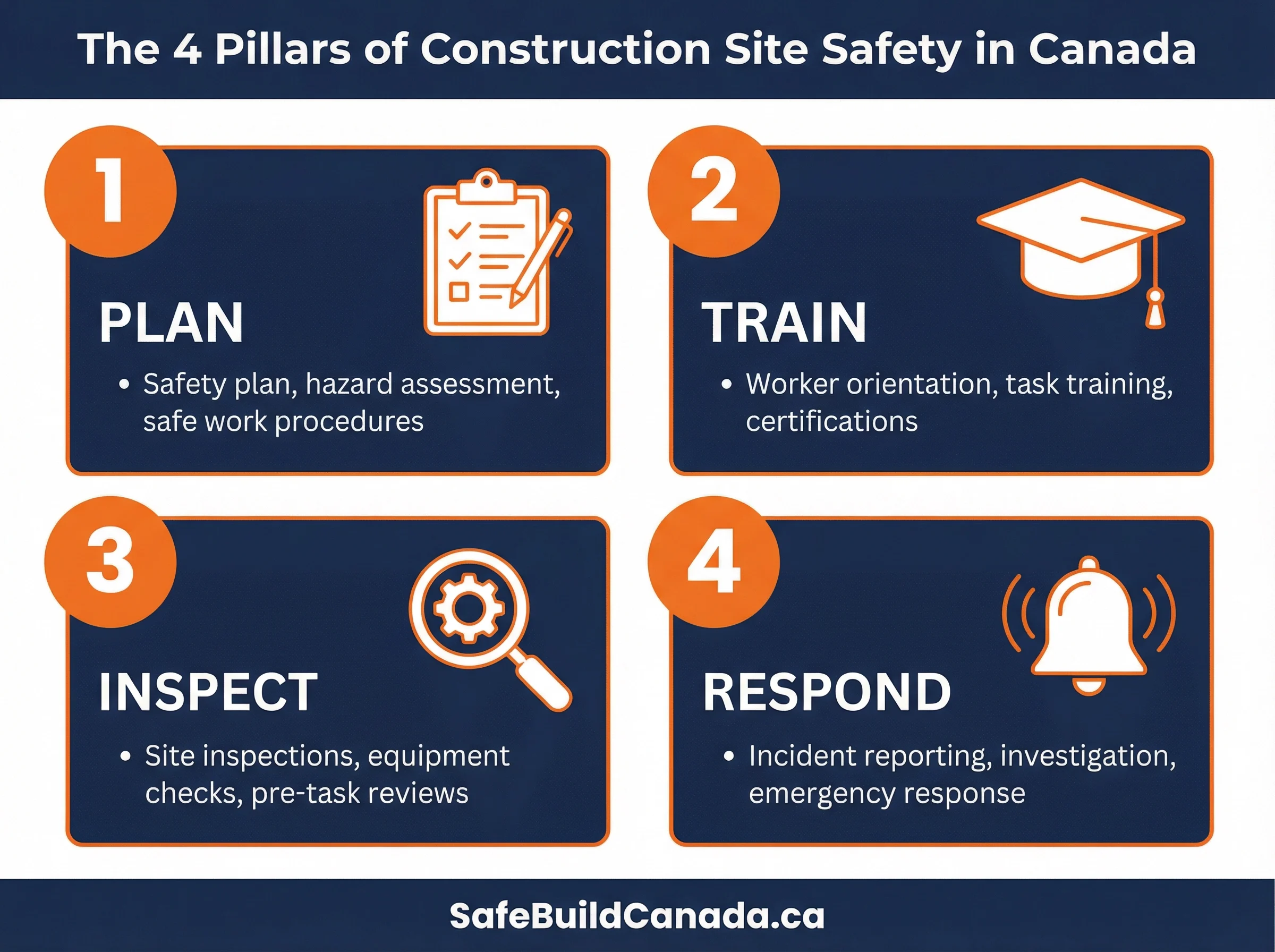
A safety system is not a binder on a shelf. It is a set of processes that run continuously on the site, embedded in how work is planned, how workers are oriented, how the site is monitored, and how the organization responds when something goes wrong.
Pillar 1: Plan
Planning is where safety either gets built into the work or gets left out. The planning pillar includes three core documents: the site safety plan, the hazard assessment, and the safe work procedures for high-risk tasks.
The site safety plan is the master document that describes how safety will be managed on the project. It covers roles and responsibilities, site-specific hazards, emergency procedures, and the processes for inspections, incident reporting, and subcontractor management. The SafeBuild Canada guide on how to build a construction site safety plan in Canada covers all ten required sections in detail.
The hazard assessment is the process of identifying what can go wrong before work starts. In Ontario, employers are required to assess hazards before work begins and to review the assessment when conditions change. In BC, the OHS Regulation requires a written safe work procedure for any work that involves a risk of injury. In Alberta, the OHS Code requires a hazard assessment before work begins on any project.
Safe work procedures are the step-by-step instructions for how high-risk tasks are to be performed. They are not generic. A safe work procedure for working at heights on a specific project should reflect the actual conditions on that project, the equipment being used, and the controls that are in place.
Pillar 2: Train
Training is the mechanism by which planning becomes practice. A safe work procedure that workers have never seen is not a control. A hazard assessment that supervisors have not reviewed with their crews is not a communication.
Every worker on a Canadian construction site must receive a site-specific orientation before starting work. The orientation covers site hazards, emergency procedures, the location of first aid, and the worker's rights under OHS legislation, including the right to refuse unsafe work. This is a legal requirement in all three provinces.
Beyond orientation, workers who perform high-risk tasks must be trained on those tasks. Fall protection training, confined space entry training, and WHMIS training are all required by regulation. The training must be documented, and the documentation must be kept on site and available for inspection.
Supervisors have a separate training obligation. In Ontario, the Working at Heights training standard requires that supervisors who direct workers at heights have completed the approved training. In BC, the OHS Regulation requires that supervisors be familiar with the OHS Regulation and the safe work procedures for the work they are supervising.
Pillar 3: Inspect
Inspections are how you find out whether the controls you planned are actually in place. A site that is inspected regularly and where findings are acted on is a site that gets safer over time. A site that is inspected only when a regulator arrives is a site that is managed reactively.
There are three types of inspections that should be running on any serious construction site. Pre-task inspections happen before high-risk work begins and confirm that the controls are in place for that specific task. Regular site inspections, typically weekly, cover the whole site and look for hazards, housekeeping issues, and compliance with safe work procedures. Equipment inspections happen before each use and confirm that tools and machinery are in safe operating condition.
The SafeBuild Canada guide on hazard identification on construction sites covers the inspection process in detail, including what to look for, how to document findings, and how to ensure corrective actions are completed.
Pillar 4: Respond
The response pillar covers two things: what happens when an incident occurs, and what happens when an inspection finds a hazard.
When an incident occurs, the first priority is the safety of the injured worker and the prevention of further injury. The second priority is preserving the scene for investigation. The third priority is reporting. In Ontario, critical injuries and fatalities must be reported to the Ministry of Labour immediately by telephone. In BC, serious injuries and fatalities must be reported to WorkSafeBC immediately. In Alberta, serious injuries and fatalities must be reported to Alberta OHS immediately.
After the immediate response, the investigation begins. The purpose of an incident investigation is not to assign blame. It is to find the root causes of the incident and to put controls in place that prevent recurrence. The SafeBuild Canada guide on construction site emergency response plans covers both the emergency response process and the incident investigation framework in detail.
When an inspection finds a hazard, the response must be proportionate to the risk. An imminent danger requires immediate action: stop the work, remove workers from the hazard, and fix the problem before work resumes. A lower-risk finding can be addressed on a scheduled timeline, but it must be tracked and closed.
Managing safety across multiple employers
Most construction projects involve multiple employers on the same site at the same time. General contractors, subcontractors, and specialty trades all share the same space, and the hazards created by one trade can affect workers from another.
The constructor or prime contractor is legally responsible for coordinating OHS activities across all employers on the site. That responsibility cannot be contracted away. The SafeBuild Canada guide on managing subcontractor safety on Canadian construction sites covers the prequalification process, contract language, orientation requirements, and the documentation that demonstrates the constructor has met its legal obligations.
The practical challenge is communication. When a subcontractor starts a new task that creates a hazard for workers from another trade, someone needs to know and someone needs to act. That requires a site coordination process: regular safety meetings, a system for communicating hazard changes, and clear lines of authority for stopping work when a hazard is identified.
What a mature safety culture actually looks like
The four pillars describe the structural elements of a safety system. But structure alone does not prevent incidents. The sites with the best safety records are the ones where safety culture is embedded in how people think and talk about work, not just in what documents they have on file.
A mature safety culture has a few recognizable characteristics. Workers raise hazards without fear of being dismissed or penalized. Supervisors stop work when something does not look right, even when it creates schedule pressure. Near-misses are reported and investigated with the same seriousness as incidents. Management visibly participates in safety activities, not just in signing off on documents.
The opposite of a mature safety culture is one where safety is treated as a compliance exercise. Where the binder exists because the inspector might ask for it. Where workers know that raising a concern will slow the job down and they will be blamed for it. Where incidents are attributed to worker error and the system is never examined.
The data on this is consistent. Sites with strong safety cultures have lower injury rates, lower lost-time claim rates, and lower insurance costs. The investment in building a real safety culture pays back in measurable ways. The question is whether the people running the site are willing to make that investment before an incident forces the issue.
The right to refuse unsafe work
Every worker in Canada has the legal right to refuse work they believe is likely to endanger themselves or another worker. This right exists under the OHSA in Ontario, the Workers Compensation Act in BC, and the OHS Act in Alberta. It is not a disciplinary offence to exercise this right, and an employer who penalizes a worker for a legitimate refusal is in violation of the law.
In practice, the right to refuse is underused. Workers on construction sites often feel that raising a safety concern will slow the job down and create friction with supervisors or the general contractor. That perception is a symptom of a weak safety culture. On sites where the culture is strong, workers know that raising a concern is the right thing to do and that it will be taken seriously.
The process for a work refusal is similar across provinces. The worker notifies the supervisor. The supervisor investigates. If the worker remains unsatisfied, a worker representative or joint health and safety committee member is brought in. If the matter is still unresolved, the regulator is notified. At no point during this process can the worker be assigned to the refused task until the hazard is resolved.
Supervisors need to understand this process and respond to refusals without defensiveness. A refusal is information. It means something on the site is not right, and the response should be to find out what it is, not to pressure the worker back to work.
Reporting and investigation requirements
When something goes wrong on a construction site, the reporting and investigation requirements are specific and time-sensitive. Getting them wrong creates legal exposure on top of the incident itself.
In Ontario, the OHSA requires that a constructor or employer notify the Ministry of Labour immediately by telephone when a worker is killed or critically injured. Critical injury is defined in the regulations and includes fractures, amputations, loss of vision, and injuries requiring admission to hospital for 24 hours or more. The scene of a critical injury or fatality must not be disturbed except to save life or relieve suffering, and the Ministry inspector must give permission before the scene is altered.
In BC, WorkSafeBC must be notified immediately when a worker is killed or seriously injured. Serious injury includes any injury that requires medical treatment beyond first aid, any injury that results in lost time beyond the day of the incident, and any incident that had the potential to cause serious injury even if no one was hurt. BC also requires that the employer conduct a formal investigation and submit a written report.
In Alberta, Alberta OHS must be notified immediately when a worker is seriously injured or killed. The employer must also conduct an investigation and prepare a written report within 10 days. Alberta's OHS Act requires that the investigation identify the causes of the incident and the corrective actions that will prevent recurrence.
Across all three provinces, the investigation report must go beyond identifying what happened and must address why it happened. Root cause analysis, not blame assignment, is the legal and practical standard. The SafeBuild Canada guide on construction site emergency response plans covers the full investigation framework and the documentation requirements in detail.
Joint health and safety committees
On larger construction projects, joint health and safety committees are a legal requirement. In Ontario, a JHSC is required on projects where 20 or more workers are regularly employed. The committee must have at least two members, at least half of whom must be worker representatives who are not management. The committee meets regularly, conducts workplace inspections, reviews incident reports, and makes recommendations to the employer.
In BC, a joint committee is required on worksites with 20 or more workers. In Alberta, a health and safety committee is required for employers with 20 or more workers at a worksite.
The JHSC is not a rubber stamp. It is a mechanism for workers to participate meaningfully in safety decisions. Employers who treat the committee as a compliance checkbox rather than a genuine advisory body are missing the point and, in many cases, not meeting their legal obligations. The committee's recommendations must be responded to in writing, and if the employer disagrees with a recommendation, the employer must explain why.
Where to start if you are building a safety program from scratch
If your site does not have a formal safety program, the place to start is not with the most complex element. Start with the hazard assessment. Walk the site, identify what can go wrong, and write it down. That document becomes the foundation for everything else: the safe work procedures, the inspection checklists, the training topics, and the emergency response plan.
From there, build the site safety plan. The SafeBuild Canada guide on how to build a construction site safety plan in Canada walks through all ten required sections with specific guidance on what each section needs to contain to satisfy Ontario, BC, and Alberta requirements.
If your site already has a plan but you are not sure it is working, the inspection process is the fastest diagnostic tool. Run a full site inspection against your existing plan and see where the gaps are. The gaps between what the plan says and what is actually happening on site are the gaps that will show up in an incident investigation.
The goal is not a perfect document. It is a system that actually operates, that workers know about and use, and that gets better over time as you learn from inspections and incidents. That is what the law requires, and it is what actually keeps workers from getting hurt.
Sources
Canadian Centre for Occupational Health and Safety. Health and Safety Program: General Elements. CCOHS OSH Answers Fact Sheet, 2024.
Association of Workers' Compensation Boards of Canada. National Work Injury / Disease Statistics Program (NWISP). AWCBC, 2023 data year.
WorkSafeBC. WorkSafeBC urges construction employers to prevent falls from heights. WorkSafeBC News Release, April 16, 2025.
Ontario Ministry of Labour, Immigration, Training and Skills Development. Guide to the Occupational Health and Safety Act. Ontario.ca, updated June 29, 2022.
Government of Alberta. OHS Act, regulation and code. Alberta.ca, 2025.
Infrastructure Health and Safety Association. Construction Health and Safety Manual (M029). IHSA, current edition.