
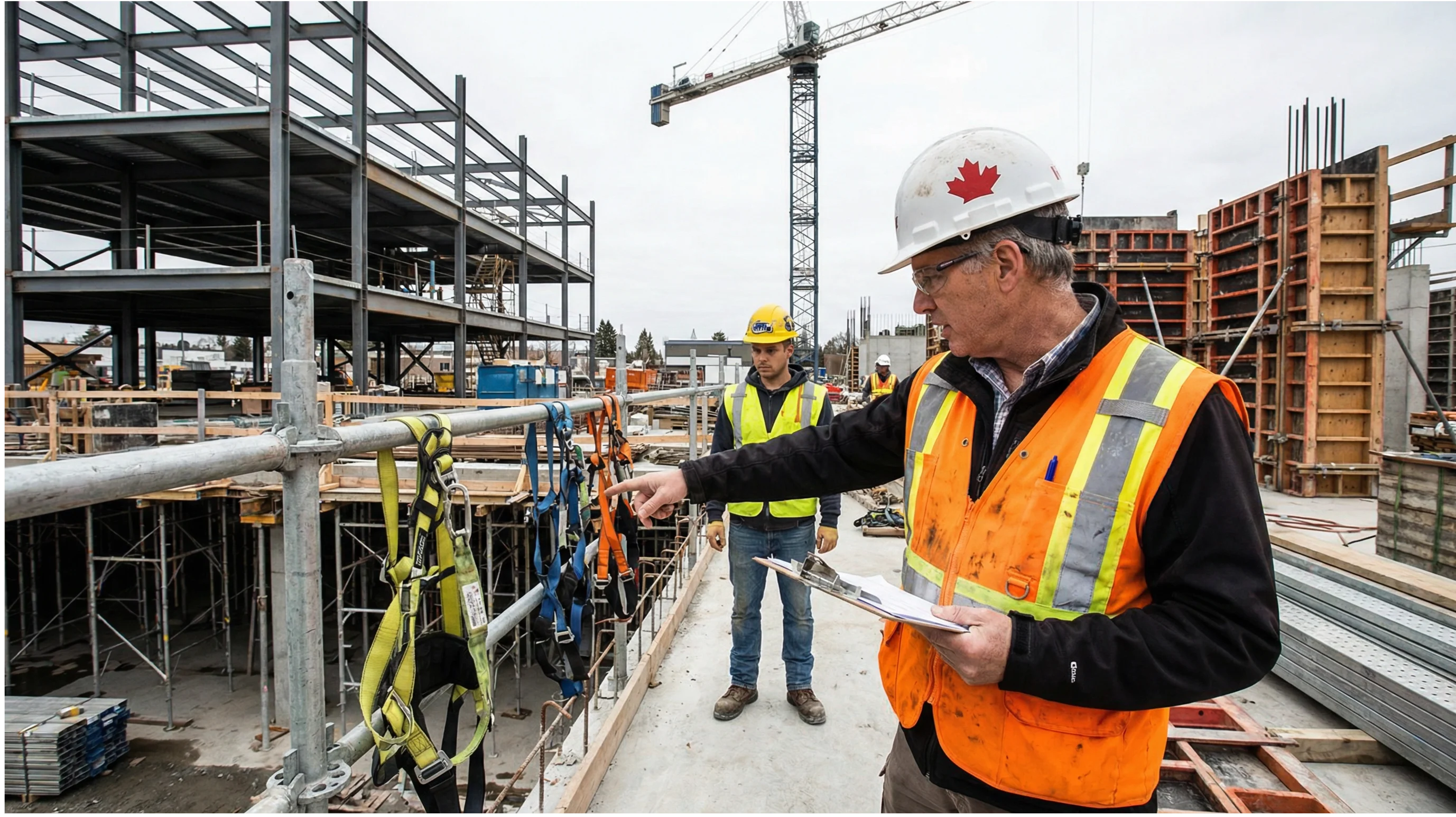
Construction site inspections are one of those things that every employer knows they should be doing, but the details (who does them, how often, what gets documented, and what happens with the findings) are often murkier than they should be. The legal requirements vary by province and by the size of the project, and the connection between your day-to-day inspection program and your COR certification is something that catches a lot of contractors off guard during audits.
This guide walks through the legal inspection requirements for Canadian construction sites, the four types of inspections you need to understand, who is responsible for conducting them, how to document findings and follow up on corrective actions, and how a well-run inspection program becomes one of your strongest assets when a COR auditor or Ministry of Labour inspector shows up on site.
Why inspections are a legal obligation, not just a best practice
Every Canadian province and the federal jurisdiction under the Canada Labour Code Part II imposes a legal duty on employers to inspect their workplaces on a regular basis. The specific frequency and format requirements vary, but the underlying obligation is consistent: employers must have a systematic process for identifying hazards in the physical workplace and acting on what they find.
Under the Canada Labour Code Part II, as explained in the Employment and Social Development Canada guide to workplace inspections, employers must ensure that all or part of the workplace is inspected every month by the workplace committee or the health and safety representative, and that the entire workplace is fully inspected over the course of each year. That is not a suggestion. It is a statutory obligation for federally regulated workplaces, and the equivalent requirements in provincial legislation follow the same logic.
In Ontario, the Occupational Health and Safety Act requires that a joint health and safety committee (JHSC) be established on construction projects expected to last three months or more with 20 or more workers regularly employed. One of the core functions of that JHSC is to conduct workplace inspections. The IHSA's guidance on workplace inspections for Ontario construction makes clear that supervisors are expected to conduct formal documented inspections weekly, and that JHSC members or health and safety representatives must conduct monthly inspections of the entire site.
In British Columbia, WorkSafeBC's OHS Regulation requires employers to establish an inspection program as part of their overall occupational health and safety program. The frequency and scope of inspections must be appropriate to the hazards present on the site, and the results must be documented and acted upon.
The WorkSafeNB OHS Guide on workplace inspections summarizes the general Canadian standard well: employers must include inspection procedures and schedules in their hazard identification system, ensure the workplace is inspected at least monthly, develop the inspection program in consultation with the JHSC or health and safety representative, and keep records of all inspections, findings, recommendations, and follow-up actions.
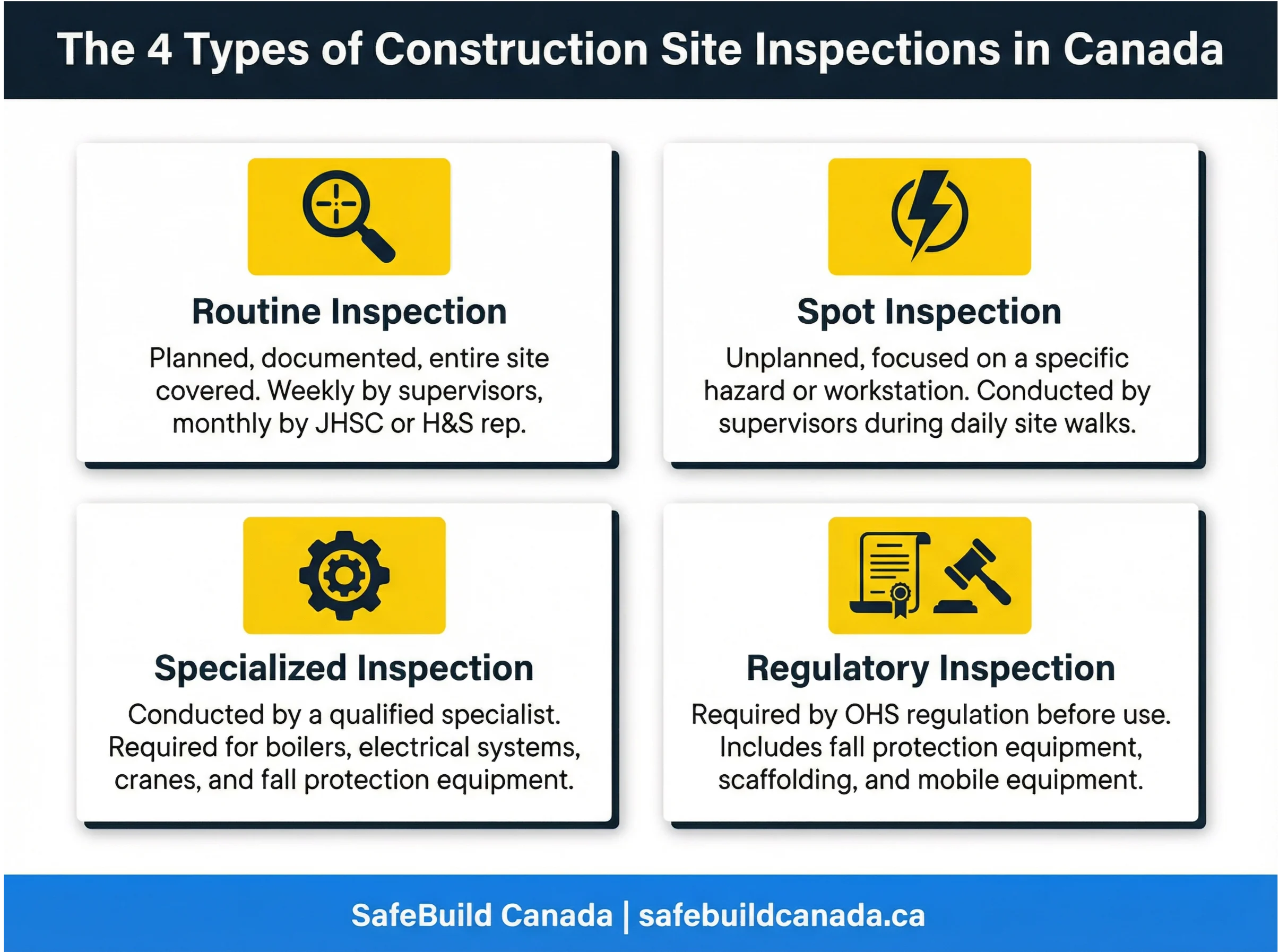
The four types of construction site inspections
Not all inspections are the same, and understanding the four types helps you build a program that actually covers your legal obligations rather than just going through the motions with a single checklist.
Routine inspections are the backbone of any inspection program. They are planned, documented, and cover the entire site systematically over a defined period. In Ontario construction, this means weekly by supervisors and monthly by JHSC members or health and safety representatives. Routine inspections use a checklist that covers all working conditions, including hazards, processes, equipment, housekeeping, and PPE compliance. The goal is not to catch workers doing something wrong. It is to identify conditions that could lead to injury before they do.
Spot inspections are unplanned and focused. A supervisor walking the site and noticing that a guardrail has been removed, or that a worker is using a ladder that should have been taken out of service, is conducting a spot inspection. These happen continuously throughout the workday and are one of the most effective ways to catch hazards in real time. They do not replace routine inspections, but they are an essential complement to them.
Specialized inspections are conducted by a qualified person with specific technical knowledge. Crane inspections, boiler inspections, and fall protection equipment inspections all fall into this category. The Canada.ca workplace inspections guide notes that critical parts inspections, which are regular inspections of machine components with high potential for serious accidents, are often part of a preventive maintenance program. On a construction site, this includes the daily crane pre-operation inspection, the start-of-shift inspection for mobile equipment, and the periodic inspection of fall arrest systems by a competent person.
Regulatory inspections are required by OHS regulation before specific equipment or systems can be used. Scaffolding must be inspected before workers are permitted to use it. Fall protection equipment must be inspected before each use. Mobile equipment must be inspected at the start of each shift. These are not optional, and the inspection results must be recorded. WorkSafeBC's 2025 mobile equipment regulation update, covered in our post on provincial OHS regulation updates for 2025 and 2026, added new seat belt and operator restraint requirements that now form part of the pre-shift inspection obligation for mobile equipment operators in BC.
Who must conduct inspections and what qualifies them
The answer to "who does the inspection" depends on the type of inspection and the size of the project. For routine inspections, the IHSA's guidance on workplace inspections establishes a clear hierarchy for Ontario construction: supervisors conduct formal documented inspections weekly, JHSC members or health and safety representatives conduct monthly inspections, and middle and upper management conduct periodic safety tours to identify substandard conditions.
The WorkSafeNB OHS Guide recommends that the inspection team for a routine inspection ideally include the workplace manager, the floor supervisor, an employee with good knowledge of the processes involved, and a JHSC member or health and safety representative. That is not always practical on a small site, but the principle is sound: inspections are more effective when the people conducting them have direct knowledge of the work being done.
For specialized inspections, the inspector must be a qualified person as defined by the applicable regulation. On a construction site, that typically means a competent person with specific training and experience relevant to the equipment or system being inspected. A general labourer cannot conduct a crane inspection. A supervisor without fall protection training cannot certify that a fall arrest system is fit for use.
The four-step inspection process
A good inspection is not a walk around the site with a clipboard. The Canada.ca workplace inspections guide outlines a four-step process that applies equally well to construction site inspections.
Step one is planning. Before the inspection begins, the team should review the floor plan or site layout, the previous inspection report and any outstanding corrective actions, incident and near-miss records for the area being inspected, and the relevant sections of the OHS regulation that apply to the work being done. The checklist should be prepared in advance and tailored to the specific hazards on the site.
Step two is the physical inspection. The team moves through the site systematically, observing work being done, examining equipment and materials, checking housekeeping and storage, and noting any conditions that deviate from the standard. Good inspectors ask questions. A worker who has been doing a task for three months often knows about a hazard that has never been formally identified.
Step three is writing the report. Every finding gets documented, including the location, the nature of the hazard, the risk level, and the recommended corrective action. Findings should be prioritized: immediate hazards that require work to stop get addressed before the inspector leaves the area. Lower-priority findings get assigned to a responsible person with a target completion date.
Step four is follow-up. This is where most inspection programs fall apart. A finding that gets documented but never acted on is worse than useless. It is evidence that the employer knew about a hazard and did nothing. The IHSA's guidance on inspections is clear: inspection results must be communicated to the appropriate supervisors, kept on file on site, and forwarded to the company head office for review and retention. Corrective actions must be tracked to completion.
How your inspection program connects to COR certification
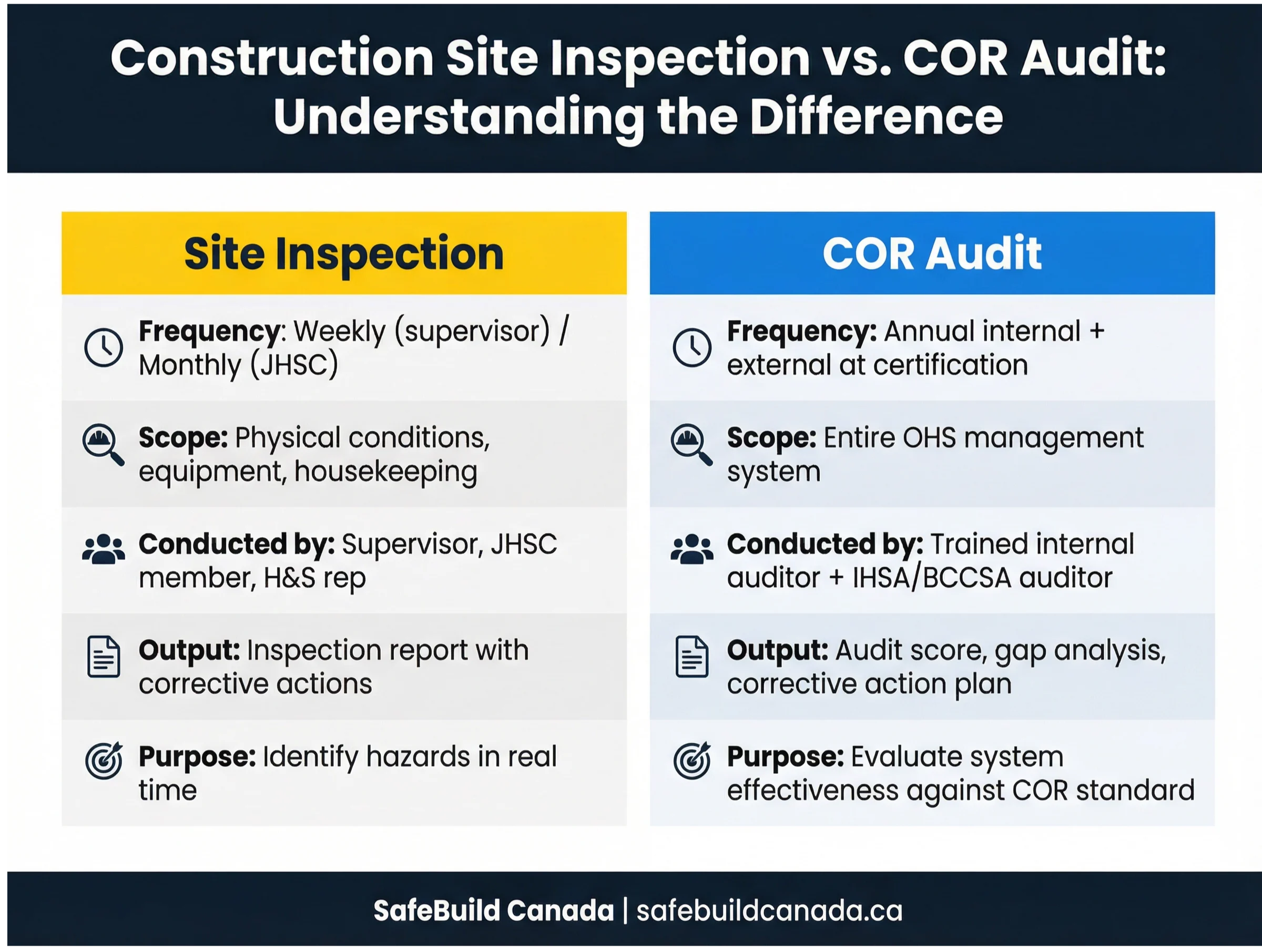
If you are working toward COR certification or maintaining your Letter of Good Standing, your inspection program is not just a legal obligation. It is audit evidence. The IHSA's COR program requires that employers demonstrate a health and safety management system that is developed, implemented, and evaluated annually. Inspections are one of the primary mechanisms through which that system is evaluated.
When a COR auditor reviews your program, they will look at your inspection records to answer several questions. Are inspections being conducted at the required frequency? Are they covering the entire site over the course of the audit period? Are findings being documented with enough detail to be useful? Are corrective actions being assigned, tracked, and closed out? Is there evidence that senior management is reviewing inspection results and acting on systemic issues?
A site that conducts weekly supervisor inspections and monthly JHSC inspections, documents every finding with a corrective action and a responsible person, and tracks those actions to completion will score well in a COR audit. A site that has a blank inspection form on file with a date and a signature but no findings will not, because auditors know that a site with zero findings is a site where the inspection was not done properly.
The connection between inspections and audits runs the other way too. The gap analysis from a COR audit should feed back into your inspection program. If an audit identifies that your workers are not consistently using the correct PPE for a particular task, that item should be added to your routine inspection checklist until the behavior is consistently observed.
What triggers a Ministry of Labour or WorkSafeBC order during an inspection
Government inspectors visit construction sites in Canada both reactively (in response to complaints or incidents) and proactively (as part of planned compliance campaigns). Ontario's 2025-2026 residential construction inspection campaign is targeting fall protection, ladders, and electrical safety.
The most common triggers for orders on construction sites are not exotic or complicated. They are the same issues that show up in inspection reports week after week: missing or inadequate fall protection, unsecured materials at heights, damaged or improperly stored equipment, missing or illegible safety signage, workers without required PPE, and housekeeping failures that create trip and fall hazards.
The pattern that leads to stop-work orders and prosecutions is not a single missed inspection. It is a pattern of identified hazards that were never corrected. If your inspection records show that the same guardrail deficiency was noted three weeks in a row with no corrective action, you have a problem that goes beyond the guardrail.
Building an inspection program that actually works
The difference between an inspection program that protects workers and one that just generates paperwork comes down to a few practical decisions.
First, use a checklist that is specific to your site and your work. A generic construction inspection checklist is a starting point, not a finished product. Add items for the specific hazards present on your project: the confined space entry points, the crane swing radius, the electrical panel locations, and the areas where fall protection is required.
Second, make sure the people conducting inspections have the training and authority to act on what they find. A supervisor who identifies a hazard but does not feel empowered to stop work or issue a corrective action is not conducting an effective inspection.
Third, close out corrective actions before the next inspection. If you are still carrying open items from three weeks ago, your inspection program is not functioning as a hazard control mechanism. It is functioning as a documentation exercise.
Fourth, connect your inspection records to your broader safety program. Inspection findings should feed into your hazard identification and risk assessment in Canadian construction. Recurring inspection findings are a signal that a hazard has not been adequately controlled, and that signal should trigger a review of the control measures in your site safety plan.
The construction sites that have the fewest injuries are not the ones with the most elaborate inspection forms. They are the ones where inspections are taken seriously at every level of the organization, findings are acted on promptly, and the results are used to make the site safer rather than to satisfy a regulatory checkbox.
SOURCES
WorkSafeNB OHS Guide, Workplace Inspections.
IHSA, Workplace Inspections: Procedures and Checklists.
IHSA, COR Certification: What is COR?.
Employment and Social Development Canada, Work place inspections: A matter of health and safety.
Workplace Safety and Prevention Services, Guide for JHSC and Health and Safety Representatives.