

When a workplace injury occurs on a Canadian construction site, the immediate focus is always on getting the worker medical attention and securing the area. However, once the initial emergency is handled, the administrative clock starts ticking. Managing workers compensation claims through provincial boards like the Workplace Safety and Insurance Board in Ontario or the Workers Compensation Board in Alberta is a critical legal responsibility for construction employers.
Failing to report an injury on time, mishandling the return to work process, or discouraging a worker from filing a claim can result in severe financial penalties, prosecution, and skyrocketing insurance premiums. For construction companies operating on tight margins, effective claims management is not just a compliance requirement; it is a fundamental business survival skill.
This guide breaks down exactly what Canadian construction employers need to know about managing WSIB and WCB claims, from mandatory reporting deadlines to the financial impact of experience rating systems.
The Immediate Aftermath of a Workplace Injury
The moments following a workplace injury dictate how the entire workers compensation claim will unfold. Employers have strict legal obligations that trigger the second an incident occurs.
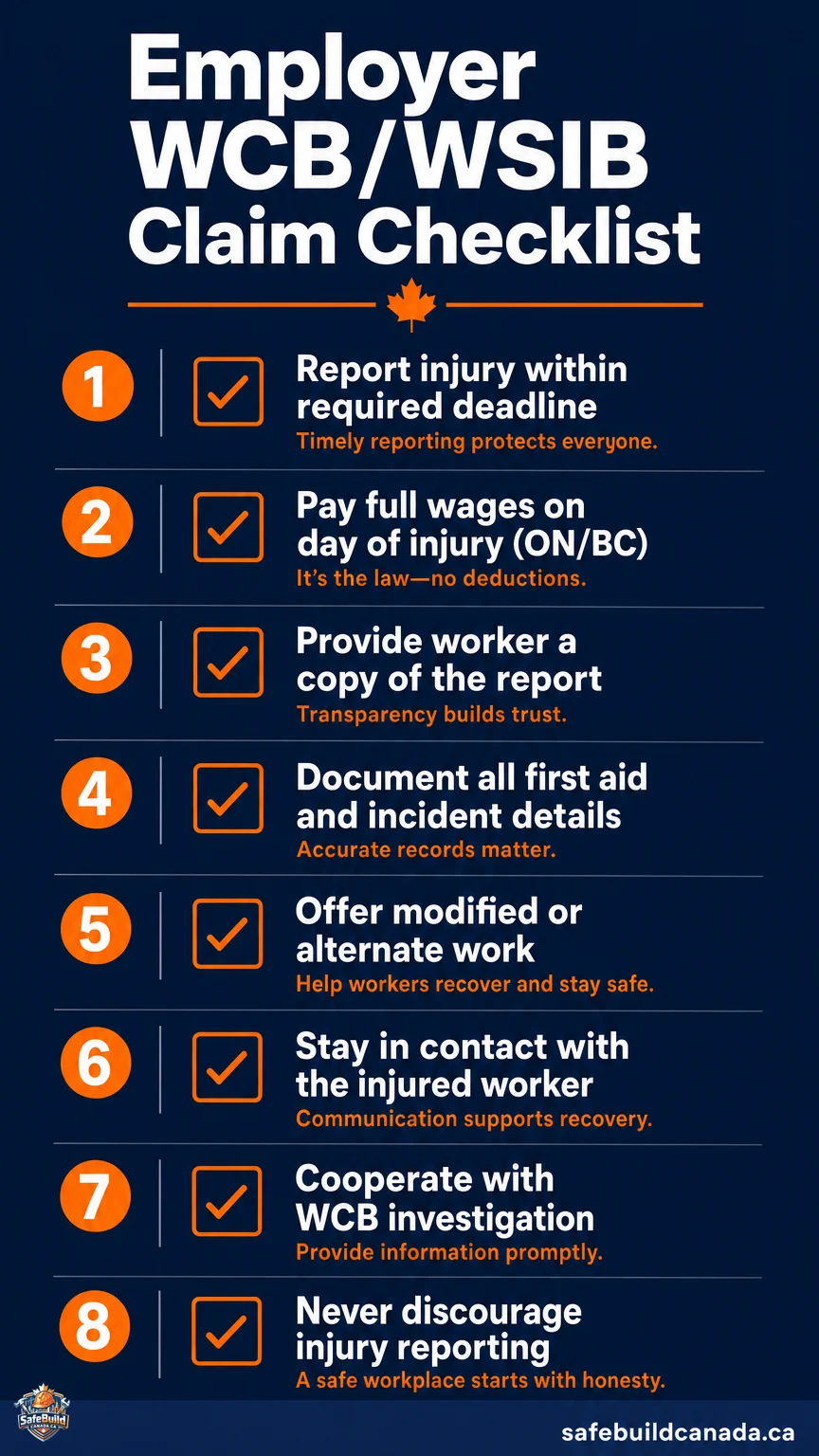
First and foremost, the employer must arrange and pay for the injured worker's transportation to a hospital, clinic, or doctor's office on the day of the injury. This is a universal requirement across provincial jurisdictions. Furthermore, the employer is legally obligated to pay the worker their full wages for the day the injury occurred, regardless of what time they had to leave the site. Deducting hours for the time spent at the hospital is a direct violation of workers compensation laws.
Once the worker is receiving care, the site supervisor or safety officer must secure the scene and begin documenting the incident. This ties directly into the broader construction site safety plan protocols. Every detail matters: witness statements, photographs of the hazard, and a clear timeline of events. If the incident is severe or fatal, employers must immediately notify the provincial occupational health and safety regulator by phone, which is a separate obligation from filing a workers compensation claim. For example, WorkSafeBC requires an immediate call to their Prevention Information Line for any serious incident.
Understanding Employer Reporting Deadlines
The most common mistake construction employers make is missing the mandatory reporting deadline. Provincial workers compensation boards have zero tolerance for late reporting, and the timelines are exceptionally tight.
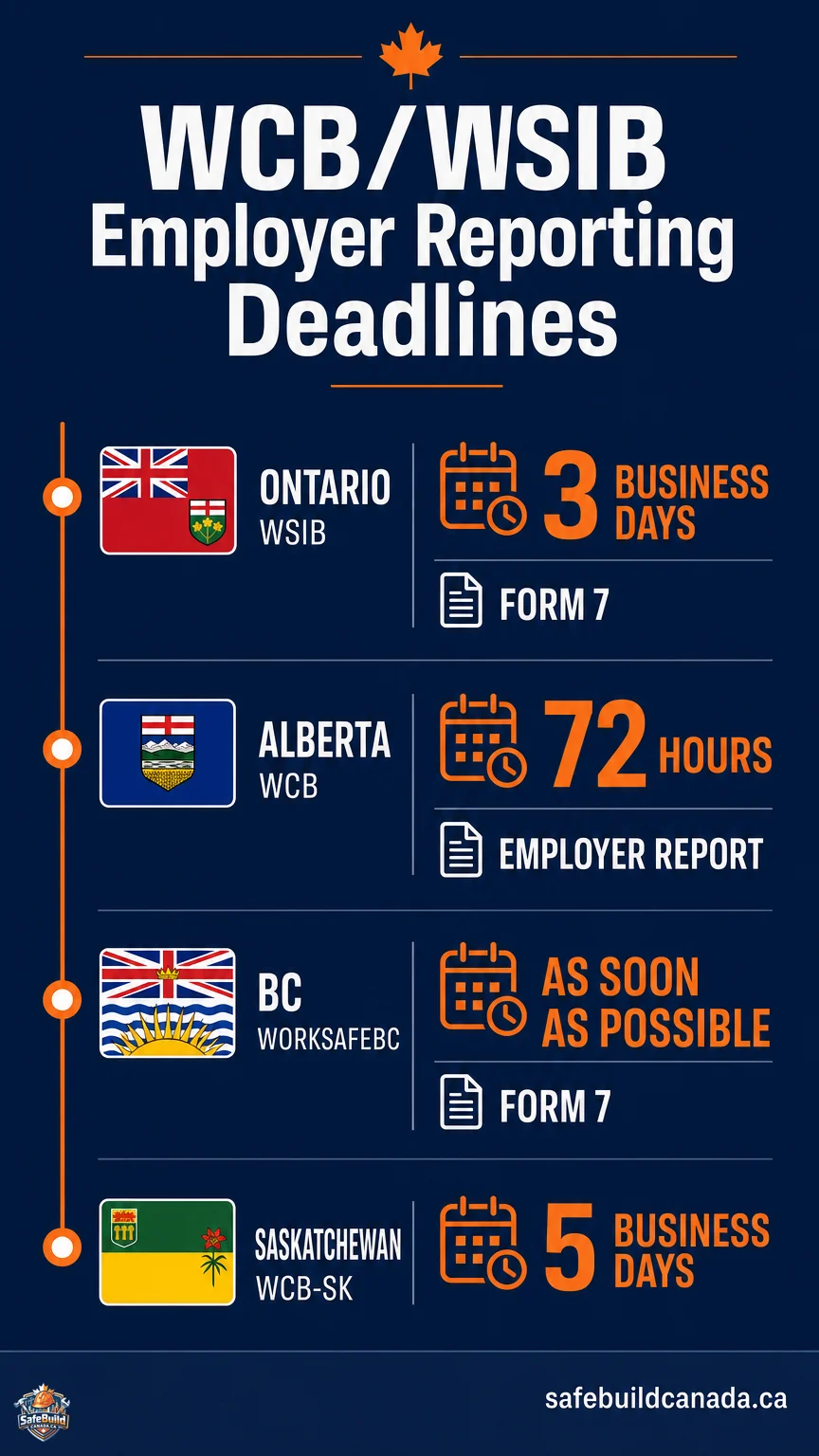
In Ontario, the Workplace Safety and Insurance Board requires employers to submit a Form 7 (Employer's Report of Injury or Disease) within three business days of learning about a reportable injury. A reportable injury is defined as one where the worker needs medical treatment beyond first aid, is absent from work, earns less than their regular pay, or requires modified work at less than regular pay. If a worker requires modified work at regular pay for more than seven calendar days, the reporting obligation is also triggered.
In Alberta, the Workers Compensation Board is even stricter. Employers must submit their report within 72 hours of becoming aware of an injury or illness that results in lost time, the need for modified work, or medical treatment beyond first aid. This 72-hour window includes weekends, making prompt administrative action essential.
In British Columbia, WorkSafeBC requires employers to submit their Form 7 "as soon as possible" after a worker receives medical treatment from a qualified practitioner. While the language is slightly more flexible than a hard hour count, any unnecessary delay can trigger an investigation and subsequent penalties.
The Financial Impact: Experience Rating and Premiums
Workers compensation is a no-fault insurance system funded entirely by employer premiums. However, those premiums are not static. Provincial boards use experience rating systems to adjust a company's premium rate based on their actual claims history compared to the industry average.
In the construction sector, where base premium rates are already high due to the inherent risks of the work, experience rating can make or break a company's profitability. For example, the 2026 WCB Alberta premium rate for wood framing services is set at $5.27 per $100 of insurable payroll. If a framing contractor has a poor safety record with multiple lost-time claims, their experience rating surcharge could push that rate materially higher, making it impossible for them to bid competitively on new projects.
Conversely, employers with strong safety records and effective claims management processes receive premium discounts or rebates. In Ontario, the WSIB is distributing a $2 billion surplus rebate to eligible, safe businesses starting in October 2025. In Alberta, the WCB is providing $61.9 million in premium rate subsidies to employers in 2026.
Every claim impacts the experience rating. In Alberta, any claim costing $2,100 or more is fully included in the experience rating calculation, as are all lost-time claims regardless of cost. This makes disciplined hazard identification and risk assessment the most effective financial strategy a construction company can deploy. Preventing the injury is always cheaper than managing the claim.
The Legal Duty to Accommodate and Return to Work
When a worker is injured, the employer's responsibility does not end with filing the paperwork. Canadian workers compensation laws place a heavy emphasis on early and safe return to work programs.
Employers have a legal duty to cooperate in the return to work process. This means staying in regular contact with the injured worker, communicating with the workers compensation board, and actively seeking ways to bring the worker back to the site in a safe capacity.
In British Columbia, recent legislative changes have strengthened these obligations. Employers and workers now have an explicit legal duty to cooperate with each other and with WorkSafeBC. Furthermore, employers with 20 or more workers have a duty to maintain the employment of injured workers who have been employed for at least 12 continuous months before the injury date.
In Ontario, the WSIB enforces strict re-employment obligations for construction employers. If a worker is medically cleared to perform the essential duties of their pre-injury job, the employer must offer to re-employ them. If they cannot perform their essential duties but can perform suitable modified work, the employer must offer the first available suitable position.
Offering modified work is not just a legal requirement; it is a critical cost management strategy. When a worker returns to modified duties at their regular rate of pay, the workers compensation board stops paying wage-loss benefits. This directly reduces the total cost of the claim, which in turn protects the employer's experience rating and future premium rates. Modified work in construction might include site security, inventory management, safety orientations, or administrative tasks in the site trailer.
Navigating the Claims Investigation Process
When a claim is filed, the workers compensation board will assign an adjudicator or case manager to determine if the injury is work-related and if benefits should be approved. Employers must cooperate fully with this investigation.
The board will review the employer's report, the worker's report, and the medical reports from the treating physician. Discrepancies between these three documents are the most common cause of delayed claim decisions. This is why accurate, detailed incident reporting is so vital. If an employer doubts the validity of a claim, they have the right to object, but they must still file the initial report on time. Failing to report a suspicious claim is a violation of the law; the correct procedure is to file the report and attach a letter outlining the reasons for the objection.
During the investigation, the board may request additional payroll information, witness statements, or a copy of the company's construction site emergency response plan. Providing this information promptly demonstrates good faith and helps expedite the decision-making process.
It is also important to note that workers compensation investigations are separate from occupational health and safety investigations. While the WCB is determining benefit entitlement, a provincial OHS inspector may arrive on site to investigate the safety failure that caused the injury. Knowing what happens when an OHS inspector shows up is a separate but equally important aspect of post-incident management.
Penalties for Non-Compliance and Claim Suppression
Provincial workers compensation boards take employer non-compliance very seriously. The penalties for failing to meet reporting obligations or attempting to suppress claims are severe.
Claim suppression occurs when an employer discourages a worker from reporting an injury to the board. This often takes the form of offering to pay the worker's wages out of pocket while they recover at home, or pressuring them to use their sick days instead of filing a claim. This practice is strictly illegal across Canada.
In Ontario, it is an offence under the Workplace Safety and Insurance Act to discourage reporting, report late, provide false details, or fail to provide a copy of the report to the worker. Employers caught engaging in claim suppression face massive financial penalties and potential prosecution. The WSIB actively audits employers who show suspicious reporting patterns, such as a high rate of injuries that only require first aid and never progress to medical treatment.
Similarly, the Alberta OHS Act employer duties and the BC OHS Regulation both contain strict anti-reprisal clauses. A worker cannot be fired, demoted, or disciplined for exercising their right to report a workplace injury.
The Role of COR Certification in Claims Management
For construction companies looking to optimize their claims management and reduce their premium costs, achieving the Certificate of Recognition is a proven strategy.
The COR program is a national standard that verifies a company has implemented a full health and safety management system. While the primary goal of COR is to prevent injuries from happening in the first place, the framework also requires companies to have thorough incident investigation and return to work protocols in place.
Provincial workers compensation boards heavily incentivize COR certification. In Alberta, employers who achieve and maintain their COR through the Alberta Construction Safety Association can receive up to a 20 percent rebate on their WCB premiums. In British Columbia, the BCCSA COR program offers up to a 10 percent rebate from WorkSafeBC.
Understanding COR certification is essential for any construction employer looking to turn safety compliance into a competitive financial advantage. The premium rebates alone often cover the cost of implementing the safety program, while the reduction in workplace injuries protects the company's experience rating for years to come.
Best Practices for Construction Employers
Managing workers compensation claims effectively requires preparation before an injury ever occurs. Construction employers should implement the following best practices to protect their workers and their business:
First, establish a clear internal reporting policy. Every worker on the site must know exactly who to notify if they are injured, no matter how minor the injury seems. This policy should be covered during the site orientation and reinforced during weekly toolbox talks.
Second, train supervisors on their immediate responsibilities. When an injury happens, the site supervisor is the company's first responder. They need to know how to secure the scene, arrange transportation, and document the initial facts without compromising the area.
Third, build a library of modified work options before you need them. Trying to invent a light-duty job while a worker is sitting at home recovering is stressful and often unsuccessful. Having a pre-approved list of modified duties allows the employer to make an immediate return to work offer as soon as the physician clears the worker for light duty.
Finally, treat the workers compensation board as a partner, not an adversary. While the paperwork can be frustrating and the premium costs are real, the board's core goal is the same as the employer's: getting the injured worker healthy and back on the job safely. Prompt communication, accurate reporting, and a genuine commitment to the return to work process will always yield the best results for both the worker and the company's bottom line.
By understanding the strict reporting deadlines, the financial mechanics of experience rating, and the legal duty to accommodate, Canadian construction employers can navigate the WSIB and WCB claims process with confidence and full compliance.