
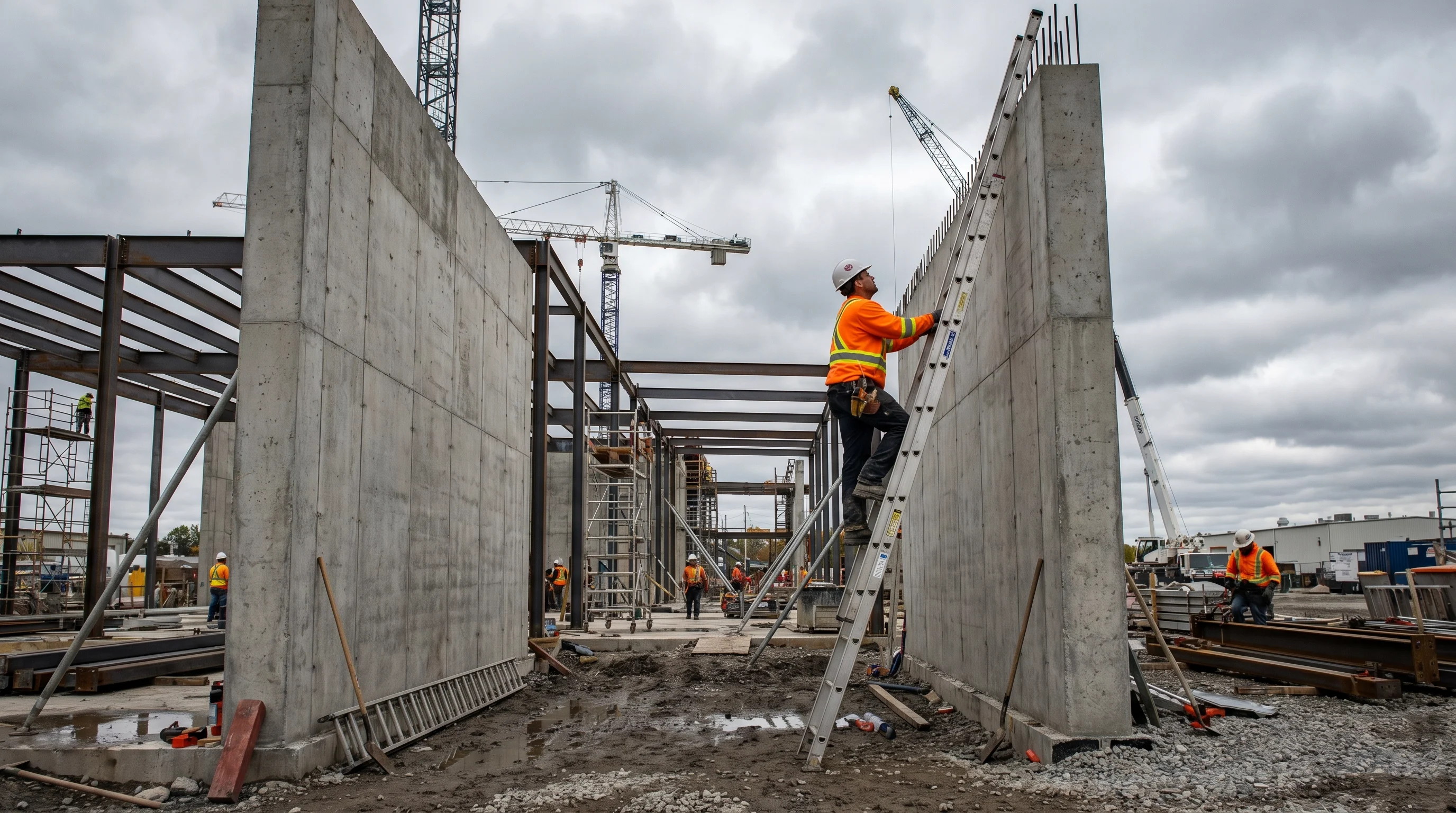
Ladders are among the most common pieces of equipment found on any construction site. They are also among the most dangerous. Despite their simple design and widespread use, ladders are involved in a disproportionate number of workplace injuries and fatalities across the country. The Canadian Centre for Occupational Health and Safety reports that ladders are involved in approximately two percent of all occupational accidents in industrialized nations. On construction sites, the consequences of a fall from a ladder are often severe, leading to critical injuries, long-term disability, or death.
The problem is not that ladders are inherently unsafe. The problem is that they are frequently misused. Workers often underestimate the risks associated with climbing a few feet off the ground, leading to complacency and the violation of fundamental safety rules. A quick task that seems too minor to warrant setting up a scaffold or a work platform often results in a worker grabbing the nearest ladder, regardless of its condition or suitability for the job. This casual approach to ladder use is a primary driver of fall-related incidents in the construction industry.
Understanding and applying the correct safety procedures is not just about avoiding fines from provincial inspectors; it is about protecting lives. This guide explores the critical ladder safety rules that are most frequently misunderstood or ignored on Canadian construction sites, detailing the specific regulatory requirements in Ontario, British Columbia, and Alberta. By addressing these common mistakes, site supervisors and workers can meaningfully reduce the risk of falls and create a safer working environment.
The true cost of ladder falls in construction
The statistics surrounding ladder falls in the Canadian construction industry paint a sobering picture. According to data from the Workplace Safety and Insurance Board in Ontario, there were hundreds of injury claims related to ladder accidents in recent years, with each incident resulting in an average of nearly a month of lost work days per person. These numbers only account for reported injuries that led to claims; the actual number of incidents, including near misses and minor injuries, is undoubtedly much higher.
Fatalities are also a tragic reality. During a targeted inspection blitz focused on fall hazards, the Ontario Ministry of Labour, Immigration, Training and Skills Development found that a notable percentage of fall-related fatalities were directly attributed to falls from ladders. The Infrastructure Health and Safety Association consistently highlights ladder falls as a leading cause of critical injuries and deaths among construction workers. These incidents are rarely the result of equipment failure; they are almost always the result of human error, improper setup, or the selection of the wrong equipment for the task.
The financial impact on construction companies is substantial, encompassing increased insurance premiums, lost productivity, potential regulatory fines, and the costs associated with project delays. However, the human cost is immeasurable. A fall from even a relatively low height can result in traumatic brain injuries, spinal cord damage, and severe fractures. Preventing these incidents requires a fundamental shift in how ladders are perceived and used on the job site. It requires moving away from the mindset that a ladder is a universal tool for any task at height and recognizing it as a specific piece of equipment with strict operational limitations.
The hierarchy of controls and ladder selection
Before a worker even touches a ladder, the first question should always be whether a ladder is the right tool for the job. Occupational health and safety regulations across Canada emphasize the hierarchy of controls, a framework designed to eliminate or minimize exposure to hazards. When it comes to working at heights, the most effective control is to eliminate the need to work at height altogether. If that is not possible, the next step is to use passive fall protection systems, such as guardrails or travel restraint systems.
Ladders fall near the bottom of the hierarchy of controls. They should only be used when it is not reasonably practicable to use a safer alternative, such as a scaffold or an elevating work platform. If a task requires a worker to use both hands, reach extensively, or work at height for an extended period, a ladder is almost certainly the wrong choice. This principle is a core component of any well-built construction site safety in Canada: the complete guide.
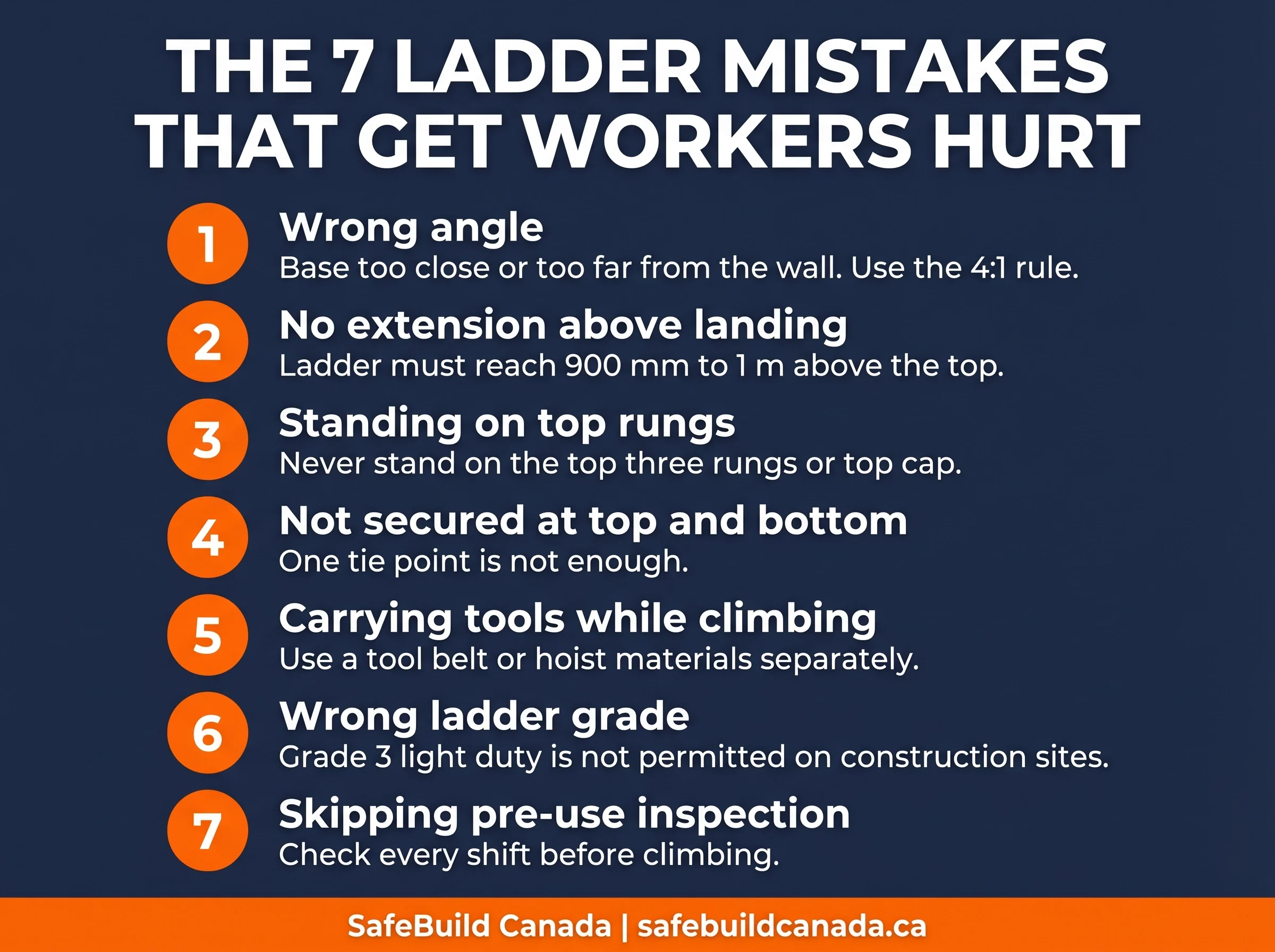
When a ladder is deemed necessary, selecting the correct type and grade is crucial. The Canadian Standards Association standard Z11-18 for Portable Ladders classifies ladders into different grades based on their load capacity and intended use. Grade 1 (Heavy Duty), Grade 1A (Extra Heavy Duty), and Grade 1AA (Special Duty) are the only acceptable grades for construction sites. Grade 3 (Light Duty) ladders, typically intended for household use, are strictly prohibited in commercial construction environments because they cannot withstand the rigors of a job site or the combined weight of a worker wearing heavy gear and carrying tools.
The rules most workers get wrong
Despite mandatory training and regular safety talks, certain ladder safety rules are consistently violated on construction sites. These violations are often the result of rushing, convenience, or a misunderstanding of the physics involved in ladder stability. Addressing these common mistakes is the most effective way to reduce ladder-related incidents.
The four-to-one angle rule
One of the most critical factors in ladder stability is the angle at which it is set up. A ladder that is placed too close to the wall is at risk of tipping backward, while a ladder placed too far away is at risk of the bottom sliding out. The universal standard for setting up a non-self-supporting portable ladder is the four-to-one rule. For every four feet of vertical height, the base of the ladder must be placed one foot away from the supporting structure.
This placement creates an angle of approximately 75 degrees from the horizontal, which provides the optimal balance of strength and stability. Many workers attempt to eyeball this angle, often resulting in a setup that is either too steep or too shallow. A simple method to check the angle is for the worker to stand with their toes touching the base of the ladder and extend their arms straight forward; their fingertips should just touch the rungs.
Securing the ladder
A ladder that is simply leaning against a wall is inherently unstable. It can easily shift laterally if the worker leans too far to one side, or the base can slip on uneven or slippery ground. To prevent movement, a portable ladder must be secured. This means tying off the top of the ladder to a sturdy anchor point to prevent lateral movement and securing the base to prevent it from slipping outward.
Many workers mistakenly believe that having a coworker hold the base of the ladder is a sufficient substitute for properly securing it. While having a spotter can provide some additional stability for short-duration tasks, it is not a reliable method for preventing a fall, especially if the ladder shifts suddenly or the spotter becomes distracted. Proper securing at both the top and bottom is a fundamental requirement that is frequently overlooked.
Maintaining three-point contact
When climbing up or down a ladder, a worker must maintain three points of contact at all times. This means having two hands and one foot, or two feet and one hand, securely on the ladder. This rule is frequently violated when workers attempt to carry tools or materials in their hands while climbing.
Carrying items compromises the worker's ability to grip the rungs and sharply increases the risk of a fall if they lose their footing. Tools should be carried in a tool belt, and materials should be hoisted up separately using a rope or a bucket after the worker has safely reached the working level. Furthermore, workers should always grasp the rungs, not the side rails, when climbing. If a foot slips, it is much easier to maintain a grip on a horizontal rung than a vertical side rail.
Extension above the landing
When a portable ladder is used to access an upper landing, such as a roof or a scaffold platform, the side rails must extend a specific distance above the landing surface. This extension provides the worker with a secure handhold to grasp while transitioning from the ladder to the landing and vice versa.
The required extension distance varies slightly by province, but it is generally around one metre or three feet. A common mistake is using a ladder that is too short, forcing the worker to step over the top of the ladder without adequate handholds, a maneuver that frequently leads to falls. Confirming the ladder is long enough to provide this critical extension is a vital step in preventing access and egress accidents.
Standing on the top rungs
Step-ladders are designed to be self-supporting, but they have strict limitations on where a worker can safely stand. The top cap and the top step of a step-ladder are not designed to bear a worker's weight and do not provide sufficient stability. Standing on these upper sections raises the worker's centre of gravity above the ladder's safe operating range, making it highly susceptible to tipping.
Workers must never stand on the top cap, the top step, or the pail shelf of a step-ladder. If a task cannot be reached while standing on a safe lower rung, the ladder is too short for the job, and a taller ladder or a different type of access equipment must be used. This rule is explicitly stated on the warning labels of all manufactured step-ladders, yet it remains one of the most common violations observed on job sites.
Provincial regulations: Ontario, BC, and Alberta
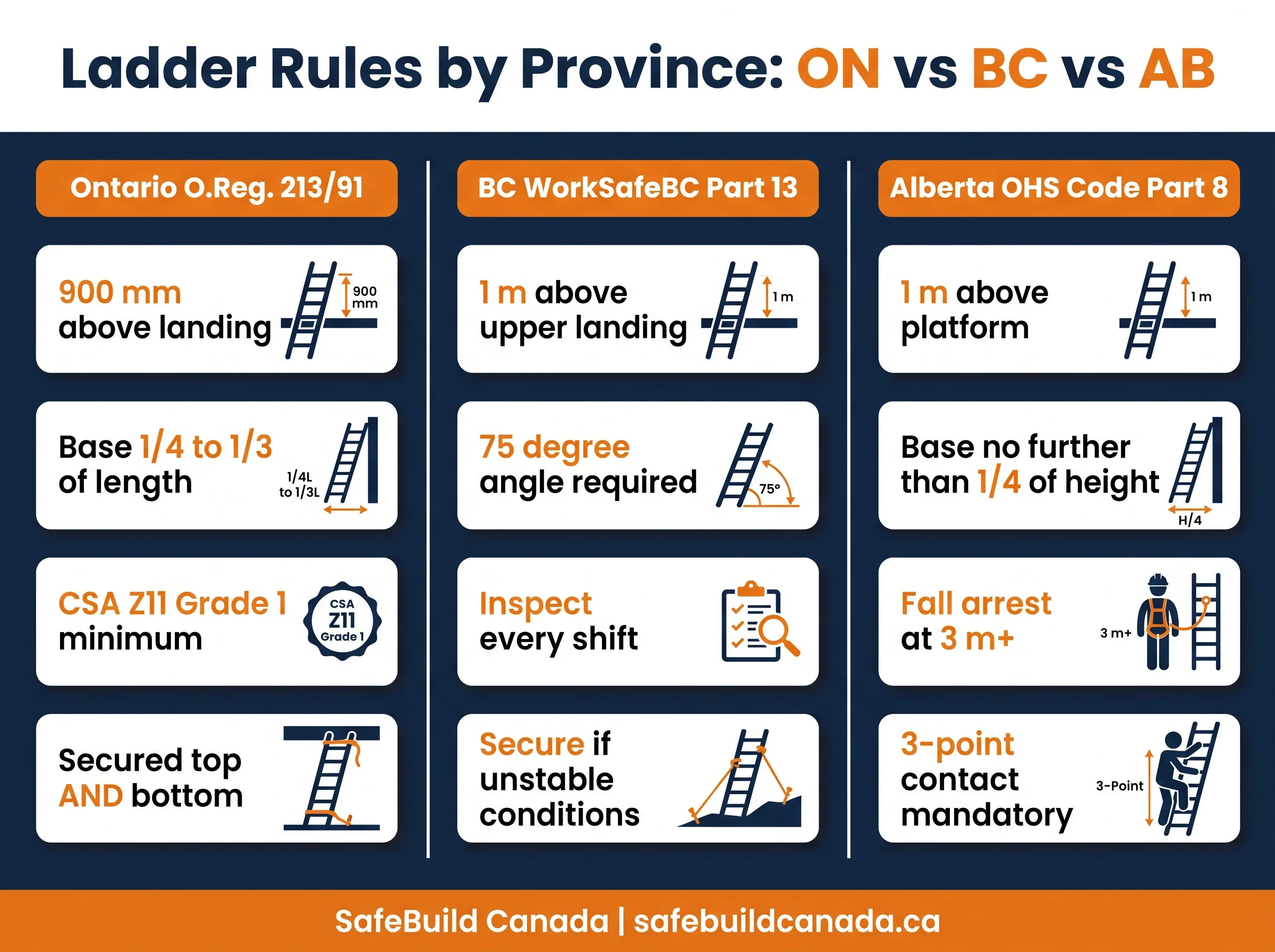
While the fundamental principles of ladder safety are universal, the specific regulatory requirements vary across Canadian jurisdictions. Construction companies operating in multiple provinces must be intimately familiar with the nuances of each occupational health and safety code to maintain compliance and protect their workforce.
Ontario: O.Reg. 213/91
In Ontario, ladder safety on construction projects is governed by the Construction Projects Regulation, O.Reg. 213/91. The regulation mandates that all portable ladders must meet the design and performance requirements of a Grade 1, Grade 1A, or Grade 1AA ladder in the CSA Standard Z11.
Section 81 of the regulation explicitly addresses the setup of non-self-supporting portable ladders, requiring the base to be situated not less than one-quarter and not more than one-third of the length of the ladder from a point directly below the top. This codifies the four-to-one rule into law. Furthermore, the regulation prohibits tying or fastening ladders together to increase their length unless explicitly permitted by the manufacturer.
When a ladder is used for access between levels, Section 82 requires the ladder to extend at least 900 millimeters above the landing surface. It also mandates a clear space of at least 150 millimeters behind every rung to provide adequate footing and requires the ladder to be secured at both the top and bottom to prevent movement. For step-ladders, Section 83 strictly prohibits standing on the top cap, top step, or pail shelf. These requirements must be integrated into any thorough fall protection plan.
British Columbia: WorkSafeBC Part 13
In British Columbia, the Occupational Health and Safety Regulation Part 13 covers ladders, scaffolds, and temporary work platforms. WorkSafeBC requires that all ladders meet the applicable CSA or ANSI standard in effect at the time of manufacture. A critical requirement in BC is the mandatory inspection of ladders before use on each shift, ensuring that defective equipment is identified and removed from service promptly.
Section 13.5 dictates the positioning of portable non-self-supporting ladders, requiring them to lean against the vertical plane of support at an approximate angle of 75 degrees. If the ladder provides access to an upper landing, it must project approximately one metre above the landing and be sufficiently secured to maintain stability during access and egress.
WorkSafeBC also places a strong emphasis on the hierarchy of controls. Section 13.6 states that if work cannot be done from a ladder without hazard to a worker, a work platform must be provided. It also explicitly prohibits workers from carrying heavy or bulky objects up or down a ladder, reinforcing the necessity of maintaining three-point contact. These rules are essential components of a thorough hazard identification and risk assessment.
Alberta: OHS Code Part 8
Alberta's Occupational Health and Safety Code addresses ladder safety in Part 8: Entrances, Walkways, Stairways and Ladders. Section 136 requires that a portable ladder be secured against movement and placed on a stable base. It also mandates the four-to-one rule, stating that the base of an inclined portable ladder must be no further from the wall than one-quarter of the distance between the base and the contact point.
Similar to BC, Alberta requires the side rails of a portable ladder to extend at least one meter above a platform or landing if used for access. A unique aspect of Alberta's code is its specific requirements regarding fall protection while working from a ladder. Section 137 states that a worker working from a portable ladder from which they may fall three metres or more must use a personal fall arrest system.
There are exceptions to this fall protection requirement, but they are narrow. A worker may work without fall protection only if the task is light duty and of short duration, the worker's centre of balance remains at the centre of the ladder, and the worker maintains three-point contact whenever extending an arm beyond a side rail. This strict approach underscores the high risk associated with ladder work at elevation and aligns with the requirements for CSA PPE standards for Canadian construction.
Integrating ladder safety into daily operations
Preventing ladder falls requires more than just knowing the rules; it requires integrating those rules into the daily culture of the construction site. This begins with thorough training that goes beyond simply telling workers to be careful. Training must include practical demonstrations of proper ladder setup, inspection techniques, and the correct methods for climbing and working from a ladder.
Supervisors play a critical role in enforcing ladder safety. They must actively monitor ladder use on the site, correcting improper behavior immediately and confirming that workers have access to the right equipment for the job. If a task requires a scaffold or a work platform, supervisors must confirm that equipment is provided, rather than allowing workers to make do with a ladder. This forward-looking approach is a key element of effective scaffolding safety.
Pre-use inspections must become a non-negotiable habit. Before climbing any ladder, a worker must inspect it for defects such as cracked rungs, bent side rails, missing hardware, or damaged slip-resistant feet. Any ladder that fails inspection must be immediately tagged out of service and removed from the work area to prevent accidental use. By treating ladders with the respect they demand and strictly adhering to provincial regulations, construction companies can protect their workers from one of the industry's most persistent and preventable hazards.
Sources
Ontario Ministry of Labour, Immigration, Training and Skills Development: Inspection blitz results: Falls
Canadian Centre for Occupational Health and Safety: Ladders - Portable
Infrastructure Health and Safety Association: Falls from Ladders
Government of Ontario: O. Reg. 213/91: Construction Projects
WorkSafeBC: OHS Regulation Part 13: Ladders, Scaffolds and Temporary Work Platforms
Government of Alberta: OHS Code Part 8: Entrances, Walkways, Stairways and Ladders