
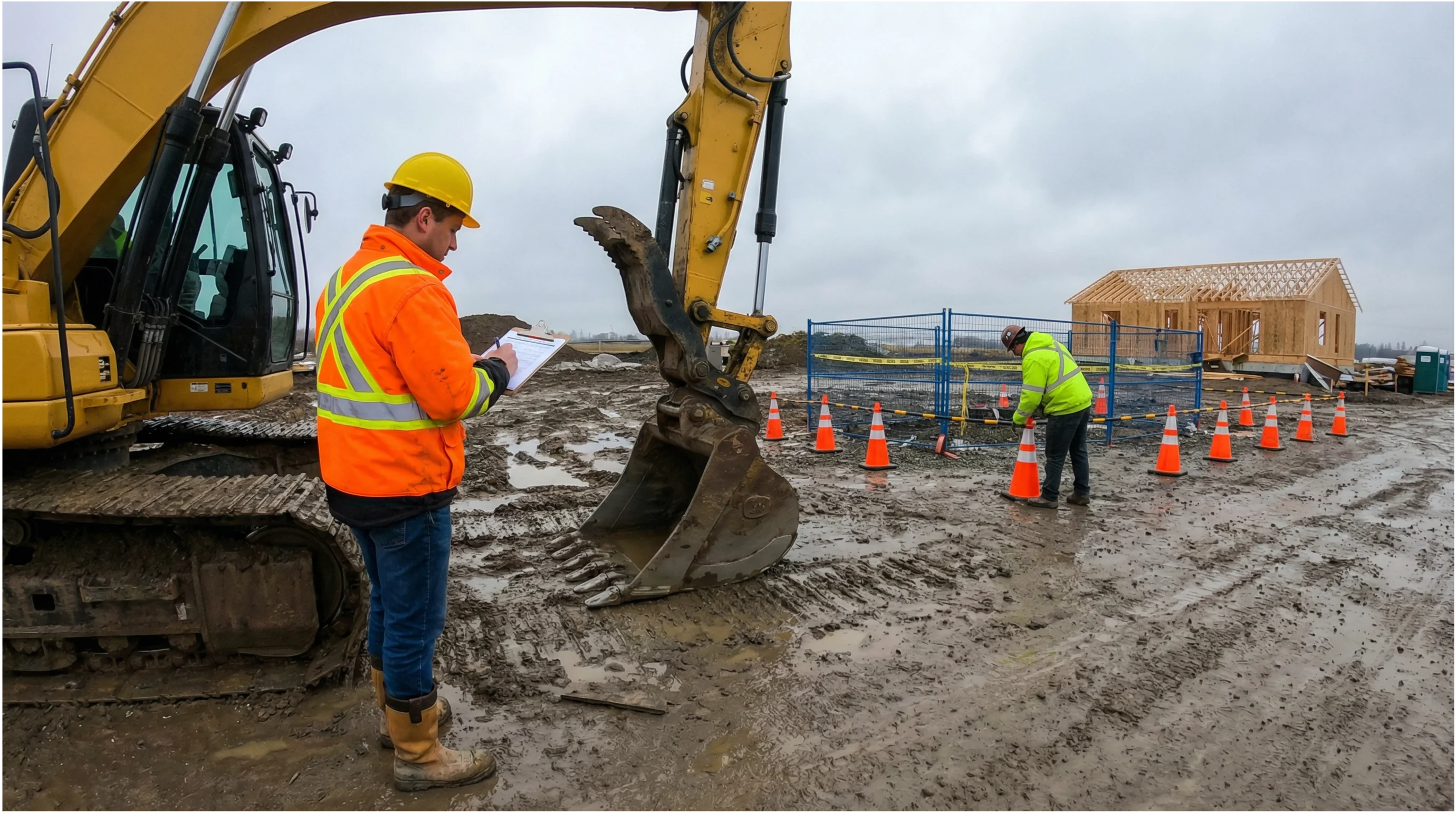
Between 2017 and 2022, vehicle and equipment contact killed 22 workers and caused 192 critical injuries on Ontario construction sites alone. That is one critical injury every eleven days from a single hazard category. Across Canada, the numbers are worse. WorkSafeBC reported 54 worker deaths in BC in 2022, the highest in 35 years, with mobile equipment incidents among the leading causes.
Heavy equipment safety is not about the machines themselves. Modern excavators, loaders, and dozers are engineered with sophisticated safety systems. The fatalities happen because of the systems around the machines: how they are inspected, how operators are trained, and how the site manages the space where the equipment operates.
This guide breaks down the five primary heavy equipment hazards on Canadian construction sites and the specific regulatory requirements in Ontario, British Columbia, and Alberta that supervisors must enforce to prevent them.
The five primary heavy equipment hazards
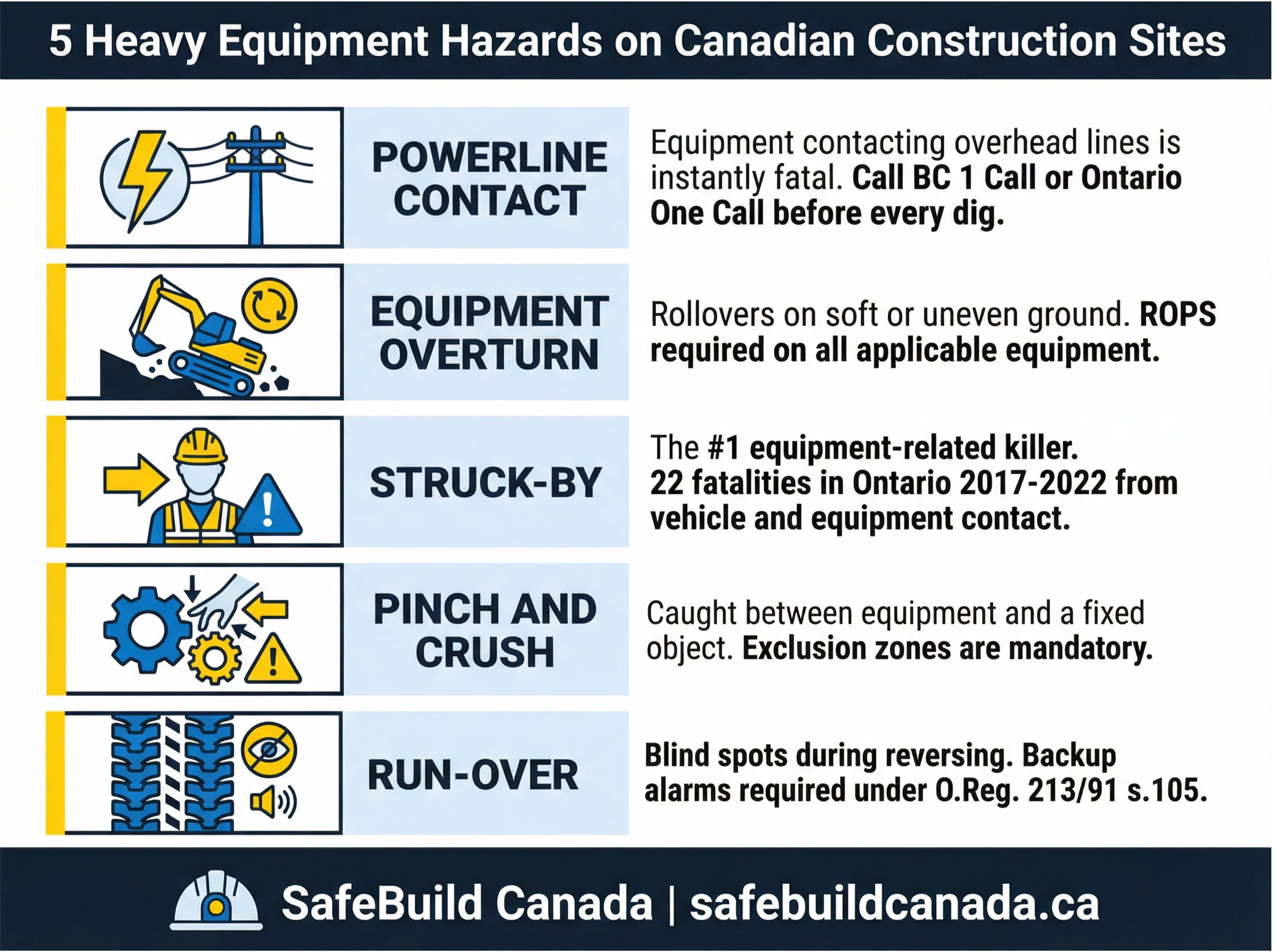
When an incident occurs involving heavy equipment, it almost always falls into one of five categories. Understanding these categories is the first step in building a compliant construction site safety plan that addresses equipment operations as a distinct risk category.
Struck-by incidents occur when a worker on foot is hit by moving equipment. This is the leading cause of equipment-related fatalities in Canada. It typically happens when a machine is backing up, when a worker enters a blind spot, or when an operator swings an excavator cab without checking the radius. According to the IHSA, struck-by incidents account for a disproportionate share of construction fatalities in Ontario every year.
Caught-between incidents occur when a worker is crushed between a piece of equipment and a fixed object (like a wall or trench box), or between the articulating parts of the machine itself. These incidents are less frequent than struck-by events but are almost always fatal or result in critical injuries.
Rollovers happen when equipment tips over due to unstable ground, operating on too steep a grade, or improper loading. If the machine lacks a Rollover Protective Structure (ROPS) or the operator is not wearing a seatbelt, rollovers are frequently fatal. WorkSafeBC's 2024 amendments to Part 16 tightened the three-point seatbelt requirements specifically because of rollover fatality data.
Powerline contact occurs when a boom, mast, or raised dump box contacts an overhead powerline. This hazard requires specific limits of approach based on the voltage of the line. In Ontario, O.Reg. 213/91 sets out minimum distances that must be maintained, and the constructor must contact the utility before work begins within those distances.
Equipment failure covers brake failures, hydraulic line bursts, and steering system malfunctions. This is almost always the result of skipped pre-use inspections or deferred maintenance. The machine was showing signs of the problem before the incident. Someone chose not to act on them.
Pre-use equipment inspection requirements
The most effective administrative control for equipment failure is the pre-use inspection. It is also the control most frequently skipped or pencil-whipped on busy sites.
In Ontario, O.Reg. 213/91 requires that all vehicles, machines, tools, and equipment be maintained in a condition that does not endanger a worker. In BC, WorkSafeBC Part 16 explicitly requires that mobile equipment be inspected before use on each shift. Alberta's OHS Code Part 19 has similar requirements for powered mobile equipment.
A compliant pre-use inspection is not a visual once-over. The operator must physically check the fluid levels, test the brakes, verify the backup alarm is functioning, inspect the tires or tracks, and confirm the ROPS is undamaged. The inspection must be documented, and the record must stay with the machine or be accessible on site.
If a defect is found that affects the safe operation of the equipment, the machine must be tagged out of service immediately. It cannot be used until a qualified mechanic repairs it and the repair is documented. This is not optional. An inspector who finds a machine with a defective backup alarm and no record of the defect being reported will issue a stop-work order and may recommend charges under the applicable OHS legislation.
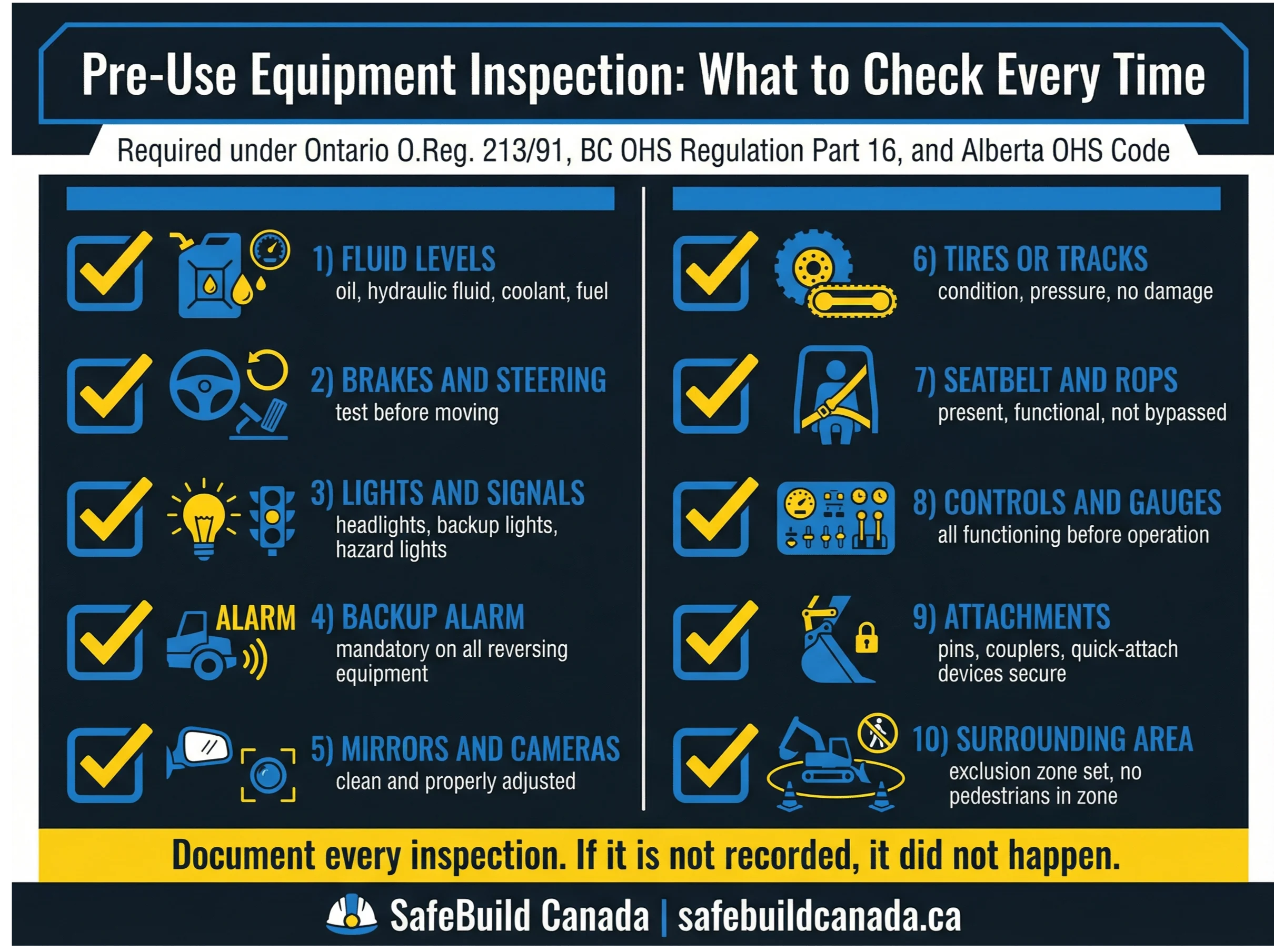
Description: A branded SafeBuild Canada infographic showing a pre-use inspection checklist with checkboxes for: fluid levels, brakes, backup alarm, tires/tracks, ROPS condition, seatbelt, hydraulic lines, lights, and documentation. Includes a note on what to do if a defect is found. Footer: 'SafeBuild Canada | safebuildcanada.ca'
Exclusion zones and spotter requirements
Struck-by incidents happen because a worker is in the wrong place and the operator cannot see them. The regulatory standard in all three provinces is that no worker shall be within the swing radius or travel path of operating equipment unless the equipment has been stopped and its movement is controlled.
A spotter is required when the operator's view is obstructed. The spotter must be in constant communication with the operator and must have the authority to stop the machine. A spotter who does not have the authority to stop the machine is not a spotter in any meaningful sense.
If your site is running equipment near other trades, the exclusion zone must be physically barricaded, not just marked with cones. Cones are not a barrier. Under O.Reg. 213/91 and WorkSafeBC Part 16, the constructor is responsible for ensuring that the zone is maintained throughout the shift, not just set up at the start of the day.
What OHS inspectors look for on heavy equipment
When an OHS inspector arrives on your site, heavy equipment is one of the first areas they check. The compliance campaign results from Ontario's 2023-2024 struck-by initiative give a clear picture of what inspectors find most often.
The most common orders issued during the campaign related to: missing or non-functional backup alarms, workers in exclusion zones without a spotter, missing or damaged ROPS, no pre-use inspection records, and operators without documented training for the specific equipment type.
All of these are preventable. All of them are also the kinds of violations that result in stop-work orders, not just compliance orders. An inspector who finds a worker in an active exclusion zone with no spotter will stop the work immediately.
The equipment section of your construction site emergency response plan should address what happens when a piece of equipment is involved in an incident: who calls 911, who secures the scene, who preserves the equipment for investigation, and who contacts the Ministry of Labour. Under the OHSA and its equivalents in BC and Alberta, a critical injury or fatality involving equipment must be reported to the regulator immediately, and the scene must not be disturbed until the inspector arrives.
Operator training and competency requirements
All three provinces require that heavy equipment operators be competent to operate the specific equipment they are assigned. Competency means trained, experienced, and familiar with the particular machine, not just licensed for a category.
In Ontario, O.Reg. 213/91 s.93 requires that operators be competent persons as defined under the OHSA. In BC, WorkSafeBC Part 16 requires that operators be qualified for the specific type of equipment. In Alberta, the OHS Code Part 19 requires that operators be trained and competent.
What this means in practice: a worker who is experienced on a skid steer is not automatically competent to operate an excavator. A new hire who has operated equipment in another province may need a site-specific orientation before being assigned to a machine. The training records must be documented and available for inspection.
The full framework for what training documentation your site must maintain is covered in the CSA PPE standards guide for Canadian construction, which also addresses the equipment-specific PPE requirements that apply when working around heavy machinery.
The pattern behind the fatalities
Looking at the struck-by and caught-between fatalities in Canada over the past decade, a pattern emerges. The Daily Commercial News analysis of Canadian construction deaths found that very few of them involve equipment failure. The machines were working as designed. The failures were in the systems around the machines: no exclusion zone, no spotter, no pre-use inspection, no documented training, no emergency response procedure.
That pattern matters because it means the deaths were preventable. Not in a general, aspirational sense, but specifically: if the exclusion zone had been enforced, if the backup alarm had been checked that morning, if the spotter had been in position, the outcome would have been different.
The regulatory requirements in Ontario, BC, and Alberta are not arbitrary. They are the distilled result of decades of incident investigations. Every specific requirement in O.Reg. 213/91, WorkSafeBC Part 16, and the Alberta OHS Code Part 19 exists because someone died and an investigator traced the failure back to a missing control.
Running a compliant heavy equipment program is not complicated. It requires a pre-use inspection checklist that operators actually complete, exclusion zones that are physically enforced, backup alarms that are tested before each shift, ROPS that are intact and seatbelts that are worn, and training records that document who is competent on which machine. None of that is beyond any site's capacity. The sites that do not do it are making a choice, whether they think of it that way or not.
SOURCES
Ontario Ministry of Labour, Immigration, Training and Skills Development, Compliance campaign results: struck-by hazards (2024).
WorkSafeBC, OHS Regulation Part 16: Mobile Equipment, 2021.
Infrastructure Health and Safety Association (IHSA), Struck-By Hazards on Jobsites.
Ontario Government, O. Reg. 213/91: Construction Projects.
Daily Commercial News, Canada lagging in death stats and why construction workers die, January 2024.
Alberta Government, Occupational Health and Safety Code Part 19: Powered Mobile Equipment.