

The construction industry across Canada is facing a massive shift in how safety is managed on site. With regulatory scrutiny increasing and project owners demanding higher standards, the role of the safety officer has never been more critical. For tradespeople looking to get off the tools, or administrators wanting to move into the field, the National Construction Safety Officer designation is the recognized standard.
The NCSO is not just another certificate to hang on the wall. It is a professional designation recognized by every provincial and territorial construction safety association in Canada. Whether you are working on a high-rise in Toronto, a pipeline in Alberta, or a bridge in British Columbia, the NCSO proves you have the practical experience and the regulatory knowledge to manage site safety.
This guide breaks down exactly what the NCSO is, the four steps required to earn it, and how it compares to other safety designations in Canada.
What is the National Construction Safety Officer designation?
The National Construction Safety Officer designation is administered by the Canadian Federation of Construction Safety Associations. It is designed specifically for individuals who regularly perform a safety function in the field.
Unlike general occupational health and safety certificates, the NCSO is built by the construction industry, for the construction industry. It verifies that a person has met strict training requirements, understands provincial legislation, and has practical, hands-on experience managing safety on active job sites.
The designation is recognized nationally. If you earn your NCSO in Ontario through the Infrastructure Health and Safety Association, and later move to Alberta, the Alberta Construction Safety Association will recognize your credential. You will only need to prove your knowledge of Alberta's specific legislation to transfer the designation.
The difference between NCSO and NHSA
A common point of confusion is the difference between the NCSO and the National Health and Safety Administrator designation.
The NCSO requires a minimum of three years of active construction field experience. This means working directly on site as a labourer, skilled tradesperson, site superintendent, or dedicated site safety coordinator.
The NHSA is designed for individuals who manage safety at an administrative level. This includes human resources professionals, office-based safety administrators, or claims managers. The NHSA requires the exact same coursework as the NCSO, but it does not require the three years of field experience. If an NHSA later gains the required field experience, they can upgrade their designation to an NCSO.
The 4 steps to earning your NCSO in Canada
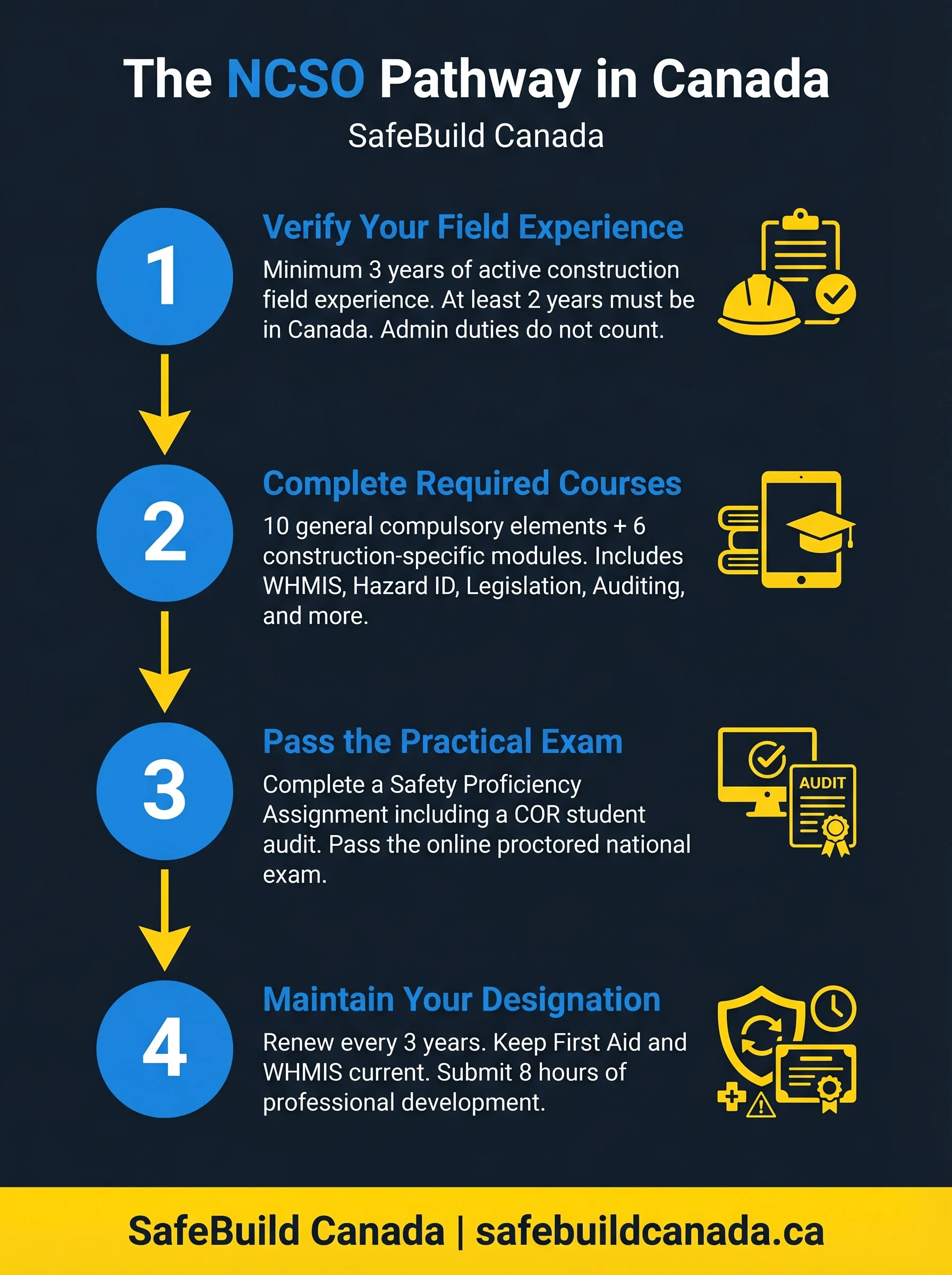
While each province has its own administering body, the core requirements for the NCSO are standardized across the country by the CFCSA. The pathway generally follows four distinct steps.
Step 1: Verify your field experience
Before you invest time and money into the coursework, you must verify that you meet the experience requirement. You need a minimum of three years of construction field experience from within the past ten years.
Administrative duties completed in a site trailer or head office do not count toward this requirement. You must have been actively engaged in construction work or the direct supervision of construction work. A minimum of two years of this experience must have been obtained within Canada. A maximum of one year of international experience can be applied.
Step 2: Complete the mandatory training courses
The CFCSA mandates a core set of general compulsory training elements that every NCSO candidate must complete. These include:
Health and safety program content
Investigations and reporting
Training and communication
Legislation and responsibilities
Supervisory training
Emergency preparedness and first aid
Hazard identification, analysis, and control
Inspections
Records and statistics
Auditing
In addition to these general elements, candidates must complete construction-specific training. This covers WHMIS, preventative maintenance, occupational hygiene, safe work practices, personal protective equipment, and site housekeeping.
Each provincial association packages these elements into specific courses. In British Columbia, the BCCSA requires candidates to complete ten compulsory courses, including their SiteReadyBC program and a Train the Safety Trainer module. This is just one part of the broader landscape of mandatory construction site training required across the country that every employer must understand before putting workers on site.
Step 3: Pass the practical application and final exam
Knowledge is useless if it cannot be applied on site. The NCSO requires candidates to prove their practical competency.
This typically involves a safety proficiency assignment. Candidates must conduct a formal hazard identification and risk assessment exercise, complete a communication exercise like delivering a toolbox talk, and perform a safety program audit. In many provinces, this means conducting a Certificate of Recognition student audit of their own company.
Once the coursework and practical assignments are approved, candidates must pass a national exam covering both the CFCSA standards and their specific provincial legislation. This is typically an online, proctored, multiple-choice test.
Step 4: Maintain your designation
Earning the NCSO is not a one-time event. The designation must be renewed every three years.
To maintain your active status, you must keep your core training certificates current. This usually means renewing your standard first aid and WHMIS training. You must also submit proof of ongoing professional development. In Ontario, the IHSA requires eight hours of professional development every three years, along with updated documentation of your practical safety work.
NCSO vs CRSP: Which pathway is right for you?
As you plan your career in construction safety, you will likely encounter the Canadian Registered Safety Professional designation. Understanding the difference between the NCSO and the CRSP is important for anyone mapping their career through the various safety certifications in Canada available to construction professionals.
The NCSO is the entry point for construction-specific safety leadership. It requires three years of field experience and the completion of roughly a dozen short courses. It is highly practical and focused entirely on the realities of the construction site.
The CRSP is a broader, more advanced designation. It is administered by the Board of Canadian Registered Safety Professionals and applies to all industries, not just construction. To be eligible for the CRSP, you typically need a bachelor's degree or a specialized occupational health and safety diploma, along with four years of professional-level safety experience.
Many safety professionals start by earning their NCSO to establish their credibility in the construction sector, and later pursue their CRSP as they move into senior corporate management roles.
The role of the NCSO on a Canadian construction site
Once you have earned the designation, the daily reality of the job shifts from completing coursework to managing complex, dynamic environments. An NCSO is not a desk job. It requires constant engagement with site supervisors, tradespeople, and project managers.
The primary responsibility of an NCSO is to assist management in the administration, implementation, and maintenance of a health and safety management system. This means taking the corporate safety manual and making it actually function on the ground. You are the bridge between the legal requirements drafted in an office and the physical work happening on the scaffolding.
Hazard identification and risk assessment
A core function of the NCSO is identifying and reviewing health and safety concerns specific to the worksite. This is where the hierarchy of controls becomes a daily tool rather than a theoretical concept.
When a new phase of construction begins, the NCSO must evaluate the planned work. If a contractor is scheduled to perform hot work in a confined space, the NCSO must confirm that all permits are in place, that the atmosphere has been tested, and that a rescue plan is established. They must verify that the workers are not relying solely on personal protective equipment, but have implemented engineering controls like ventilation and administrative controls like a fire watch.
Communication and training
An NCSO must communicate effectively with government occupational health and safety officers, management, and workers. This requires a unique skill set. You must be able to explain a complex regulatory requirement to a site superintendent in a way that makes sense for their schedule, and you must be able to deliver a toolbox talk to a crew of framers that actually changes their behavior.
When an OHS inspector arrives on site, the NCSO is typically the primary point of contact. They must be able to produce the required documentation, demonstrate that the site is in compliance, and professionally manage any orders or citations that are issued.
Incident investigation and reporting
When things go wrong, the NCSO is responsible for managing the aftermath. This involves securing the scene, confirming injured workers receive medical attention, and conducting a thorough investigation to determine the root cause of the incident.
The NCSO must understand the difference between a direct cause and a root cause. They must interview witnesses, review site conditions, and draft a detailed report that satisfies both the employer's internal requirements and any reporting obligations to the provincial workers' compensation board. In Ontario, for example, a critical injury must be reported to the Ministry of Labour, Immigration, Training and Skills Development immediately by phone, followed by a written notice within 48 hours.
Why companies hire NCSOs
For construction companies, having an NCSO on staff is increasingly becoming a requirement rather than a preference. Many large project owners, including government agencies and major developers, now mandate that contractors have a designated safety professional on site for projects over a certain dollar value or worker count.
Beyond that, the NCSO designation is deeply tied to the Certificate of Recognition program. COR is a national standard that verifies a company has a fully implemented health and safety program that meets provincial standards. In many provinces, holding a valid COR is a pre-qualification requirement for bidding on public sector projects.
Because the NCSO curriculum includes training on how to build a construction site safety plan, implement it, and audit it, an NCSO is the ideal person to guide a company through the COR certification process. They understand the documentation required, the training standards that must be met, and the practical application of the safety manual on the job site.
The financial return on safety leadership
Investing in an NCSO designation is a real commitment of time and resources, but the financial return is strong. According to recent salary data from PayScale Canada, a safety officer with an NCSO designation earns an average of $74,000 per year, with experienced professionals in high-demand sectors like oil and gas or heavy civil construction earning well over $100,000.
For the employer, the return on investment is measured in reduced incident rates, lower workers' compensation premiums, and the ability to bid on larger, more lucrative projects. A competent NCSO can identify a hazard before it results in a stop-work order, saving the company thousands of dollars in delays and potential fines.
The pathway to becoming a National Construction Safety Officer is rigorous, but it is designed to produce professionals who can genuinely improve the safety culture of the Canadian construction industry. By combining practical field experience with standardized national training, the NCSO designation means the people managing safety on our sites have the knowledge and the credibility to protect the workers who build our country.
Equipping your team for hazard control
As an NCSO, one of your primary responsibilities will be managing the hierarchy of controls on your site. While elimination and engineering controls are always the priority, personal protective equipment remains a critical last line of defense.
Understanding the nuances of CSA standards for PPE is a core competency for any safety officer. Knowing when a site requires a Type 1 versus a Type 2 hard hat, for example, can mean the difference between compliance and a stop-work order. You must be able to assess the specific hazards of a task and confirm your workers are equipped with gear that meets the appropriate CSA standards.
When to bring in a safety consultant
Even with an NCSO on staff, there are times when a construction company needs external expertise.
If your company is preparing for its first COR audit, or if you are facing complex regulatory orders following an inspection, bringing in a specialized safety consultant can provide the objective perspective needed to get your program on track. A consultant can help build the foundational safety manual that your internal NCSO will then implement and manage on a daily basis.
Download your Canadian-compliant FLHA template
A large part of an NCSO's daily routine is managing field-level hazard assessments. If your site supervisors are working with complicated, generic forms, compliance will drop.
We have built a streamlined, Canadian-compliant FLHA template designed specifically for active construction sites. It prompts workers to identify hazards and implement controls without burying them in paperwork. Download the template and start standardizing your site's hazard assessment process.
Sources
Canadian Federation of Construction Safety Associations, NCSO Training Elements, 2024. cfcsa.ca
Infrastructure Health and Safety Association, NCSO Designation Requirements, 2024. ihsa.ca
Alberta Construction Safety Association, NCSO/HSA Designation, 2024. youracsa.ca
BC Construction Safety Alliance, NCSO/NHSA Designation Requirements, 2024. bccsa.ca
Board of Canadian Registered Safety Professionals, CRSP Certification Eligibility, 2024. bcrsp.ca
PayScale Canada, National Construction Safety Officer Salary, 2024. payscale.com