
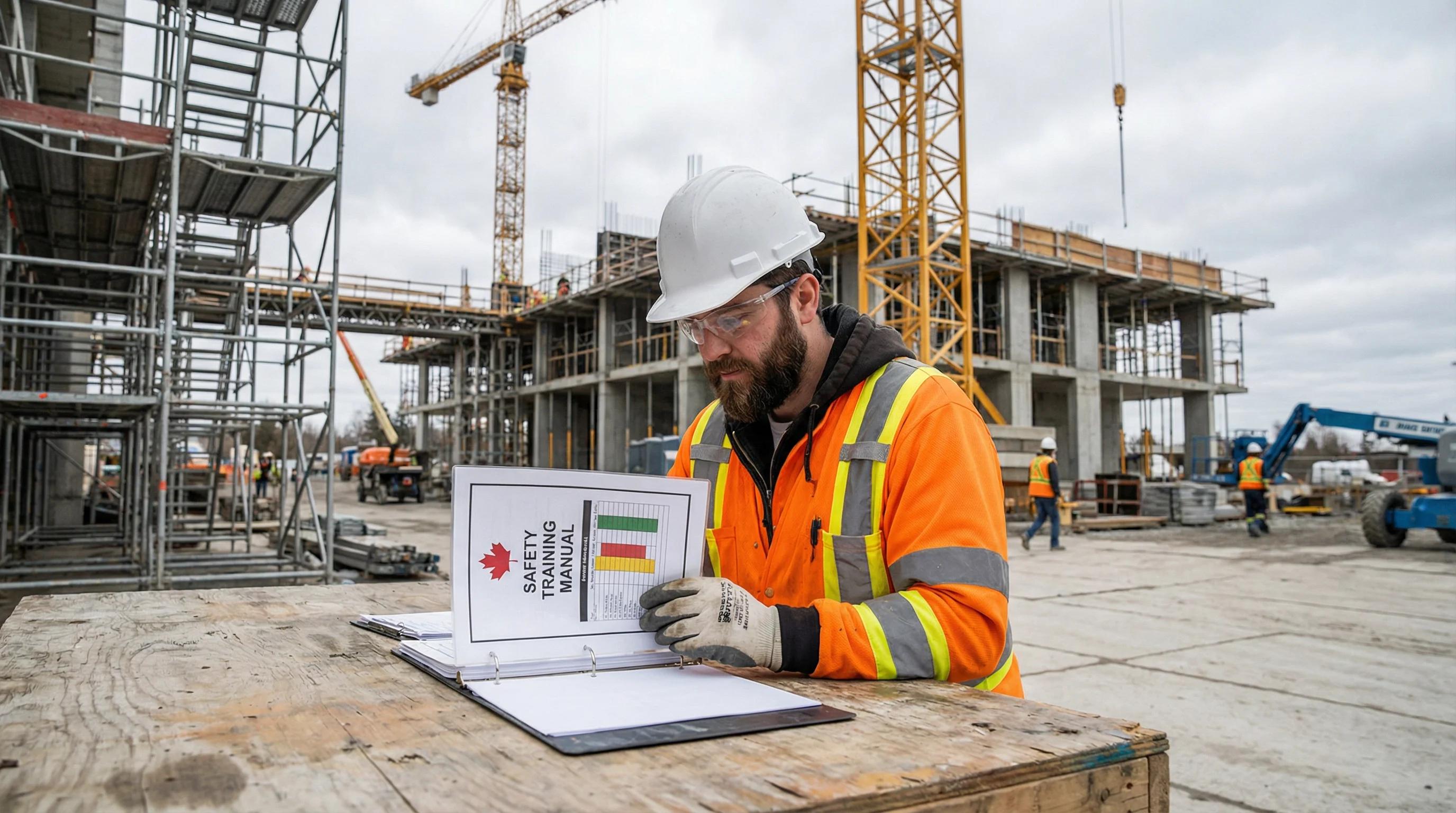
Every year, new workers account for a disproportionate share of construction injuries in Canada. The Institute for Work and Health has consistently found that workers are most vulnerable during their first months on a job, regardless of age or prior experience. That vulnerability is not random. It is the direct result of workers starting tasks before they have received the training the law requires. Understanding what mandatory construction site training in Canada actually covers, which programs are legislated versus industry-standard, and how requirements differ across Ontario, Alberta, and British Columbia is not optional knowledge for employers. It is a compliance obligation with real legal consequences.
This guide covers the pre-work training requirements that apply before a worker sets foot on a Canadian construction site, province by province, so employers and workers know exactly what is required and what the law says about it.
Why pre-work training is a legal obligation, not a recommendation
The framing matters. In every Canadian jurisdiction, the requirement to train workers before they perform work is written directly into OHS legislation. It is not a best practice. It is not a recommendation from an industry association. It is a legal duty that sits with the employer.
Under the Alberta OHS Act, employers are responsible for ensuring workers are competent to perform their work safely. "Competent" is a defined term: it means adequately qualified, suitably trained, and with sufficient experience to perform the work without risk to health and safety. That definition makes training a precondition for assigning any task, not something that happens in the first week on the job.
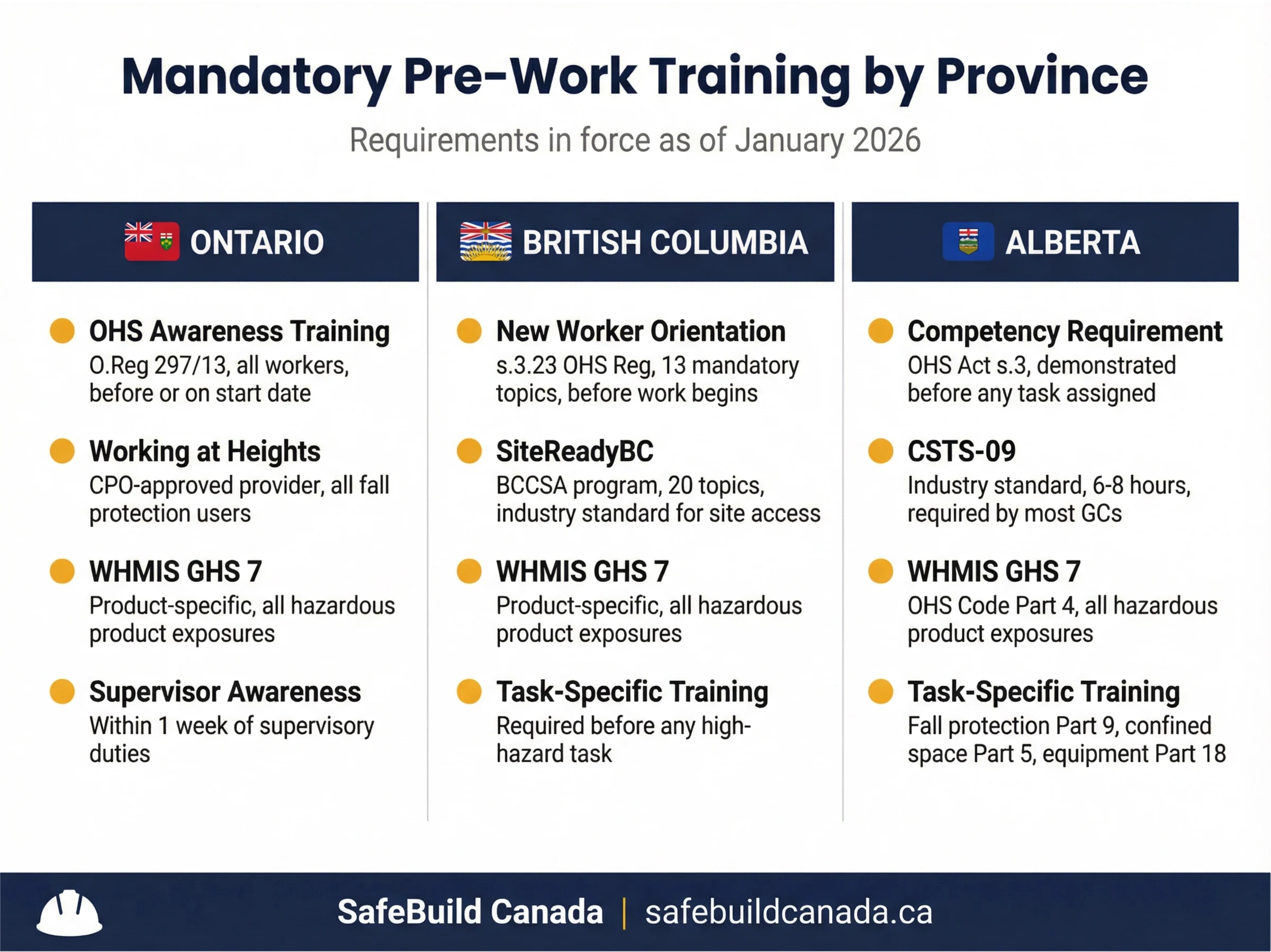
In Ontario, O.Reg 297/13 under the Occupational Health and Safety Act requires employers to ensure every worker completes a basic OHS awareness training program. For supervisors, that training must be completed within one week of beginning supervisory work. For workers, it must happen as soon as practicable, which courts and the Ministry of Labour have consistently interpreted as before or immediately upon starting work.
In British Columbia, section 3.23 of the OHS Regulation under the Workers Compensation Act is the most explicit of the three: an employer must ensure that before a young or new worker begins work, that worker receives health and safety orientation and training specific to their workplace. The word "before" is not ambiguous.
Understanding the full picture of Canadian OHS regulations helps employers see how these training obligations fit into the broader compliance framework.
OHS awareness training: the baseline requirement in Ontario
Ontario's O.Reg 297/13 sets the floor for worker training on every construction site in the province. Every worker must complete a basic OHS awareness training program that covers: the duties and rights of workers under the OHSA; the duties of employers and supervisors; the roles of the joint health and safety committee and health and safety representative; the roles of the Ministry of Labour, Immigration, Training and Skills Development and the WSIB; common workplace hazards; WHMIS requirements; and occupational illness, including latency.
For supervisors, the program must also cover how to recognize, assess, and control workplace hazards, and how to evaluate those controls. The supervisor version must be completed within one week of beginning supervisory duties, which means a worker promoted to lead hand or site supervisor on Monday must have completed the training by the following Monday.
The regulation does not specify a minimum duration or require a third-party provider. Employers can deliver this training in-house, provided the content meets the requirements. Many employers use the free online awareness training available through the MLITSD website to satisfy this requirement, though site-specific orientation delivered by the employer is equally valid.
Working at heights: Ontario's most-enforced mandatory training requirement
For construction workers in Ontario who use fall protection equipment, working at heights (WAH) training is mandatory under O.Reg 297/13 and is one of the most actively enforced training requirements in the province. A worker cannot legally use fall protection devices on a construction project without first completing a WAH program approved by the Chief Prevention Officer.
The program must be delivered by a CPO-approved training provider. As of March 2026, there are 172 approved providers across Ontario. The training covers fall hazard recognition, fall prevention planning, the correct use of travel restraint systems, fall restricting systems, fall arrest systems, and safety nets. Workers who complete an approved program receive a wallet card and certificate that employers must keep on file.
The regulation does not set an expiry date for WAH certification, but the Ministry of Labour recommends refresher training every three years, and many project owners require proof of recent training as a condition of site access. Employers should build a training record system that tracks both the initial certification date and any refresher completions.
Working at heights training is one component of a broader fall protection plan that every Ontario construction site must maintain. The relationship between training records and the written fall protection plan is direct: if a worker's training is not documented, the plan cannot demonstrate compliance.
WHMIS: the one training requirement that applies everywhere in Canada
Workplace Hazardous Materials Information System (WHMIS) training is mandatory for every worker in every Canadian jurisdiction who works with or may be exposed to hazardous products. The requirement flows from the federal Hazardous Products Act and provincial OHS legislation, which means there is no province where this training is optional.
The Canadian Centre for Occupational Health and Safety is clear on the employer's obligations: every employer must develop, implement, and maintain a WHMIS education and training program. Workers must receive both general WHMIS education (how the system works, how to read safety data sheets, how to interpret labels) and product-specific training for the hazardous materials they will actually encounter on site.
As of January 1, 2026, WHMIS GHS 7 is fully in force across Canada, replacing the previous GHS 3 standard. The transition updated the classification criteria, label requirements, and safety data sheet format. Employers who have not yet updated their WHMIS training programs to reflect GHS 7 are out of compliance. Refresher training is required whenever new hazardous products are introduced to a site, when product hazard information changes, or when work conditions change in a way that affects worker exposure.
On construction sites, WHMIS-relevant products include adhesives, solvents, concrete admixtures, paints, coatings, and many cleaning products. The list is longer than most employers expect, and the obligation to train workers on each product is ongoing, not a one-time event.
Alberta: competency, CSTS-09, and what the OHS Act actually requires
Alberta's approach to pre-work training is grounded in the concept of competency rather than a specific list of mandatory programs. The OHS Act requires employers to ensure workers are competent before assigning any task. That means the employer must assess whether a worker has the qualifications, training, and experience to perform the work safely, and if not, provide the training needed to reach competency before the work begins.
In practice, the Alberta construction industry has standardized around the Construction Safety Training System (CSTS-09) as the baseline pre-entry orientation for most commercial and industrial construction sites. CSTS-09 is a 6-8 hour online course covering OHS legislation, hazard recognition, WHMIS, fall protection, confined spaces, and emergency procedures. It is not legislated as mandatory by the Alberta government, but the vast majority of general contractors and project owners require it as a condition of site access, which makes it effectively mandatory for any worker seeking employment on a commercial construction site in the province.
Beyond CSTS-09, Alberta employers must ensure workers receive task-specific training before performing high-risk work. Fall protection training is required under Part 9 of the Alberta OHS Code before a worker uses any fall protection system. Confined space entry training is required under Part 5 before a worker enters a confined space. Workers operating powered mobile equipment must be trained and authorized under Part 18. These are legislative requirements, not industry standards.
WHMIS training is required under Part 4 of the OHS Code for any worker who works with or may be exposed to hazardous products, consistent with the national standard.
British Columbia: the most prescriptive new worker orientation requirement in Canada
BC's OHS Regulation section 3.23 is the most detailed new worker orientation requirement in any Canadian jurisdiction. Before a young or new worker begins work, the employer must provide health and safety orientation and training specific to that worker's workplace. The regulation defines "new worker" broadly: it covers workers new to a workplace, workers returning after an absence where hazards have changed, workers affected by a change in workplace hazards, and workers relocated to a new workplace with different hazards. A worker who has been in the trades for twenty years can still be a "new worker" under this definition if they move to a site with different hazards.
The 13 mandatory topics for BC new worker orientation include: the supervisor's name and contact information; the employer's and worker's rights and responsibilities under the Workers Compensation Act and OHS Regulation; workplace health and safety rules; hazards the worker may be exposed to; working alone or in isolation procedures; violence in the workplace; personal protective equipment; location of first aid facilities; emergency procedures; instruction and demonstration of the worker's specific tasks; the employer's health and safety program; WHMIS; and contact information for the joint health and safety committee or worker health and safety representative.
The BC Construction Safety Alliance's SiteReadyBC program is the industry's primary tool for meeting these obligations. The 6-8 hour online course covers all 20 core construction safety topics, includes WHMIS 2015 certification at no additional cost, and is recognized by a growing number of BC project owners as a prerequisite for site access. SiteReadyBC is not legislated as mandatory, but it is designed specifically to help employers satisfy their s.3.23 obligations, and its adoption across the province has made it the de facto standard for pre-entry orientation on BC construction sites.
Documentation: the part of training most employers get wrong
Training is not complete until it is documented. Every jurisdiction requires employers to keep records of worker training, and those records must be available for inspection by an OHS officer on request. In Ontario, O.Reg 297/13 requires employers to keep a record of each worker's OHS awareness training completion. WAH training records must include the worker's name, the training provider, the date of completion, and the certificate number. In Alberta, the OHS Code requires employers to keep records of training for any task covered by a specific training requirement in the Code. In BC, section 3.24 of the OHS Regulation requires documentation of additional orientation and training for specific hazardous tasks.
The most common documentation failure is not the absence of training but the absence of proof. A worker who completed WHMIS training two years ago but whose employer cannot produce the record is, from a compliance standpoint, an untrained worker. Building a training record system that captures the worker's name, the training completed, the delivery method, the date, and the trainer or provider is not optional. It is the evidence that protects both the worker and the employer when an inspector arrives or an incident occurs.
A well-documented training program is also a core component of a construction site safety plan. The safety plan should reference the training matrix, identify which workers have completed which programs, and flag any gaps that need to be addressed before work begins.
What happens when training is not completed before work starts
The consequences of sending an untrained worker onto a site are not limited to fines. In Ontario, failure to ensure a worker completes OHS awareness training is a violation of the OHSA that can result in a stop-work order, a fine of up to $500,000 for a corporation, and potential prosecution. In Alberta, assigning work to a worker who is not competent to perform it safely is a direct violation of the OHS Act. In BC, failing to provide new worker orientation before work begins is a violation of the OHS Regulation that WorkSafeBC officers actively enforce.
Beyond the regulatory consequences, the practical risk is straightforward. A worker who has not been trained on the hazards of their specific workplace is more likely to be injured. That injury creates a workers' compensation claim, potential civil liability, and the kind of reputational damage that follows a company for years. The cost of delivering orientation training before work starts is a fraction of the cost of any of those outcomes.
For workers pursuing careers in construction safety, understanding the full scope of mandatory training requirements is foundational. The pathway from site worker to certified safety professional begins with knowing what the law requires and why it requires it. The NCSO certification pathway is one of the most direct routes for workers who want to move into a safety role on Canadian construction sites.
Conclusion
Mandatory construction site training in Canada is not a single program or a one-time event. It is a layered set of requirements that vary by province, by task, and by the specific hazards present on each site. Ontario requires OHS awareness training for every worker and working at heights training for anyone using fall protection. Alberta requires demonstrated competency before any task, with CSTS-09 as the industry-standard baseline. BC requires a 13-topic new worker orientation before work begins, with SiteReadyBC as the practical tool most employers use to deliver it. WHMIS training is mandatory everywhere, and it must be product-specific, not generic.
The employer's job is not to find the minimum that satisfies the regulation. It is to ensure every worker on site has the knowledge they need to go home at the end of the shift. Documentation is the proof that the job was done. If the record does not exist, the training did not happen, regardless of what was actually delivered.
Workers who want to understand how these training requirements connect to the broader construction safety certifications landscape in Canada will find that the pre-work training requirements covered here are the foundation every certification pathway builds on.
Sources
Ontario O.Reg 297/13, Occupational Health and Safety Awareness and Training
CCOHS, WHMIS Education and Training
WorkSafeBC OHS Regulation s.3.23, Young or new worker orientation and training
Government of Alberta, Obligations of work site parties
BCCSA, SiteReadyBC