

If you work in Canadian construction and you are serious about a career in safety, you will eventually face a question that trips up a lot of people: which construction safety certification should you pursue? The NCSO, the CRSP, and the Gold Seal Safety Practitioner designation are the three credentials that come up most often, and they are frequently misunderstood as interchangeable. They are not. Each one was designed for a different stage of a safety career, a different type of role, and a different level of responsibility. Getting clear on the differences before you invest your time and money is not a minor detail. It is the difference between a credential that opens doors and one that sits on your wall without moving your career forward.
This guide breaks down Canada's main construction safety certifications in plain language: what each one requires, who it is designed for, and how they fit together as a career pathway. For a broader overview of how certifications connect to training requirements, see our guide to construction safety training in Canada.
Why certifications matter in Canadian construction safety
The Canadian construction industry does not have a single national licensing body for safety professionals the way it does for engineers or electricians. What it has instead is a set of nationally recognized designations that signal to employers, regulators, and workers that a person has met a defined standard of training, experience, and competency. These designations are not legally required to work in a safety role in most provinces, but the practical reality is that employers treat them as requirements. The BCRSP's own research found that 70% of employers list the CRSP as a requirement for professional OHS positions. The NCSO is similarly expected on most mid-to-large construction sites in Ontario, Alberta, and British Columbia.
The other reason certifications matter is that they are tied to the Certificate of Recognition (COR) program. In provinces like Alberta and British Columbia, COR certification allows employers to receive a rebate on their workers' compensation premiums. The NCSO designation is directly connected to the COR audit process. NCSO candidates must complete a COR student audit as part of their certification requirements. If your company is pursuing COR, having certified safety staff is not optional.
The NCSO: the field-level standard for construction safety
The National Construction Safety Officer (NCSO) designation is the most widely held construction-specific safety credential in Canada. It is recognized by all provincial and territorial construction safety associations across the country through the Canadian Federation of Construction Safety Associations, which means an NCSO earned in Ontario carries the same national recognition as one earned in Alberta or British Columbia.
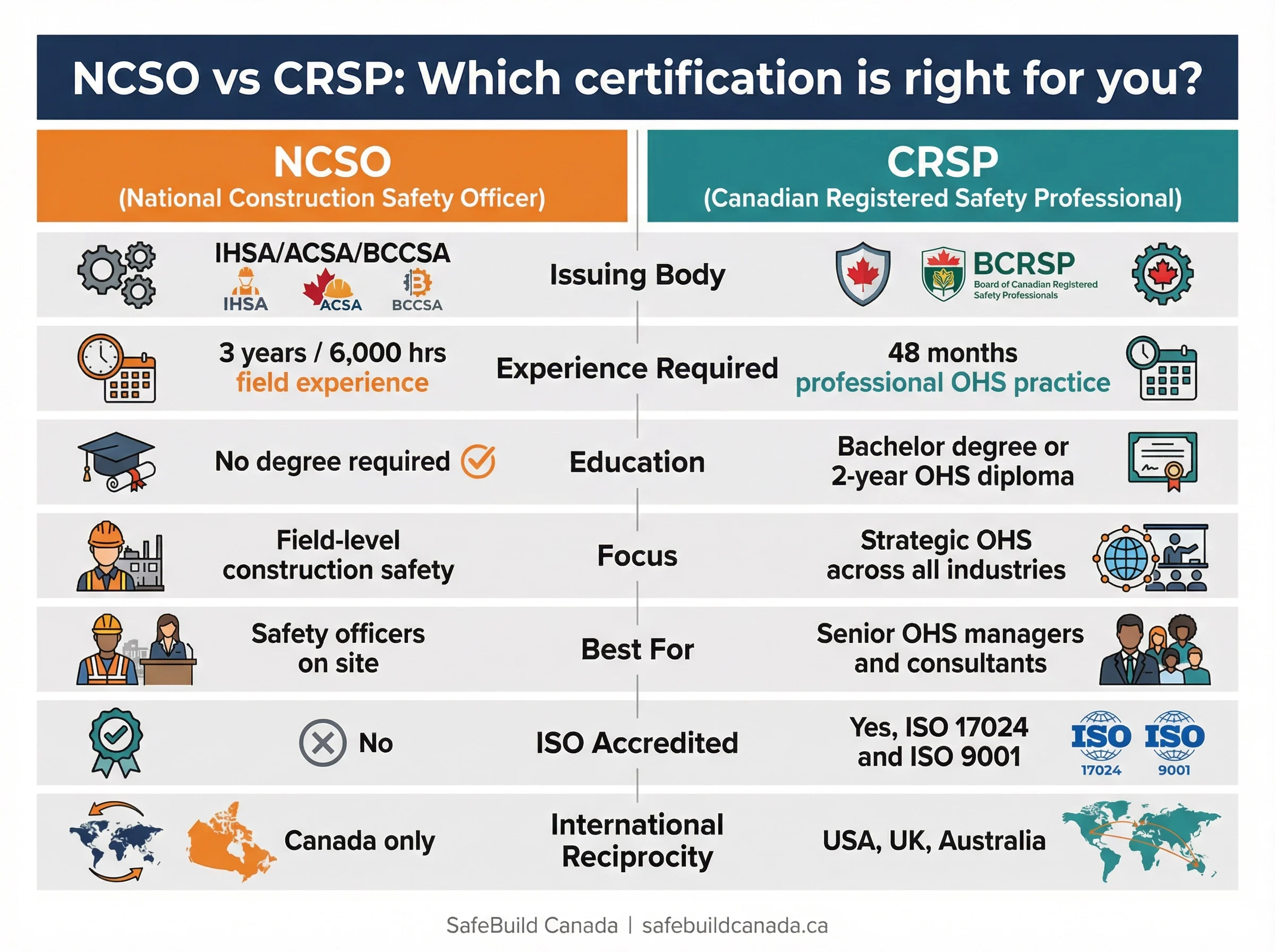
The NCSO was designed specifically for people who perform safety functions in the field: on the jobsite, working directly with crews, conducting inspections, and supporting site management. It is not an administrative credential. The experience requirement reflects this: applicants must have a minimum of three years, or 6,000 hours, of construction field experience within the past ten years. At least two of those years must have involved direct safety responsibilities.
Beyond experience, NCSO candidates must complete nine compulsory courses plus two elective courses. The exact course list varies slightly by province, but the core curriculum covers hazard identification, incident investigation, OHS legislation, and safety management systems. Candidates must also pass a qualification exam and complete a COR health and safety student audit of their own company. The audit requirement is one of the things that makes the NCSO genuinely practical. It forces candidates to apply what they have learned in a real workplace context, not just pass a test.
Once certified, NCSO holders must renew every three years. Renewal requires keeping all training certificates current, maintaining the practical elements of the designation, and completing at least eight hours of professional development. In Ontario, the IHSA administers the NCSO program and provides the courses, exam, and application process. In Alberta, it is the ACSA. In British Columbia, the BCCSA.
One important note: if you do not yet have three years of construction field experience, the NHSA (National Health and Safety Administrator) designation is the entry point. The NHSA covers the same curriculum but is designed for those performing safety functions at an administrative level rather than in the field. If you want a full walkthrough of the NCSO pathway, our post on how to become a construction safety officer covers the application process step by step.
The CRSP: the benchmark for OHS professionals
The Canadian Registered Safety Professional (CRSP) designation is a different credential entirely. Where the NCSO is built around field experience and construction-specific knowledge, the CRSP is built around formal education, professional-level OHS practice, and a rigorous competency examination. It is the benchmark certification for OHS professionals across all industries in Canada, not just construction.
The BCRSP describes the CRSP as "the certification of choice for OHS professionals," and the data supports that claim. It is the only Canadian OHS certification accredited to ISO 17024 and certified to ISO 9001. It has international reciprocity agreements with the Board of Certified Safety Professionals in the United States, IOSH and NEBOSH in the United Kingdom, and the Australia Institute of Health and Safety. A CRSP is a genuinely portable credential if your career takes you beyond Canada.
The eligibility requirements for the CRSP are substantially more demanding than those for the NCSO. Applicants must hold either a Bachelor's degree in any field (combined with demonstrated professional development in OHS) or a two-year diploma or certificate in occupational health and safety with a minimum of 900 hours or 60 credits from a recognized institution. On top of that, applicants need 48 months of professional-level OHS experience obtained within the last 72 months, with a minimum of 900 hours per calendar year of active OHS practice. The application fee is $525 plus GST/HST and is non-refundable, so the BCRSP strongly advises applicants to verify their CRSP eligibility criteria before submitting.
The salary data associated with the CRSP is worth noting. According to the BCRSP's 2019 Salary Survey, 51.7% of CRSP respondents reported salaries above $100,000. The number of active CRSPs has grown by 56% since 2006, which reflects both the growing demand for credentialed safety professionals and the increasing expectation among employers that senior safety roles will be filled by CRSP holders.
The practical distinction between the NCSO and the CRSP is one of scope and level. An NCSO is the right credential for a safety officer who works on the tools, conducts site inspections, and supports a safety management system at the project level. A CRSP is the right credential for someone who designs and manages safety systems across an organization, advises senior leadership, and operates at a strategic level. As one Edmonton-based safety consultant put it in OHS Canada magazine, "Compared to an NCSO, the CRSP is like a Master's degree." That framing is useful, though it undersells the NCSO. The two designations are not in competition; they serve different functions.
The Gold Seal Safety Practitioner: construction management's credential
The Canadian Construction Association's Gold Seal Certification is less well known in safety circles than the NCSO or CRSP, but it occupies a distinct space: it is a construction management credential that includes a Safety Practitioner stream. Gold Seal is not a safety-only designation. It certifies Estimators, Forepersons, Project Managers, Superintendents, and Owner's Construction Managers as well. The Safety Practitioner stream is for safety professionals who work in Canada's industrial, commercial, institutional, and civil construction sectors and want a credential that signals both safety expertise and construction management competency.
The process is structured differently from the NCSO and CRSP. Applicants must first enrol in the Gold Seal Certification Program and be approved as a Gold Seal Intern (GSI). From there, they have five years to meet the program requirements, submit their Gold Seal Certified (GSC) application, and be approved to write the Gold Seal exam. The specific experience and education requirements for the Safety Practitioner stream are tied to the CCA's national standards for construction management professionals.
Gold Seal is the right credential to consider if you are a safety professional who wants to be recognized within the broader construction management community, or if you are moving into a role that bridges safety and project management. It carries significant weight with general contractors and owners who use the Gold Seal designation as a hiring benchmark for their management teams.
How the certifications fit together as a career pathway
The most useful way to think about Canadian construction safety certifications is as a career progression rather than a competition. Most safety professionals in construction start with site-level training, move into the NCSO as they build field experience, and then pursue the CRSP as their career moves into organizational or strategic roles. The Gold Seal Safety Practitioner sits alongside the CRSP as a parallel credential for those whose careers span safety and construction management.
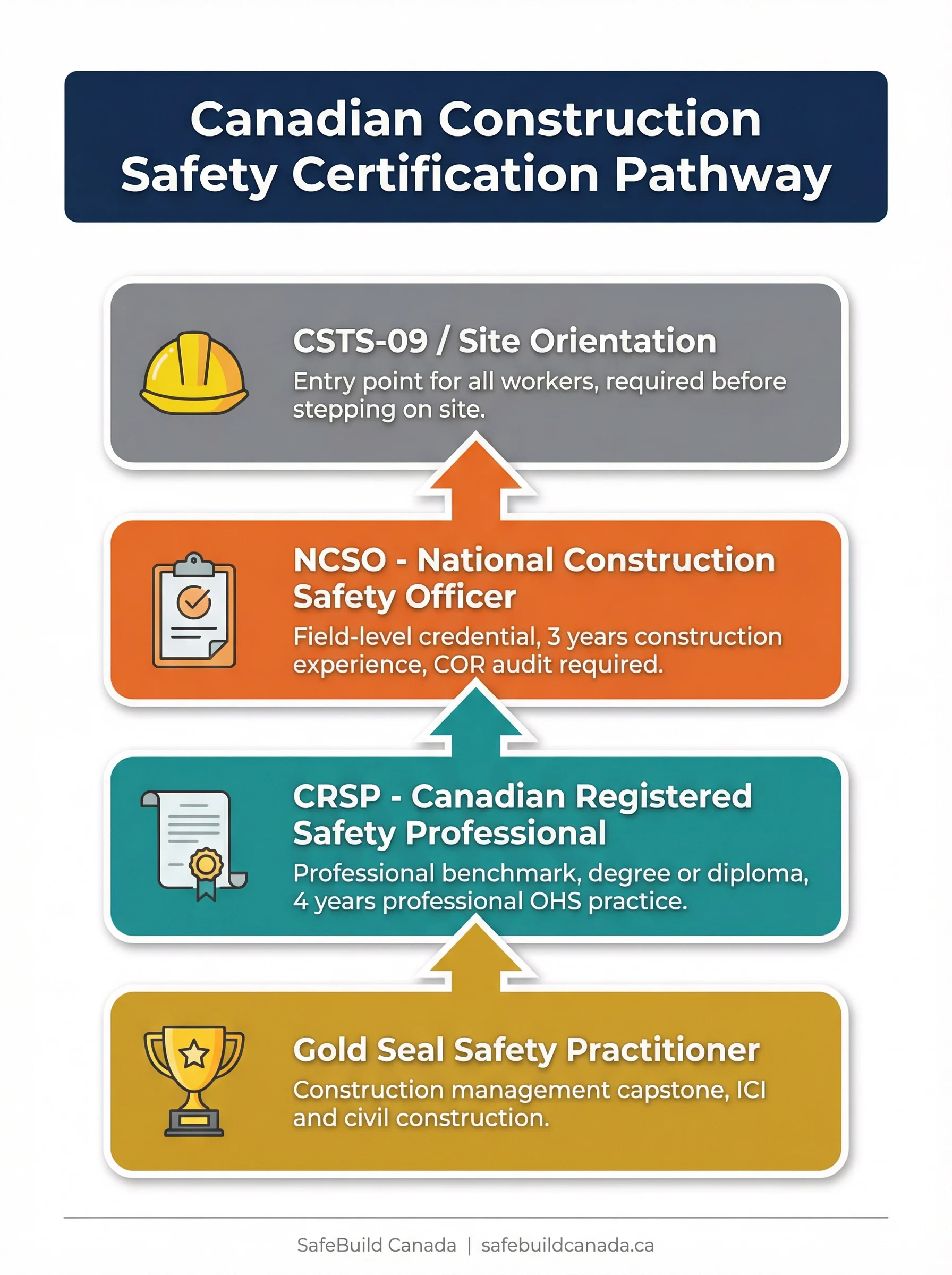
The CSTS-09 (Construction Safety Training System) is the entry point for most workers on Canadian construction sites. It is not a professional designation. It is a site orientation course, but it is the baseline that most provincial OHS regulations and COR programs expect workers to hold before they step onto a site. From there, the NCSO is the natural next step for anyone moving into a safety function in the field. The CRSP follows for those who want to move into organizational or strategic safety roles. The Gold Seal Safety Practitioner is the capstone for those who want to be recognized at the construction management level. For a full breakdown of what site training is required before any of these designations, see our overview of mandatory construction site training in Canada.
One thing worth saying directly: pursuing the CRSP without first having the NCSO is not a mistake, but it does mean entering the safety profession without the field-level credential that most site managers and workers recognize immediately. The NCSO carries a particular kind of credibility on a construction site that the CRSP, for all its rigor, does not automatically confer. If your career is in construction specifically, having both is not redundant. It is the combination that signals you understand both the field and the system.
Choosing the right certification for your career stage
The question of which certification to pursue first comes down to where you are in your career and what role you are trying to move into.
If you are working in the field with three or more years of construction experience and you want to move into a safety officer role, the NCSO is the right starting point. It is recognized across Canada, it is directly tied to the COR program, and it is the credential that site managers and safety directors look for when hiring field safety staff. In Ontario, the IHSA is the place to start. In Alberta, the ACSA. In British Columbia, the BCCSA.
If you have a post-secondary education in OHS or a related field and four or more years of professional-level safety experience, the CRSP is worth pursuing in parallel with or after the NCSO. The application process is more involved and the exam is more demanding, but the career ceiling for a CRSP holder is substantially higher than for an NCSO alone. The BCRSP's eligibility self-assessment tool is a useful first step before committing to the application fee.
If you are a safety professional working in ICI or civil construction and your role is moving toward construction management, the Gold Seal Safety Practitioner stream is worth exploring through the CCA.
For those navigating the regulatory requirements that underpin all of these certifications, our overview of Canada Labour Code Part II covers the legal framework that applies to federally regulated workplaces, and our guide to building a fall protection plan covers one of the most critical site-level competencies that NCSO candidates are expected to demonstrate.
The bottom line
The Canadian construction safety certification picture is not as complicated as it sometimes appears, but it does require some clarity about what each credential is actually for. The NCSO is the field-level standard, built around construction experience and site-specific knowledge. The CRSP is the professional benchmark, built around formal education and strategic OHS practice. The Gold Seal Safety Practitioner bridges safety and construction management for those whose careers span both domains.
None of these certifications is a shortcut. The NCSO requires three years of real construction field experience and a genuine engagement with the COR audit process. The CRSP requires a degree or diploma, four years of professional practice, and a demanding exam. The Gold Seal requires proven industry experience and a multi-year intern program. That rigor is exactly what makes them worth having. A credential that anyone can obtain in a weekend does not signal much to an employer. These ones do.
Sources
Infrastructure Health and Safety Association (IHSA), National Construction Safety Officer (NCSO) Program. IHSA, 2024.
Canadian Federation of Construction Safety Associations (CFCSA), The NCSO Designation. CFCSA, 2024.
Board of Canadian Registered Safety Professionals (BCRSP), About the CRSP Certification. BCRSP, 2024.
Board of Canadian Registered Safety Professionals (BCRSP), CRSP Eligibility Criteria. BCRSP, 2025.
Canadian Construction Association (CCA), Gold Seal Certified. CCA, 2024.
OHS Canada, Raising the Bar. OHS Canada, March 2015.