
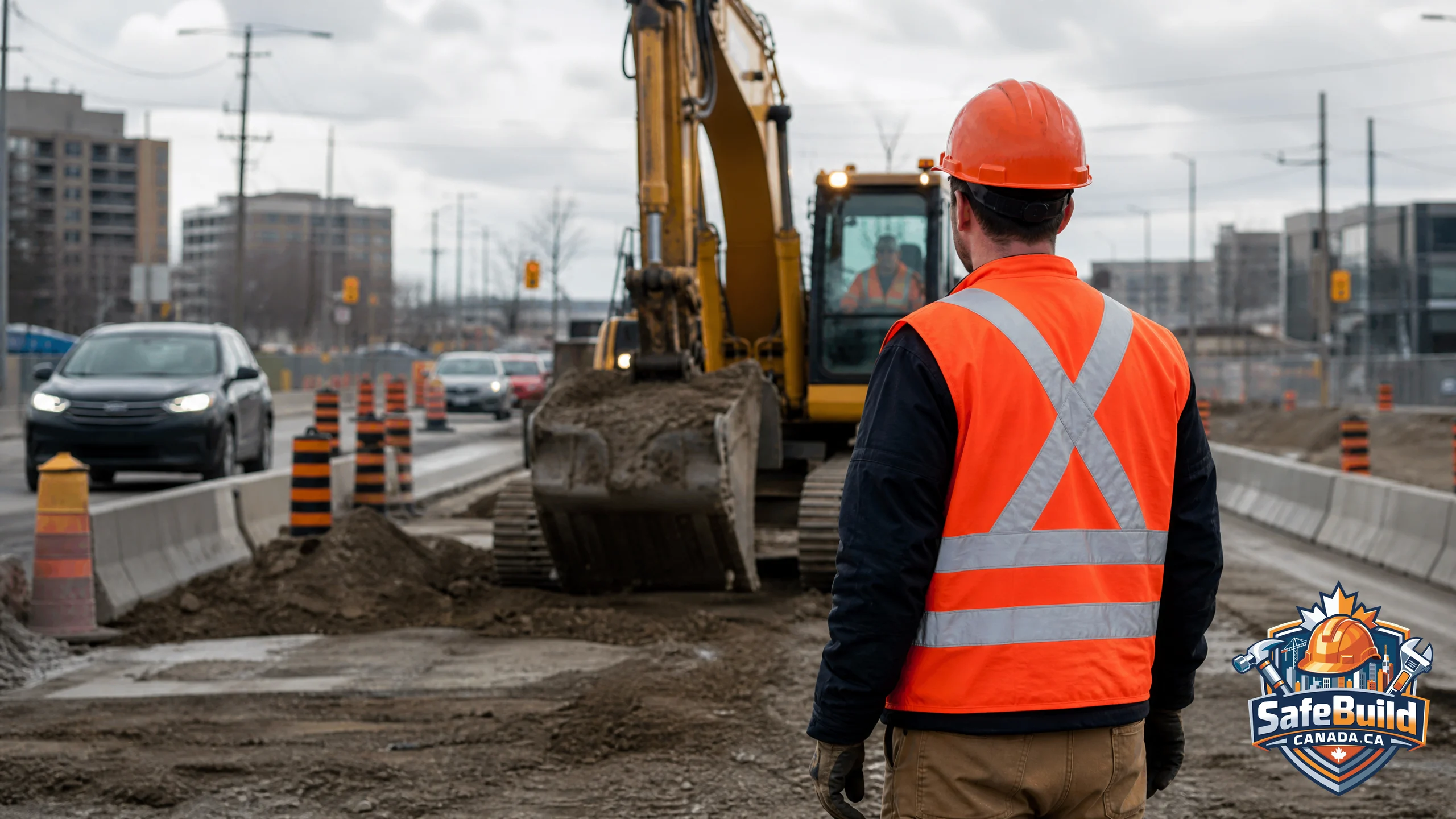
Visibility is a matter of life and death on a busy construction site. When heavy machinery, commercial vehicles, and ground workers operate in the same space, the risk of struck by incidents skyrockets. To mitigate this risk, Canadian occupational health and safety regulators rely on the CSA Z96 standard for high visibility safety apparel.
Understanding the requirements of CSA Z96 high visibility clothing in Canada is not just about buying bright vests. It requires a clear grasp of the different classes of apparel, the specific provincial regulations that govern your site, and the ongoing maintenance required to keep the gear effective. This guide breaks down everything construction employers and supervisors need to know to keep their crews visible and compliant.
The foundation of visibility: understanding CSA Z96
The Canadian Standards Association developed the CSA Z96 standard to provide a consistent, science based approach to high visibility safety apparel. The standard dictates the amount of fluorescent background material required, the placement and width of retroreflective tape, and the overall design of the garment.
The goal of the standard is to make workers conspicuous in all lighting conditions. Fluorescent materials, typically yellow green, orange red, or red, gather invisible ultraviolet light and reflect it back as visible light, making the wearer stand out during the day. Retroreflective tape bounces light from headlights directly back to the source, ensuring visibility at night or in low light conditions.
When selecting gear, it is crucial to verify that the apparel explicitly states compliance with the CSA Z96 standard on its interior tag. Generic bright clothing without this certification will not meet regulatory requirements and will leave your workers vulnerable.
The three classes of CSA Z96 apparel
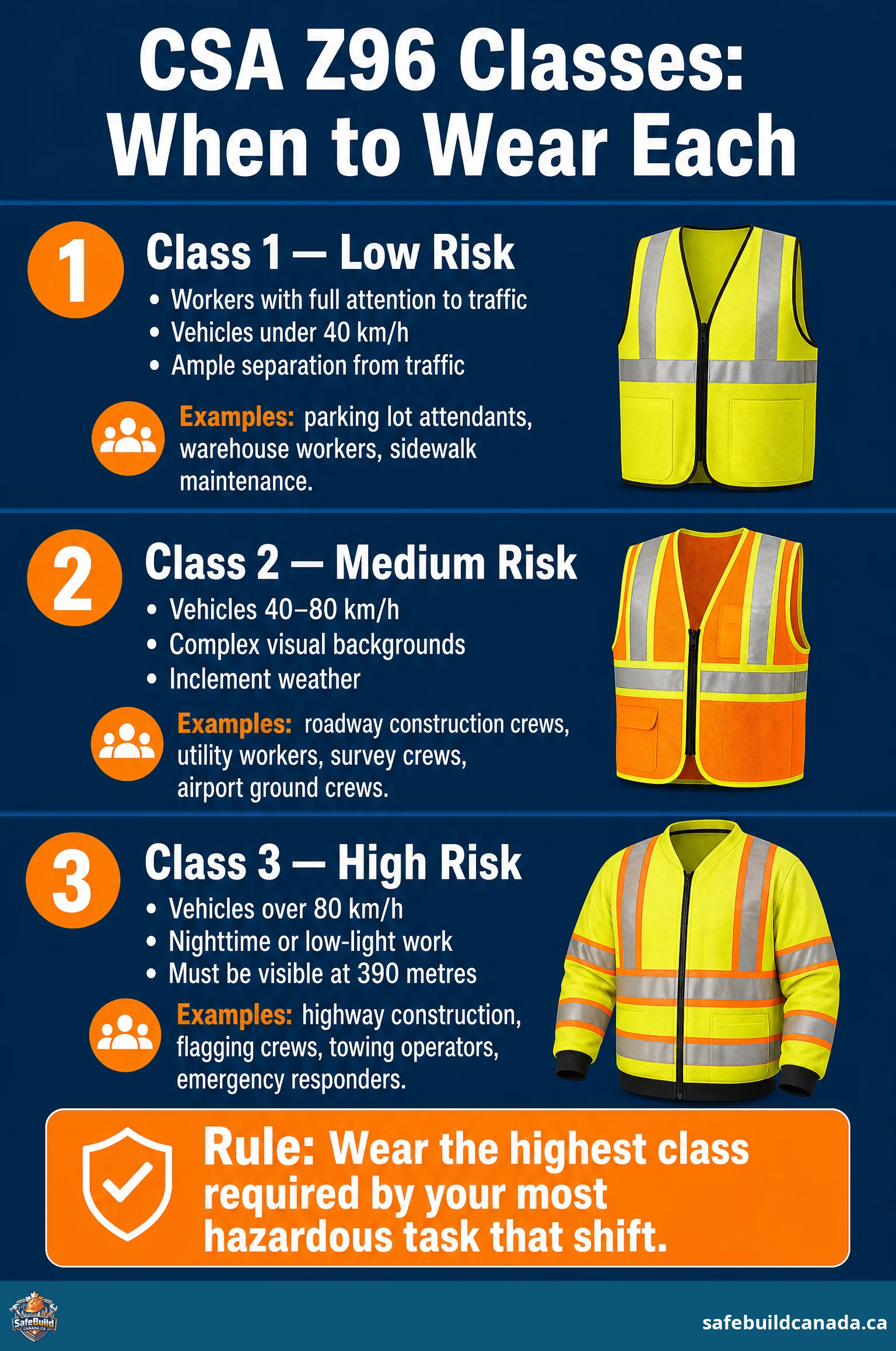
The CSA Z96 standard categorizes high visibility safety apparel into three distinct classes based on the level of risk the worker faces. The higher the risk, the more body coverage and reflective material the garment must provide.
Class 1: Low risk environments
Class 1 apparel provides the minimum amount of high visibility material. It is designed for workers who are separated from vehicular traffic and where vehicles are travelling at speeds under 40 kilometres per hour.
Workers wearing Class 1 gear must be able to give their full attention to approaching traffic. Typical applications include parking lot attendants, warehouse workers, and crews performing sidewalk maintenance well away from the active roadway. In the context of a major construction project, Class 1 is rarely sufficient for active work zones.
Class 2: Medium risk environments
Class 2 apparel is the standard for most Canadian construction sites. It requires significantly more fluorescent background material and retroreflective tape than Class 1, providing superior visibility.
This class is required when workers are exposed to vehicles travelling between 40 and 80 kilometres per hour, or when they are working against complex visual backgrounds that make them harder to spot. Roadway construction crews, utility workers, and survey teams typically require Class 2 apparel. If your site involves heavy equipment on a Canadian construction site, Class 2 should be considered the absolute minimum baseline for ground workers.
Class 3: High risk environments
Class 3 apparel provides the highest level of visibility, requiring the greatest amount of background and reflective material. This class is designed for the most dangerous environments, where workers are exposed to vehicles travelling over 80 kilometres per hour, or where they are working in nighttime or low light conditions.
To achieve Class 3 status, the apparel must outline the human form, typically requiring a Class 2 vest or jacket combined with compliant high visibility striping on the arms and legs. This ensures that drivers can recognize the wearer as a human being from a distance of at least 390 metres. Highway construction crews, flagging personnel, and emergency responders operating on active roadways must wear Class 3 gear.
Provincial requirements for high visibility clothing
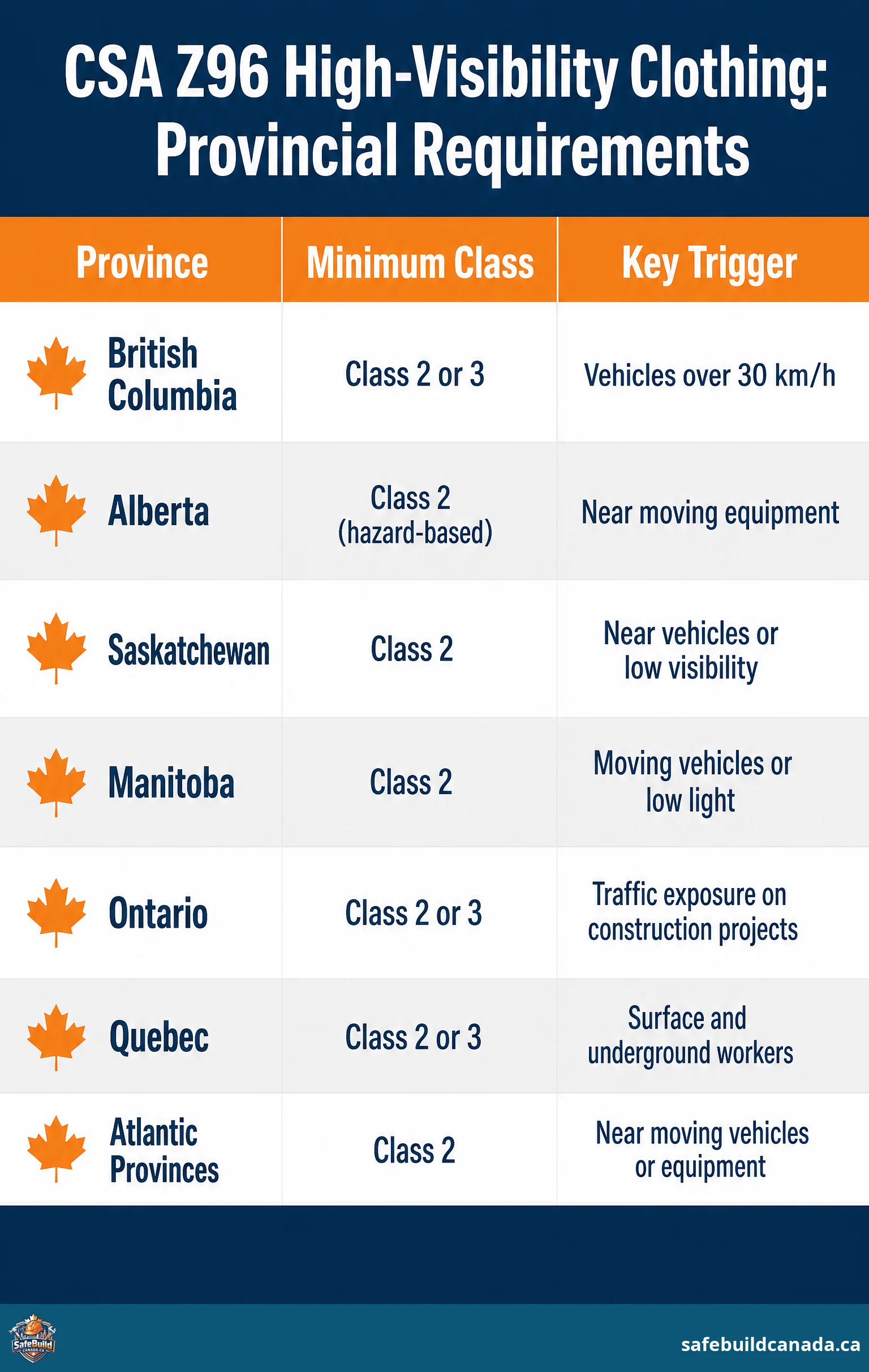
While the CSA Z96 standard provides the technical specifications for the apparel, provincial occupational health and safety regulations dictate when and where that apparel must be worn. The rules vary significantly across the country.
British Columbia
WorkSafeBC takes a prescriptive approach to high visibility apparel under Section 8.24 of the Occupational Health and Safety Regulation. The regulation explicitly links the required class of apparel to the speed of the vehicles the worker is exposed to.
If a worker is exposed to vehicles travelling over 30 kilometres per hour, they must wear apparel that meets the requirements for Class 2 or Class 3 under the CSA Z96 standard. If the vehicles are travelling at 30 kilometres per hour or less, the worker may wear Class 1, Class 2, or Class 3 apparel. This makes speed limits a critical factor in your site safety planning.
Alberta
The Alberta Occupational Health and Safety Code handles high visibility apparel differently. Part 18 of the Code, which covers personal protective equipment, does not explicitly mandate the use of the CSA Z96 standard by name in all situations.
Instead, Alberta relies on a hazard based approach. Employers must conduct a formal hazard identification and risk assessment to determine the appropriate level of visibility required for the specific tasks being performed. If the assessment identifies a risk of a worker being struck by moving vehicles or equipment, the employer must provide high visibility safety apparel appropriate to the hazard. In practice, most major contractors in Alberta adopt CSA Z96 Class 2 as their site standard to meet regulatory expectations and protect their workers.
Saskatchewan and Manitoba
In Saskatchewan, the Employment Act regulations require workers to wear high visibility apparel when they are exposed to the hazard of moving vehicles. The regulations also specify requirements for fluorescent headwear in certain industries, such as mining and drilling.
Manitoba's Workplace Safety and Health Act is more explicit, requiring that high visibility safety apparel meet the CSA Z96 standard when workers are exposed to moving vehicles or low visibility conditions.
Ontario
Ontario's construction regulations are highly specific regarding high visibility clothing. Under O. Reg. 213/91, Section 69.1, workers exposed to vehicular traffic on a construction project must wear a garment that is fluorescent blaze orange or international orange.
The garment must feature retroreflective yellow stripes: two vertical stripes on the front and an X pattern on the back. For nighttime work, additional silver reflective stripes encircling the arms and legs are required. While the regulation details these specific design elements, the Ministry of Labour, Immigration, Training and Skills Development accepts apparel that meets the CSA Z96 standard as compliant with the regulation, provided it meets the color and striping requirements.
Quebec and the Atlantic Provinces
In Quebec, the regulations specify that surface workers exposed to vehicular traffic must wear Class 2 or Class 3 apparel, while underground workers are required to wear Class 3.
The Atlantic provinces generally require high visibility apparel when workers are exposed to moving vehicles or equipment, with Nova Scotia explicitly referencing the CSA Z96 standard in its offshore and general safety regulations.
Employer obligations for high visibility apparel
Providing the right class of high visibility clothing is only the first step. Employers have ongoing obligations to confirm that the apparel remains effective and that workers understand how to use it properly.
Provision and cost
Across Canada, occupational health and safety regulations generally require employers to provide required personal protective equipment, including high visibility apparel, at no cost to the worker. This is a fundamental principle of CSA PPE standards in Canada. The employer is responsible for ensuring that the gear fits the worker properly and is appropriate for the specific hazards of the site.
Training and instruction
Workers must be trained on the limitations of their high visibility apparel. They need to understand that a Class 2 vest does not make them invincible and that they must still remain vigilant around moving equipment.
Training should also cover how to wear the apparel correctly. A high visibility vest must be worn fully fastened to provide the required 360 degree visibility. Wearing a vest open at the front significantly reduces the amount of visible fluorescent and reflective material, effectively dropping the garment below its certified class and putting the worker at risk.
Inspection and maintenance
High visibility apparel degrades over time. Exposure to ultraviolet light from the sun fades the fluorescent background material, while dirt, abrasion, and repeated washing cycles damage the glass beads in the retroreflective tape.
Workers must be trained to inspect their apparel daily before starting their shift. If the garment is heavily soiled, torn, or faded, it must be replaced. Employers should establish a clear process for workers to exchange damaged apparel for new gear without penalty. A vest that has lost its retro reflectivity is useless at night, regardless of what the interior tag says.
Integrating high visibility apparel with other PPE
High visibility clothing must work in concert with the other personal protective equipment required on your site. When selecting apparel, consider how it will interact with fall protection harnesses, tool belts, and winter clothing.
If a worker wears a fall protection harness over a high visibility vest, the harness straps may obscure the retroreflective tape, reducing the worker's visibility. In these situations, employers should consider providing high visibility apparel designed to be worn over the harness, or harnesses with built in high visibility materials.
Similarly, when the weather turns cold, workers cannot simply wear a dark winter jacket over their high visibility vest. The outermost layer of clothing must always meet the required visibility class. Employers must provide high visibility winter parkas or insulated coveralls that meet the CSA Z96 standard.
It is also important to consider the visibility of the worker's head. While hard hat requirements on Canadian construction sites (https://www.safebuildcanada.ca/blog/type-1-vs-type-2-hard-hat-canada-csa-z94) focus primarily on impact protection, selecting hard hats in high visibility colors or adding retroreflective striping to the shell can significantly enhance a worker's overall conspicuity, especially in low light conditions.
The bottom line on high visibility compliance
Compliance with CSA Z96 high visibility clothing requirements is a critical component of your overall site safety strategy. By understanding the different classes of apparel, adhering to your specific provincial regulations, and enforcing strict rules on how the gear is worn and maintained, you can drastically reduce the risk of struck by incidents on your site.
Do not treat high visibility apparel as a generic commodity. Treat it as a vital piece of engineered safety equipment. Assess your site hazards carefully, select the appropriate class of gear, and make sure your workers understand that their visibility is their first line of defense against moving equipment.
Review your high visibility program at least once per year, or whenever site conditions change significantly. If you bring in new subcontractors, add new phases of work near active traffic, or extend your project into nighttime hours, your current class of apparel may no longer be adequate. Revisit your hazard assessment, update your site safety plan, and communicate the changes clearly to all workers before the new conditions begin.