
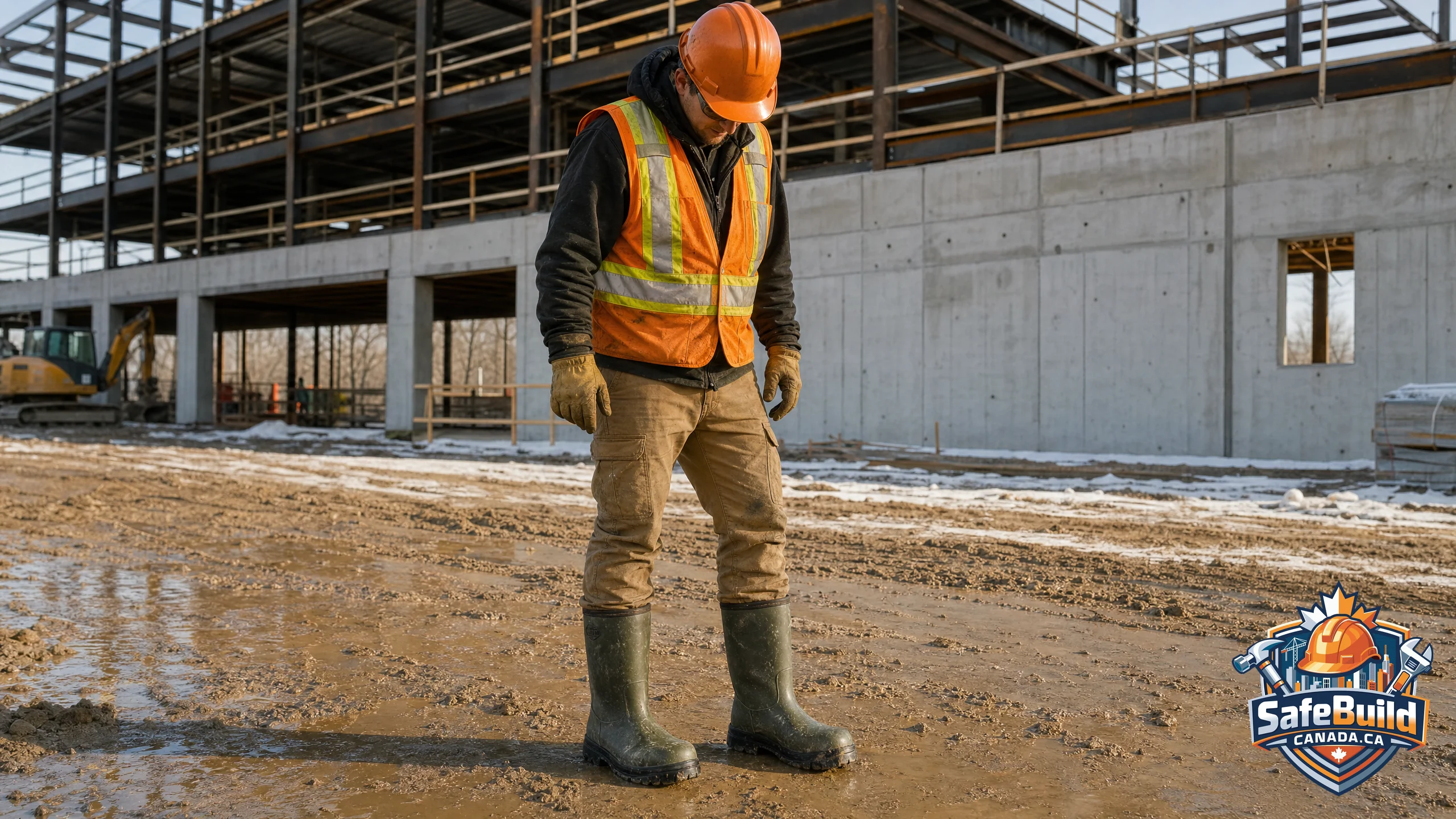
When you step onto a Canadian construction site, the hazards are everywhere. From dropped steel beams and exposed nails to live electrical wires and slippery mud, your feet are constantly in the line of fire. That is why wearing the right safety footwear is not just a good idea; it is a strict legal requirement across the country. In Canada, the benchmark for foot protection is the CSA Z195 standard.
Understanding the CSA Z195 safety footwear standard is critical for both workers and employers. It dictates exactly what level of protection your boots must provide to keep you safe on the job. Whether you are a framer in British Columbia, an electrician in Ontario, or a heavy equipment operator in Alberta, knowing how to read the symbols on your boots and matching them to your site hazards is a fundamental part of construction safety.
In this guide, we will break down the CSA Z195 standard, explain what the different symbols mean, and detail the specific provincial requirements for safety footwear on Canadian construction sites.
What is the CSA Z195 standard?
The Canadian Standards Association (CSA) develops the technical standards that govern personal protective equipment across the country. For foot protection, that standard is CSA Z195 "Protective Footwear." This document outlines the design and performance requirements for safety boots and shoes sold and used in Canada.
The standard covers a wide range of protective features. It tests how much impact the toe cap can withstand before crushing. It measures how much force is required to puncture the sole. It evaluates the electrical resistance of the materials, the durability of the sole when flexed repeatedly, and the slip resistance of the tread.
It is important to note that CSA Z195 does not cover every single type of specialized footwear. For example, it does not cover firefighter boots, spiked climber footwear, or riot boots. However, for the vast majority of industrial and construction applications, CSA Z195 is the definitive rulebook. When a pair of boots passes these rigorous tests, they earn the right to display specific CSA symbols that tell you exactly what protection they offer.
The green triangle: the construction standard
If you look at the boots of almost any worker on a Canadian construction site, you will see a familiar symbol: a green triangle. This is the most common and most important mark for construction work.
The green triangle indicates that the footwear provides Grade 1 toe protection and sole puncture protection. Grade 1 toe protection means the toe cap can withstand an impact of 125 joules. To put that in perspective, that is roughly equivalent to a 22.7-kilogram (50-pound) weight dropped from a height of 0.6 metres (2 feet). The puncture-resistant sole must be able to withstand a force of at least 1.2 kilonewtons (about 270 pounds of force) before a sharp object penetrates through to the foot.
On a construction site, the risk of dropping heavy materials or stepping on exposed nails is constant. Therefore, the green triangle is considered the baseline minimum requirement for construction work across Canada. If your boots do not have this symbol, they are likely not compliant for site work.
Understanding other CSA Z195 symbols
While the green triangle is the most common, the CSA Z195 standard includes several other symbols to indicate different types of protection. Understanding these is crucial when conducting a hazard assessment for specific trades or tasks.
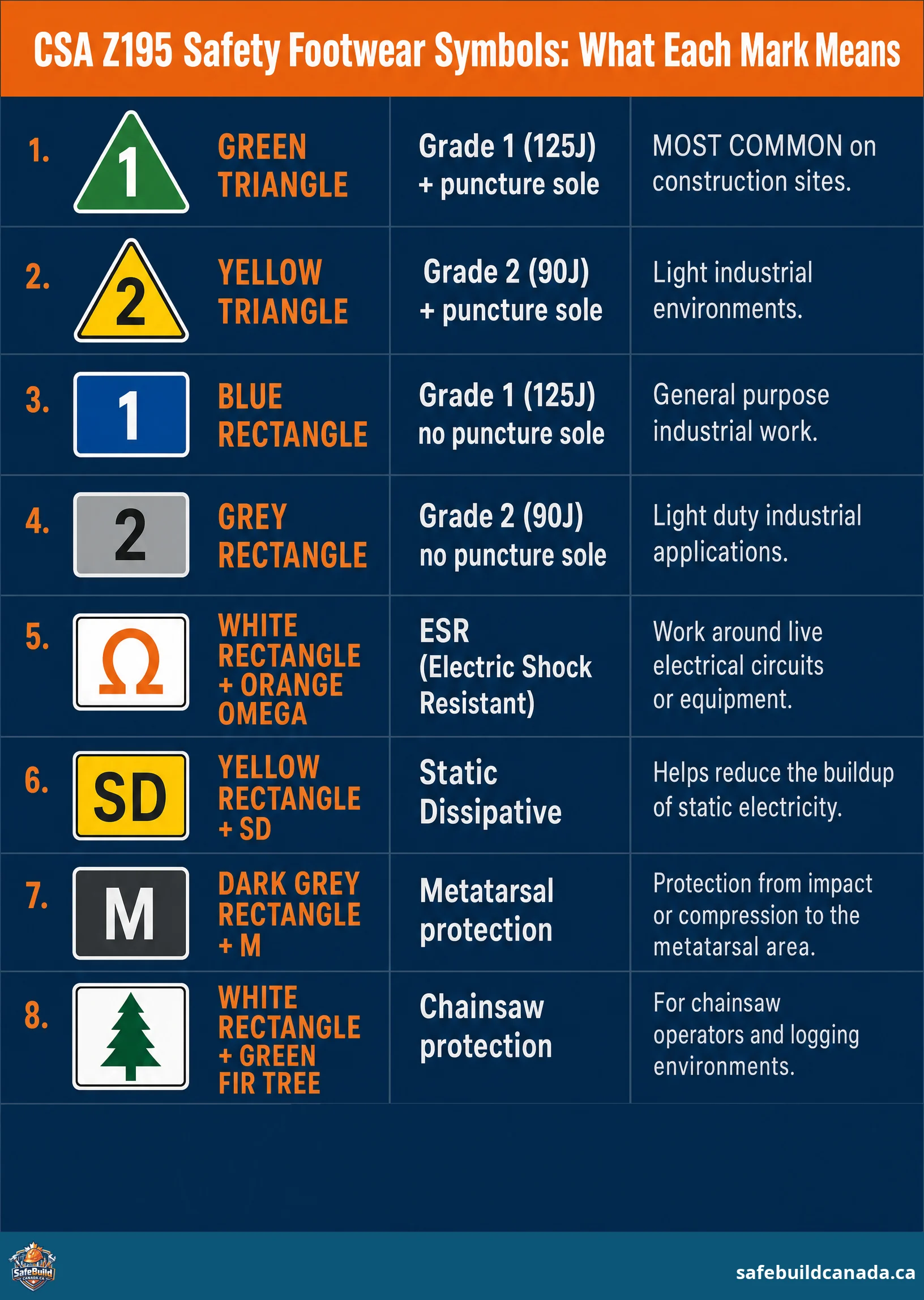
Beyond the green triangle, the white rectangle with an orange omega symbol is highly relevant for construction. This indicates Electric Shock Resistant (ESR) footwear. These boots have soles that provide resistance to electric shock under dry conditions. They are essential for electricians or anyone working near live electrical circuits. However, it is critical to remember that ESR protection deteriorates as the boots wear down or if they become wet.
Another important symbol is the dark grey rectangle with an "M," which stands for metatarsal protection. While the toe cap protects your toes, the metatarsal guard protects the delicate bones on the top of your foot behind the toes. This protection is often required for workers handling heavy pipes, concrete blocks, or steel beams that could roll or drop onto the top of the foot.
Provincial requirements for safety footwear
Occupational health and safety is regulated provincially in Canada, which means the exact legal wording regarding safety footwear varies depending on where you are working. However, the practical application remains remarkably consistent: you must protect your feet from the hazards present.
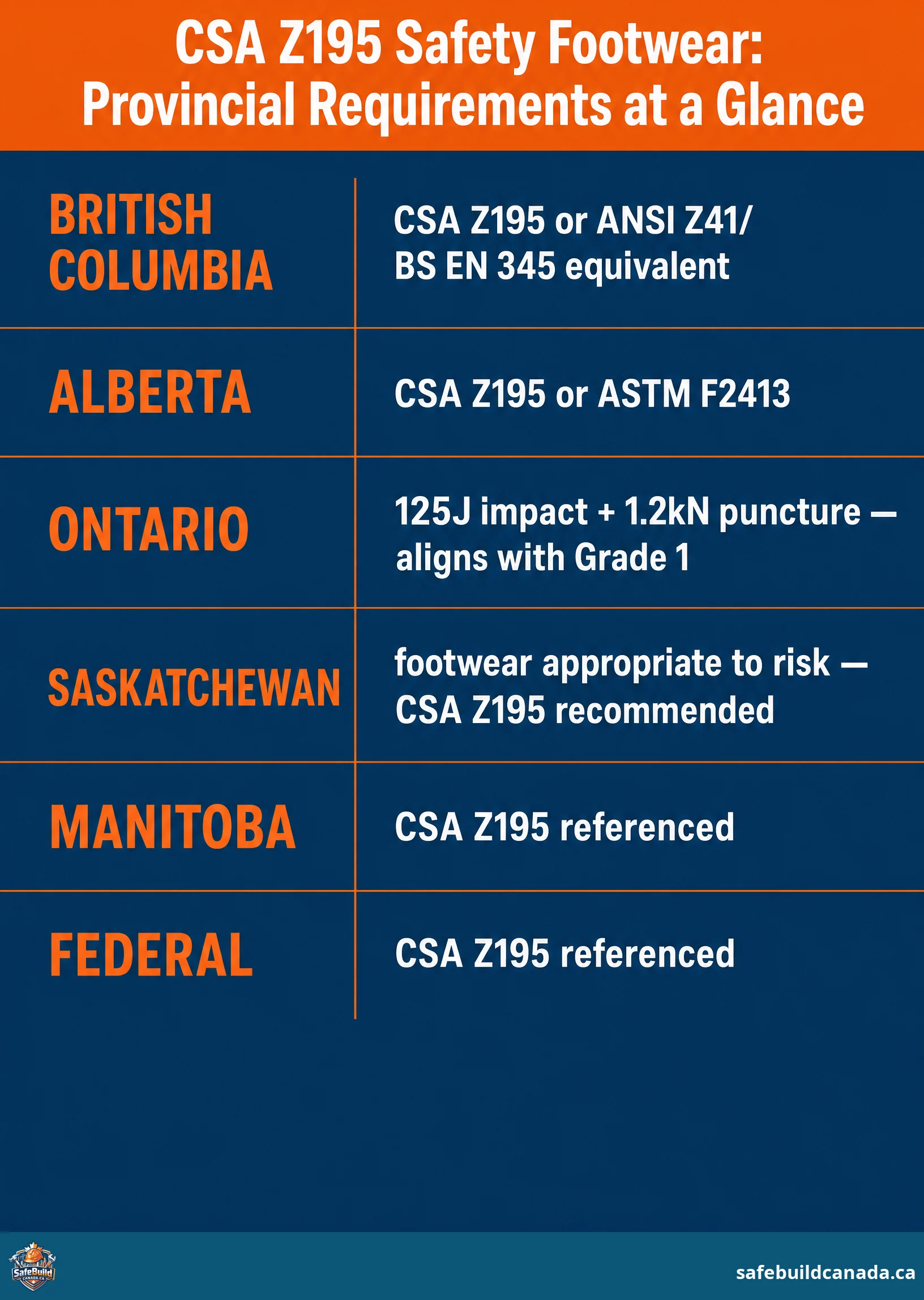
In British Columbia, WorkSafeBC requires workers to wear protective footwear meeting the CSA Z195 standard (or equivalent standards like ANSI Z41 or BS EN 345) whenever there is a risk of foot injury from falling objects, sharp objects, or rolling equipment. The employer is responsible for assessing the site hazards and determining the appropriate grade of protection required.
Alberta takes a slightly different approach. The Alberta OHS Code explicitly allows workers to wear footwear that complies with either the Canadian CSA Z195 standard or the American ASTM F2413 standard. This flexibility is unique to Alberta and is helpful for companies that operate on both sides of the border.
Ontario's approach is also distinct. The Ontario Construction Projects Regulation (O. Reg. 213/91) states that a worker must wear protective footwear at all times when on a project. Interestingly, the regulation does not mention CSA Z195 by name. Instead, it specifies the performance requirements: the footwear must have a box toe resisting at least 125 joules of impact and a sole resisting a puncture load of 1.2 kilonewtons. These numbers perfectly align with the testing requirements for a CSA Z195 Grade 1 (green triangle) boot.
In Saskatchewan, the OHS Regulations use broader language, simply stating that footwear must be "appropriate to the risks." While it does not name the standard, safety professionals rely on the CSA Z195 framework to determine what is appropriate. If a hazard assessment identifies puncture and impact risks, a green triangle boot is the appropriate choice to meet the legal requirement.
Employer responsibilities and hazard assessments
Providing a safe work environment is the core responsibility of every employer. When it comes to safety footwear, this means more than just telling workers to buy steel-toed boots. Employers must conduct a thorough hazard assessment to determine exactly what type of foot protection is required for the tasks being performed.
This assessment must look at the entire scope of work. Are workers navigating terrain with exposed nails or sharp metal debris? If so, puncture-resistant soles are mandatory. Are they working alongside heavy equipment where a tire could roll over a foot? Grade 1 toe protection is essential. Are they performing electrical work? ESR footwear must be specified.
The requirement to assess hazards and mandate appropriate PPE is a foundational element of CSA PPE standards in Canada. Employers must document these requirements in their site safety plans and communicate them clearly to all workers during site orientation.
Supervisors must verify that footwear is actually being worn and maintained properly. They must enforce the rules on the ground. If a worker shows up in running shoes or boots with the steel toe exposed through worn leather, they cannot be allowed to work.
Selecting and maintaining your safety boots
Choosing the right safety footwear is a personal responsibility that directly affects your comfort and safety. When selecting boots, always look for the appropriate CSA symbols based on your employer's hazard assessment. For most construction work, start by confirming the boots carry the green triangle.
Fit is incredibly important. You will be wearing these boots for long hours on hard surfaces. It is best to try on new boots midday or in the afternoon, as feet naturally swell during the day. Allow about 12.5 millimetres (half an inch) of space between your longest toe and the front of the toe cap. The heel should fit snugly without slipping, and the ankle should be well supported.
Maintenance is just as critical as selection. Safety footwear does not last forever. The materials degrade over time, especially when exposed to harsh chemicals, concrete, or extreme weather. Inspect your boots regularly for signs of wear. Look for cracks in the leather, separation of the sole, or exposed protective components.
Most importantly, if your boots sustain a significant impact, they must be replaced immediately. The toe cap is designed to absorb energy by deforming. Even if the boot looks fine on the outside, the structural integrity of the cap may be compromised, meaning it will not protect you during a second impact. Treat your safety boots like you would treat hard hat requirements on Canadian construction sites. If it takes a hit, it goes in the garbage.
The bottom line on foot protection
Your feet are your foundation on a construction site. A severe foot injury can end a career and cause lifelong mobility issues. The CSA Z195 standard exists to prevent these devastating injuries by requiring that the footwear sold in Canada meets rigorous performance criteria.
Whether you are working around heavy equipment on a Canadian construction site or navigating a cluttered framing site, wearing the correct, certified safety footwear is non-negotiable. By understanding the symbols, following provincial regulations, and maintaining your boots properly, you give yourself the best possible chance of walking off the site safely at the end of every shift.