
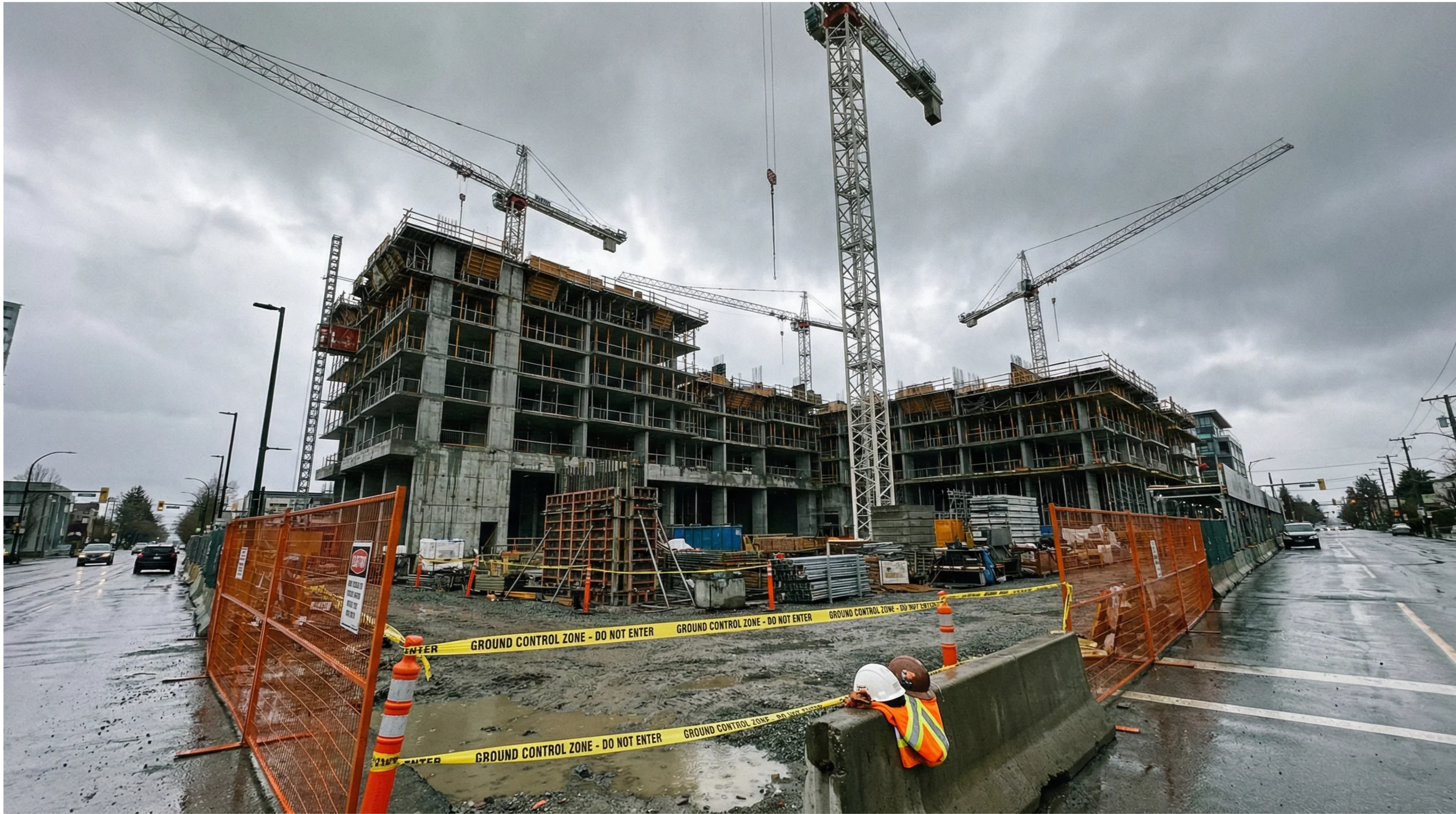
On February 21, 2024, a worker named Yuridia Flores was standing at the base of a tower crane at Vancouver's Oakridge Park development when a concrete forming mould fell 26 storeys and struck her. She was 41 years old, a mother of two, and she had not received any training for the role she was performing that day.
What followed was one of the most closely scrutinized construction safety investigations in British Columbia's recent history. WorkSafeBC released its formal investigation report in March 2025, identifying six critical safety failures across two contractors. By December 2025, fines totaling more than $627,000 had been issued to the prime contractor EllisDon and its subcontractor Newway Concrete Forming. EllisDon's total penalties across three separate crane incidents reached more than $1.2 million.
This case study breaks down exactly what went wrong, what the investigation found, and what every Canadian construction site manager, safety officer, and prime contractor can do to make sure the same failures never appear on their site. For a broader look at how case studies like this one fit into the construction industry insights Canada resource hub, that page brings together the most important lessons from across the industry.
The site and the incident
The Oakridge Park project is a $6.5-billion redevelopment in South Vancouver, covering 11 hectares and spanning roughly eight city blocks. Developed by Westbank and QuadReal Property Group, the project involves 14 towers, 3,000 homes, and hundreds of retail spaces. It is one of the largest active construction projects in Canada.
On the morning of the incident, Newway Concrete Forming was using a tower crane to move a fly-table, which is a pre-assembled concrete forming mould, from one floor to another. As workers pushed the rigged fly-table, it accelerated out of the side of the building and fell to the ground below. Flores, who was providing traffic control and spotting at the base of the crane, was struck and killed.
The evacuation that followed removed approximately 1,700 workers from the site. WorkSafeBC opened multiple investigations, eventually executing a search warrant in November 2024 and alleging dozens of safety violations across the project. The March 2025 investigation report focused specifically on the February fatality and named six distinct failures that contributed to it.
What WorkSafeBC found: six failures that should not have coexisted
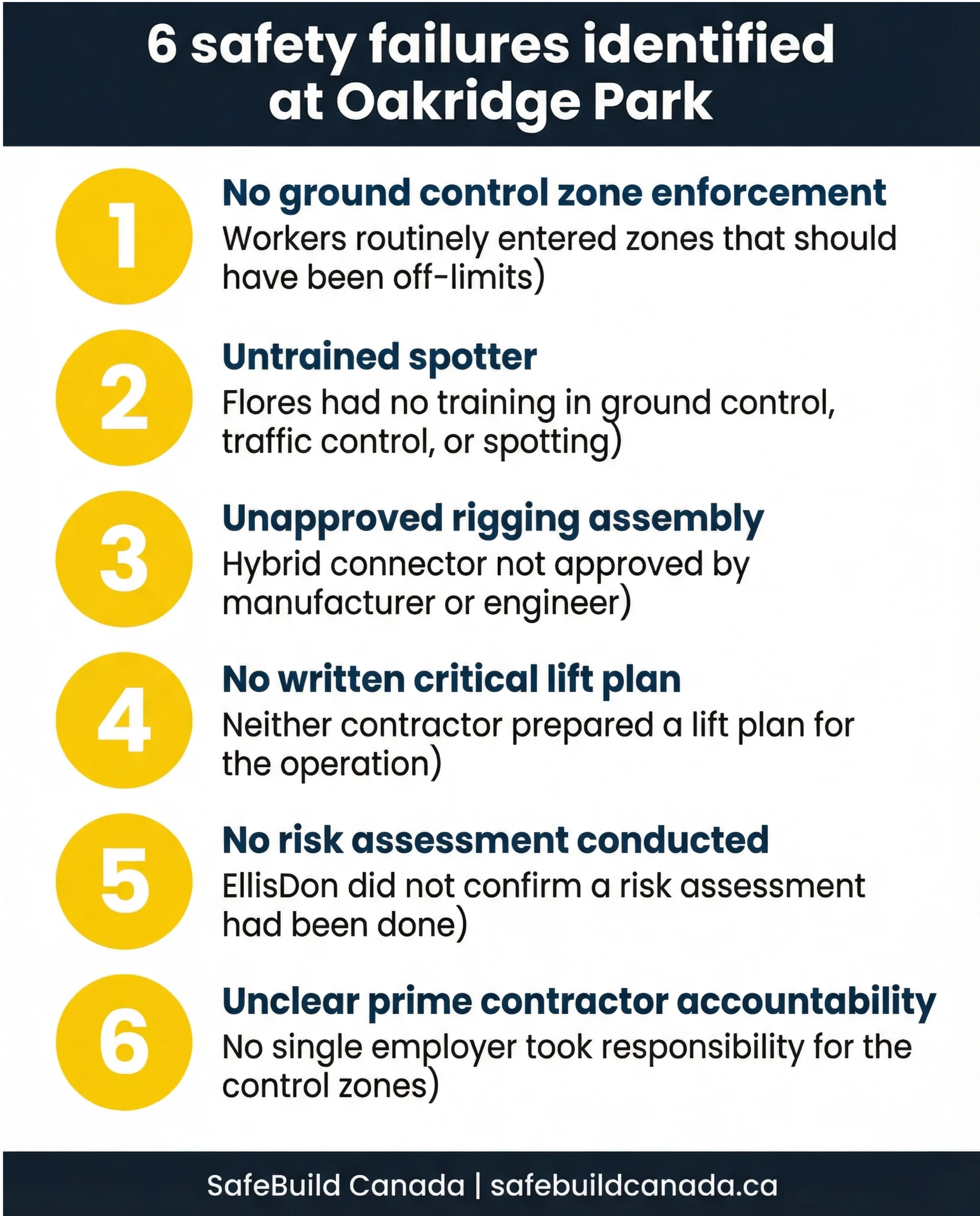
The investigation report, covered in detail by CBC News and OHS Canada, is worth reading in full if you manage a site with overhead work. The six failures it identified are not obscure edge cases. They are the kind of gaps that develop slowly on busy sites when production pressure outpaces safety administration.
No ground control zone enforcement.
A ground control zone is a designated area, typically marked with barriers and red danger tape, that workers and other persons must not enter during overhead lifts. WorkSafeBC's review of CCTV footage found no effective controls in place. Workers were routinely entering areas that should have been off-limits, and the zones were not being enforced before or during the lift.
An untrained spotter in a safety-critical role.
Flores was assigned to provide traffic control and spotting. The investigation found she had received no training or instruction in ground control, traffic control, or spotting. Placing an untrained worker in a safety-critical position during a crane operation is not a minor oversight. It is a fundamental failure of the employer's duty to ensure workers are competent for the work they are assigned.
Unapproved rigging equipment.
The rigging used to connect the fly-table to the crane included what WorkSafeBC described as a hybrid connector assembly that had not been approved by the manufacturer or a professional engineer. The front portion of the rigging used hooks with safety latches, while the back used this improvised assembly. When the fly-table was pushed, the pins gave way and a brake line failed. Equipment that has not been approved for its intended use has no place on a critical lift.
No written critical lift plan.
WorkSafeBC found that neither EllisDon nor Newway had prepared a written lift plan for the operation. Under BC's OHS Regulation, critical lifts require documented planning. The absence of a lift plan means there was no formal process for identifying the risks of this specific operation before it began.
No confirmed risk assessment.
EllisDon, as the prime contractor, had not confirmed that a risk assessment had been conducted for the critical lift and overhead work taking place that day. A risk assessment is not a checkbox. It is the mechanism by which a contractor identifies what can go wrong and puts controls in place before work starts. For a full breakdown of how to build a hazard identification and risk assessment process that satisfies Canadian OHS requirements, that guide covers the framework in detail.
Unclear accountability between contractors.
Perhaps the most systemic finding in the report is this: there was a lack of clarity about which contractor was responsible for the ground control zone. WorkSafeBC stated that this ambiguity contributed significantly to the outcome, because no single employer took responsibility for enforcing it. On a multi-contractor site, this is a failure of the prime contractor's coordination role, not just a communication gap between trades.
The penalties and what they signal
In December 2025, WorkSafeBC issued administrative penalties totaling $627,456 for the Flores fatality. EllisDon was fined $514,831 and Newway Concrete Forming was fined $112,625. These are among the larger penalties WorkSafeBC has issued for a single construction incident.
The fines matter less than the message they carry. WorkSafeBC's administrative penalty system is designed to reflect the severity of the violation and the size of the employer. A $515,000 penalty for a company the size of EllisDon is not a deterrent in the way it might be for a small contractor. What matters more is the public investigation record, the reputational cost, and the fact that the findings are now part of the permanent public record of how this project was managed.
WorkSafeBC also fined EllisDon more than $688,000 for two additional crane incidents in 2025, one in Vancouver in April and one in Victoria in June. Both involved loss of load with no serious injuries. In both cases, EllisDon had not reviewed lift plans. The pattern across three incidents suggests the failures at Oakridge were not isolated to one subcontractor's conduct.
If a WorkSafeBC officer had attended this site before the fatality, the ground control zone violations alone would have triggered a stop-work order. Understanding what happens when an OHS inspector shows up on your site, and what they are looking for, is one of the most practical steps a site manager can take to identify these gaps before they become fatalities.
Why prime contractor accountability is the central lesson
The Oakridge investigation is, at its core, a case about what happens when a prime contractor does not fulfil its coordination role on a complex multi-contractor site.
Under BC's OHS Regulation, the prime contractor is responsible for ensuring that the activities of all employers and workers at a workplace are coordinated, and that the health and safety of all workers is protected. This is not a passive obligation. It requires the prime contractor to actively verify that subcontractors have safe work procedures in place, that those procedures are being followed, and that hazards created by the interaction of multiple trades are identified and controlled.
WorkSafeBC's report stated directly that the inadequate fulfilment of prime contractor responsibilities was a key contributing factor in the incident. EllisDon had not conducted regular reviews of Newway's safe work procedures. It had not confirmed a risk assessment had been conducted. It had not ensured that the ground control zone was properly established and enforced. And it had not reviewed the policies and procedures for spotters during the hoisting operation.
This matters for every Canadian construction site, not just those in BC. Ontario's OHSA, Alberta's OHS Act, and the federal Canada Labour Code Part II all place equivalent coordination obligations on the constructor or prime contractor. The specific regulatory language differs by province, but the principle is the same: when you are the prime contractor, you are responsible for the safety of everyone on that site, including workers employed by your subcontractors.
What the data says about crane and overhead hazards in Canada
The Oakridge fatality did not happen in isolation. Crane and overhead hazards are a persistent source of serious injuries and fatalities in Canadian construction, and the data supports treating them as a priority risk category.
The Institute for Work and Health published a study in the American Journal of Public Health in 2023 that found Ontario's mandatory working-at-heights training, introduced in 2017, was associated with a 19 per cent reduction in fall-from-height lost-time injuries in the three years after it came into full effect. That reduction translated to four deaths and 320 lost-time injuries avoided. The same study found that workers maintained improved safety practices two years after completing the training, which challenges the assumption that training effects fade quickly.
The contrast with other Canadian provinces is worth noting. During the same period, other provinces saw only a six per cent decline in comparable injuries. The Ontario result was not accidental. It came from a deliberate policy decision to standardize and mandate training, combined with a regulatory framework that gave employers clear obligations and workers clear rights.
The lesson for crane and overhead work is the same one Ontario applied to falls from heights: standardize the requirements, make training mandatory, and document everything. The Oakridge investigation found that Flores had no documented training for her role. That gap is not unique to this site. It is common on sites where spotter and traffic control roles are filled informally, without written assignment or verified competency.
Five things to do before your next critical lift
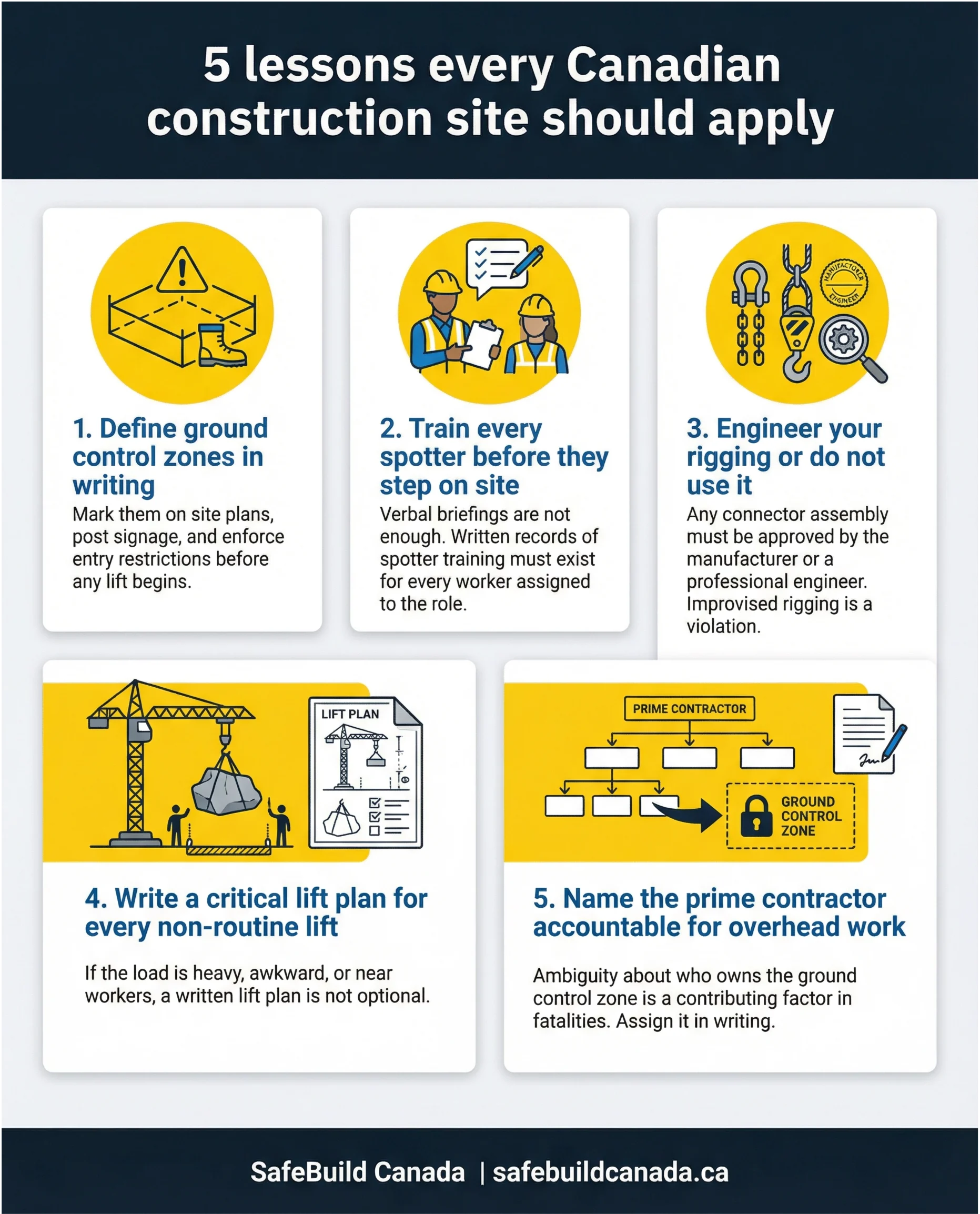
The six failures identified at Oakridge are preventable. None of them required new technology, new regulation, or extraordinary resources. They required planning, documentation, and a prime contractor willing to enforce its own standards on subcontractors. Here is what that looks like in practice.
Define your ground control zones before work begins.
Mark them on your site plan, show them on your daily toolbox talk, post physical barriers and signage, and assign someone the specific responsibility of enforcing entry restrictions during every lift. This is not optional under BC's OHS Regulation, and equivalent requirements exist in every other Canadian province.
Train every spotter before they step on site.
Verbal briefings are not enough. Written records of spotter training must exist for every worker assigned to the role. If a worker cannot produce evidence of training for the role they are performing, they should not be performing it.
Use only approved rigging.
Every component of a rigging assembly must be rated for the load and approved by the manufacturer or a professional engineer. If a connector is not in the manufacturer's documentation, it does not go on the crane. This rule is simple and absolute.
Write a critical lift plan for every non-routine lift.
If the load is heavy, awkward, near workers, or involves multiple contractors, you need a written lift plan. The plan should identify the load weight, the rigging method, the ground control zone boundaries, the spotter assignments, the communication protocol, and the emergency response procedure. Review it with everyone involved before the lift starts. Knowing how to build a construction site emergency response plan that covers crane operations is an essential part of this preparation.
Assign prime contractor accountability in writing.
On every multi-contractor site, the prime contractor must document which employer is responsible for each safety-critical function. Ground control zones, spotter assignments, and critical lift oversight must be assigned to a named employer, not left to informal agreement. If it is not in writing, it does not exist when WorkSafeBC comes to investigate.
A case that should change how you run your site
Yuridia Flores was not killed by an unforeseeable accident. She was killed by a sequence of decisions, or the absence of decisions, that left her in a dangerous position without the training, the equipment, or the protective controls that would have kept her safe.
WorkSafeBC's investigation report is a public document. The failures it describes are not unique to Oakridge. They exist, in varying degrees, on construction sites across Canada every day. The difference between a near-miss and a fatality is often not the severity of the hazard. It is whether the controls were in place and enforced when the hazard materialized.
The $1.2 million in fines issued to EllisDon will not bring Flores back. What might prevent the next fatality is a construction industry that reads these reports, takes the findings seriously, and makes the changes before WorkSafeBC has to issue another one.
SOURCES
WorkSafeBC, "WorkSafeBC updates penalties database to include $1.3 million in penalties", WorkSafeBC, December 2025.
CBC News, "'Several critical safety failures' behind B.C. worker's death, WorkSafeBC says", CBC News, March 12, 2025.
CBC News, "EllisDon fined more than $1.2M for crane safety violations, including fatal Vancouver case", CBC News, December 12, 2025.
OHS Canada, "'Critical safety failures' behind deadly Oakridge crane accident: WorkSafeBC", OHS Canada Magazine, March 14, 2025.
Institute for Work and Health, "Worker injuries due to falls from heights declined after Ontario made training standardized and mandatory", Institute for Work and Health, November 3, 2023.