
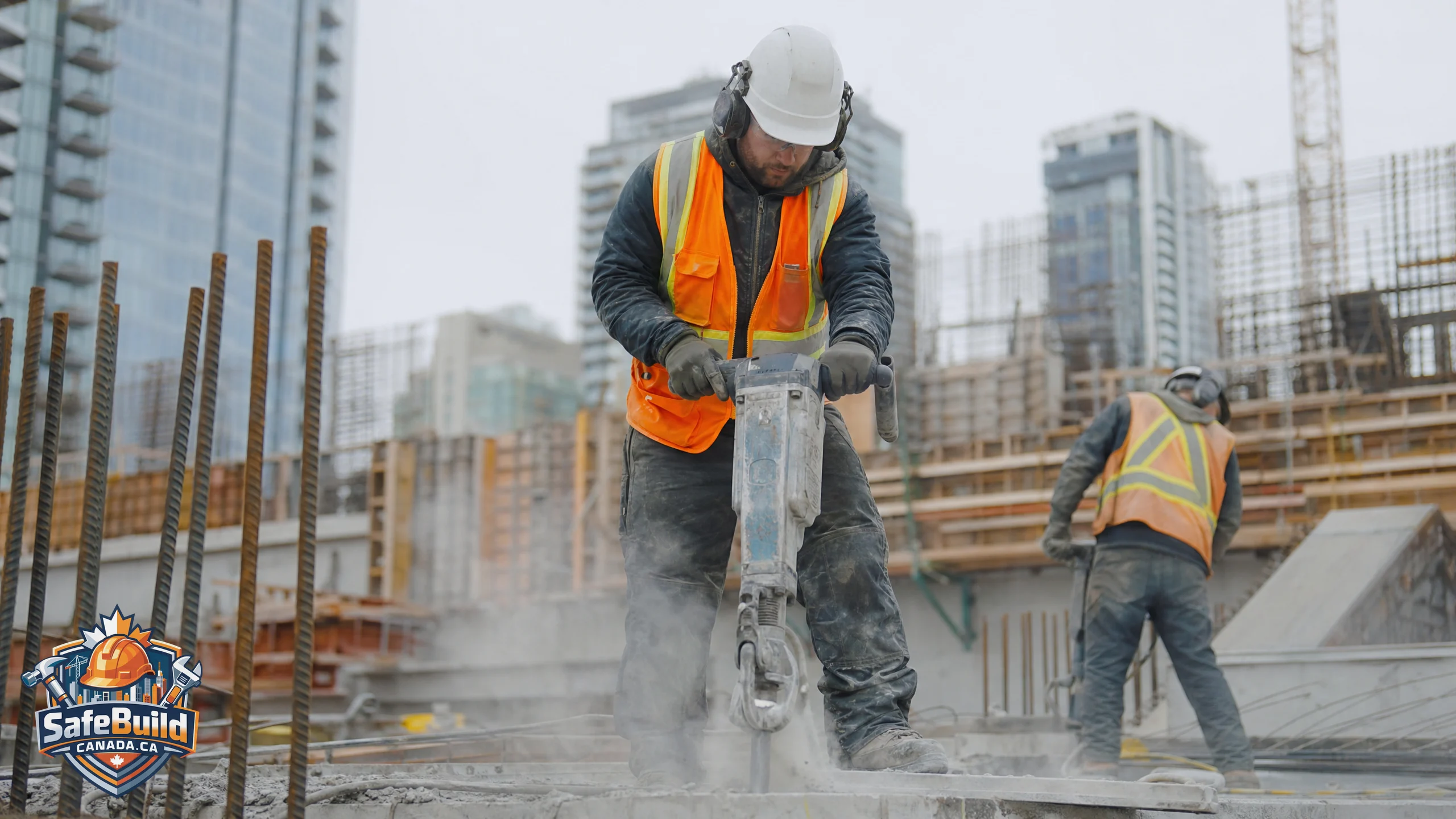
Construction sites rank among the loudest work environments in Canada. Between jackhammers, concrete saws, heavy equipment, and compressors running simultaneously, workers are routinely exposed to noise levels that can cause permanent, irreversible damage long before they notice any symptoms. Hearing protection on Canadian construction sites is not optional, and the rules governing what employers must provide go well beyond handing out a pair of foam earplugs.
This post covers the legal exposure limits, the CSA Z94.2 standard that governs hearing protection device selection, how the Noise Reduction Rating actually works in practice, and what a compliant hearing conservation program looks like in the field.
Why construction noise is a different kind of hazard
Most occupational hazards announce themselves. A fall, a chemical spill, a struck-by incident — these produce immediate, visible consequences. Noise-induced hearing loss (NIHL) is different. It accumulates silently over years. Workers often do not realize how much hearing they have lost until the damage is well advanced, and by that point it cannot be reversed.
According to the CCOHS Noise — Basic Information fact sheet, noise-induced hearing loss is one of the most common occupational diseases in Canada. The hazard is compounded on construction sites by the sheer variety of noise sources operating at the same time. A single worker may move between a concrete saw at 110 dBA, a compressor at 95 dBA, and a nail gun at 100 dBA within a single shift. That cumulative exposure adds up fast.
Understanding how to properly assess and control that exposure is a core part of any site safety program. If you have not yet reviewed the broader framework for identifying and managing hazards on your site, the hazard identification and risk assessment guide for Canadian construction is a strong starting point for building that foundation.
Noise exposure limits across Canadian jurisdictions
The legal threshold that triggers mandatory action in most Canadian provinces is 85 dBA measured as a time-weighted average over an eight-hour shift. This is the criterion level used in British Columbia, Alberta, Ontario, and most other provinces for construction workers.
The CCOHS Noise — Occupational Exposure Limits in Canada page explains the two key variables that define how long a worker can be exposed at any given level: the criterion level and the exchange rate. Most provinces use a 3 dBA exchange rate, which means the allowable exposure time is cut in half for every 3 decibels above the limit. At 88 dBA, the maximum is four hours. At 91 dBA, it drops to two hours. At 100 dBA, a worker should not be exposed for more than 15 minutes unprotected.
In British Columbia, the WorkSafeBC OHS Regulation Part 7 sets the daily noise exposure limit at 85 dBA Lex and a peak sound level limit of 140 dbc. These limits apply to all workers, including those in construction. When either limit is exceeded, the employer must develop and implement a noise control and hearing conservation program.
Ontario's noise regulation, O. Reg. 381/15, similarly requires employers to ensure no worker is exposed to a time-weighted average above 85 dBA over an eight-hour day. Critically, Ontario places hearing protection at the bottom of the hierarchy of controls, meaning employers must first attempt engineering and administrative controls before relying on personal protective equipment.
The hierarchy of controls: hearing protection is the last resort
Before selecting hearing protection devices, employers are legally required to work through the hierarchy of controls. This is not a suggestion — it is a legal obligation in every Canadian jurisdiction.
The hierarchy for noise control runs in this order: eliminate the noise source, substitute quieter equipment, apply engineering controls (such as enclosures, barriers, or vibration dampening), implement administrative controls (such as rotating workers out of noisy areas or scheduling loud tasks during lower-occupancy periods), and only then provide personal protective equipment.
If a contractor can replace an older pneumatic tool with a quieter hydraulic alternative, that substitution must be considered before ordering earmuffs. If a noisy compressor can be positioned further from the work area, that engineering control should be implemented first. Hearing protection fills the gap when these higher-order controls are not practicable or do not reduce exposure below 85 dBA on their own.
This same principle applies across all PPE categories. The CSA PPE standards guide for Canadian construction covers the broader framework for how personal protective equipment fits within the hierarchy, and it is worth reviewing alongside the specific requirements for hearing protection.
CSA Z94.2: the standard that governs hearing protection in Canada
When hearing protection is required, the equipment must meet the requirements of CSA Standard Z94.2, "Hearing protection devices — Performance, selection, care, and use." This standard is referenced directly in the WorkSafeBC OHS Regulation and is the benchmark used by regulators across the country to evaluate whether an employer has provided adequate protection.
CSA Z94.2 covers three main categories of hearing protection devices: earplugs (disposable and reusable), earmuffs, and semi-insert or canal cap devices. Each type has different performance characteristics, and the right choice depends on the specific noise environment, the worker's other PPE requirements, and individual fit.
The standard also governs how devices are tested, how performance data must be reported by manufacturers, and how employers must use that data to select appropriate protection for their specific hazard levels.
Understanding the Noise Reduction Rating and why you must de-rate it
Every hearing protection device sold in Canada carries a Noise Reduction Rating (NRR), a single number that represents the attenuation the device provides under laboratory conditions. The problem is that laboratory conditions are not construction sites. Poor fit, inconsistent wear, and contamination from sweat and debris all reduce real-world protection significantly.
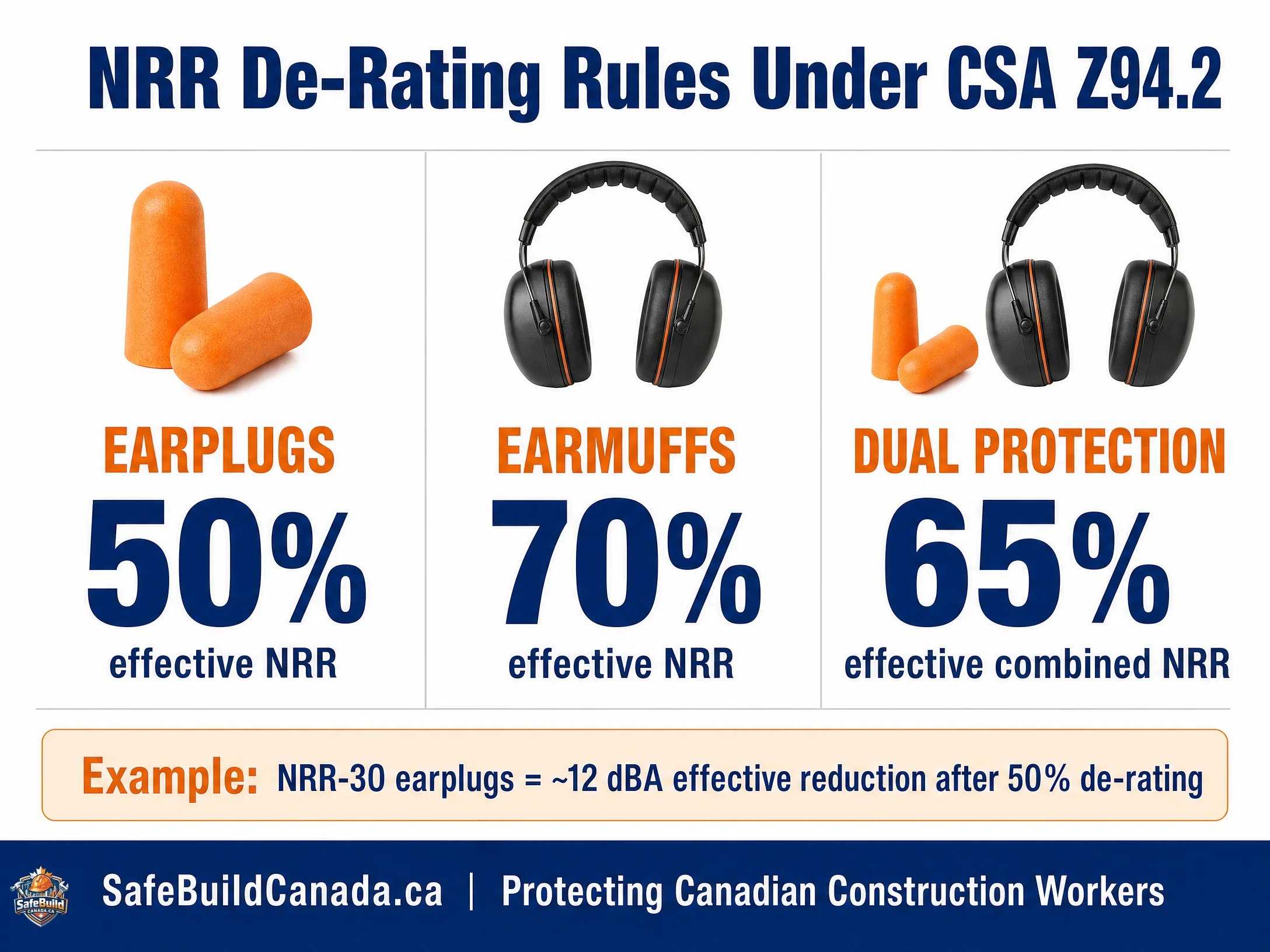
CSA Z94.2 addresses this directly by requiring employers to de-rate the NRR before using it to determine whether a device provides adequate protection. The CCOHS Hearing Protectors fact sheet summarizes the de-rating calculations as follows:
For earplugs, the effective protection is calculated at 50% of the NRR. For earmuffs, it is 70% of the NRR. When workers wear dual protection (both earplugs and earmuffs simultaneously), the effective protection is calculated at 65% of the combined rating using a specific formula.
Here is a practical example. An earplug with an NRR of 30 sounds impressive on the packaging. But after applying the 50% de-rating for earplugs, the effective noise reduction is approximately 12 dBA. If the worker is exposed to 97 dBA, the effective exposure after protection is still around 85 dBA — right at the limit. If the fit is poor or the worker removes the earplugs briefly, they are over the limit.
This is why selecting hearing protection is a calculation, not a shopping decision. Employers must work through the math for each noise environment and verify that the selected device, after de-rating, actually brings exposure below the legal threshold.
Choosing the right type of hearing protection for construction
The choice between earplugs and earmuffs is not simply a matter of preference. Each type has practical advantages and limitations that matter in a construction environment.
Earplugs, when properly inserted, can provide high levels of attenuation and are less likely to interfere with hard hats or other head-worn PPE. However, they require correct insertion technique to achieve their rated performance, and dirty hands on a construction site create a contamination risk that can cause ear infections if workers are not trained and supervised properly.
Earmuffs are easier to use correctly and can be quickly removed and replaced, which makes them practical in environments where workers move in and out of noisy areas frequently. The trade-off is that the seal of earmuffs can be compromised by safety glasses, hard hat suspension systems, or long hair. The WorkSafeBC hearing protection campaign from September 2024 notes that many construction sites have noise levels between 90 and 95 dBA, where Class B hearing protection is appropriate, and that double protection (both earplugs and earmuffs) is required for exposures above 105 dBA.
Employers must provide a variety of options. Because ear canals vary significantly in size and shape between individuals, a single type of earplug will not fit every worker adequately. Providing choice is not just good practice — it is necessary to achieve consistent, effective protection across a diverse workforce.
The hearing conservation program: what employers must build
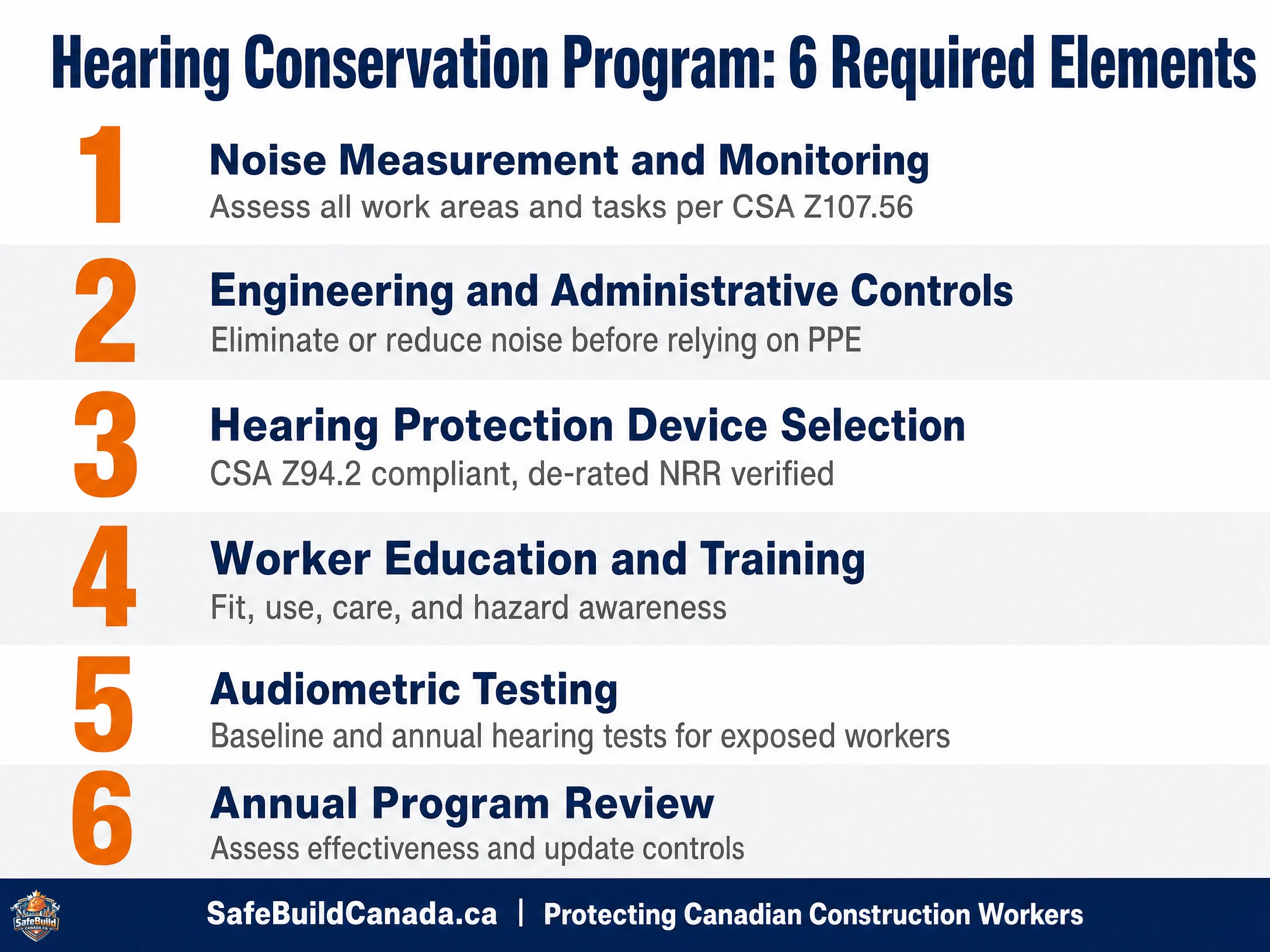
Providing hearing protection is one component of a larger legal obligation. When noise levels exceed the exposure limits, most provincial regulations require employers to implement a formal hearing conservation program. In British Columbia, this is explicitly required under Section 7.5 of the OHS Regulation.
A compliant hearing conservation program includes several interconnected elements. Noise measurement and monitoring must be conducted to identify hazardous areas and quantify worker exposures. This assessment should follow CSA Standard Z107.56 for noise measurement methodology.
Worker education and training is mandatory. Workers must understand why hearing protection is required, how to select and fit their devices correctly, and what the consequences of non-compliance are. Training records must be kept.
Audiometric testing is required in most provinces when workers are exposed above the limit. In British Columbia, employers must arrange an initial hearing test within six months of employment and annual tests thereafter. These tests establish a baseline and allow for early detection of any shift in hearing thresholds. If a shift is identified, the employer must investigate and take corrective action. The CCOHS Hearing Conservation Program fact sheet notes that ten Canadian jurisdictions require audiometric testing when a worker's noise exposure exceeds the jurisdictional OEL, including British Columbia, Alberta, and Quebec.
Finally, the program must be reviewed annually to assess its effectiveness and make improvements. A program that exists only on paper is not a program — it is a liability.
Noise exposure and the broader PPE picture
Hearing protection does not exist in isolation. On most Canadian construction sites, workers are managing multiple simultaneous hazards, and the PPE required for each must work together without compromising any single layer of protection. A hard hat with a suspension system that breaks the seal on an earmuff cup is a real problem that requires a purpose-built solution, such as earmuffs designed to attach directly to a hard hat.
The broader context of construction PPE requirements is covered in detail in the complete guide to CSA PPE standards for Canadian construction, which addresses how the various standards interact and what employers must provide across all categories of protective equipment.
Noise is also one of several environmental hazards that construction employers must assess as part of their overall site safety program. The noise exposure on Canadian construction sites post covers the regulatory landscape in more detail, including the specific equipment and activities that generate the highest exposure levels on typical construction sites.
What due diligence looks like in practice
Regulators across Canada take noise-induced hearing loss seriously because it is entirely preventable. An employer who provides hearing protection without conducting a noise assessment, without training workers on proper use, and without maintaining audiometric testing records is not demonstrating due diligence — they are creating a paper trail that shows they knew about the hazard and failed to manage it properly.
Due diligence in hearing protection means conducting and documenting noise assessments for each work area and task, selecting hearing protection that meets CSA Z94.2 and achieves adequate protection after de-rating, training every worker who enters a noise hazard area, enforcing consistent use, and maintaining records of all of the above.
It also means reviewing the program when something changes — when new equipment arrives on site, when a worker's audiometric test shows a threshold shift, or when a new task introduces a noise source that was not previously assessed.
Construction employers who build this kind of systematic approach to hearing protection are not just meeting their legal obligations. They are protecting workers from a permanent, debilitating condition that affects quality of life long after a person leaves the industry.
Sources