
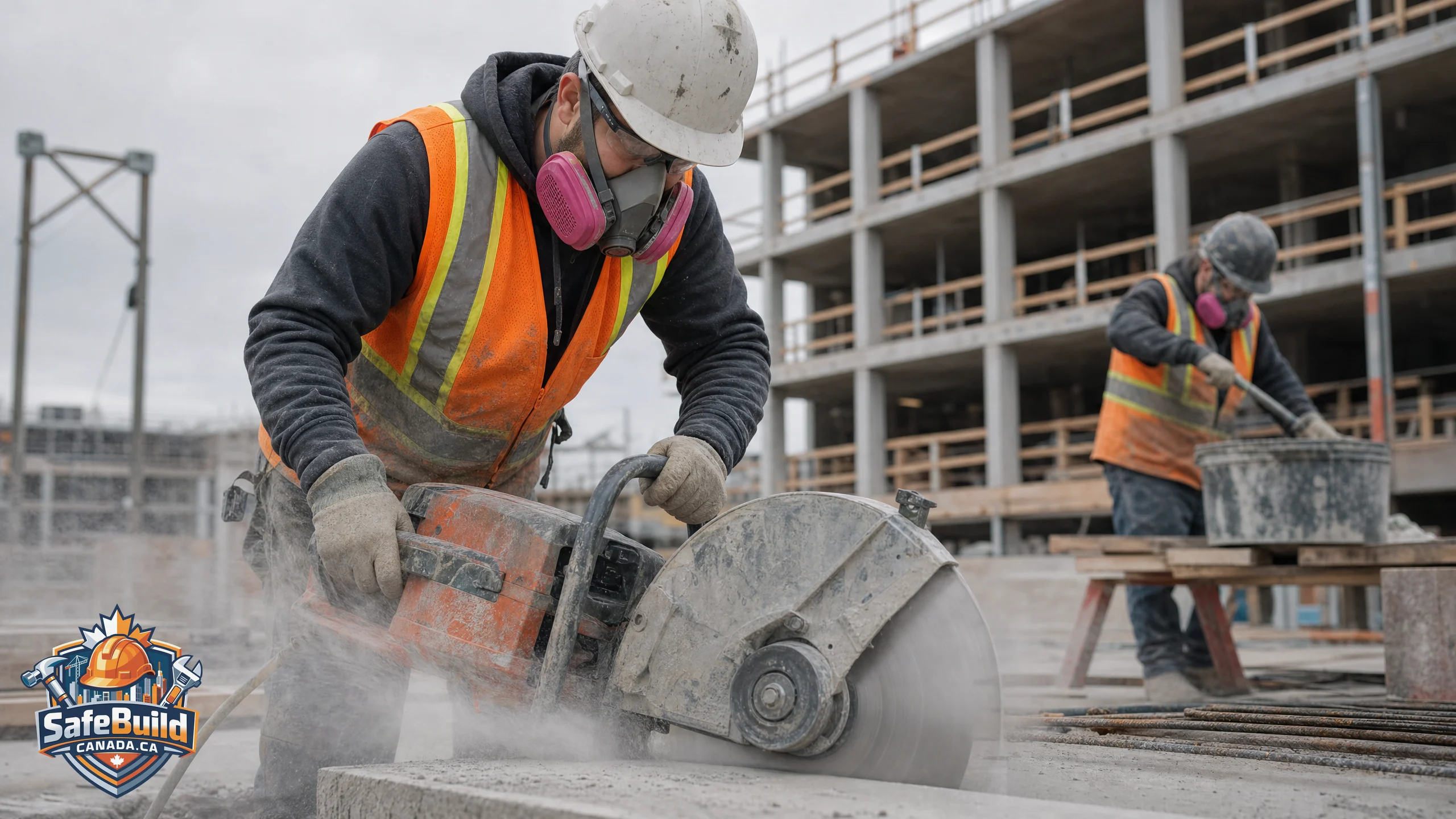
Walk onto any active construction site in Canada and you will see workers wearing masks. Look closer, and you will notice a wide variation in what they are actually wearing. Some have basic paper dust masks. Others have half-facepiece elastomeric respirators with pink cartridges. Some are clean-shaven, while others have full beards pressing against the seal of their mask.
The difference between "wearing a mask" and actually being protected is significant, and the health consequences of getting it wrong are permanent. With provincial regulators in Ontario, BC, and Alberta all increasing enforcement around silica dust, understanding exactly what N95 and P100 mean is no longer optional for site supervisors and safety managers. This guide breaks down the Canadian regulatory requirements, explains the NIOSH filter classification system that all Canadian provinces accept, and outlines what a compliant respiratory protection program actually looks like in the field.
The hierarchy of controls comes first
Before getting into filter types, there is a rule that applies in every province: personal protective equipment is the last line of defense, not the first.
The Canadian Centre for Occupational Health and Safety respirator selection guidelines are clear that employers must first attempt to eliminate the hazard, substitute it with something less dangerous, or implement engineering controls. On a construction site, this typically means using wet cutting methods for concrete, attaching local exhaust ventilation (HEPA vacuums) directly to tools, or enclosing dusty operations. Only when these methods are not practical, or when they fail to reduce the airborne contaminant below the occupational exposure limit, should you turn to respiratory protection.
This matters legally, not just philosophically. Under Alberta OHS Code Part 18, an employer who hands a worker a mask without first demonstrating that engineering controls were considered is not in compliance. The same principle applies under BC's OHS Regulation Part 8 and Ontario's O. Reg. 213/91. Respiratory protection is a last resort, and your hazard identification and risk assessment documentation should show that you worked through the hierarchy before reaching for the PPE cabinet.
Decoding the alphabet: N, R, and P series filters
When you look at a particulate respirator or filter cartridge, you will see a letter followed by a number. This classification system comes from the US National Institute for Occupational Safety and Health (NIOSH), and it is the standard accepted by Canadian regulators across every province, including WorkSafeBC under OHS Regulation Part 8 and the Ontario Ministry of Labour.
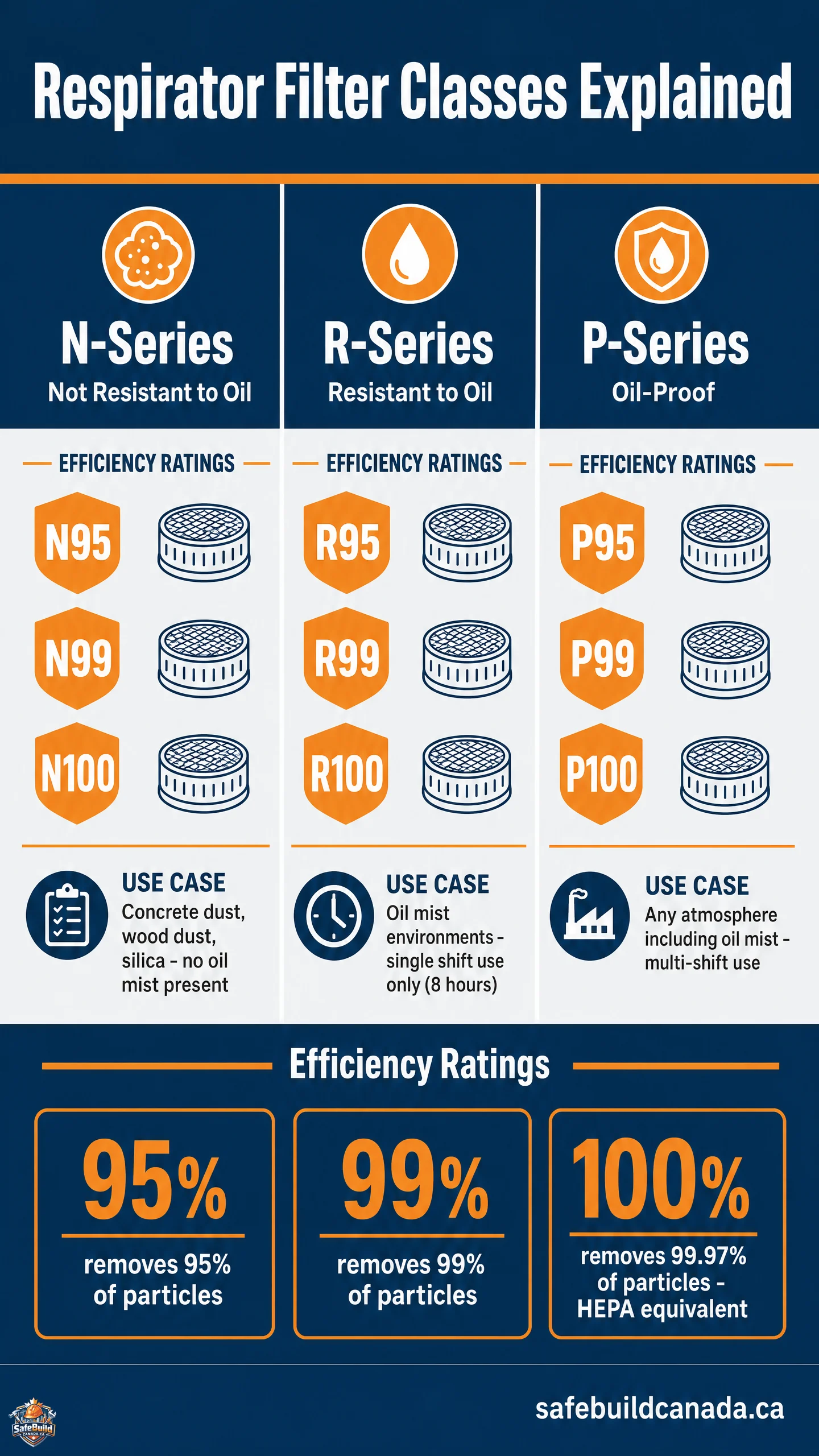
The letter tells you how the filter handles oil:
N-Series (Not resistant to oil): These filters work in any atmosphere where there is no oil particulate. They are the most common choice for standard construction dust, including wood dust, silica, and concrete dust.
R-Series (Resistant to oil): These can be used in atmospheres where oil particulate is present, but only for a single shift, defined as eight hours of continuous or intermittent use.
P-Series (Strongly resistant to oil, or oil-Proof): These can be used in any atmosphere, including those with oil particulates, for more than one shift.
Why does oil matter on a construction site? The most common source of oil mist in construction comes from percussion drills and certain cutting equipment. If oil mist is present in the air, an N-series filter will degrade and lose its effectiveness. According to the CDC NIOSH guide to respirators for dust in construction, in those environments you must upgrade to an R or P series filter.
Understanding efficiency ratings: 95, 99, and 100
The number following the letter indicates the filter's minimum efficiency in removing airborne particles of 0.3 microns in diameter, which is the hardest particle size to capture.
95 means the filter removes at least 95 percent of airborne particles. 99 means at least 99 percent. 100 means at least 99.97 percent, which is the threshold that qualifies a filter as HEPA-equivalent.
Therefore, an N95 respirator filters out 95 percent of non-oil-based particles. A P100 filter blocks 99.97 percent of all particles, including oil-based ones. The most commonly purchased filter types on Canadian construction sites are N95s and P100s. Type 95 filters generally have a lower cost and lower breathing resistance than type 100 filters, but as the NIOSH bulletin notes, as the letter rating and number rating increase, breathing fatigue also increases.
The silica dust challenge
The most significant respiratory hazard on most Canadian construction sites is respirable crystalline silica. When workers cut, grind, drill, or crush concrete, brick, block, or stone, they generate microscopic silica particles small enough to bypass the body's natural defenses and lodge deep in the lungs. The result is silicosis, a progressive and irreversible lung disease. Silica exposure is also classified as a Group 1 carcinogen by the International Agency for Research on Cancer, meaning it is a known cause of lung cancer.
The occupational exposure limit for silica in most Canadian jurisdictions is 0.025 milligrams per cubic meter of air as a Time-Weighted Average (TWA), based on the ACGIH Threshold Limit Value cited by the CCOHS silica quartz chemical profile. That is an extremely low threshold. Many common construction tasks, including tuckpointing, dry sweeping, and jackhammering concrete, can generate silica concentrations that exceed this limit by a factor of ten or more without any controls in place.
Because the OEL is so low, basic CSA PPE standards for construction are often not enough on their own. When engineering controls cannot keep silica dust below the OEL, high-level respiratory protection is mandatory. This is not a judgment call; it is a legal requirement.
When to use N95 vs P100
The choice between an N95 and a P100 depends on the concentration of the hazard in the air and the Assigned Protection Factor (APF) required to bring the worker's exposure below the OEL.
The APF is the anticipated level of protection provided by a properly functioning, well-fitted respirator. A standard N95 filtering facepiece respirator (a disposable dust mask) has an APF of 10. This means it can protect a worker in environments where the contaminant concentration is up to 10 times the OEL.
A half-facepiece elastomeric respirator (the reusable rubber masks) equipped with P100 cartridges also has an APF of 10 under BC's OHS Regulation Table 8-1. However, because the P100 filter captures 99.97 percent of particles compared to the N95's 95 percent, it provides a significantly higher margin of safety against microscopic silica particles, and it holds up in environments where oil mist is also present.
For high-exposure tasks like tuckpointing, abrasive blasting, or cutting concrete indoors without adequate ventilation, the silica concentration can easily exceed 10 times the OEL. In those scenarios, neither an N95 nor a half-face P100 is sufficient. You must move to a full-facepiece respirator, which carries an APF of 50, or a Powered Air-Purifying Respirator (PAPR) with a protection factor of 25 or 1,000 depending on the specific model and manufacturer testing data.
On many commercial and industrial sites in Canada, prime contractors are moving away from disposable N95s entirely, mandating half-face P100 elastomeric respirators for any task that generates significant dust. The cost difference is modest, the protection margin is substantial, and the reusable design means less waste on site.
The fit testing requirement
This is where many contractors fail regulatory inspections. A respirator only works if all the air you breathe goes through the filter. If the mask does not seal to your face, contaminated air will take the path of least resistance and leak in around the edges, bypassing the filter entirely.
Under Alberta OHS Code Part 18, Section 250, employers must ensure that any respirator requiring an effective facial seal is correctly fit tested in accordance with CSA Standard Z94.4. BC's OHS Regulation Part 8, Section 8.33 requires respirator selection in accordance with CSA Standard CAN/CSA-Z94.4-18. Ontario's O. Reg. 213/91 and O. Reg. 833 carry similar requirements.
Fit testing is not just putting the mask on and asking the worker if it feels tight. It is a formal, documented process conducted in two forms:
Qualitative fit testing uses a bitter or sweet-tasting aerosol. If the worker can taste the aerosol while wearing the mask, the seal has failed.
Quantitative fit testing uses a machine to measure the exact ratio of particles outside the mask to particles inside, giving a precise fit factor number.
Fit testing must be conducted before the worker uses the respirator for the first time, at least every two years thereafter, and whenever there is a change in the worker's physical condition that could affect the seal, including significant weight change, dental work, or facial scarring. The fit test is specific to a make and model of mask. If a worker switches from one brand to another, they need a new fit test.
The facial hair rule
There is no ambiguity here. If a respirator relies on a tight facial seal, including an N95 or a half-face P100, the worker must be clean-shaven where the respirator seals to the skin.
A day or two of stubble is enough to break the seal and allow microscopic silica dust into the lungs. Alberta OHS Code Section 250(2) states this explicitly: the employer must ensure the worker is clean-shaven where the facepiece seals to the skin. The same requirement is embedded in CSA Z94.4-18.
If a worker has a beard for religious, medical, or personal reasons, they cannot wear a tight-fitting respirator. The employer must provide an alternative, typically a loose-fitting PAPR with a hood or helmet that does not rely on a skin seal. This is not optional, and it is not a conversation about personal preference. It is a legal requirement tied to the effectiveness of the protection.
The written respiratory protection program
If you require workers to wear respirators, you cannot simply buy a box of masks and leave them in the job box. You must have a formal written program.
Under Alberta OHS Code Section 245, if respiratory protective equipment is used at a work site, the employer must prepare a code of practice governing the selection, maintenance, and use of that equipment. BC's OHS Regulation Part 8 and Ontario's O. Reg. 185/19 carry parallel requirements. The expectation across all provinces aligns with CSA Standard Z94.4, which mandates a written respiratory protection program.
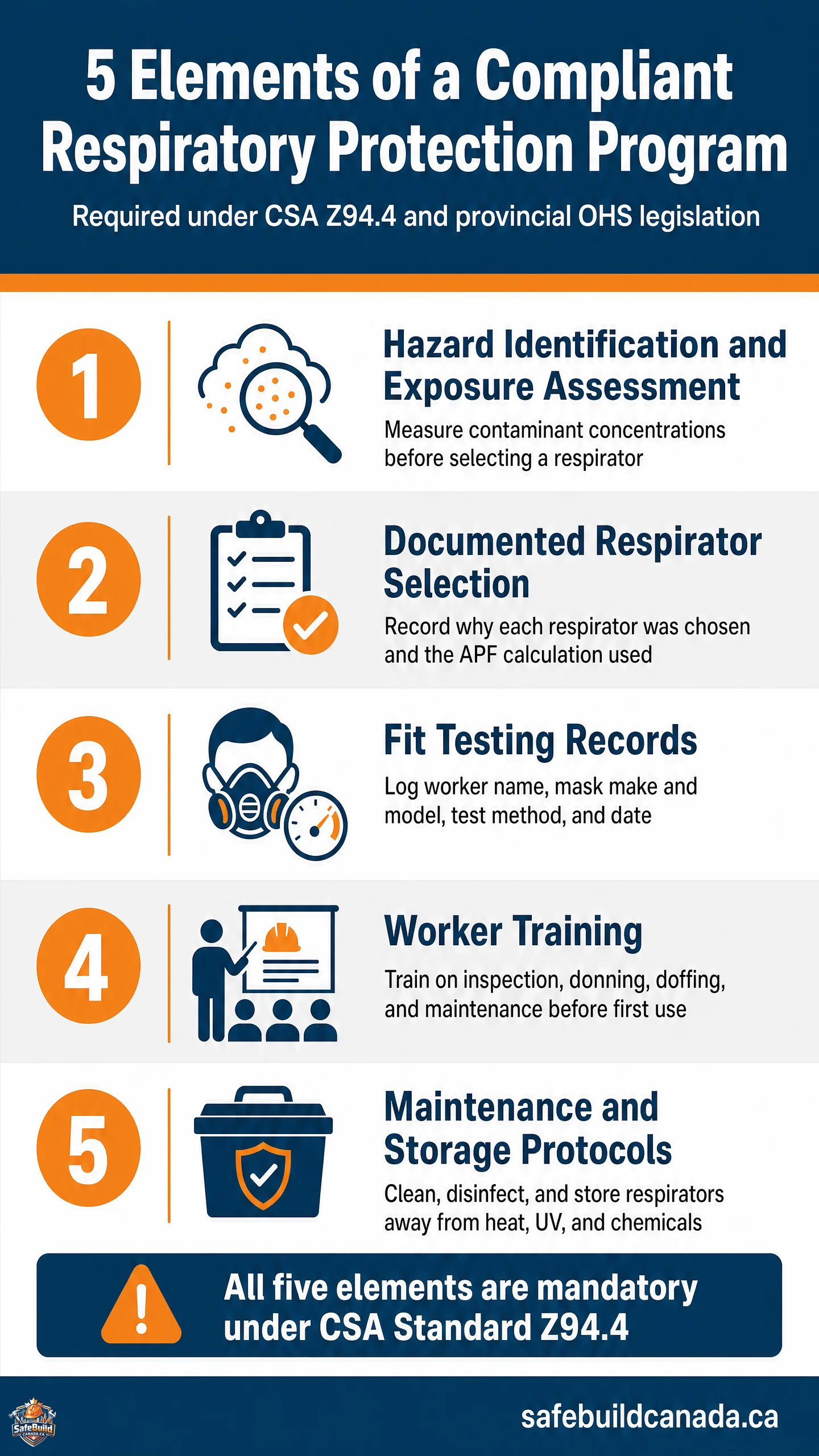
A compliant program must include five elements.
The first is hazard identification and exposure assessment. You must know what hazards are present and at what concentrations before you can select the right respirator. This ties directly into your site's hazard identification and risk assessment process and should be documented in your site safety plan.
The second is documented respirator selection criteria. Write down exactly why you chose a specific respirator for a specific task, including the APF calculation that shows the selected respirator is adequate for the measured or estimated contaminant concentration.
The third is fit testing records. Keep records of who was tested, on what specific make and model of mask, and when. These records must be available for inspection.
The fourth is worker training. Workers must be trained on how to inspect, put on, take off, and maintain their respirators. Fit testing alone is not training. This should be integrated into your site's mandatory construction site training program and documented with the same rigour as any other safety training.
The fifth is maintenance and storage protocols. Respirators must be cleaned, disinfected, and stored in a way that protects them from damage and contamination. Hanging a half-face respirator from the rearview mirror of a truck is a reliable way to degrade the rubber facepiece and ruin the filter cartridges. Filters have service lives, and they must be replaced on schedule or when breathing resistance increases noticeably.
The prime contractor's role
If you are the constructor or prime contractor on a multi-employer site, your construction site safety plan must address respiratory protection as a site-wide coordination issue, not just an individual employer issue.
Subcontractors are responsible for providing respirators and fit testing for their own workers. But the prime contractor has an overarching duty to coordinate safety across all employers on site. If a masonry subcontractor is generating significant silica dust, the prime contractor must ensure that the hazard is controlled so it does not expose the electrical subcontractor working in the adjacent space.
If you see a subcontractor worker wearing a paper dust mask over a full beard while cutting concrete, the prime contractor's site supervisor has an obligation to intervene. Ignoring it is a failure of the coordination duty under the Workers Compensation Act in BC, the OHS Act in Alberta, and the OHSA in Ontario.
Respiratory hazards also do not exist in isolation. Sites with high dust levels often have elevated noise exposure on construction sites from the same equipment. Managing both hazards together, and documenting that you did, is part of what a comprehensive site safety program looks like.
Protecting the lungs of the workforce
Silicosis is irreversible. There is no treatment that restores lung tissue once it has been scarred. Every case of occupational silicosis on a Canadian construction site is a preventable failure.
Understanding the difference between filter classes, enforcing fit testing and clean-shaven policies, choosing the right APF for the actual exposure level, and documenting all of it in a written program are the steps that prevent that failure. None of it is complicated. All of it is required.