
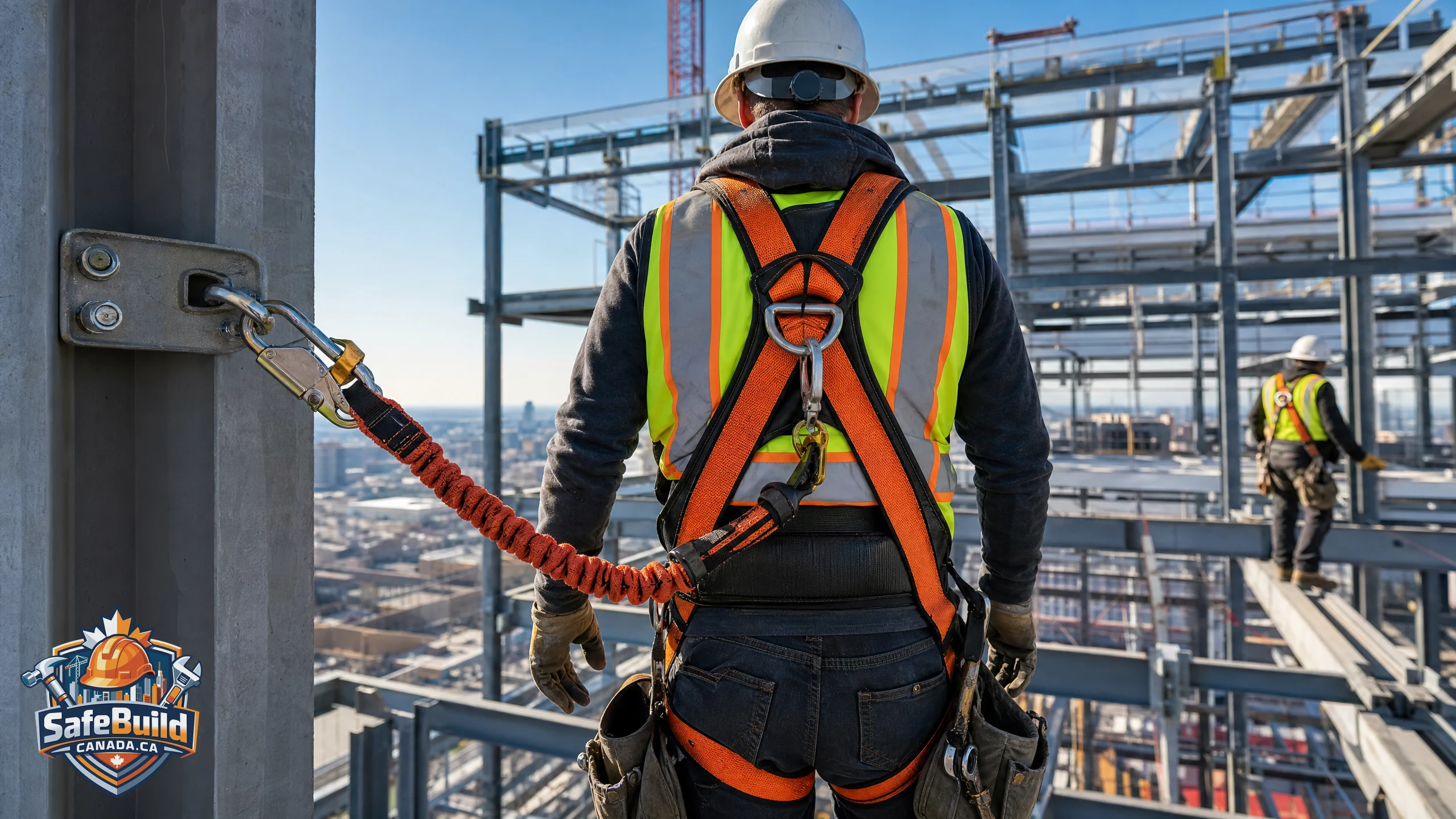
Gravity does not negotiate. When a worker steps off a leading edge or slips from a temporary platform, the equipment they wear is the only thing standing between a close call and a catastrophic fatality. In Canadian construction, the foundation of that survival system is the full body safety harness.
But simply handing a worker a harness is not enough. A harness that is improperly selected, poorly fitted, or damaged from previous use can fail when it is needed most. This is why Canadian occupational health and safety regulators rely on strict national standards to govern fall arrest equipment. Understanding what CSA Z259 requires is not just a compliance exercise for safety managers. It is a fundamental requirement for keeping crews alive.
This guide breaks down the critical elements of safety harness selection, fitting, and inspection on Canadian construction sites. We will explore the specific requirements of CSA Z259.10-18, how provincial regulations trigger fall protection rules, and what employers must do to ensure their fall arrest systems are ready for the reality of the jobsite.
The regulatory trigger: when is a harness required?
Before we look at the harness itself, we need to understand when the law requires a worker to wear one. Across Canada, the trigger height for fall protection varies slightly by province, but the underlying principle remains the same: if a worker can fall and be injured, they must be protected.
In most jurisdictions, including Ontario and Nova Scotia, the standard trigger height is 3 metres (10 feet). However, as outlined in Alberta OHS Code Part 9, employers must also provide fall protection at heights less than 3 metres if there is an unusual possibility of injury. This includes working above operating machinery, open vats of hazardous substances, or water.
When guardrails or travel restraint systems are not reasonably practicable, a personal fall arrest system becomes mandatory. The core component of that system is the full body harness. It is important to note that older "body belts" are no longer legally permitted for fall arrest in Canada. As the CCOHS fall arrest guidelines make clear, body belts can cause severe internal injuries during a fall and are now restricted strictly to work positioning or travel restraint. If the system is designed to catch a falling worker, a full body harness is the only legal option.
Decoding CSA Z259.10-18: the Canadian harness standard
When you purchase a safety harness for a Canadian jobsite, you cannot simply buy the cheapest option off the shelf. The equipment must be certified to the national standard. For full body harnesses, that standard is CSA Z259.10-18.
This standard dictates how harnesses are designed, tested, and classified. It ensures that the webbing can withstand the massive kinetic forces generated during a fall, that the stitching will not unravel under sudden load, and that the D-rings are positioned correctly to keep a suspended worker upright.
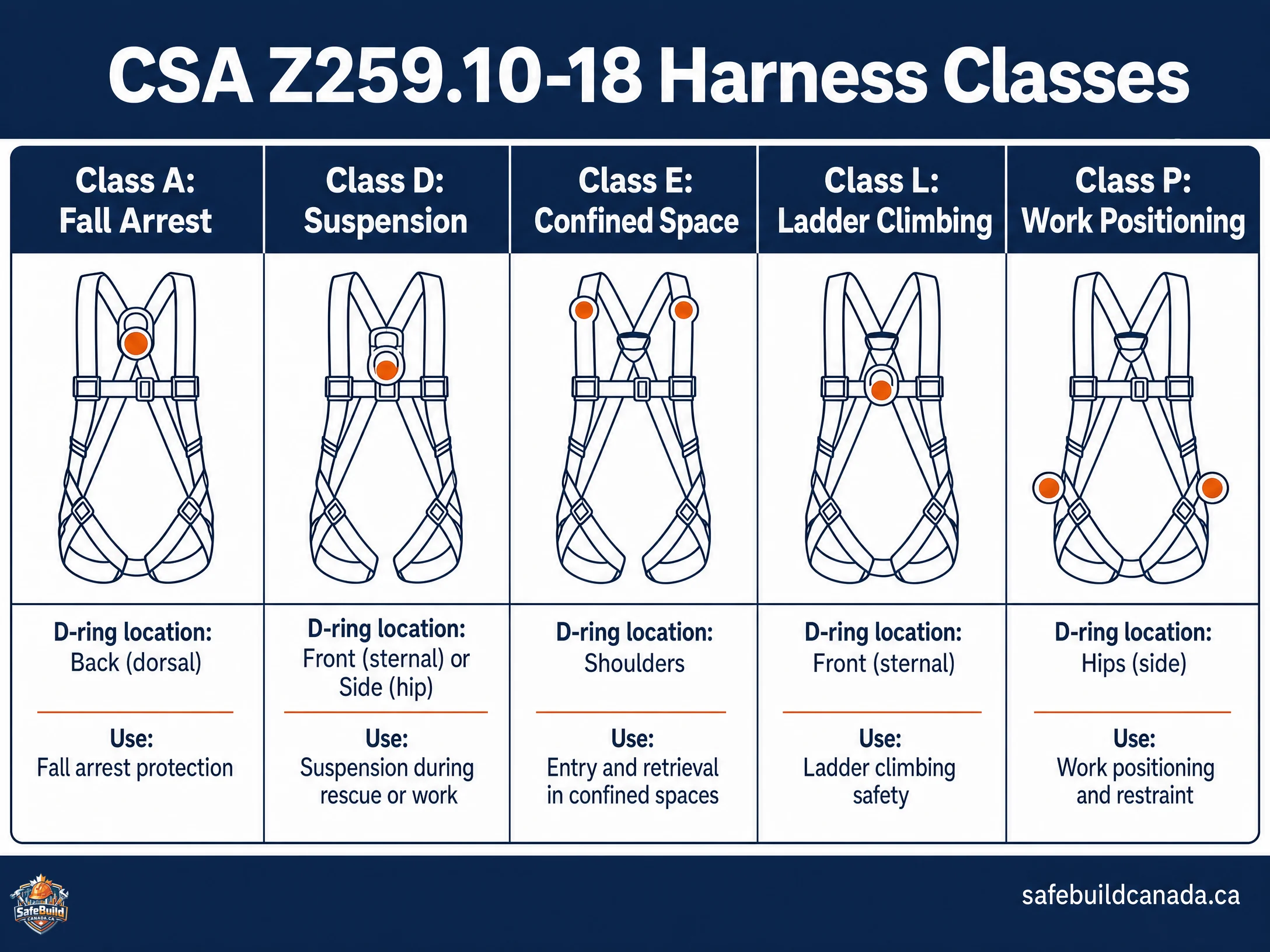
Under CSA Z259.10-18, harnesses are categorized into different classes based on their intended use. Understanding these classes is critical for proper selection:
Class A (Fall Arrest): This is the standard construction harness. It features a single D-ring located high on the back, between the shoulder blades. This dorsal D-ring is the only attachment point designed to arrest a free fall. Every harness sold in Canada must meet Class A requirements, even if it has additional features.
Class D (Suspension and Descent): These harnesses include additional D-rings on the front or sides, designed for workers who need to be suspended or lowered, such as those doing rope access work or tower maintenance.
Class E (Limited Access): Designed for confined space entry and rescue, these harnesses feature D-rings on each shoulder strap to allow a worker to be pulled vertically through a narrow opening.
Class L (Ladder Climbing): These feature a frontal D-ring attached to a permanent ladder safety system, preventing falls while climbing fixed vertical ladders.
Class P (Work Positioning): These harnesses include side D-rings at the hips. They allow a worker to attach a positioning lanyard and work hands-free, such as when tying rebar on a vertical wall. These side D-rings must never be used for fall arrest.
When selecting a harness, safety managers must match the class to the specific hazards identified in the site's hazard identification and risk assessment protocols. A standard Class A harness is sufficient for a roofer, but a worker entering a deep trench will need a Class E configuration.
The critical importance of proper fit
A CSA-certified harness is useless if it does not fit the worker correctly. In fact, an improperly fitted harness can be deadly. If the leg straps are too loose, the immense upward force of a fall arrest can cause severe trauma to the groin area. If the chest strap is positioned too high, it can crush the worker's trachea during a fall; if it is too low, the worker could slip out of the harness entirely upon impact.
Proper fitting is a mandatory component of worker training. When donning a harness, workers must follow a specific sequence to ensure all straps are secure and correctly positioned.
First, the worker should hold the harness by the dorsal D-ring and shake it to ensure no straps are twisted. After slipping the arms through the shoulder straps like a vest, the leg straps must be connected and tightened. The rule of thumb for leg straps is the "flat hand test": the worker should be able to slide a flat hand between the strap and their thigh, but not a closed fist.
Next, the chest strap is connected. It must sit squarely across the mid-chest, typically at nipple line or sternum level. Finally, the shoulder straps are adjusted to ensure the dorsal D-ring sits exactly between the shoulder blades. If the D-ring is too low, a fall will cause the worker to hang facing downward, increasing the risk of suspension trauma and making rescue significantly more difficult.
Ensuring every worker knows how to achieve this fit is a core part of mandatory construction site training programs. Supervisors must actively monitor their crews, as straps can loosen throughout a long shift of bending, reaching, and climbing.
Pre-use inspection: the daily lifeline check
The harsh environment of a Canadian construction site is brutal on safety equipment. UV radiation from the sun degrades synthetic webbing. Concrete dust acts as an abrasive, slowly wearing away fibers. Welding sparks, chemical spills, and sharp leading edges can compromise a harness in seconds.
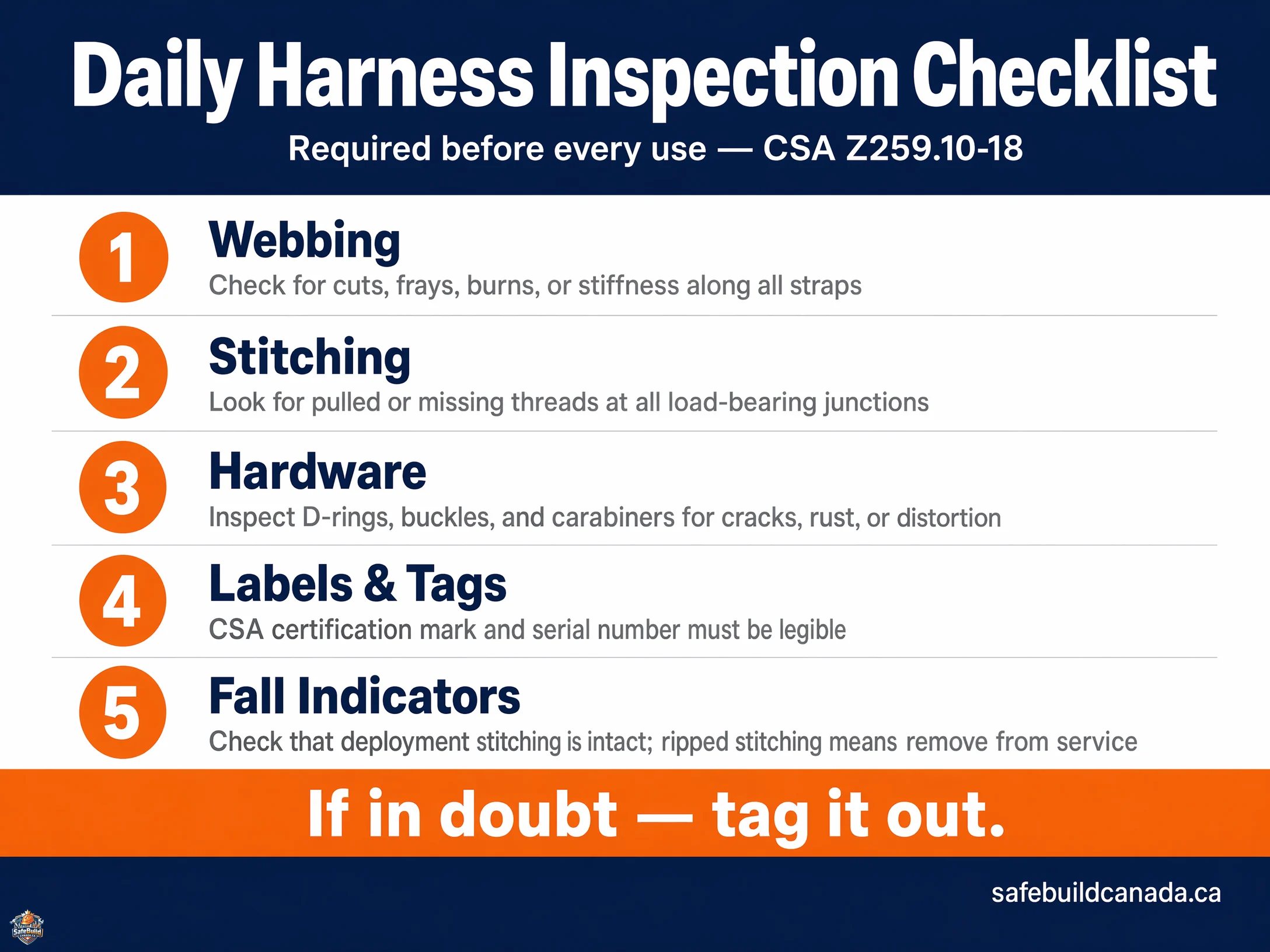
Because of these environmental hazards, provincial regulations and CSA standards mandate that every piece of fall protection equipment must be inspected by the worker before every single use. This is not a casual glance; it is a systematic, tactile inspection of the entire harness.
Workers must run their hands along every inch of the webbing, feeling for cuts, frays, burns, or areas where the material has become stiff or brittle. They must inspect the stitching, looking for pulled or missing threads, particularly at load-bearing junctions.
The hardware requires equal attention. D-rings, buckles, and grommets must be checked for cracks, distortion, rust, or sharp edges that could cut the webbing. The plastic components, such as strap keepers and the back pad, must be intact.
Finally, the worker must check the harness's tags. The tags must be legible, displaying the CSA certification mark, the date of manufacture, and the serial number. If the tags are missing or unreadable, the harness must be removed from service immediately. Furthermore, every harness has a built-in fall indicator — usually a folded section of webbing secured with specific stitching. If this stitching is ripped, it means the harness has been subjected to fall arrest forces and must be destroyed.
Maintenance, storage, and removal from service
A harness is a precision piece of life-saving equipment, and it must be treated as such. When the shift ends, harnesses should never be thrown into the back of a pickup truck or left lying on a concrete slab.
Proper storage is essential for maximizing the lifespan of the equipment. Harnesses should be hung by the dorsal D-ring in a clean, dry, and well-ventilated area, away from direct sunlight, extreme heat, and corrosive chemicals. If a harness becomes dirty, it should be cleaned with a damp sponge and mild soap, then allowed to air dry away from direct heat sources.
But even with perfect care, harnesses do not last forever. While CSA Z259.10-18 does not mandate a strict expiration date, most manufacturers specify a maximum service life — typically five years from the date of first use, provided the harness passes all inspections.
However, age is only one factor. As noted in the Alberta OHS Code, an employer must ensure that any personal fall arrest system that has stopped a fall is immediately removed from service. It cannot be reused. Even if the harness looks perfectly fine, the internal fibers have been stretched beyond their design limits. The equipment has done its job; it must now be destroyed to prevent accidental reuse.
Furthermore, any harness that fails a daily visual inspection or the mandatory annual inspection by a competent person must be tagged out of service. There is no room for "good enough" when it comes to fall protection.
Integrating the harness into the broader safety plan
A safety harness is only one component of a complete fall arrest system. It must be paired with a compatible energy-absorbing lanyard and a secure anchor point capable of withstanding massive forces. If any one of these links fails, the entire system fails.
This is why equipment selection must be integrated into the broader construction site safety plan. Employers must ensure that the lanyards chosen are compatible with the harness D-rings, that the anchor points are engineered correctly, and that the total fall clearance distance has been calculated accurately to prevent the worker from striking the ground.
Moreover, the safety plan must include a detailed rescue procedure. If a worker falls and is suspended in their harness, the clock starts ticking. Suspension trauma can become fatal in a matter of minutes as blood pools in the legs, depriving the brain of oxygen. The site must have the equipment and trained personnel ready to retrieve a suspended worker immediately.
The bottom line on fall arrest equipment
Fall protection is consistently one of the most cited safety violations on Canadian construction sites. Yet, the rules governing this equipment are clear, standardized, and readily available.
By adhering to CSA PPE standards, ensuring rigorous daily inspections, and training workers on proper fit and usage, employers can transform the safety harness from a mere compliance checkbox into a reliable lifeline. When a worker puts on a harness, they are placing their life in the hands of the equipment and the safety culture that provided it. It is the employer's absolute responsibility to ensure that trust is never broken.
Sources