
A joint health and safety committee is one of the most powerful tools for preventing injuries on a construction site. By bringing workers and management together to identify hazards and recommend solutions, these committees make safety a shared responsibility. However, the rules for when you need a committee, who must be on it, and what they must do vary significantly across Canada.
Understanding these requirements is critical for maintaining compliance and protecting your crew. Whether you are breaking ground on a new high-rise in Toronto or managing a long-term infrastructure project in Calgary, you must know exactly when the law requires you to establish a committee and how to support its operations.
This guide breaks down the legal thresholds for joint health and safety committees across Canadian provinces, explains their core functions, and provides practical advice for making your committee effective. If you are still getting your site safety foundations in place, the construction site safety orientation requirements across Canada are a good starting point.
What is a joint health and safety committee?
A joint health and safety committee is an advisory group made up of both worker and management representatives. The committee's primary purpose is to identify workplace hazards and make written recommendations to the employer on how to improve health and safety.
The "joint" aspect is crucial. The law requires these committees to have equal or greater representation from workers who do not exercise managerial functions. This structure means the people facing the actual risks on the site have a direct voice in how those risks are managed.
While the employer remains ultimately responsible for site safety, the committee acts as an internal auditing and advisory body. They provide a structured forum for discussing safety concerns, reviewing incident data, and developing proactive solutions.
When is a committee required?
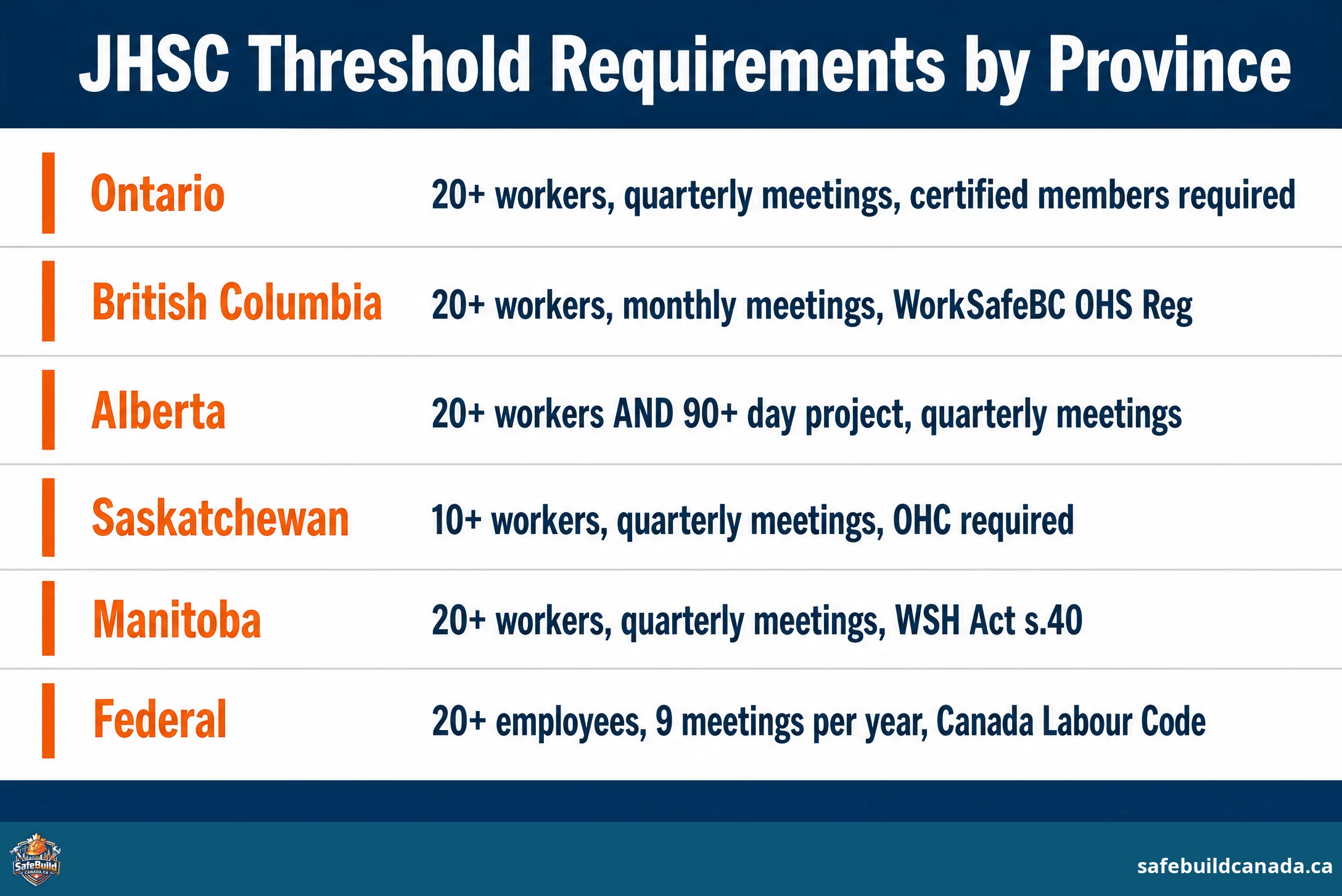
The threshold for requiring a joint health and safety committee depends on the province where your project is located and the number of workers regularly employed at the site.
Ontario requirements
In Ontario, the Occupational Health and Safety Act requires a joint health and safety committee at any construction project where 20 or more workers are regularly employed. The committee must have at least two members if the site has fewer than 50 workers, and at least four members if there are 50 or more workers.
Ontario also has strict certification requirements. At least one worker representative and one management representative must complete a specialized certification training program approved by the Chief Prevention Officer. The committee must meet at least once every three months.
British Columbia requirements
Under the Workers Compensation Act in British Columbia, a joint committee is mandatory for any workplace, including construction sites, that regularly employs 20 or more workers. The committee must have at least four members, with at least half being worker representatives.
Unlike Ontario, British Columbia requires the committee to meet at least once a month. The committee must also establish its own written rules of procedure governing how it will perform its duties.
Alberta requirements
Alberta's Occupational Health and Safety Act requires a joint work site health and safety committee if a project employs 20 or more workers and the work is expected to last 90 days or more. The committee must have at least four members, and the number of worker representatives must equal or exceed the number of employer representatives.
If your site has between 5 and 19 workers, or if the project will last less than 90 days, you must designate a health and safety representative instead of a full committee.
Saskatchewan and Manitoba requirements
In Saskatchewan, the threshold is lower. An occupational health committee is required at any construction site with 10 or more workers. The committee must meet at least quarterly.
Manitoba aligns with the 20-worker threshold. Under the Workplace Safety and Health Act, a committee is required for sites with 20 or more workers, and they must meet at least once every three months.
The 8 core functions of a committee
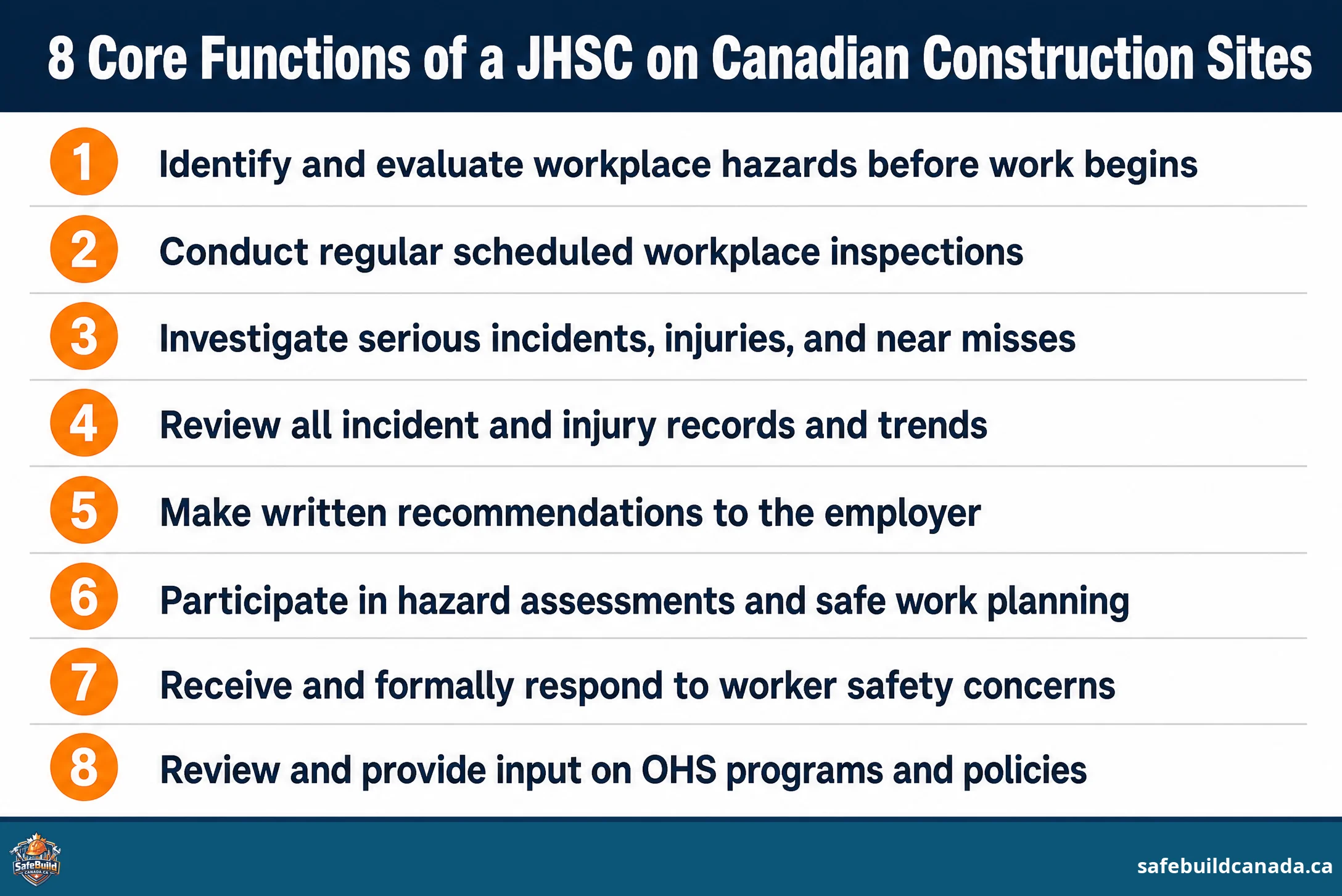
Regardless of the province, the core functions of a joint health and safety committee are remarkably consistent across Canada. Their role is to monitor the site, identify problems, and advise the employer.
1. Hazard identification and evaluation
The committee plays a central role in identifying potential dangers before they cause harm. This involves reviewing the site layout, observing work practices, and analyzing the materials and equipment being used. They provide a critical second set of eyes to complement the employer's formal hazard identification and risk assessment processes.
2. Workplace inspections
Committee members are legally entitled to inspect the physical condition of the workplace. In most provinces, a designated worker representative must inspect the entire site at least once a month. These inspections are a proactive measure to catch unsafe conditions, such as missing guardrails, improper scaffolding, or poor housekeeping, before an incident occurs. This function is a key component of any well-run construction site inspection program.
3. Incident investigation
When a serious injury, fatality, or significant near miss occurs, the committee has a right to participate in the investigation. A worker representative will typically examine the scene, interview witnesses, and help determine the root cause. Their involvement promotes transparency and helps prevent similar incidents in the future. For a full breakdown of what a proper incident investigation on a Canadian construction site should involve, that process is covered in detail separately.
4. Reviewing records and trends
Employers must share relevant health and safety information with the committee. This includes injury logs, first aid records, and reports from occupational hygiene testing. By reviewing this data, the committee can identify trends, such as a spike in hand injuries or recurring equipment failures, and recommend targeted interventions.
5. Making written recommendations
The most powerful tool a committee has is the ability to make formal, written recommendations to the employer. When the committee identifies a hazard or a gap in the safety program, they submit a recommendation for improvement. By law, the employer must respond in writing within a specified timeframe (typically 21 days), either accepting the recommendation or explaining why they disagree.
6. Participating in safe work planning
Committees should be involved in the development and review of safe work procedures. Their practical experience on the tools makes them invaluable for making sure that procedures are realistic and effective.
7. Addressing worker concerns
Workers who have safety concerns should first report them to their supervisor. If the issue is not resolved, they can bring it to the committee. The committee acts as an intermediary, investigating the concern and advocating for a solution if necessary.
8. Reviewing OHS programs
The committee should regularly review the employer's overall health and safety program, including training materials, emergency response plans, and policies. They confirm that the program remains relevant to the actual conditions on the site and complies with all current OHS regulations for Canadian construction.
Setting your committee up for success
Meeting the legal requirement to form a committee is only the first step. To truly benefit from the committee, you must support its members and integrate their work into your daily operations.
First, all committee members should receive adequate training. Even in provinces where certification is not strictly required, providing committee members with training on hazard recognition, inspection techniques, and incident investigation on construction sites will drastically improve their effectiveness.
Second, provide the committee with the time and resources they need. Members must be paid for the time they spend preparing for meetings, attending meetings, and conducting inspections. Do not treat committee duties as an afterthought to be squeezed in during breaks.
Finally, foster a culture of collaboration. The committee is not an adversary; they are an internal consulting team dedicated to keeping your site safe. When the committee submits a recommendation, treat it with respect. Even if you cannot implement their exact suggestion, work with them to find an alternative solution that addresses the underlying hazard.
By treating your joint health and safety committee as a vital partner in your safety management system, you can move beyond mere compliance and build a culture where every worker goes home safe at the end of the day.
Section 3: Sources
Government of Ontario. "Occupational Health and Safety Act, R.S.O. 1990, c. O.1 — Section 9 (Joint Health and Safety Committees)"
Government of Alberta. "Occupational Health and Safety Act — Part 2: Health and Safety Committees, Representatives and Programs"
WorkSafeBC. "Workers Compensation Act — Joint Health and Safety Committees"
Canadian Centre for Occupational Health and Safety (CCOHS). "Health and Safety Committees — What is a Health and Safety Committee?"
Canadian Centre for Occupational Health and Safety (CCOHS). "Health and Safety Committee — Creation Requirements by Province"