
Every serious incident on a Canadian construction site represents a failure of imagination. Someone failed to imagine how a piece of equipment could fail, how a trench wall could collapse, or how a worker could fall. Pre-task planning is the formal process of forcing that imagination to happen before the work begins.
Whether you call it a Field Level Hazard Assessment, a Job Safety Analysis, or a Safe Work Plan, the goal is identical. You are pausing the momentum of the site to ask three questions. What are we doing? What could hurt us? How are we going to stop that from happening?
When pre-task planning is done correctly, it is the most effective safety tool on your site. When it is done poorly, it is just another piece of paper that gets signed without being read. This guide will break down what Canadian occupational health and safety regulations require, how to build a process that actually works, and why worker participation is the only metric that matters.
The legal foundation of pre-task planning in Canada
The requirement to assess hazards before work begins is baked into the occupational health and safety legislation of every province and territory in Canada. While the specific terminology varies, the core obligation remains consistent: employers must identify hazards and implement controls before exposing workers to risk.
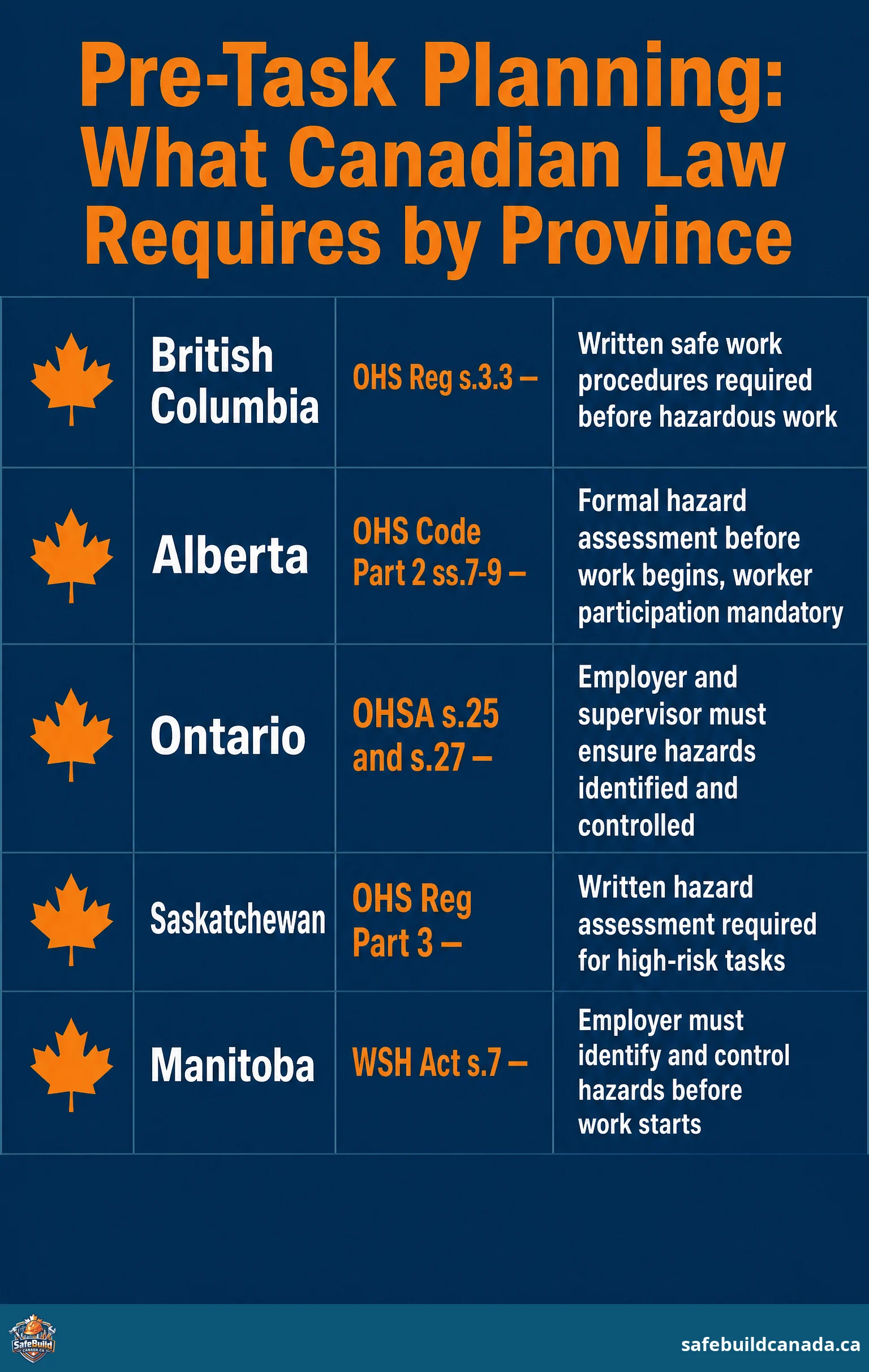
In British Columbia, the Workers Compensation Act and the Occupational Health and Safety Regulation require employers to provide workers with the information, instruction, training, and supervision necessary to protect their health and safety. Section 3.3 of the WorkSafeBC OHS Regulation specifically mandates that when a task involves a known hazard, the employer must develop written safe work procedures and instruct workers in them.
Alberta takes a highly prescriptive approach. Part 2 of the Occupational Health and Safety Code requires employers to conduct a formal hazard assessment before work begins at a site or when a new work process is introduced. Crucially, Section 8 of the Code mandates that employers must involve affected workers in the hazard assessment process. You cannot simply hand a worker a completed form; they must participate in identifying the risks they will face.
Ontario relies on the broad duties outlined in the Occupational Health and Safety Act. Section 25 requires employers to take every precaution reasonable in the circumstances for the protection of a worker. Section 27 places a similar duty on supervisors, requiring them to advise workers of any potential or actual danger to their health or safety. In practice, the Ministry of Labour, Immigration, Training and Skills Development expects to see documented pre-task planning as evidence that these duties are being met.
The difference between formal and field-level assessments
To understand pre-task planning, you must understand where it fits within your broader safety management system. A thorough hazard identification and risk assessment program operates on two distinct levels.
The formal hazard assessment is a high-level document created by management and safety professionals. It looks at the entire scope of the company's operations. If you are a roofing contractor, your formal assessment will identify falls from heights as a baseline hazard for your business. It will establish your company-wide policies, such as requiring fall protection for any work above three metres. This document is updated annually or when major operational changes occur.
The field-level hazard assessment is the pre-task plan. It is completed on the site, on the day the work is happening, by the people doing the work. It takes the broad policies of the formal assessment and applies them to the specific reality of today's environment.
Your formal assessment might say 'use a harness when working on a roof.' Your field-level assessment asks: Is the roof wet today? Are there skylights we need to cover? Is the wind too high to safely handle the materials? Where exactly are our anchor points?
The pre-task plan bridges the gap between the safety manual in the site trailer and the actual conditions on the ground.
The 6-step pre-task planning process
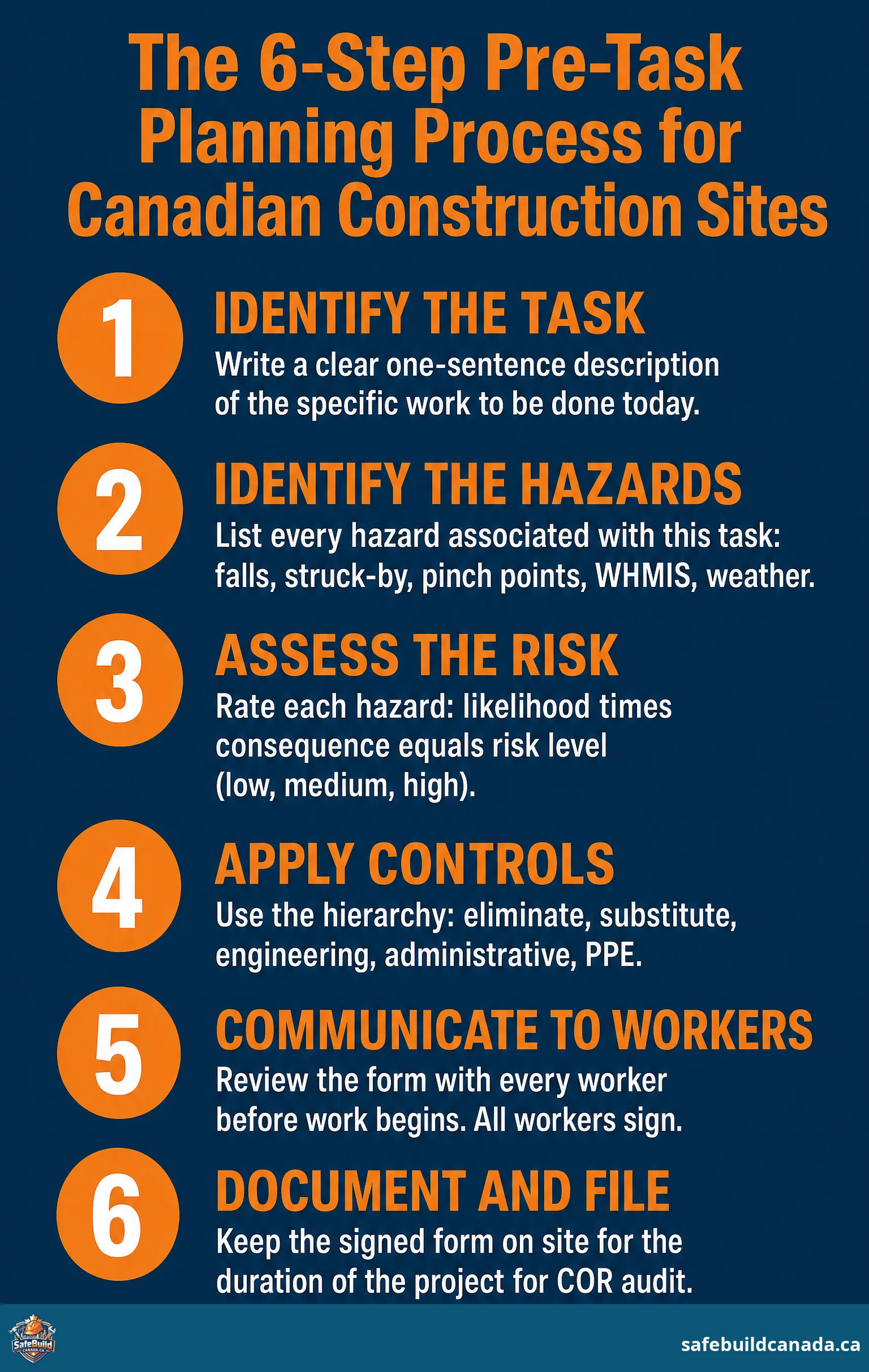
A successful pre-task plan is not a novel. It should be a concise, highly focused document that can be completed in ten to fifteen minutes. The most effective programs follow a standardized six-step process.
Step 1: Identify the specific task
Vagueness is the enemy of safety. If the task description on the form says 'general construction,' the assessment is already useless. The task must be specific and bounded. 'Installing drywall on the east elevation of building B' is a specific task. 'Operating the excavator' is not.
Step 2: Identify the hazards
Once the task is defined, the crew must identify every hazard associated with it. This requires looking in all six directions: up, down, left, right, front, and back. Are there overhead power lines? Is there an open excavation nearby? Are other trades working above us? What hazardous materials are we using? How is the weather impacting the site?
Step 3: Assess the risk
Not all hazards require the same level of intervention. A paper cut is a hazard, but it does not require a site shutdown. The crew must evaluate the risk by considering two factors: how likely is the event to occur, and how severe would the consequences be if it did? A high-likelihood, high-consequence hazard requires immediate, aggressive control measures.
Step 4: Apply the hierarchy of controls
This is the most critical step in the process. Once a hazard is identified and assessed, the crew must determine how to protect themselves. They must use the hierarchy of controls, starting at the top.
Can we eliminate the hazard entirely by doing the work on the ground instead of at heights? If not, can we substitute a less hazardous chemical for the one we planned to use? If not, can we implement an engineering control, like installing a guardrail? If not, can we use administrative controls, like limiting the time a worker spends in a noisy area?
Only when all other options have been exhausted should the crew rely on personal protective equipment. PPE is the least effective control because it only works if the hazard actually strikes the worker.
Step 5: Communicate and sign
A pre-task plan is useless if it stays in the foreman's pocket. The completed assessment must be reviewed with every worker who will be involved in the task. They must understand the hazards and agree to the controls. Once the review is complete, every worker must sign the document. This signature is not just a bureaucratic requirement; it is a formal acknowledgment that the worker understands the risks and knows how to stay safe.
Step 6: Document and file
The signed pre-task plan must remain on the site for the duration of the project. These documents are critical evidence of due diligence. If an incident occurs, the provincial regulator will immediately ask to see the hazard assessment for that specific task. Furthermore, these documents form the backbone of your construction site inspection program and are essential for maintaining your COR certification.
The danger of pencil-whipping
The greatest threat to a pre-task planning program is 'pencil-whipping.' This occurs when a foreman or worker fills out the form as quickly as possible, checking boxes without actually looking at the site or thinking about the hazards.
Pencil-whipping happens for three reasons. First, the forms are often too long and complex, requiring workers to spend more time doing paperwork than planning the work. Second, the safety culture of the company prioritizes production speed over genuine hazard assessment. Third, supervisors fail to review the forms and hold crews accountable for the quality of their assessments.
When a pre-task plan is pencil-whipped, it creates a dangerous illusion of safety. The company believes the hazards have been controlled because the paperwork is filed, but the workers on the ground remain exposed.
How to make your pre-task plans actually work
If you want your pre-task planning process to be effective, you must build it around the reality of the construction site, not the convenience of the safety office.
Keep the forms simple. A field-level hazard assessment should fit on a single page. Use checkboxes for common hazards to save time, but always leave blank space for site-specific issues. The goal is to prompt critical thinking, not to create a data entry burden.
Make it a collaborative process. The foreman should not fill out the form alone in the truck. The assessment should be completed at the actual work location, with the entire crew participating. The workers who are swinging the hammers are the ones who know the hazards best. Their input is invaluable.
This collaborative approach is a core component of mandatory construction site training. Workers must be taught not just how to do their jobs, but how to actively participate in the safety planning process.
Finally, supervisors must audit the process. A site superintendent should regularly walk the site, ask crews to see their pre-task plans, and verify that the controls listed on the paper are actually being used in the field. If the form says the crew is using a specific type of fall protection, the superintendent must verify that the harnesses are on and properly tied off.
Integrating pre-task planning with subcontractor management
On a modern Canadian construction site, the general contractor rarely performs the majority of the physical work. The site is a complex ecosystem of specialized trades. This makes pre-task planning exponentially more difficult, but also exponentially more important.
Effective subcontractor safety management requires the general contractor to establish clear expectations for hazard assessments. The general contractor must demand that every subcontractor complete a pre-task plan before beginning work each day.
More importantly, the general contractor must manage the overlapping hazards created by multiple trades working in close proximity. If the framing contractor's pre-task plan does not account for the electrical contractor working directly above them, both crews are at risk. The site superintendent must review the daily plans from all trades to identify and resolve these conflicts before the work begins.
The foundation of a safe site
Pre-task planning is not a paperwork exercise. It is the tactical execution of your construction site safety plan. It is the moment when abstract safety policies are translated into concrete actions that keep workers alive.
When you build a culture that values genuine hazard assessment, you enable your workers to take control of their own safety. You shift the focus from reacting to incidents to preventing them. And on a Canadian construction site, prevention is the only strategy that works.