
Construction safety software in Canada: what to look for and which platforms are worth your time
Canadian construction recorded 183 fatalities in 2022, the highest of any sector in the country, according to data compiled by the Association of Workers' Compensation Boards of Canada. That number has not moved as quickly as it should. Part of the problem is that too many sites are still running their safety programs on paper forms, shared drives, and email threads that nobody reads until something goes wrong.
Digital safety software does not solve every problem on a construction site. But it does make the right things harder to ignore. When a worker submits a hazard report through an app, that report lands in a dashboard immediately. When a certification expires, the system flags it before the worker steps onto the site. When a COR audit comes around, the documentation is already organized. That shift from reactive to documented is where the real value sits.
The challenge for Canadian construction managers is that most of the content about safety software online is either written by the vendors themselves or built around US regulatory frameworks that do not apply here. This guide is written for Canadian safety officers, site managers, and contractors who need to evaluate platforms against real Canadian requirements: COR compliance, provincial OHS regulations, WHMIS documentation, bilingual support, and the offline capability that anyone running a remote site in northern Alberta or coastal BC will tell you is non-negotiable. For a broader look at how technology is reshaping Canadian construction safety, the complete guide to construction safety technology in Canada covers the full picture.
Why generic safety software often falls short in Canada
The Canadian construction safety environment has several features that global platforms frequently do not account for. The most important is the Certificate of Recognition program. COR is a voluntary but widely expected certification that demonstrates a company's OHS management system meets a provincial standard. In Alberta, BC, and several other provinces, COR is effectively required to bid on public sector work and many large private projects. A safety platform that cannot generate COR-ready audit documentation is not a platform built for the Canadian market, regardless of how polished its interface looks.
Provincial regulation adds another layer of complexity. WorkSafeBC, the Ontario OHSA, the Alberta OHS Act, and Quebec's Act Respecting Occupational Health and Safety all have different documentation requirements, different incident reporting timelines, and different rules around what must be posted and maintained on site. A platform that bundles all Canadian provinces into a single compliance template is cutting corners that will eventually cost you during an inspection.
Bilingual capability matters more than most software vendors acknowledge. Federal workplaces and any site operating in Quebec are legally required to support French-language workers. Even outside Quebec, a large portion of the Canadian construction workforce is more comfortable working in French. A platform that offers only English-language forms and interfaces creates a real barrier to adoption on mixed-language crews.
Finally, offline functionality is not a nice-to-have for Canadian construction. It is a requirement. Remote resource extraction sites, northern infrastructure projects, and rural construction across every province regularly operate in areas with no reliable cell or data coverage. If a worker cannot complete a Field Level Hazard Assessment because the app needs a signal, the app has failed its most basic purpose.
The 8 features that matter most for Canadian construction sites
Before evaluating any specific platform, it helps to have a clear list of what you actually need. The infographic below outlines the eight features that Canadian construction safety managers consistently identify as essential.
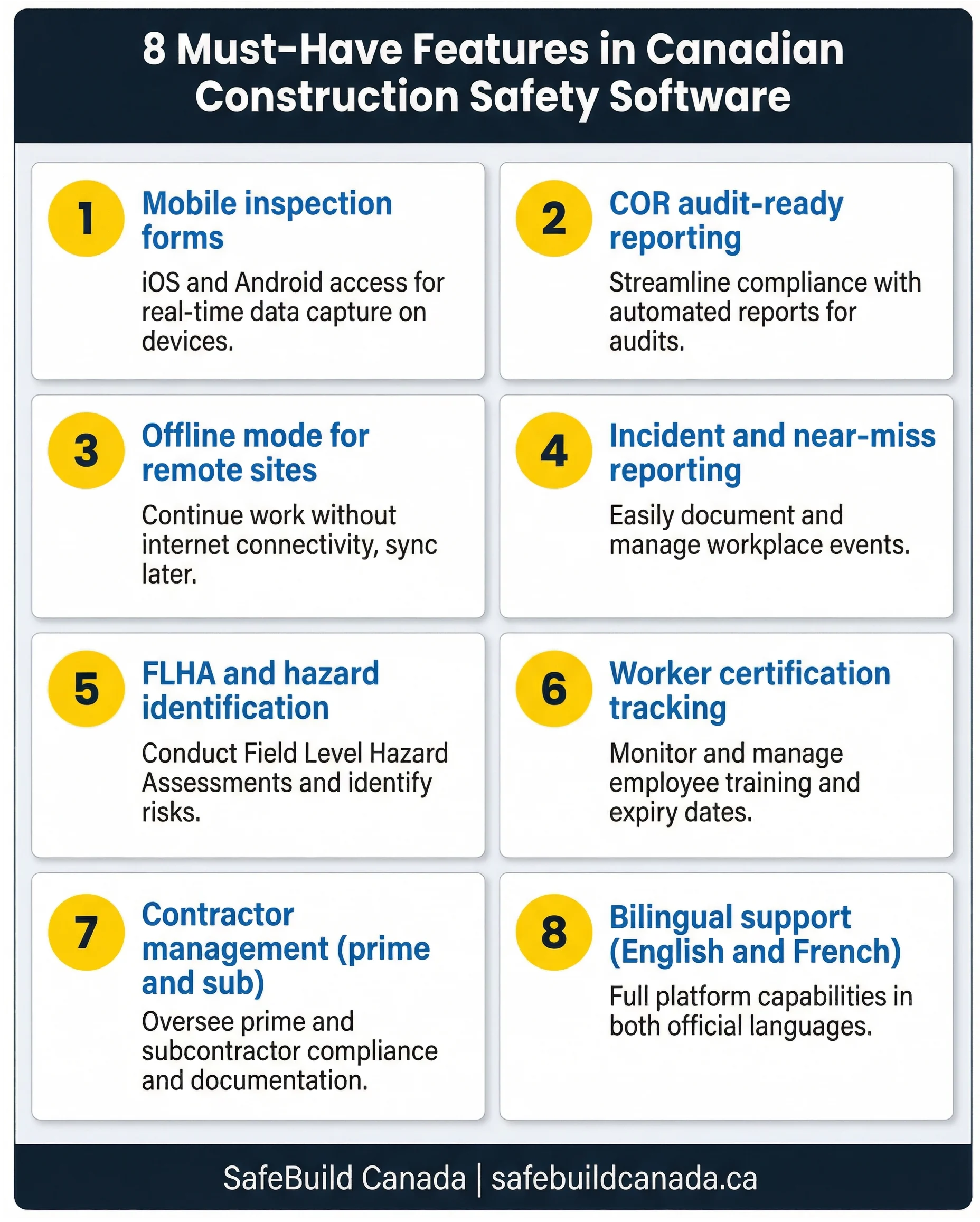
Mobile inspection forms are the foundation. Every platform offers them, but the quality varies considerably. Look for drag-and-drop form builders that let you replicate your existing paper forms exactly, not force you to adapt your program to their template library. Forms should work on both iOS and Android, and workers should be able to complete and sign them without needing a login that takes three steps to navigate.
COR audit-ready reporting is the feature that separates platforms built for Canada from those that were adapted for it. A good platform should be able to generate a COR audit package at the click of a button, organized by the audit elements your provincial certifying partner uses. If you have to manually compile documentation from multiple reports every time an audit comes around, the software is not doing its job.
Offline mode has already been discussed, but it is worth being specific about what good offline functionality looks like. The app should allow workers to complete any form, submit any report, and capture any photo without a connection. All of that data should sync automatically the moment a connection is restored, without requiring any manual action from the worker.
Incident and near-miss reporting needs to be fast enough that workers actually use it. If submitting a near-miss report takes more than two minutes on a mobile device, most workers will not bother. The best platforms reduce this to a guided form that takes under 90 seconds and automatically routes the report to the right supervisor.
FLHA and hazard identification tools need to reflect how Canadian sites actually run hazard assessments. A Field Level Hazard Assessment is a daily requirement on most Canadian construction sites, and the form needs to be customizable to match your site conditions, not a generic checklist that was designed for a warehouse.
Worker certification tracking becomes more valuable as your crew size grows. The platform should track expiry dates for every certification your workers hold, send automated reminders before expiry, and block workers from being assigned to tasks they are not qualified for. This is particularly useful for managing subcontractors, where you may have limited visibility into individual worker credentials.
Contractor management is a feature that many platforms treat as an afterthought. For general contractors managing multiple trade partners, the ability to track subcontractor compliance, collect their safety documentation, and verify that their workers have completed your site orientation is essential. Platforms that handle prime-sub relationships well save enormous amounts of administrative time on larger projects.
Bilingual support should mean more than a French translation of the interface. It should mean that forms, notifications, and reports can be generated and submitted in either official language, and that the platform's support team can assist in French when needed.
How the leading Canadian platforms compare
The Canadian safety software market has matured considerably over the past five years. Several platforms built specifically for the Canadian regulatory environment have emerged alongside global platforms that have invested in Canadian-specific features. The comparison infographic below covers the five platforms that come up most frequently in conversations with Canadian construction safety professionals.
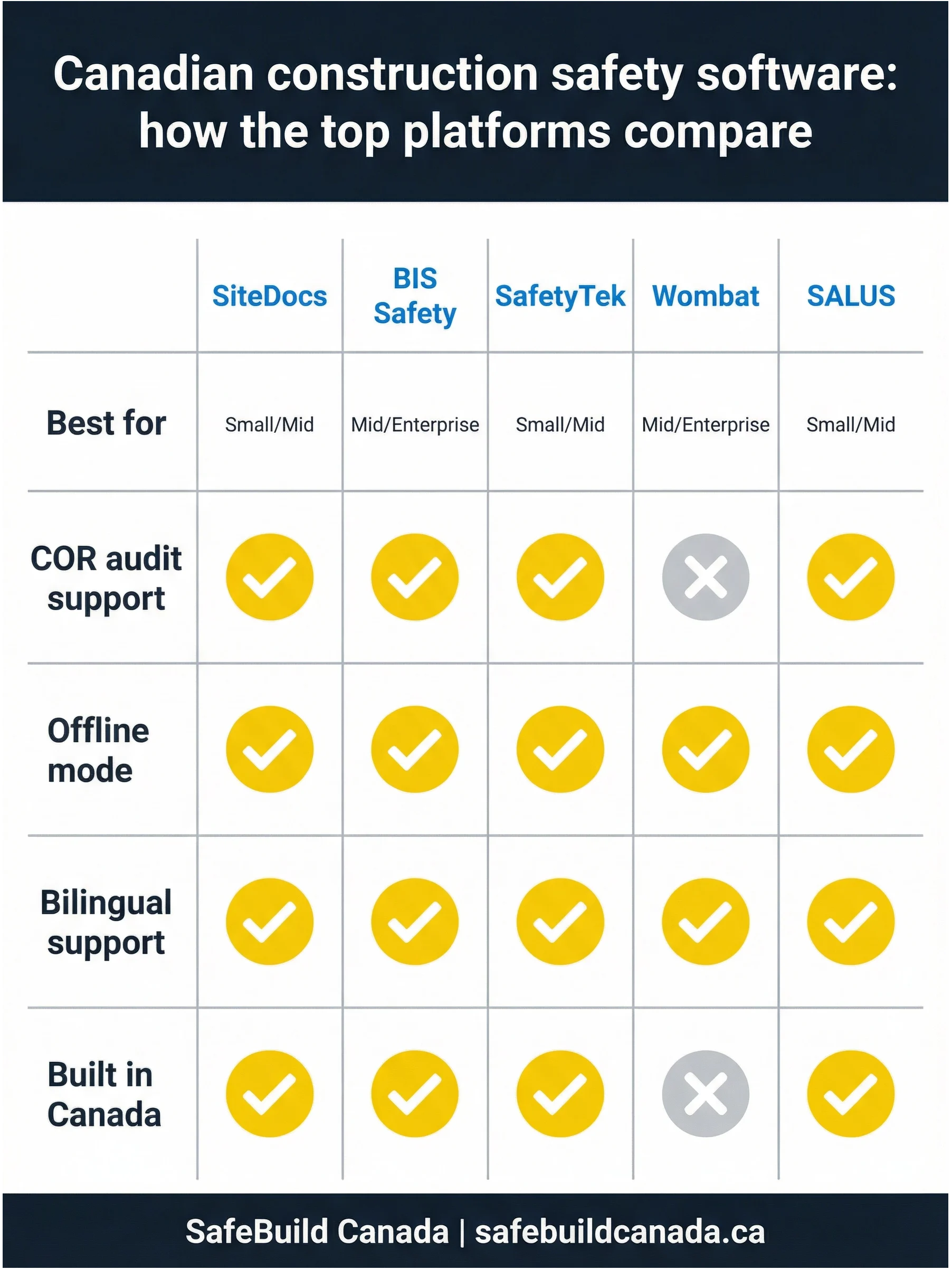
SiteDocs, based in Victoria, BC, is probably the most recognized name in Canadian construction safety software. It was built specifically for field-based industries and has a strong track record in construction. Its digital forms library is extensive, its mobile interface is genuinely easy for workers to use, and its contractor management module handles prime-sub relationships reasonably well. The platform's main limitation is that its workflow customization is less flexible than some competitors, and its training and certification tracking module is not as deep as platforms built around an LMS foundation. For small to mid-sized construction companies that primarily need to digitize their forms and inspections, SiteDocs is a strong starting point.
BIS Safety Software, based in Alberta, takes a different approach. It was built around a Learning Management System core, which means its training, competency tracking, and certification management capabilities are considerably more developed than most safety-first platforms. For contractors operating in Alberta and BC where COR audit requirements are most stringent, BIS Safety's audit module is one of the most complete available. The platform works well for multi-site, contractor-heavy operations where workforce qualification proof is a daily operational requirement. It is more complex to set up than SiteDocs, but that complexity reflects genuine depth rather than poor design.
SafetyTek is a Canadian-developed platform that sits comfortably in the mid-market. It is mobile-friendly, reasonably customizable, and well-suited for field operations. Its dashboards give safety managers a clear view of compliance activity across multiple sites. The platform's integration options are more limited than the enterprise-level competitors, which can be a constraint for larger organizations that need to connect their safety data to project management or HR systems.
Wombat Safety Software, delivered through a partnership with Irwin's Safety, positions itself as a full safety ecosystem rather than a standalone software platform. The combination of the software with Irwin's consulting support is genuinely useful for organizations that are making the transition from paper to digital and need guidance on how to structure their digital safety program, not just a tool to run it. The offline capability is solid, and the implementation support reduces the time-to-value considerably compared to self-serve platforms.
SALUS, based in Vancouver, BC, is a Canadian-built platform that has built a strong following among small to mid-sized construction companies that want a clean, field-first interface without the complexity of an enterprise system. SALUS was designed specifically for construction, which shows in how its workflows are structured. The daily form completion process is fast enough that field workers actually use it without being prompted, which is the real test of any safety app. Its COR audit support is solid, it works offline, and its iOS and Android apps are consistently well-reviewed for ease of use. For contractors who have tried larger platforms and found them overcomplicated for their crew size, SALUS is worth a serious look.
What the 2022 fatality data tells us about where software can help most
The 183 construction fatalities recorded in Canada in 2022 were not evenly distributed across hazard types. Falls from heights, struck-by incidents, and caught-in/between incidents account for the majority of construction fatalities year after year, as the CCOHS consistently documents in its sector-specific fatality data. These are also the hazard categories where digital safety tools have the most direct impact.
Fall protection inspections completed on paper are frequently backdated, incomplete, or filed in a binder that nobody reviews until after an incident. When the same inspection is completed on a mobile app, it is timestamped, geotagged, and visible to the safety manager in real time. That visibility does not prevent every fall, but it does create accountability that paper never could. For a practical look at how digital tools connect to a structured inspection program, the guide on how to run a construction site inspection program in Canada covers the full process from scheduling through documentation.
Near-miss reporting rates are consistently higher on sites using digital reporting tools than on sites using paper forms, according to research published by the Construction Industry Institute. Higher near-miss reporting rates are a leading indicator of a stronger safety culture, because they reflect a workforce that believes reporting is worthwhile. A platform that makes reporting fast and easy removes the friction that keeps workers from flagging the conditions that precede serious incidents.
Making the transition from paper to digital
The biggest mistake Canadian construction companies make when adopting safety software is trying to replicate their paper program exactly in digital form. The transition is an opportunity to review which forms are actually being used, which ones are being completed correctly, and which ones exist because someone created them years ago and nobody has questioned them since.
Before selecting a platform, spend time with your safety team and your site supervisors to identify the five or six forms that get completed every single day. Those are your starting point. Get those forms working well on the platform before you migrate everything else. A phased approach to digitization produces better adoption rates than a full cutover, and it gives you time to train workers on the new tools without overwhelming them. The guide on how to go paperless with construction site inspections in Canada walks through this transition process step by step.
Data residency is worth checking before you sign a contract. Canadian privacy law under PIPEDA requires that personal information about Canadian workers be handled in compliance with Canadian standards. Some platforms store all data on US servers, which can create compliance issues for federally regulated employers and for any organization that has made data residency commitments to clients. Ask the vendor directly where your data lives and get the answer in writing.
Budget for training time. The platforms reviewed here are all reasonably intuitive, but a worker who has been filling out paper forms for fifteen years will not immediately embrace a tablet-based inspection workflow. Dedicated training time, ideally delivered by someone who has used the platform on a real construction site, is the single most reliable predictor of successful adoption.
Where to go from here
Choosing the right safety software is one piece of a larger digital safety strategy. The platform you select needs to connect to your site-specific safety plan, your worker training records, and your incident investigation process. The Canadian construction industry is moving toward digital safety management faster than most people realize, and the role of AI in that shift is expanding quickly. The post on how AI is changing construction safety in Canada covers where predictive safety tools are heading and what Canadian contractors need to know.
The contractors who are ahead of that curve are not just saving administrative time. They are building the documentation trail that protects them during audits, during inspections, and in the event of a serious incident. Getting the right platform in place now is worth the effort.
SOURCES
OHS Canada Magazine, "Redefining workplace safety through digital transformation", July 2024.
Irwin's Safety, "Top 5 safety management software solutions in Canada", October 2025.
TrainAndDevelop.ca, "The 10 best EHS software platforms in Canada (2026 guide)", January 2026.