
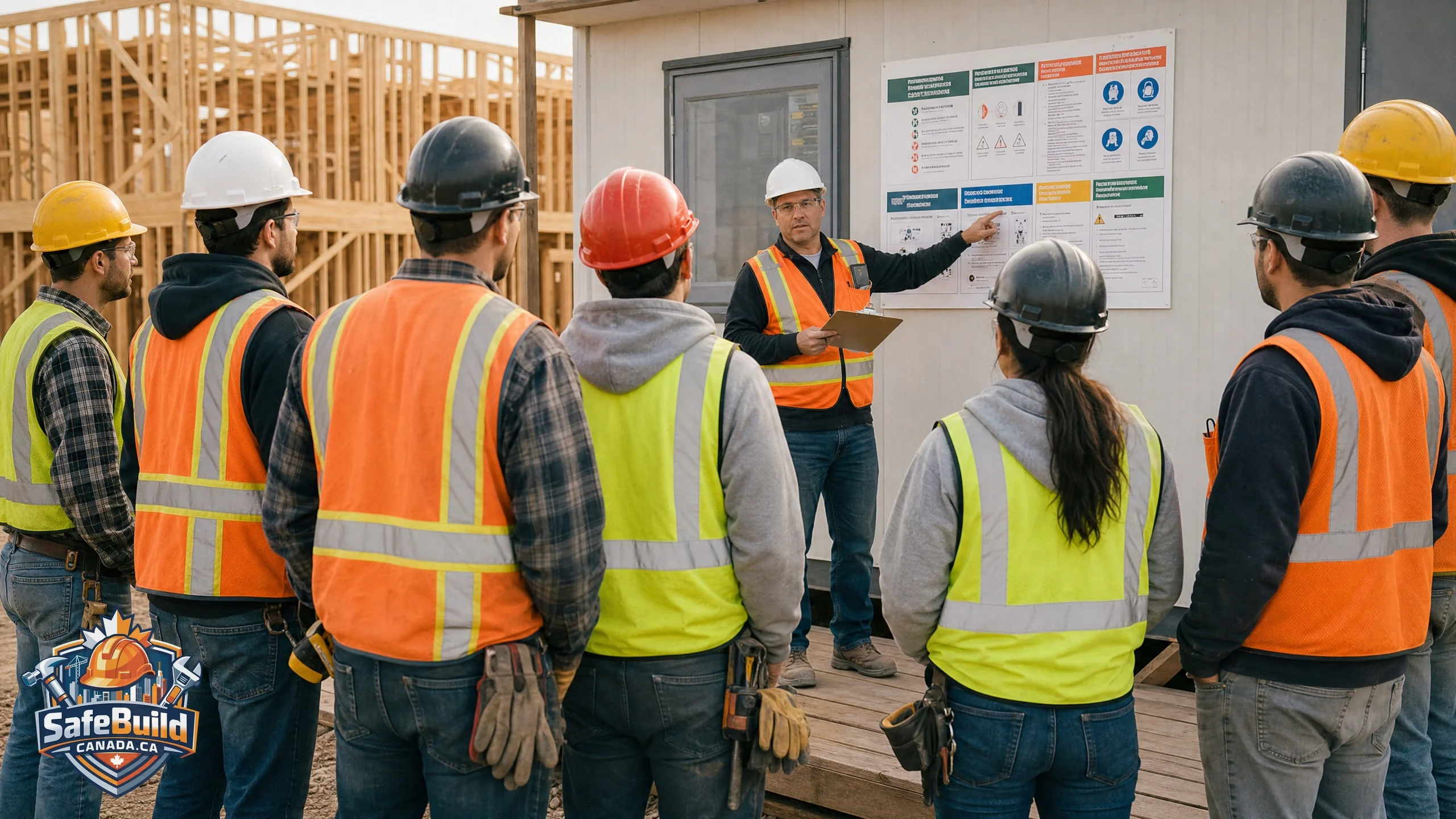
When a new worker steps onto a Canadian construction site, the clock starts ticking on employer liability. Before that worker picks up a tool, climbs a ladder, or enters a trench, they must understand the specific hazards of that environment. Providing a thorough construction site safety orientation is not just a best practice; it is a strict legal requirement across every province and territory in Canada.
Failing to provide adequate orientation exposes workers to severe injury and exposes employers to significant regulatory fines, stop-work orders, and potential criminal liability. This guide breaks down the legal requirements for safety orientation across Canada, the mandatory topics you must cover, and how to implement a compliant program that protects both your crew and your company.
The legal foundation of safety orientation
Across Canada, occupational health and safety legislation is built on the internal responsibility system. This system requires employers to take every reasonable precaution to protect workers. A core component of this duty is providing the information, instruction, and supervision necessary to ensure health and safety.
While the specific wording varies by jurisdiction, the underlying mandate remains consistent: you cannot assume a worker knows how to stay safe, regardless of their previous experience. Every site is different, and every employer must verify competency before allowing work to commence.
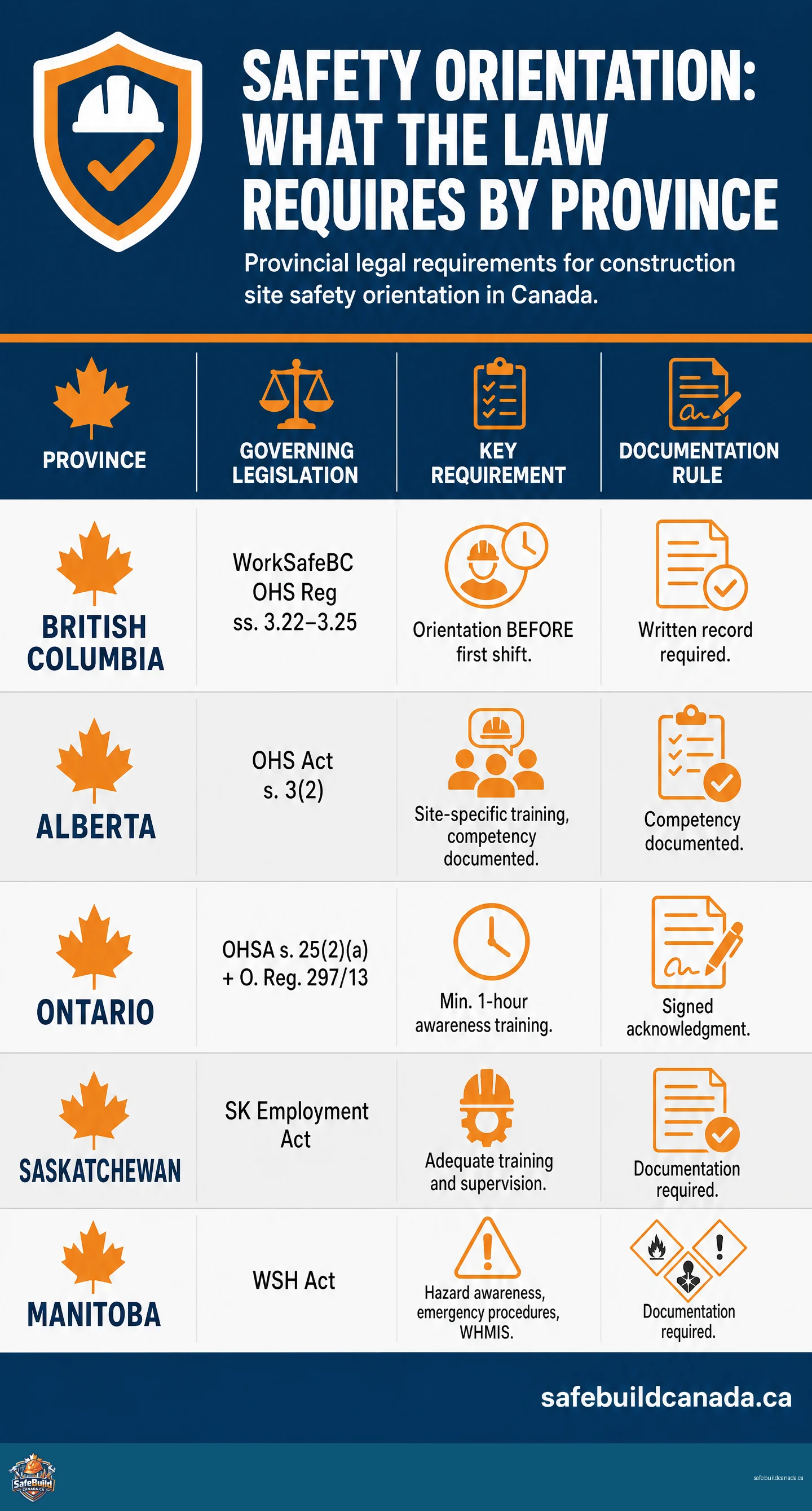
British Columbia: prescriptive and detailed
British Columbia maintains some of the most prescriptive orientation requirements in the country. Under the WorkSafeBC Occupational Health and Safety Regulation, sections 3.22 through 3.25 specifically address young and new workers.
The regulation defines a new worker not just as someone newly hired, but also as someone returning to a workplace where hazards have changed, or someone relocated to a new area with different risks. Employers must ensure orientation occurs before the worker begins their first shift. The rules mandate specific topics, including supervisor contact information, rights and responsibilities, workplace rules, and emergency procedures. Furthermore, employers must keep a written record of the orientation.
Alberta: competency and site-specific training
In Alberta, the Occupational Health and Safety Act places a clear duty on employers to ensure workers are adequately trained. Section 3(2) requires employers to ensure workers are trained in all matters necessary to perform their work safely.
Alberta emphasizes competency. If a task is hazardous, it must be performed by a competent worker or someone under the direct supervision of a competent worker. This means generic orientation videos are insufficient. Training must be site-specific, addressing the actual conditions and equipment present on the project. Documenting this competency is required for compliance and for passing audits related to construction safety certifications.
Ontario: mandatory awareness and hazard instruction
Ontario approaches orientation through a combination of the Occupational Health and Safety Act and specific regulations. O. Reg. 297/13 mandates a minimum one-hour basic occupational health and safety awareness training for all workers and supervisors. This foundational training covers basic rights, duties, and hazard recognition.
Beyond this basic awareness, section 25(2)(a) of the OHSA requires employers to provide specific information and instruction to protect workers. For construction sites, this means detailing the actual hazards present. Supervisors bear a heavy responsibility here, as they must advise workers of potential or actual dangers and provide written instructions when required.
Saskatchewan and Manitoba: program integration
In Saskatchewan, the Employment Act requires employers to provide adequate training and supervision. While not as prescriptive in minimum hours as Ontario, the expectation for thorough, documented orientation remains high, particularly for high-risk industries like construction.
Manitoba integrates orientation into the broader requirement for a workplace safety and health program. The Workplace Safety and Health Act requires employers to ensure workers are aware of hazards, emergency procedures, and WHMIS protocols. This ties directly into ongoing safety communication, such as mandatory toolbox talks, which are covered in detail in our guide on OHS regulations for Canadian construction.
10 mandatory topics for every orientation
Regardless of which province you operate in, regulatory bodies look for specific elements during an inspection. A compliant construction site safety orientation must cover these ten foundational topics.
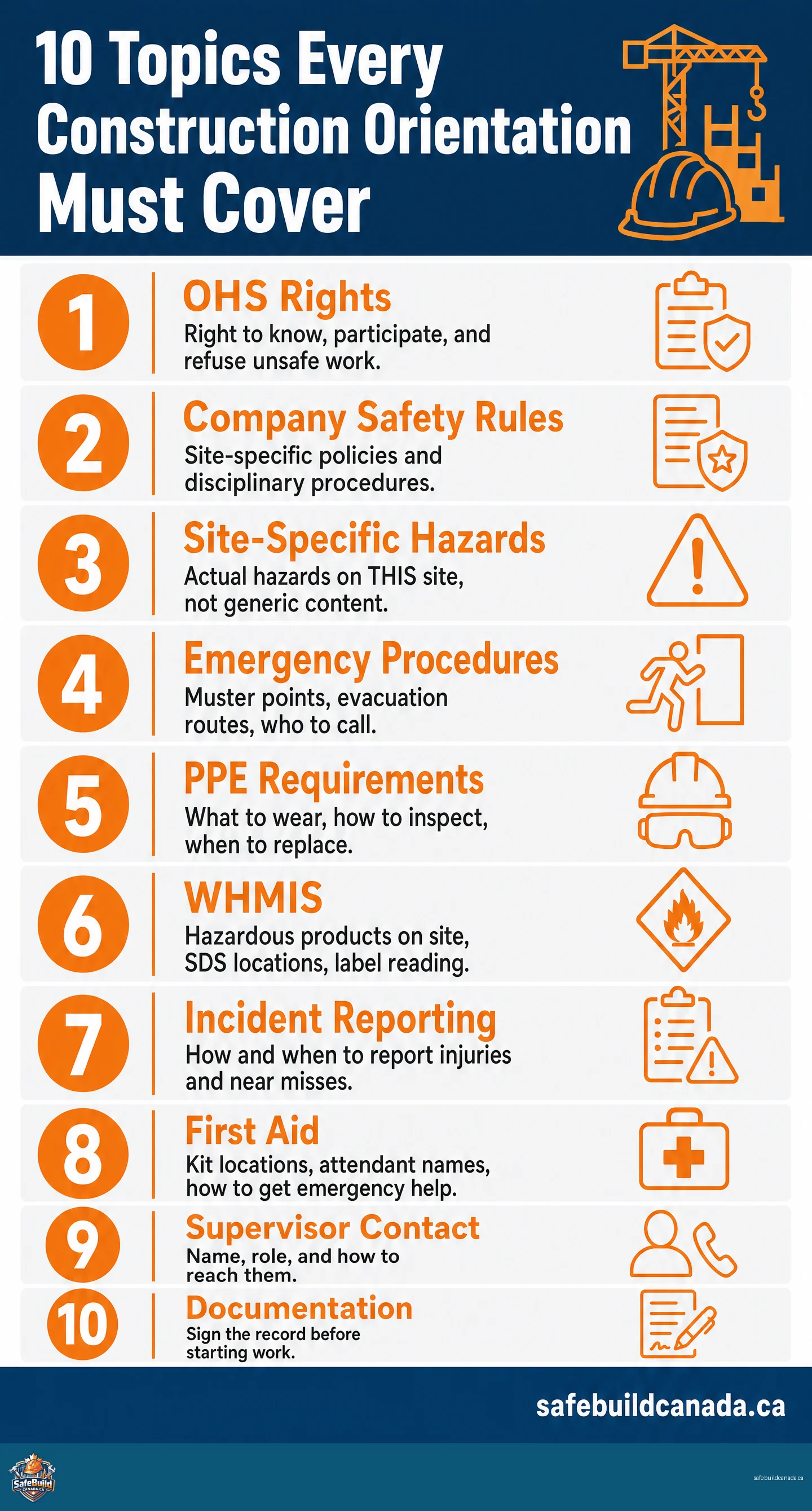
1. Occupational health and safety rights
Every worker in Canada has three fundamental rights: the right to know about hazards, the right to participate in health and safety activities, and the right to refuse unsafe work. Your orientation must explicitly state these rights and explain how a worker can exercise them without fear of reprisal.
2. Company safety rules and policies
Outline your specific site rules. This includes disciplinary procedures for safety violations, drug and alcohol policies, and general conduct expectations. Clarity here prevents confusion later.
3. Site-specific hazards
This is where generic orientations fail. You must detail the actual hazards present on this specific site. Are there overhead power lines? Deep excavations? Heavy equipment traffic? Workers need to know exactly what they are walking into today.
4. Emergency response procedures
If an incident occurs, workers must know exactly what to do. Detail the muster points, evacuation routes, locations of fire extinguishers, and the protocol for contacting emergency services. This aligns directly with your construction site emergency response plan.
5. Personal protective equipment requirements
Specify exactly what PPE is required on site. More importantly, instruct workers on how to inspect their gear, how to wear it correctly, and the process for replacing damaged equipment. Always acknowledge the hierarchy of controls before relying solely on PPE.
6. WHMIS and hazardous materials
Workers must know what hazardous products are on site, where the Safety Data Sheets are located, and how to read the labels. This is a non-negotiable federal and provincial requirement.
7. Incident and hazard reporting
Explain the exact process for reporting injuries, near misses, and identified hazards. Workers need to know who to tell and what forms to fill out. A strong reporting culture prevents future accidents.
8. First aid protocols
Detail the locations of first aid kits, the names of the designated first aid attendants, and the procedure for seeking medical help. Ensure this aligns with provincial first aid requirements.
9. Supervisor contact information
Every worker must know who their direct supervisor is, what their role entails, and exactly how to contact them during a shift.
10. Documentation and sign-off
The orientation is not complete until it is documented. Both the worker and the person delivering the orientation must sign a record confirming the training was completed and understood.
Implementing a compliant orientation program
Knowing the rules is only half the battle; executing them effectively on a busy job site is the real challenge. Here is how site supervisors can implement a solid orientation program.
Move beyond the generic video
Many companies rely on a generic safety video shown in the site trailer. While this can cover basic rights and WHMIS, it cannot cover site-specific hazards. You must supplement any generic material with a physical walk-around or a detailed briefing on the current state of the project. If the excavation phase just started, the orientation must focus heavily on trenching hazards.
Verify understanding, do not just lecture
Do not just talk at new hires. Ask open-ended questions to verify they understand the material. Ask them to point out the muster station or explain the hazard reporting process back to you. If a worker does not speak English as their first language, you must ensure they comprehend the safety instructions, which may require translated materials or a bilingual buddy system.
Update orientations as the site changes
A construction site is a dynamic environment. The hazards present during foundation pouring are entirely different from those during roofing. When the site changes significantly, or when a worker returns after a long absence, you must provide an updated orientation covering the new risks.
The critical role of documentation
If it is not documented, it did not happen. Regulatory inspectors and auditors will ask for orientation records immediately following an incident. Use a standardized checklist that covers all mandatory topics. Have the worker sign and date it, and keep these records organized and accessible. This documentation is also a mandatory component for maintaining your COR certification, and it is one of the first things reviewed during an OHS inspection on a Canadian construction site.
Deep dive: provincial enforcement and penalties
Understanding the legal requirements is essential, but understanding how those requirements are enforced provides the necessary context for why compliance is non-negotiable. Provincial regulators do not view safety orientation as a mere administrative task; they view it as a critical life-saving measure. When an incident occurs, the very first question an inspector asks is whether the worker was properly trained and oriented to the hazard that caused the injury.
WorkSafeBC enforcement mechanisms
In British Columbia, WorkSafeBC officers have broad authority to issue orders and administrative penalties for non-compliance. If an officer discovers that new or young workers are operating without the mandatory orientation outlined in sections 3.22 through 3.25 of the OHS Regulation, they can issue an immediate stop-work order. This halts production until the employer can prove that all workers have received the required training and that documentation is in place.
WorkSafeBC uses a penalty framework based on the size of the employer's payroll and the nature of the violation. Failure to provide adequate orientation, especially if it leads to an injury, is considered a high-risk violation. Penalties can easily reach tens of thousands of dollars, and in cases of gross negligence, the employer may face prosecution under the Workers Compensation Act.
Alberta OHS investigations
Alberta Occupational Health and Safety takes a similarly stringent approach. Under the OHS Act, the failure to ensure workers are adequately trained (section 3(2)) is a primary focus during any incident investigation. If a worker is injured and the employer cannot produce a documented, site-specific orientation record, the employer is almost certainly going to be found in violation of the Act.
Alberta OHS officers can issue violation tickets for immediate, observable infractions, but more serious failures regarding training and competency often lead to administrative penalties or formal charges. The maximum fine for a first offence under the Alberta OHS Act is $500,000, and $1,000,000 for subsequent offences. The financial risk of skipping a safety orientation is simply too high to ignore.
Ontario Ministry of Labour inspections
In Ontario, the Ministry of Labour, Immigration, Training and Skills Development conducts proactive inspection blitzes targeting construction sites. A frequent focus of these blitzes is worker training and orientation. Inspectors will ask workers directly about their training, their knowledge of site hazards, and their understanding of their rights under the OHSA.
If an inspector finds that workers have not received the mandatory basic awareness training (O. Reg. 297/13) or have not been instructed on site-specific hazards (OHSA s. 25(2)(a)), they will issue compliance orders. In severe cases, or where there is a history of non-compliance, the Ministry will prosecute the employer. Fines under the Ontario OHSA can reach $1,500,000 for corporations and $500,000 for individuals, alongside potential jail time.
Field execution: running an effective orientation
The gap between regulatory theory and field execution is where many construction companies struggle. Supervisors are under immense pressure to maintain schedules, and taking an hour to orient a new subcontractor can feel like a delay. However, an effective orientation actually improves productivity by reducing errors, preventing rework, and keeping workers on the job.
Structuring the orientation session
A successful orientation should be structured logically. Begin with the administrative requirements: collecting emergency contact information, verifying trade certifications, and confirming basic training like WHMIS and fall protection. Once the paperwork is handled, move to the site-specific information.
Do not conduct the entire orientation in the site trailer. The most effective orientations involve a physical walk-around of the site. Show the new workers the muster point, the first aid station, and the location of the fire extinguishers. Point out the active hazard zones, such as the crane swing radius or the open excavations. Visual context is far more memorable than a bulleted list on a clipboard.
Tailoring the message to the audience
The orientation must be tailored to the specific worker and their role. A heavy equipment operator needs a different orientation focus than a drywall installer. While the core topics (emergency procedures, rights, reporting) remain the same, the hazard instruction must be specific to their tasks.
Furthermore, pay special attention to young workers. Regulatory bodies across Canada recognize that workers under the age of 25 are at a significantly higher risk of injury. They often lack the experience to recognize hazards and may be hesitant to ask questions or refuse unsafe work. Supervisors must take extra time to ensure young workers truly understand the risks and feel comfortable speaking up.
Integrating orientation with daily safety routines
Orientation is not a one-time event; it is the beginning of an ongoing safety dialogue. The information provided during the initial orientation must be reinforced daily. This is where your mandatory toolbox talks become critical. Use the morning toolbox talk to remind workers of the hazards discussed during their orientation and to update them on any new risks that have emerged as the project progresses.
Similarly, the hazard reporting process explained during orientation must be actively encouraged. When a worker reports a hazard, supervisors must respond positively and take immediate corrective action. If workers see that their reports are ignored, the lessons from the orientation will quickly be forgotten, and the safety culture will degrade.
The role of technology in safety orientation
Managing orientation records for a transient workforce is a logistical nightmare for many construction companies. Paper checklists get lost, signatures are illegible, and tracking who needs an updated orientation when the site changes is nearly impossible using manual methods.
Digital orientation platforms
Many contractors now use digital safety management platforms to simplify the orientation process. These systems allow workers to complete the generic portions of the orientation (company policies, basic rights, WHMIS review) online before they even arrive at the site. This saves valuable time on the first morning.
Once on site, the supervisor can focus entirely on the site-specific hazards and the physical walk-around. The supervisor can then use a tablet or smartphone to complete the digital checklist, capture the worker's electronic signature, and instantly upload the record to the company's central database.
Benefits for compliance and auditing
Digital platforms provide a single source of truth for compliance. If an inspector arrives, the site superintendent can instantly pull up the orientation record for any worker on site. Furthermore, these systems can be programmed to send automated alerts when a worker's certifications are expiring or when a site-wide hazard update requires a re-orientation for all staff.
For companies pursuing or maintaining COR certification, digital records simplify the audit process immensely. Auditors can easily verify that orientations are being conducted consistently and that the documentation meets all regulatory standards.
When to use external training resources
While site-specific orientation must be handled internally, foundational safety training can often be outsourced. Many contractors use provincial safety associations or private training providers to ensure workers arrive with baseline knowledge.
For example, requiring workers to complete basic fall protection or WHMIS training before arriving on site reduces the burden on your supervisors. However, you must still verify their certifications and orient them to your specific fall protection plan and hazardous materials inventory. Utilizing a reputable safety training directory can help you find qualified providers in your region.
Conclusion
Providing a thorough construction site safety orientation is a fundamental legal duty and the first line of defense against workplace injuries. By understanding provincial requirements, covering the mandatory topics, and maintaining rigorous documentation, you protect your workers and your business. Do not treat orientation as a paperwork exercise; treat it as the most important conversation you will have with a new hire.
For more information on building a complete safety program, review our guide on mandatory construction site training in Canada.