
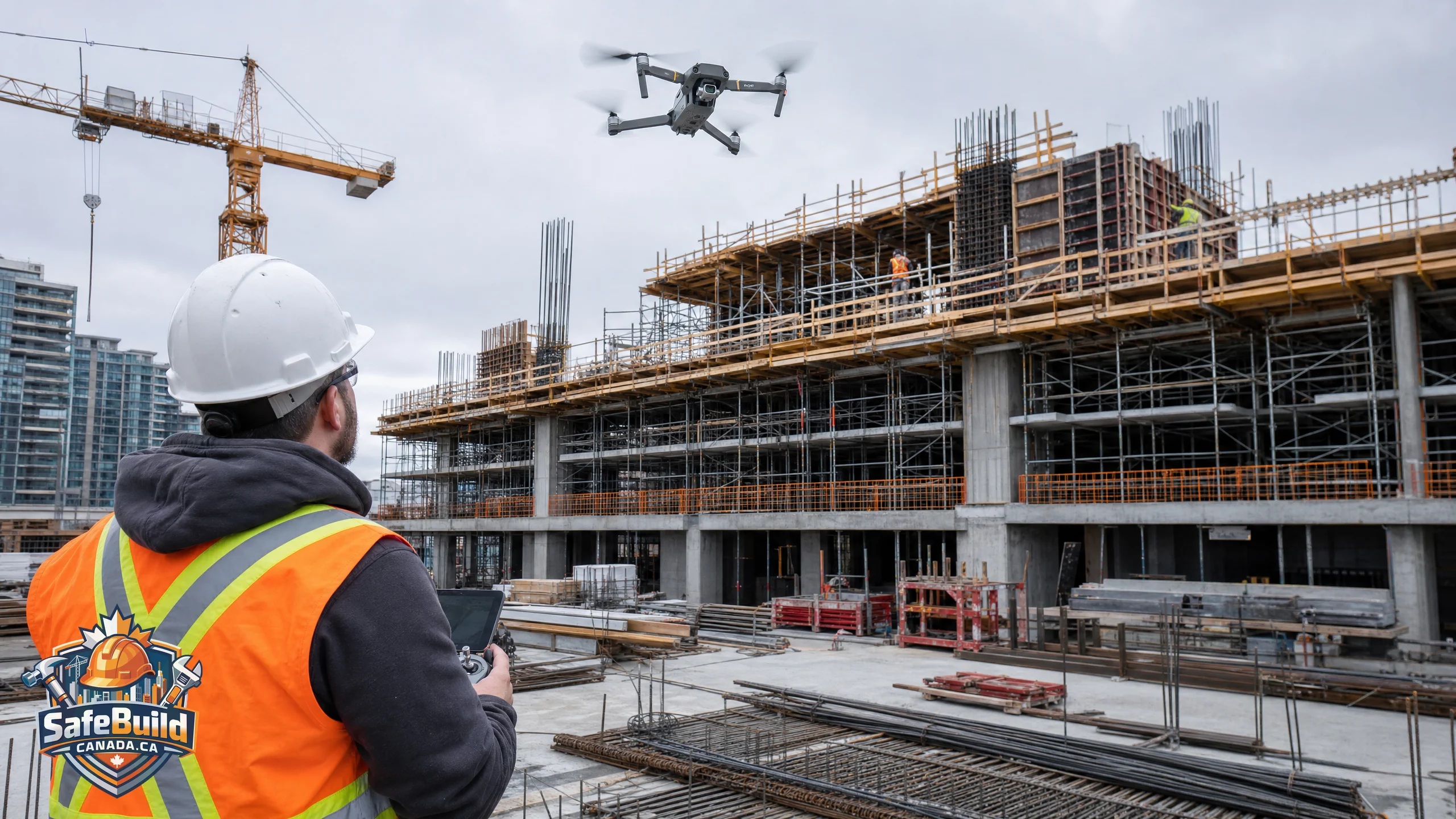
Drones have moved from novelty to practical tool on Canadian construction sites faster than most safety managers expected. A quadcopter can inspect the top chord of a truss, survey a freshly poured slab for cracking, or scan scaffolding for missing guardrails without putting a single worker at height. That is genuinely useful. The problem is that most sites deploying drones are doing so with an incomplete picture of what the law actually requires — and the rules are more layered than a quick Google search suggests.
Two separate regulatory frameworks govern drone use on a Canadian construction site. Transport Canada's Remotely Piloted Aircraft Systems (RPAS) regulations under the Canadian Aviation Regulations (CARs) Part IX control how, where, and by whom a drone can be flown. Your provincial OHS code controls the employer's duty of care for the workers on the ground. Neither framework defers to the other. A site that is fully compliant with Transport Canada rules can still be in violation of its OHS obligations if the drone operation creates a hazard for workers who were not consulted, trained, or protected.
This post covers both frameworks, explains what the RPAS categories mean in a construction context, and gives safety managers a practical picture of what a compliant drone inspection program looks like.
Why construction sites are a special case under RPAS rules
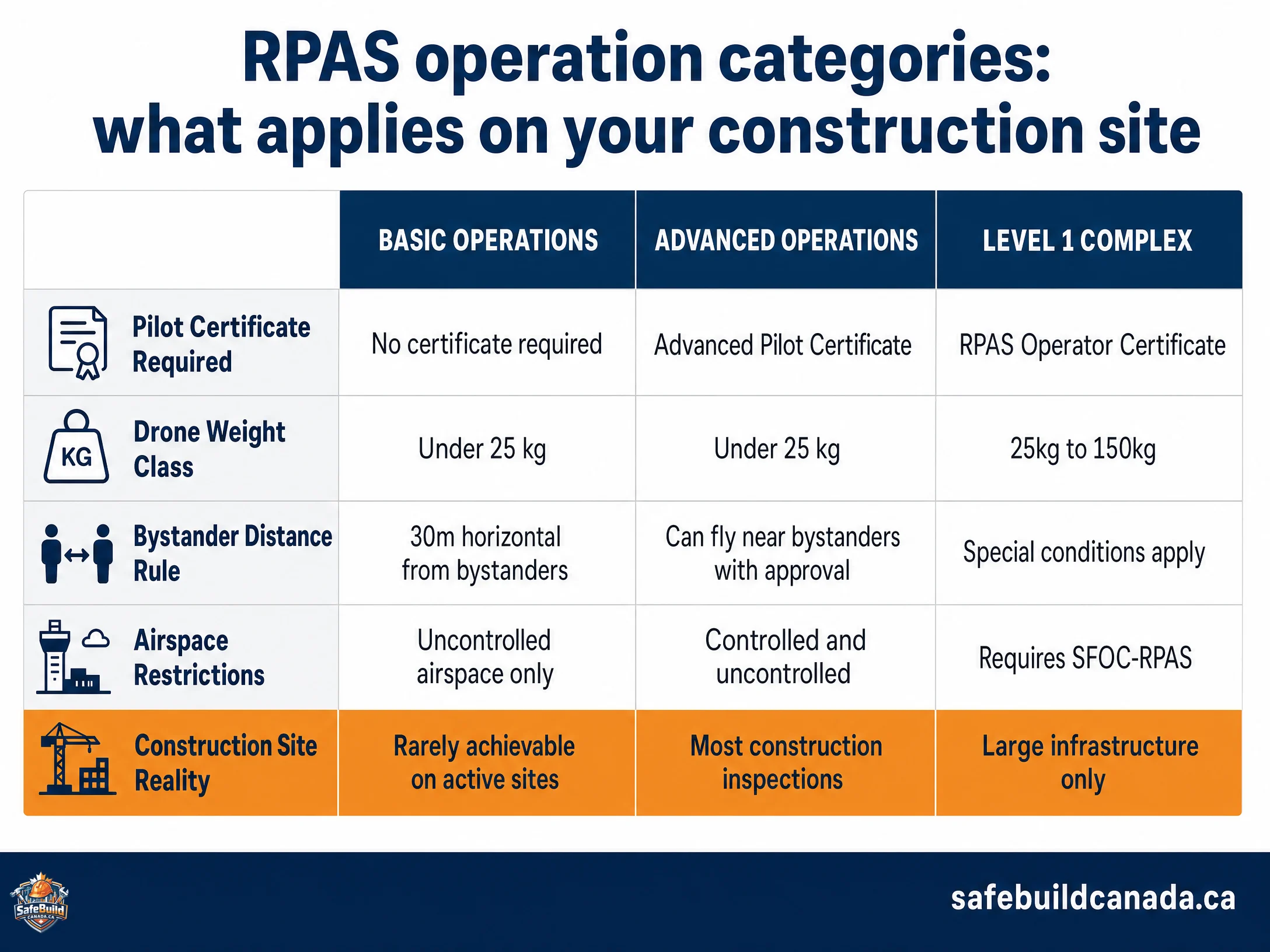
Transport Canada's RPAS regulations, which came into full effect in June 2019 and were significantly expanded in November 2025, classify drone operations into four main categories: microdrone operations (under 250 g), basic operations, advanced operations, and Level 1 Complex operations. The category that applies to your site depends on three factors: the weight of the drone, how close it will fly to bystanders, and whether it will operate in controlled airspace.
Construction sites create a specific problem with the bystander rule. Under Transport Canada's drone operation categories, basic operations require the drone to remain more than 30 metres horizontally from any bystander and never fly directly over anyone not involved in the operation. On an active construction site, that is almost impossible. Workers are moving across the site continuously. Subcontractors are working in areas the drone operator may not fully control. The moment the drone passes within 30 metres of a worker who is not part of the drone crew, the operation is no longer basic.
The practical implication is that most drone safety inspections on active Canadian construction sites will be classified as advanced operations, not basic. That classification triggers a separate set of requirements, including a Pilot Certificate for Advanced Operations, a drone that meets Transport Canada's safety feature requirements for advanced operations, and a pre-flight site survey. Treating a construction site inspection as a basic operation because the drone weighs under 25 kg is a common and potentially costly mistake.
What advanced operations actually require
Flying under the advanced operations category means the pilot must hold a Pilot Certificate for Advanced Operations issued by Transport Canada. Getting that certificate requires passing an online exam and completing an in-person flight review with a Transport Canada-approved flight reviewer. The drone itself must also be declared as meeting Transport Canada's safety feature requirements for advanced operations — not every consumer drone qualifies, and the approval is model-specific.
As of November 4, 2025, advanced pilots gained two new privileges under Transport Canada's 2025 regulatory expansion: sheltered operations and extended visual line-of-sight (EVLOS) operations. Sheltered operations allow the drone to fly within 30 metres of a structure, up to 30 metres above it, and within 61 metres horizontally from it. That is directly relevant to construction: a drone inspecting a building facade, a crane mast, or a concrete wall can now do so under an advanced certificate without needing a Special Flight Operations Certificate (SFOC-RPAS), provided the pilot stays more than 30 metres from uninvolved persons.
EVLOS operations allow the drone to fly beyond the unaided visual range of the pilot, provided a trained Visual Observer (VO) holding an RPAS pilot certificate assists. On a large construction site where the drone needs to inspect a far corner of the property, EVLOS may be the practical solution. The VO must communicate hazard information to the pilot in real time and can only perform VO duties for one drone at a time.
For operations involving medium drones (over 25 kg up to 150 kg) or beyond visual line-of-sight (BVLOS) operations without a VO, a Level 1 Complex certification and an RPAS Operator Certificate (RPOC) are required. Most construction site inspection drones fall well under 25 kg, so this category is less common, but it becomes relevant for large infrastructure projects using heavy payload drones for material transport or long-range survey work.
The OHS layer: employer obligations that Transport Canada does not cover
Transport Canada's RPAS rules govern the aircraft. Your provincial OHS code governs the workplace. The two frameworks operate independently, and compliance with one does not satisfy the other.
Under the OHS codes of Ontario, Alberta, and British Columbia, employers have a general duty to take every reasonable precaution to protect workers from hazards. A drone operating over an active construction site is a potential struck-by hazard. If the drone experiences a flyaway, a battery failure, or a software malfunction, it can fall onto workers below. That risk must be assessed and controlled before the drone goes up.
The Canadian Centre for Occupational Health and Safety is clear that workplace inspections must identify hazards systematically. When a drone is used as the inspection tool, the inspection process itself introduces a new hazard that must be managed. A site that uses drones to identify fall hazards on scaffolding but does not have a protocol for drone failure or flyaway has traded one risk for another.
Practically, this means the employer needs a written drone safety procedure that addresses at minimum: the exclusion zone for workers during drone operations, the emergency response protocol for drone malfunction, the communication plan between the drone operator and the site supervisor, and the record-keeping requirements for each flight. WorkSafeBC's OHS Regulation and Alberta's OHS Code both require employers to assess hazards before work begins. A drone inspection is work. The hazard assessment applies.
What a compliant drone inspection program looks like
The Canadian Bar Association's construction law section published a practical analysis of drone use on construction sites noting that the bystander rule, the visual line-of-sight requirement, and the documentation obligations under CARs Part IX all require active management, not just a one-time certification. The analysis also flags that crew members, including visual observers, are subject to RPAS rules, including a prohibition on acting as crew within 12 hours of consuming alcohol.
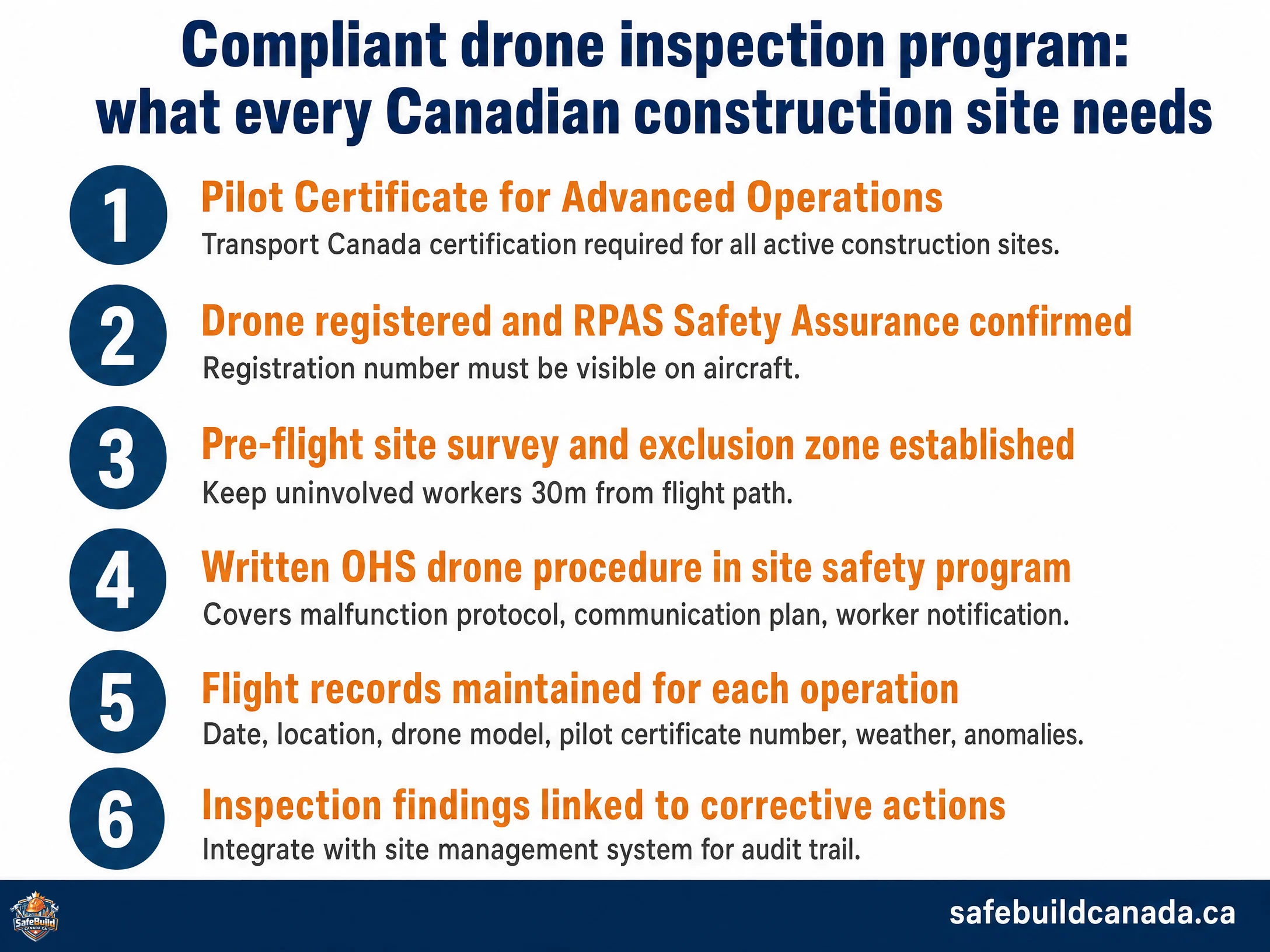
A compliant program on a Canadian construction site typically has the following elements working together:
The drone operator holds a Pilot Certificate for Advanced Operations at minimum, and the drone model has been confirmed as approved for advanced operations through Transport Canada's RPAS Safety Assurance system. Before each flight, the operator completes a pre-flight site survey, confirms weather conditions are within acceptable limits, and establishes an exclusion zone that keeps uninvolved workers at least 30 metres from the flight path. The site supervisor is briefed on the flight plan and has authority to abort the operation if site conditions change.
Flight records are maintained for each operation, including date, location, drone model, registration number, pilot certificate number, weather conditions, and any anomalies observed. Transport Canada reserves the right to inspect these records. The employer's OHS program includes the drone operation as a documented work procedure, and workers who may be in the vicinity of drone operations have been informed of the exclusion zone and the emergency response protocol.
Drone registration is not optional. All drones weighing 250 g or more must be registered with Transport Canada, and the registration number must be clearly visible on the aircraft. As of April 1, 2025, the registration fee is $10. Flying an unregistered drone on a construction site exposes the corporation to fines of up to $25,000.
What drones can actually inspect safely
The safety case for drone inspections is strongest where the alternative requires a worker to be at height or in a confined space. Drones equipped with high-resolution cameras, LiDAR, and thermal imaging can identify hazards that are genuinely difficult to see from the ground: missing guardrails on upper scaffold levels, cracking in concrete pours, overheating electrical connections, and structural deformation in temporary works.
Calgary Safety Consultants, which works with Alberta construction employers on OHS compliance, notes that drones are particularly effective for fall hazard assessments on roofs and elevated platforms, fire and explosion risk monitoring using thermal imaging, structural integrity checks on bridges and towers, and confined space pre-entry surveys where sending a worker in first would create unnecessary exposure. These are exactly the inspection scenarios where the hierarchy of controls supports drone use: the drone eliminates or substitutes the need for a worker to enter a hazardous area.
That said, drones are not a replacement for the systematic site inspection program that your OHS code requires. The construction site inspection program that satisfies a COR audit or a WorkSafeBC compliance review involves documented procedures, trained inspectors, corrective action tracking, and management review. A drone flight that produces footage no one reviews and corrective actions no one records does not satisfy those requirements. The drone is a data collection tool. The inspection program is the system that turns that data into action.
For sites that are already using construction safety software to manage inspections, integrating drone footage into the existing inspection workflow is straightforward. Most platforms that support digital construction site inspections can attach video and image files to inspection records, link findings to corrective actions, and generate the audit trail that regulators and insurers expect to see.
Privacy, insurance, and the things most sites overlook
Three areas consistently catch construction employers off guard when they start using drones.
Privacy obligations. Drones with cameras capture images of workers, neighboring properties, and members of the public. Canada's privacy legislation, including the Personal Information Protection and Electronic Documents Act (PIPEDA) for federally regulated employers and provincial equivalents in Alberta, BC, and Quebec, applies to the collection and storage of this data. Workers who are not involved in the drone operation have a reasonable expectation that footage of them is not being collected without disclosure. A drone safety procedure should address how footage is stored, who has access to it, how long it is retained, and how workers are informed.
Insurance. Transport Canada does not require insurance for standard RPAS operations, but recommends it. On a construction site, the exposure is different from recreational flying. A drone that falls onto a worker or onto a neighboring property creates a third-party liability claim. Most commercial general liability policies do not automatically cover drone operations. The employer should confirm with its insurer whether drone operations are covered under the existing policy or require an endorsement.
Union and subcontractor agreements. On unionized sites or sites with multiple subcontractors, drone operations that capture footage of workers may intersect with collective agreement provisions or subcontractor privacy expectations. The Canadian Bar Association's construction law analysis flags this explicitly: agreements with employees, unions, and subcontractors should be reviewed before drone operations begin to confirm there are no provisions that restrict surveillance or data collection.
How this fits into the broader technology picture
Drones are one piece of a larger shift in how Canadian construction sites are managing safety data. How AI is changing construction safety in Canada covers how machine learning is being applied to predict incidents before they occur. The drone is the data collection layer; AI is increasingly the analysis layer. Sites that combine drone inspection footage with AI-powered hazard detection software are getting a materially different picture of site conditions than sites relying on periodic manual inspections alone.
The hazard identification and risk assessment process that your OHS code requires is the framework that ties these tools together. A drone that identifies a missing guardrail on the third level of scaffolding has performed a hazard identification function. The risk assessment, the corrective action, and the verification that the guardrail was installed are the steps that complete the legal obligation. Technology does not replace that process. It makes it faster and more thorough.
For sites that are ready to build a formal drone inspection program, or that need help navigating the Transport Canada certification process alongside their provincial OHS requirements, the SafeBuild Canada construction safety services directory lists qualified safety consultants and RPAS-certified inspection providers working across Canada.
Conclusion
The rules around drone use on Canadian construction sites are more specific than most employers realize, and the consequences of getting them wrong run in two directions: Transport Canada fines for RPAS violations and OHS orders for failing to manage the hazards the drone creates. The good news is that the framework is manageable. An advanced pilot certificate, a registered and approved drone, a written OHS procedure, and a flight record system cover the core obligations. What the rules allow is genuinely useful: a drone can inspect areas that would otherwise require a worker to be at height, in a confined space, or in a struck-by zone. That is a real safety gain, and it is worth the compliance investment to do it properly.
Sources
Transport Canada, Flying your drone safely and legally, 2025.
Transport Canada, Drone operation categories and pilot certificates: Overview, 2025.
Transport Canada, 2025 Summary of changes to Canada's drone regulations, 2026.
Canadian Centre for Occupational Health and Safety, Effective Workplace Inspections.
Calgary Safety Consultants, Drones in OH&S: Enhancing Hazard Assessments in High-Risk Environments.
Piling Canada, Drones Are Keeping Construction Workers Safe from Jobsite Hazards, November 2022.