
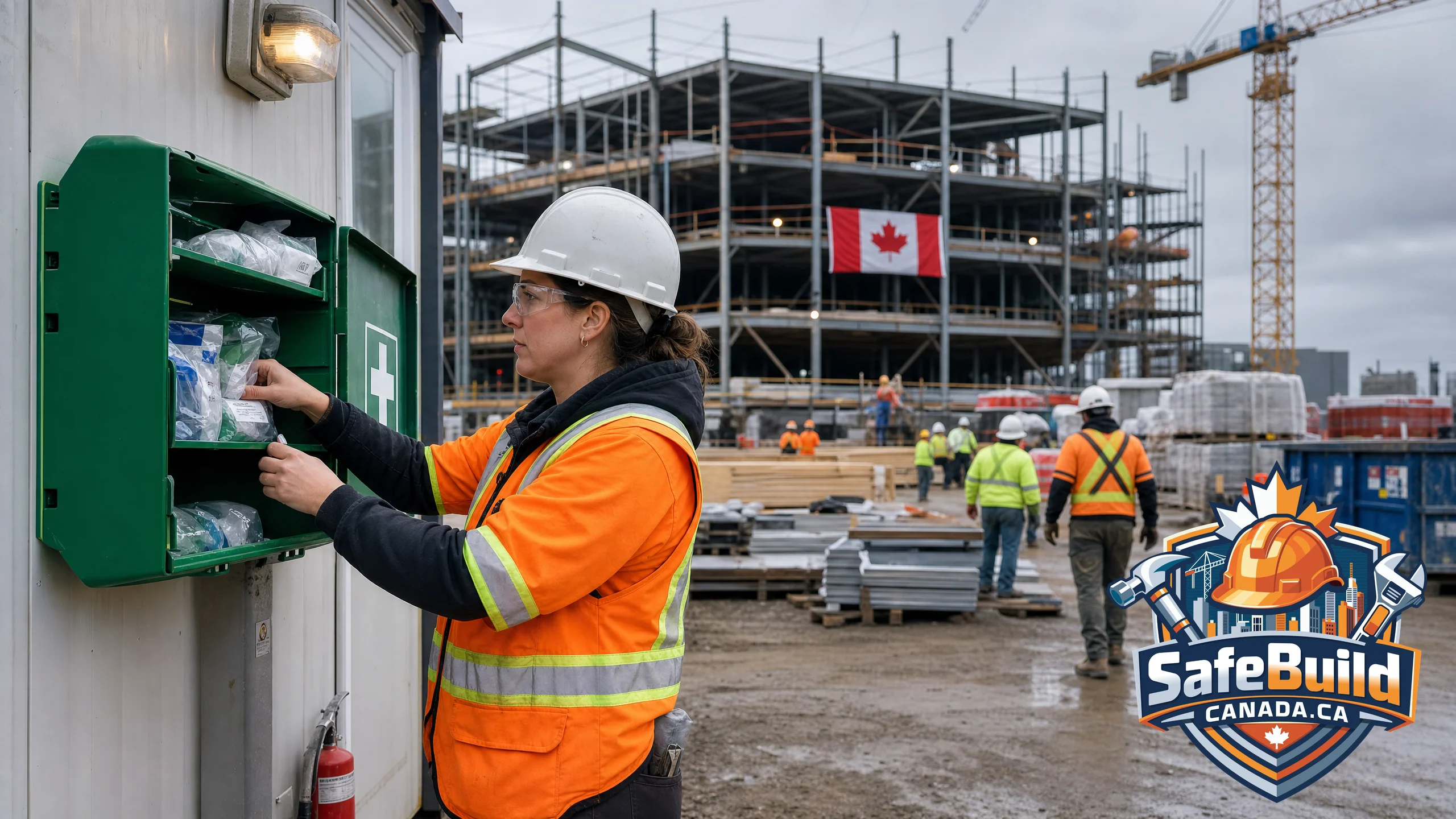
When a worker suffers a severe laceration from a circular saw or falls from scaffolding, the first few minutes dictate the outcome. On a construction site, you cannot wait for paramedics to figure out what to do. You need the right supplies, the right training, and a clear plan.
First aid requirements on Canadian construction sites are strictly regulated, but those regulations change the moment you cross a provincial border. What keeps you compliant in Ontario might result in a stop work order in British Columbia. The rules are complex, highly specific, and rigorously enforced by provincial inspectors.
This guide breaks down exactly what construction employers need to know about first aid compliance across the major Canadian jurisdictions. We will look at the shift toward national standards, the specific rules for British Columbia, Alberta, and Ontario, and the core elements that every site must have in place to protect workers and avoid costly penalties.
The shift to national standards
For decades, every province had its own highly specific list of what had to be inside a first aid kit. A contractor moving a crew from Alberta to Saskatchewan had to buy entirely new kits just to satisfy the local inspector. This fragmented approach created massive administrative headaches for national contractors and did little to actually improve worker safety.
That is finally changing. Most provinces are now adopting or accepting the CSA Z1220-17 standard for workplace first aid kits. This standard classifies kits into three types: Personal, Basic, and Intermediate. It also sizes them based on the number of workers: Small, Medium, and Large. The CSA standard ensures that kits contain modern, evidence based supplies rather than outdated items that no longer reflect current medical best practices.
If you are building a construction site emergency response plan, standardizing your kits to the CSA Z1220-17 standard is the smartest move you can make. It simplifies purchasing, makes restocking easier, and ensures your crews have modern, effective supplies. Even in provinces that have not formally adopted the standard into law, inspectors generally view CSA compliant kits as meeting or exceeding the local requirements.
British Columbia: The risk assessment model
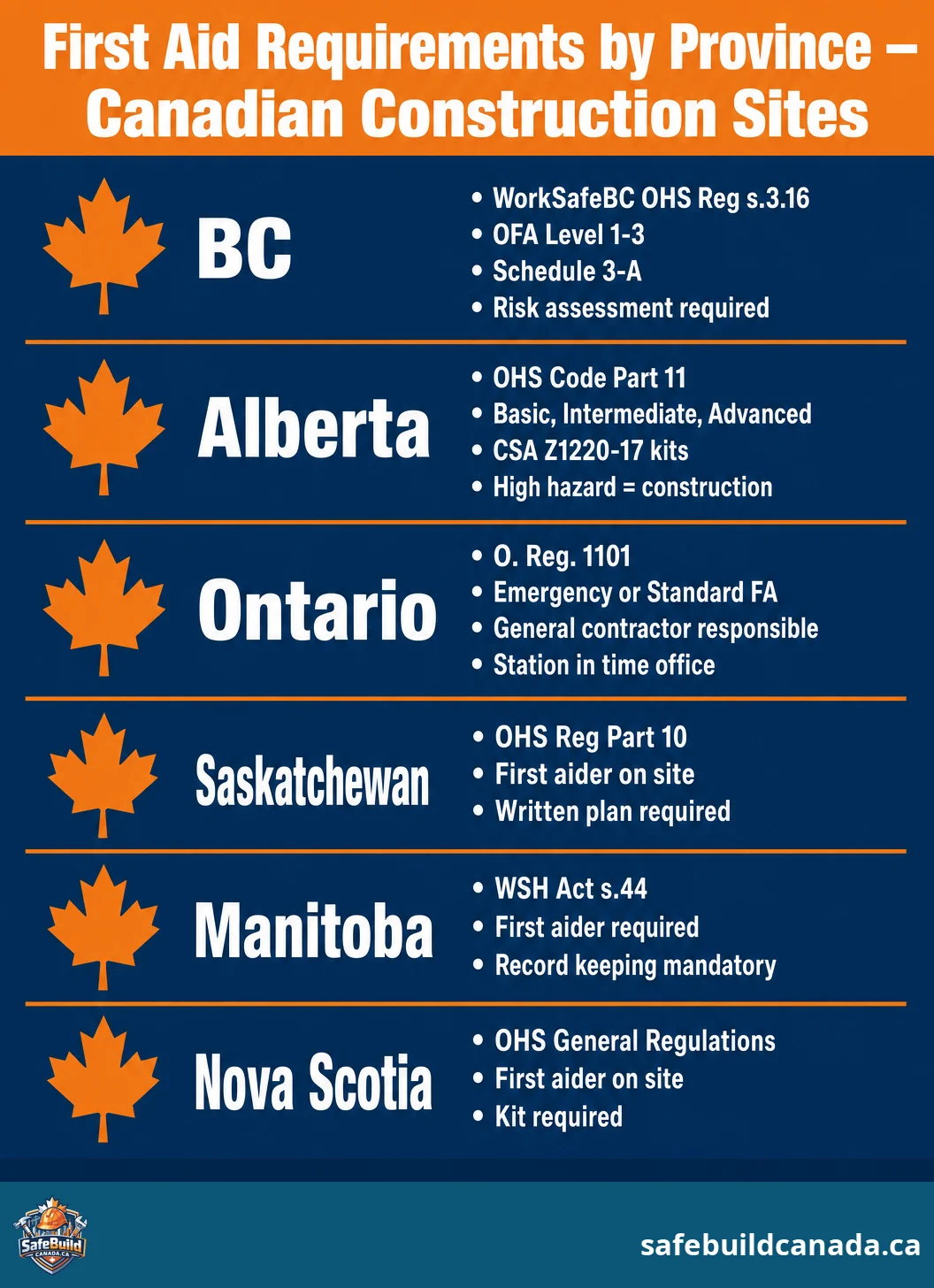
WorkSafeBC takes a highly structured approach to first aid under Part 3 of the OHS Regulation. Unlike other provinces that rely strictly on worker headcounts, BC requires employers to conduct a formal first aid risk assessment. This means you cannot simply buy a kit off the shelf and assume you are compliant.
The BC risk assessment
Before you buy a single bandage, you must assess your site. WorkSafeBC requires you to document the number of workers, the locations of those workers, the nature and extent of the risks, the types of injuries likely to occur, barriers to providing first aid, and the time required to transport an injured worker to a hospital.
Because construction is inherently high risk, your assessment will almost certainly place your site in the high hazard category. You must review and update this assessment annually, or whenever a significant change occurs in your operations. Furthermore, the assessment must be prepared in consultation with the joint health and safety committee or the worker health and safety representative.
Attendant levels in BC
WorkSafeBC uses a three tier system for Occupational First Aid (OFA) attendants. OFA Level 1 covers basic life support for sites close to medical facilities, including airway management, CPR, and minor wound care. OFA Level 2 covers advanced skills for larger sites, including preparing patients for transport and managing more complex injuries. OFA Level 3 covers comprehensive training for remote or isolated sites where paramedics are more than 20 minutes away, and these attendants are trained to manage patients for extended periods.
If your site is more than 20 minutes from a hospital, the requirements escalate dramatically. You may need an OFA Level 3 attendant and a dedicated first aid room. If air transportation is the primary method for moving an injured worker, you must have arrangements in place with an air service before work begins, and the aircraft must be able to accommodate a stretcher.
Alberta: Hazard levels and distance
Alberta recently updated Part 11 of the OHS Code to align with the CSA Z1220-17 standard. The province uses a matrix based on hazard level, worker count, and distance to a health care facility. This matrix dictates exactly what type of kit you need and what level of training your attendants must have.
Construction is high hazard
In Alberta, all construction work is automatically classified as high hazard work under Schedule 2 of the OHS Code. This includes commercial buildings, residential projects, roads, bridges, and utility installations. Because of this classification, you are subject to the strictest requirements in the province.
The Alberta matrix
The requirements scale based on how many workers are on site and how far you are from a hospital. For example, if you have 2 to 9 workers on a site that is less than 20 minutes from a hospital (a close work site), you need one Basic First Aider and a CSA Type 2 Basic Small kit.
If you have 50 to 99 workers on that same close site, you need one Basic First Aider, one Intermediate First Aider, and a CSA Type 2 Basic Large kit.
If your site is isolated (more than 40 minutes from a hospital), the requirements increase significantly. For 50 to 99 workers at an isolated site, you need three Intermediate First Aiders, a large kit, three blankets, a stretcher, and splints. For sites with 200 or more workers, you must provide a dedicated first aid room and have a nurse with an advanced first aid certificate or an advanced care paramedic on duty.
Understanding these rules is a critical part of mandatory construction site training for your supervisory staff. They need to know exactly what is required before the crew arrives on site.
Ontario: The general contractor rule
Ontario governs first aid under Regulation 1101. The most important rule for construction in Ontario is found in Section 15: the general contractor is responsible for providing and maintaining the first aid station for all workers on the project, just as if they were the direct employer. This means the general contractor cannot simply tell subcontractors to bring their own kits and wash their hands of the responsibility.
The time office requirement
Regulation 1101 specifically states that if a construction site has a time office, the first aid station must be maintained there. If there is no time office, it must be in a vehicle or building at the site. The station must be easily accessible for the prompt treatment of any worker at all times when work is in progress.
Ontario kit requirements
Unlike Alberta, Ontario still uses its own specific lists for kit contents based on worker counts. For sites with 1 to 5 workers, the kit must contain specific items like 12 adhesive dressings, 4 sterile gauze pads, and 1 triangular bandage.
For sites with 16 to 199 workers, the requirements are much more extensive. You must provide a stretcher, two blankets, and a highly specific list of dressings, including 48 adhesive dressings, 48 sterile gauze pads, and splints of assorted sizes.
The station must be in the charge of a worker holding a valid St. John Ambulance Standard First Aid Certificate or its equivalent, and that worker must work in the immediate vicinity of the box.
If you are preparing for an OHS inspection on your construction site, ensuring your first aid kit matches the exact item counts in Regulation 1101 is an easy win. Inspectors will count the bandages, and if you are short, you will be cited.
The core elements of a compliant program
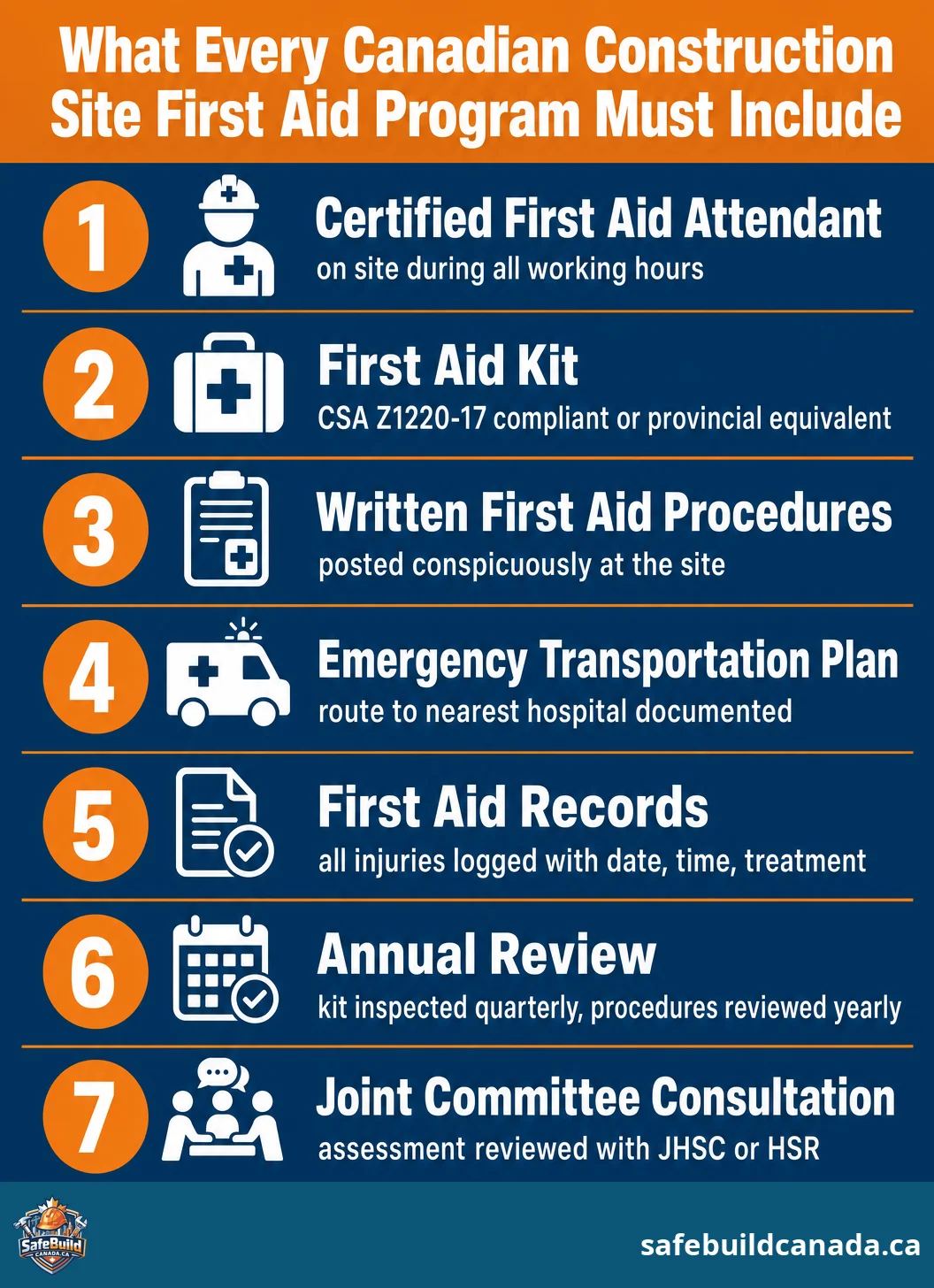
Regardless of which province you operate in, every effective first aid program shares the same foundational elements. Meeting the minimum legal requirements is just the starting point; building a thorough program ensures that when an incident occurs, the response is swift and effective.
1. Certified attendants
You must have certified attendants on site during all working hours. It is not enough to have someone who took a course five years ago. Their certification must be current, and they must be designated by the employer. In many provinces, the attendant must also work in the immediate vicinity of the first aid station so they can respond immediately.
2. Accessible equipment
Your kits must be fully stocked, clean, dry, and readily accessible. If a worker is bleeding, they should not have to hunt for a key to open the site trailer. The equipment must be protected from the environment, which is especially important on construction sites where dust, mud, and weather can quickly ruin sterile supplies.
3. Written procedures
You must have written procedures detailing how to call for first aid, how the attendant will respond, and how the injured worker will be transported. These procedures must be posted conspicuously. If you have workers who do not speak English as their first language, you must ensure they understand these procedures.
4. Record keeping
Every single first aid treatment must be recorded. The log must include the date, time, nature of the injury, treatment provided, and the name of the attendant. These records are legal documents and must be secured to protect worker privacy. They are also invaluable for identifying trends and improving your overall safety program.
5. Emergency transportation
You must have a plan for getting an injured worker to medical care. If you are relying on an ambulance, you need to know the exact address or GPS coordinates of your site. If you are in a remote area, you may need to arrange for air transportation or have a dedicated vehicle capable of transporting a stretcher.
The role of the safety officer
Managing first aid compliance is a major responsibility for site safety personnel. If you are looking at the NCSO certification pathway, understanding how to audit first aid kits, track attendant certifications, and run emergency drills will be a core part of your daily duties.
Safety officers must ensure that kits are inspected regularly, typically on a quarterly schedule, and that expired items are replaced immediately. They must also track the certification expiry dates for all designated attendants and schedule retraining before those certificates lapse.
First aid is not just a box to check on a compliance form. It is the system that keeps a bad day from becoming a tragic one. Invest in the right kits, train your people well, and make sure everyone on site knows exactly what to do when the alarm sounds.
SECTION 4: SOURCES
WorkSafeBC — Occupational Health and Safety Regulation, Part 3: Rights and Responsibilities
Government of Alberta — Occupational Health and Safety Code, Part 11: First Aid
Government of Alberta — Occupational Health and Safety Code, Schedule 2: First Aid
Government of Ontario — R.R.O. 1990, Reg. 1101: First Aid Requirements