
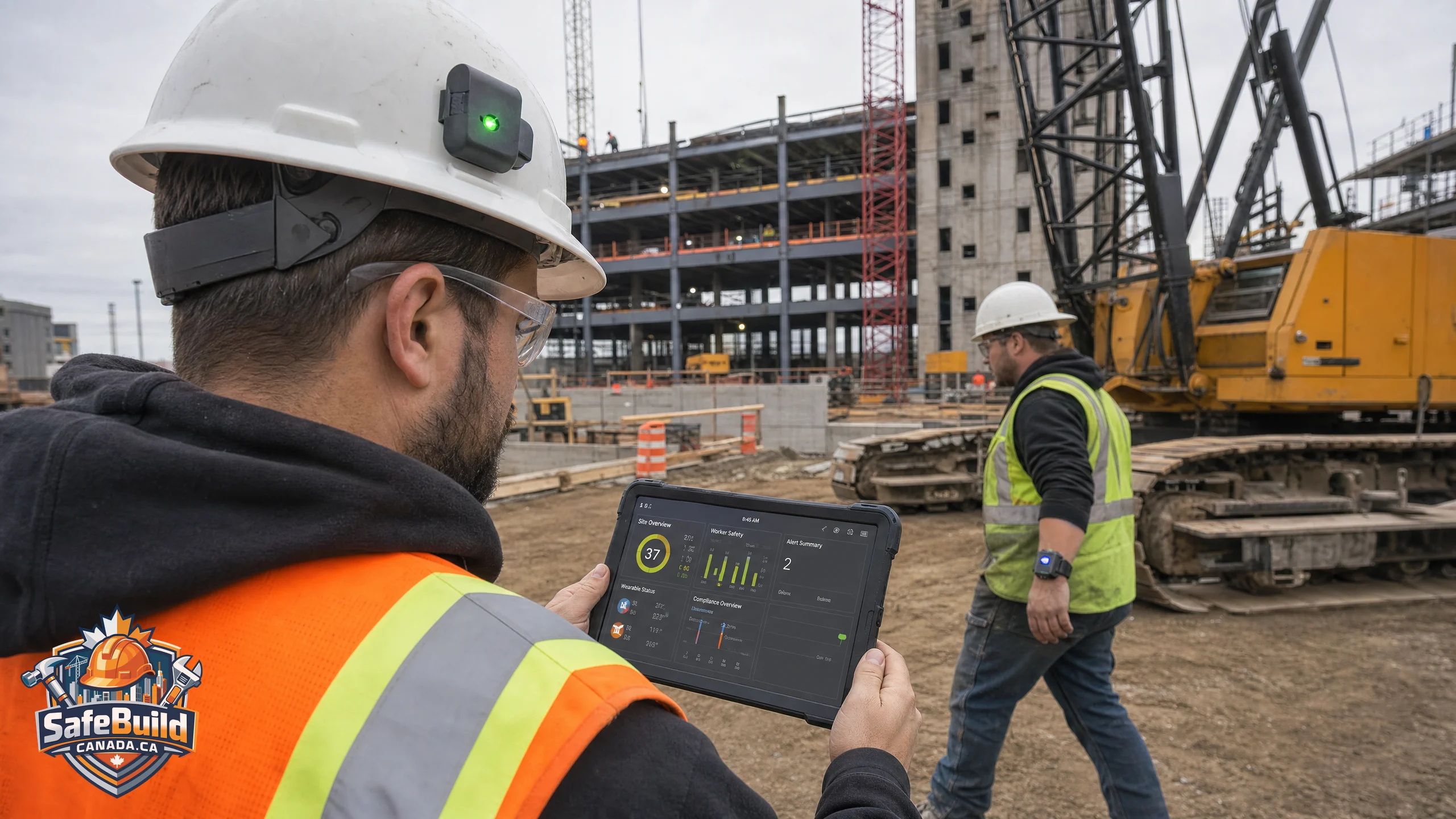
The pitch is always the same: a smart helmet that detects fatigue, a vest that vibrates when a loader gets too close, a wristband that flags heat stress before a worker collapses. Vendors are eager to demonstrate these devices at trade shows, and the safety press covers them enthusiastically. What gets less coverage is whether any of it holds up on a real Canadian construction site, where workers are sweating through 35-degree summers, operating in cellular dead zones, and skeptical of anything that feels like surveillance.
This post cuts through the noise. The devices covered here are the ones with documented use cases in construction environments, not lab settings. The privacy obligations covered here come from Canada's Personal Information Protection and Electronic Documents Act (PIPEDA) and provincial equivalents, not from a vendor's FAQ. If you are a safety manager deciding whether to pilot wearable technology on your site, this is the analysis you need before you sign a purchase order.
The landscape of wearable safety devices in construction
The NIOSH Science Bulletin on wearable technologies for construction published in 2019 identified four categories of devices with genuine potential for construction safety: proximity detection systems, physiological status monitors, environmental sensors, and exoskeletons. That taxonomy still holds. What has changed since 2019 is that the first two categories have matured from research prototypes into commercially available products, while exoskeletons remain largely in the pilot phase for most Canadian contractors.
The gap between marketing claims and field performance is wider than most vendors will admit.
Smart helmets: genuine protection or expensive hard hat?
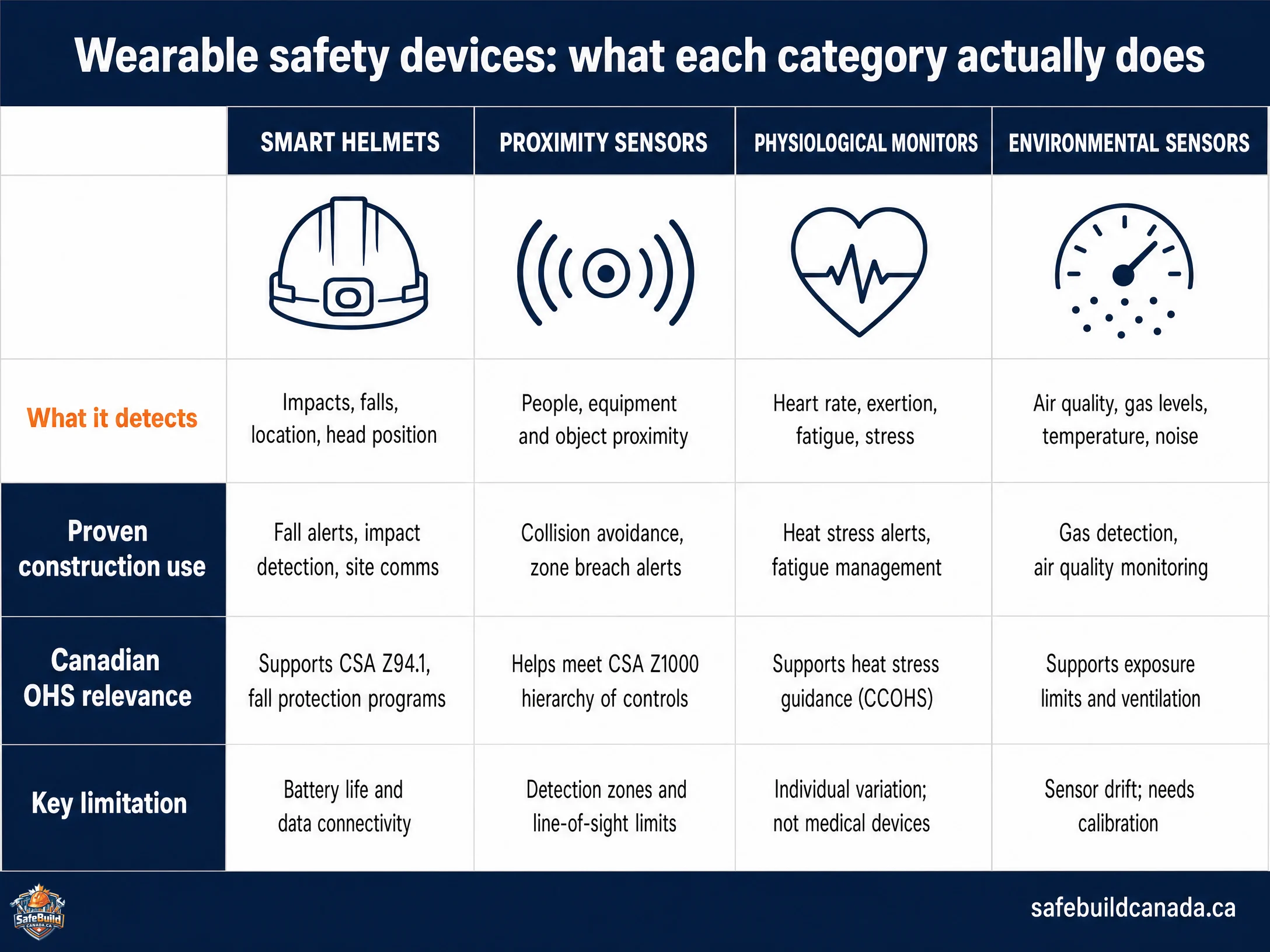
Smart helmets are the category that attracts the most attention and, frankly, the most hype. The basic concept is sound: a hard hat fitted with sensors that can detect impact, monitor head position as a proxy for fatigue, or alert a worker when they enter a restricted zone. Some models integrate with site-wide IoT networks to feed location data to a site supervisor's dashboard.
The honest assessment is that the impact detection function is the most mature and the most defensible from a safety standpoint. A helmet that records the force and location of a struck-by incident gives supervisors and safety officers objective data that a verbal report cannot provide. That data matters for WSIB claims, incident investigations, and the kind of pattern analysis that actually changes site layout decisions. If you are managing a site where struck-by incidents are a documented risk, a smart helmet with impact logging is worth evaluating.
The fatigue detection function is more complicated. Most current systems infer fatigue from head movement patterns, which is a reasonable proxy but not a reliable one. A worker who tilts their head to look at a blueprint reads as "fatigued" on some systems. Until the underlying algorithms are validated specifically for construction tasks, treat fatigue alerts as a prompt for a supervisor conversation, not as a diagnostic tool.
Hard hat standards in Canada are governed by CSA Z94.1, and any smart helmet deployed on a Canadian site must still meet the applicable Type and Class requirements. Adding sensors to a hard hat does not exempt it from the standard. Confirm with the vendor that their product holds a current CSA Z94.1 certification before purchasing.
Proximity detection: the category with the clearest ROI
Of all the wearable categories, proximity detection has the strongest evidence base for construction. The premise is straightforward: a worker wears a tag or sensor that communicates with transponders mounted on heavy equipment. When the worker enters a pre-set exclusion zone around an operating machine, both the worker and the equipment operator receive an alert.
Struck-by incidents involving heavy equipment are among the leading causes of construction fatalities in Canada. WorkSafeBC's occupational health and safety statistics consistently show mobile equipment as a top fatality cause. The Alberta OHS Code Part 9 and Ontario's Construction Projects Regulation (O. Reg. 213/91) both require employers to control the hazard of workers being struck by mobile equipment, and proximity detection is a recognized engineering control that satisfies that obligation.
The practical limitation is infrastructure. Most proximity systems require transponders on every piece of equipment and a site-wide network to function reliably. On a large civil project with a stable equipment fleet, that infrastructure investment makes sense. On a smaller residential site where equipment rotates in and out daily, the setup overhead can outweigh the benefit. Evaluate the device against your specific site conditions, not against the vendor's ideal-case scenario.
For sites where proximity detection is appropriate, the digital construction site inspection tools that integrate with proximity data can turn raw alerts into actionable inspection records. That integration is worth asking vendors about before you commit to a system.
Physiological monitors: heat stress is the real use case
Wearable physiological monitors measure heart rate, skin temperature, and sometimes core body temperature to detect early signs of heat stress. This is the category where the Canadian context matters most. Heat stress on construction sites is a documented and growing hazard, and the heat stress requirements for Canadian construction sites vary by province in ways that make a single national compliance standard difficult to apply.
The NIOSH bulletin notes that physiological status monitors "can reliably collect worker data in the outdoor environment and warn about the potential for heat stress." That reliability finding is important, because it is one of the few categories where the research has been conducted in field conditions rather than controlled settings.
The practical deployment question is what happens when a monitor triggers an alert. A wristband that detects elevated heart rate is only useful if there is a protocol for what supervisors do with that information. Before deploying any physiological monitor, write the response protocol first. Who receives the alert? What is the mandatory action? How is the incident recorded? A device without a response protocol is a liability, not a safety control.
The Canadian Centre for Occupational Health and Safety recommends a hierarchy of controls for heat stress that starts with engineering controls like shade and cooling stations, not wearable monitors. A physiological monitor is an administrative control at best. It belongs at the end of your heat stress management plan, not at the beginning.
Environmental sensors: air quality monitoring that workers can wear
Wearable environmental sensors monitor air quality in real time, including carbon monoxide, hydrogen sulfide, silica dust, and noise levels. For confined space work and demolition projects where airborne hazards are unpredictable, a wearable sensor that alerts the worker before they reach an exposure threshold is a genuine improvement over periodic area monitoring.
The limitation is calibration and maintenance. A sensor that drifts out of calibration does not just fail to detect a hazard; it can give a false "safe" reading that puts a worker at greater risk than no sensor at all. Any wearable environmental sensor program needs a documented calibration schedule and a clear process for removing devices from service when they fail a calibration check. This is the same discipline required for fixed gas detection equipment, and many sites that are comfortable with fixed detection have not yet built the same maintenance culture for wearable devices.
For sites where silica exposure is a documented risk, a wearable dust monitor that provides real-time personal exposure data is a more accurate picture of actual worker exposure than area sampling alone. The Canadian construction respiratory protection requirements set occupational exposure limits that are measured as time-weighted averages, and a wearable monitor that tracks cumulative exposure throughout a shift gives supervisors data they cannot get any other way.
What Canadian privacy law requires before you deploy
This is the section most vendor presentations skip, and it is the one that can create the most significant legal exposure for a Canadian employer.
PIPEDA applies to private sector employers in federally regulated industries and in provinces without substantially similar provincial legislation. Alberta, British Columbia, and Quebec have their own substantially similar private sector privacy laws, but the core obligations are consistent: employers must have a legitimate purpose for collecting personal information, must obtain meaningful consent, and must limit collection to what is necessary for that purpose.
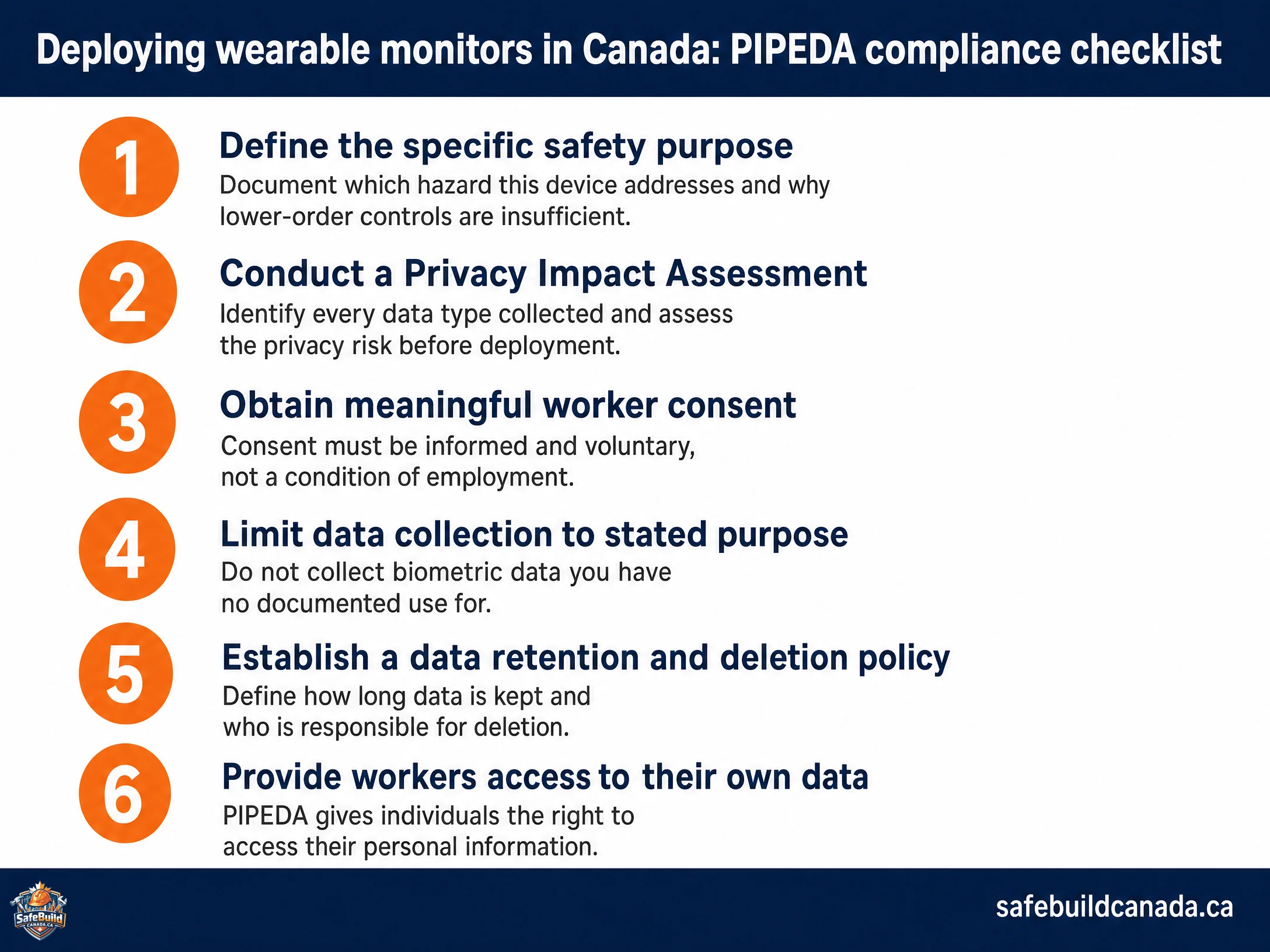
The Office of the Privacy Commissioner of Canada's guidance on privacy in the workplace is explicit on this point: "Employers must limit collection of employee information to only that which is necessary for the purposes identified by the organization." A wearable monitor that collects heart rate, location, and head movement data simultaneously is collecting a significant volume of personal information. You need a documented, specific safety purpose for each data type you collect.
Meaningful consent is not a checkbox on an onboarding form. The OPC guidance states that consent must be "clear, informed, and voluntary." In a construction employment context, where workers may feel that refusing consent affects their job security, voluntary consent is genuinely difficult to establish. The safer approach is to design the system so that workers receive only their own personal data, supervisors receive only threshold alerts without underlying biometric data, and corporate-level users see only aggregate trends. That architecture limits the privacy exposure and makes the consent conversation more honest.
The OPC also notes that consent does not waive an organization's other obligations under PIPEDA, meaning that consent is not a blanket waiver of your other obligations under PIPEDA.
What the hierarchy of controls says about wearables
Every wearable safety device is, at best, an administrative or PPE-level control. The hierarchy of controls, which is embedded in the OHS legislation of every Canadian province, requires employers to consider elimination, substitution, and engineering controls before reaching for administrative controls or PPE.
A proximity detection system is an engineering control when it is integrated into the equipment's operating system and physically prevents movement into an exclusion zone. When it is a wearable alert device that relies on a worker or operator to respond to a warning, it is an administrative control. That distinction matters for compliance purposes, and it matters for the honest assessment of what the device can and cannot do.
The AI and construction safety tools that are emerging alongside wearable devices are beginning to close that gap, particularly in predictive analytics that identify hazard patterns before incidents occur. Wearable data feeds into those systems most effectively when the data collection is consistent, well-maintained, and tied to a response protocol.
Making the decision: a practical framework for Canadian sites
The question is not whether wearable technology is good or bad. The question is whether a specific device addresses a specific, documented hazard on your specific site in a way that is proportionate to the privacy cost and the maintenance burden.
Before approving any wearable technology deployment, a safety manager should be able to answer four questions. First, what specific hazard does this device address, and is that hazard documented in your hazard identification and risk assessment? Second, where does this device sit in the hierarchy of controls, and have higher-order controls been evaluated and found inadequate? Third, what is the data retention policy, and who has access to what level of data? Fourth, has a Privacy Impact Assessment been completed and reviewed by someone with knowledge of PIPEDA and applicable provincial privacy legislation?
The construction safety software platforms that Canadian sites are increasingly adopting are beginning to integrate wearable data feeds, which means the infrastructure question is becoming less of a barrier. But the privacy and protocol questions remain the responsibility of the employer, regardless of what the software vendor promises.
The broader Canadian construction site safety guide covers the full range of hazard controls that wearable technology fits into. If you are building or reviewing your site safety program, that is the right place to start before evaluating any specific device category.
Conclusion
Wearable safety technology is not a safety program. It is a tool that can improve a safety program that already has the right foundations: documented hazard identification, a functioning hierarchy of controls, trained supervisors, and a response protocol for every alert the device can generate. Without those foundations, the most sophisticated smart helmet on the market is just an expensive hard hat.
The devices that are worth deploying on Canadian construction sites right now are proximity detection systems for sites with documented struck-by risks, physiological monitors for heat stress management where a response protocol is already in place, and wearable environmental sensors for confined space and demolition work where area monitoring is insufficient. Everything else should be evaluated against the four questions above before a purchase order is signed.
Privacy compliance is not optional and it is not a formality. The Office of the Privacy Commissioner of Canada has been clear that wearable monitoring in the workplace requires a documented purpose, meaningful consent, and data minimization. Getting that right before deployment is easier than explaining a PIPEDA complaint after the fact.
Sources
Canadian Centre for Occupational Health and Safety, Heat Stress, 2024. ccohs.ca
National Institute for Occupational Safety and Health, Wearable Technologies for Improved Safety and Health on Construction Sites, NIOSH Science Bulletin, November 2019. cdc.gov
Office of the Privacy Commissioner of Canada, Privacy in the Workplace, 2025. priv.gc.ca
WorkSafeBC, Incident Investigation — Mobile Equipment, 2024. worksafebc.com
Construction Executive, Total Safety for Workers Includes Protecting Their Personal Data, November 2020. constructionexec.com